
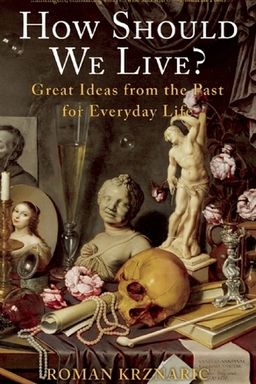
How Should We Live cover

How Should We Live

by Roman Krznaric

How Should We Live? by Roman Krznaric delves into historical insights to enhance modern living. From love and work to family dynamics and empathy, this book offers age-old advice to navigate contemporary challenges and find deeper meaning and fulfillment in everyday life.

The Art of Living in Modern Times

How can you live wisely amid abundance, speed and disconnection? This book argues that modern life has multiplied choice while thinning meaning, and that the art of living requires recovering neglected skills: loving broadly, working purposefully, conversing deeply, rebalancing senses, staying close to nature, accepting mortality, and finally acting boldly to change. Instead of asking what happiness is, the guiding question is how to cultivate the varieties that make a flourishing human life.

Mapping Love and Connection

The journey begins with the Greeks, who named different loves—eros, philia, pragma, agape, ludus, and philautia—recognising that one word cannot hold all attachments. Modern Western culture collapsed this pluralism into a single romantic myth—the soulmate—creating unrealistic expectations that one person should fulfill every need. The book urges you to decentralize love: cultivate friendship (philia), playfulness (ludus), compassion (agape), and self-respect (philautia) alongside couple bonds. When you spread affection across practices and people, your emotional ecosystem becomes resilient.

Rediscovering Family and Conversation

Historical evidence shows that caregiving and communication are arts learned over time, not instincts fixed by gender. From the Aka fathers of Central Africa to preindustrial European households, men once practiced domestic care until the Industrial Revolution segregated work and home. The book invites you to reanimate shared responsibility and family dialogue. Whether reviving dinner talks or breaking silences formed by technology, conversation is portrayed as moral craftsmanship—a practice rebuilding empathy and belonging case by case.

Work, Time and Money as Moral Materials

Work evolved from fixed stations to anxious freedom. You can transform it by pursuing values, purpose, respect, and talent instead of wages alone. Likewise, time acceleration—from medieval bells to Taylorism and smartphones—exiled slowness. You are encouraged to reclaim rhythm: treat leisure as "time on," not "time off," and practise deliberate pacing. The same moral recalibration applies to money. Where shopping became spectacle and consumerism equated possessions with identity, simplicity liberates life-hours for relationships and creativity. Simple living is reframed not as asceticism but as a trade-up: exchanging goods for time.

Senses, Travel, and Nature as Restorative Practices

Modernity narrowed attention to vision. Through historical currents—from Protestant austerity to Enlightenment sight-worship—the eye became dominant, and smell, touch, and hearing were diminished. The book shows how rediscovering full sensory literacy deepens presence and creativity, citing Helen Keller’s tactile insights and Kaspar Hauser’s heightened smell. Travel serves a parallel function: when undertaken with purpose (pilgrimage), curiosity (exploration) or simplicity (nomadism), it reconfigures perception and identity. This connects naturally to biophilia—Wilson’s insight that your mind extends into ecosystems. Spending time in local wild spaces not only restores well-being but awakens ethical duty for the planet.

Belief, Mortality, and Action

Beliefs appear personal but are cultural inheritances; integrity requires examining and revising them. Galileo’s empiricism and Tolstoy’s moral transformation illustrate knowledge gained through humility and exposure. The book’s final movement, “Deathstyle,” argues that reintroducing death—through ritual, conversation, and creative caregiving—intensifies life. Mortality becomes not a shadow but a teacher. The closing image of Goethe’s 1786 leap to Italy crystallises all earlier lessons: insight alone doesn’t suffice; you must act. Small experiments—a walk, a sabbatical, a volunteer stint—convert awareness into courage. Living well, this book concludes, is not a theory but a succession of practices: plural loves, empathic talk, mindful time, tactile creativity, ecological conscience, and audacious renewal.


Varieties of Love and the Soulmate Myth

Western culture condensed diverse affections into one phrase: "I love you." The Greeks, more precise, distinguished kinds of love—eros (passion), philia (friendship), pragma (mature partnership), ludus (play), agape (universal compassion), and philautia (self-love). Each love has its own psychology and practice. Modern romance inherited both eros’ intensity and unrealistic totality: expecting one "soulmate" to embody all six forms.

The History of a Modern Fantasy

The soulmate myth evolved via Persian tales of sudden ardor, medieval troubadour worship of unattainable ladies, Dutch companionate marriage, Romanticism’s emotional cult, and twentieth-century capitalist marketing (De Beers' slogan "A Diamond Is Forever"). Over centuries, capitalism and Romanticism merged intimacy with consumption and perfectionism. You learned to measure devotion by spectacle—rings, holidays, filtered images—while love’s other varieties withered.

The Greek Alternative

By naming multiple loves, Greeks offered resilience: when erotic fire wanes, pragmatic care or friendship can sustain. Erich Fromm’s notion of “standing in love” aligns with pragma—long-term giving instead of pursuit. Use this taxonomy like a relationship map: identify what’s missing (ludus play or agape purpose) and practise accordingly. Communicate explicitly with partners about these categories; naming reduces resentment and unrealistic demands.

Practical Rebalancing

Diversify emotional sources: friends for philia, shared laughter for ludus, volunteering for agape, good self-care for philautia. Balance expectations; no single person can embody every form continuously. When love becomes gardening rather than hunting, disillusion gives way to cultivation.


Family, Conversation and Empathy

Modern families risk living together but not knowing one another. This part of the book reconnects history, communication and empathy to rebuild relational depth. Fatherhood, dialogue and compassion are presented not as feelings but skills that cultures teach and can be relearned.

Shifting Family Roles

From the caregiving Aka fathers of the Congo to early modern househusbands, men once engaged equally in nurturing. The Industrial Revolution separated home and work, creating gendered spheres that reduced paternal intimacy. Today, policy innovations like Sweden’s paternity leave hint at recovery. Fathers regain presence through deliberate domestic learning—cooking, childcare, emotional participation—and equality becomes practical rather than ideological.

Reviving Conversation

Silence through history—monastic rules, Victorian reserve, the intrusion of mass media—eroded family talk. The author advocates conversation as moral repair: technology-free meals, inclusive discussions, and even family interviews to recover hidden stories. Like the Socratic symposium but without exclusion, dialogue becomes a shared art of listening and personal disclosure, nurturing empathy at home.

Empathy as Transformative Power

Empathy bridges the private and political. Through cases like C.P. Ellis and Ann Atwater’s interracial friendship, Orwell’s immersion among tramps, or Clarkson’s abolitionist campaigns, it’s shown that perspective-taking changes character and society alike. You train empathy through conversation, experience and social action—each expanding moral imagination. When empathy scales up, movements arise. Practise it deliberately: talk to difference, volunteer, visualise others’ struggles. Relationships and justice strengthen together.


Work, Time and Money Reimagined

Economic systems shape inner life. This section reads work, time and money not as necessities but moral materials you can remodel. Understanding their histories frees you to design meaning rather than drift into acceleration and consumption.

Meaningful Work

Medieval serfs and factory workers had little choice; modern individuals face the opposite—too much choice with little guidance. Purposeful work integrates four motivators: values, specific missions, respect, and full use of talents. Examples like Schweitzer in Gabon or Frankl’s concentration-camp insights show that a clear why sustains life. Treat your career as experiment—branch projects, conversations with mentors, and failures as learning. Work becomes a calling when aligned with these four forces.

Reclaiming Time

The clock’s conquest—mechanical bells, factories, productivity metrics—turned time into currency. You can escape busyness by changing metaphors: leisure is "time on," attention nourishes quality. Practise slowness deliberately: walking, painting, deep reading, unmeasured hours. Cultures like Bali and Zen remind you of cyclical or present time; long-term thinking (Stewart Brand’s "Clock of the Long Now") extends care across generations.

Simple Living and Financial Integrity

Consumerism manufactured desire via spectacle—from Paris’s Bon Marché to social media’s luxury display. Simplicity reclaims agency: compute purchases in life-hours, shift comparison groups to those who value experience, and participate in community exchange systems. Thoreau’s and Woolman’s models show that voluntary frugality enlarges rather than shrinks life—it buys you time, not goods.


The Sensory World and Creative Practice

Modern civilization privileges sight and abstract thinking, diminishing bodily and creative engagement. The book reframes creativity and senses as everyday crafts through which you rediscover vitality and awareness.

Recovering Full Sensory Life

Printing, Protestant austerity, and Enlightenment rationalism exalted the eye. To rebalance perception, practise tactile and olfactory training—smell exercises, blind texture identification, mindful cooking. Figures like Helen Keller prove sensory plasticity: with touch and scent she constructed rich language experiences. Kaspar Hauser’s case illustrates how environmental context shapes perception: isolation sharpened senses, culture dulled them again. When you reawaken multisensory awareness, the world regains depth and wonder.

Creativity as Democratic Craft

Rejecting the myth of divine genius (Michelangelo, Mozart), the author presents creativity as practice. Everyday making—cooking, gardening, woodworking—revives William Morris’s Homo faber ideal of engaged workmanship. Technique matters more than inspiration. You are invited to develop small art habits, learn crafts, and share skills (DIWO—do it with others). Creativity also means breaking conventions—Cézanne’s multiple viewpoints or Wollstonecraft’s social rebellion—bringing artistic courage into ordinary life choices. Making becomes moral renewal: each crafted act reconnects mind and hand, imagination and matter.


Nature, Mortality and Transformation

The closing movements link ecology, death and conscious change. You learn that living well requires reverence for both life’s continuity and transience.

Biophilia and Environmental Ethics

From medieval fear of forests to Romantic worship of mountains, human relations with nature have swung between horror and awe. Wilson’s concept of biophilia shows our neurology seeks contact with life, while studies by Ulrich and Louv prove greenery heals and focus improves outdoors. In the Anthropocene, you no longer observe nature—you shape it. Thus the moral duty emerges: carbon detox, local wildness, and ecological awareness as inner responsibility, not external activism.

Relearning Death

Death, once public through medieval memento mori, became privatized and sanitized. The author’s term “deathstyle” means reintegrating mortality into talk and ritual: family discussions of end-of-life wishes, creative commemorations, or writing epitaphs for life phases. It transforms fear into gratitude and deep care for elders, recalling cultures like Mexico’s Day of the Dead or Confucian filial piety. Recognizing mortality aligns everyday choices with value.

Acting for Change

Belief and action complete the circle. Galileo’s observation and Tolstoy’s moral humility show how truth evolves through lived experience. Goethe’s leap to Italy crowns the book: when stuck in theory, act. Outrospection—learning by stepping outside yourself—creates courage. The smallest experiment, a walk or time-off challenge, proves motion teaches more than contemplation. Thus the art of living ends where it began: not with knowledge but with practiced transformation.

Dig Deeper

Get personalized prompts to apply these lessons to your life and deepen your understanding.

Go Deeper

Get the Full Experience

Download Insight Books for AI-powered reflections, quizzes, and more.