
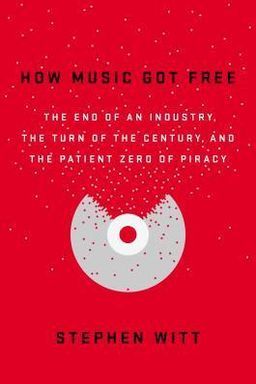
How Music Got Free cover

How Music Got Free

by Stephen Witt

How Music Got Free unravels the captivating history of the mp3, from its inception to its role in upending the music industry. Discover the key players behind this digital revolution and how the rise of the internet led to an unprecedented era of music sharing, piracy, and streaming, forever changing how we consume music.

The Compression That Changed the World

If you listen to a song stored on a pocket-sized device, you’re part of one of the most profound revolutions in digital history. This book traces how a handful of engineers, hackers, executives, and ordinary factory workers collectively reshaped how music travels—from bits of psychoacoustic theory in a German lab to torrents and streaming platforms that define modern culture.

At its center lies the MP3, a simple file format that condensed songs into data—and turned sound itself into a networked commodity. The book follows this transformation step by step: invention, commercialization, explosion, piracy, enforcement, and renewal. Each stage shows how technology doesn’t just solve problems—it rewires industries and values.

Invention through psychoacoustics

Karlheinz Brandenburg and his Bavarian team built the mp3 from deceptively simple insight: use human hearing, not just math, to decide what data matters. Following the lead of Dieter Seitzer and Eberhard Zwicker, they realized our ears ignore certain frequencies (post-masking) and merge close tones (spectral masking). By allocating bits where the ear actually pays attention, Brandenburg could shrink sound without perceptible loss. This ‘analysis by synthesis’ method transformed compression into human-centered engineering.

Market puzzles and Fraunhofer’s struggle

Fraunhofer’s lab could build the codec but not the market. Players wouldn’t exist without files; files wouldn’t spread without players. Instead of waiting for manufacturers, the team distributed encoders as shareware—L3Enc and WinPlay3—allowing public experimentation. Those cracks and free copies lit a fire the institute didn’t expect: a grassroots movement of early adopters and pirates who made mp3 the people’s format.

From executives to engineers—and blind spots between

Meanwhile, music executives like Doug Morris misunderstood what was coming. They ran an industry optimized for hits, publicity, and physical sales. When mp3s appeared, corporate reports mentioned neither streaming nor compression. Seagram’s ten-billion-dollar PolyGram deal assumed CDs would remain central. (It’s a lesson in business adaptation: dominance in one era can blind you to the next.)

Underground architectures

Once leaked, mp3 moved into the ‘Scene’—organized groups trading zero-day releases with discipline akin to corporations. IRC bots, topsites, and ASCII-art NFO files formed a parallel industry. Leaders like Kali and insiders like Dell Glover connected the underground to actual factories. Their professionalism proved that piracy wasn’t chaos but infrastructure.

Human and systemic vulnerability

The Kings Mountain disc plant became the weak link. Despite badge scans and cameras, small routines—random wand checks, overstock grinders—made physical leakage easy. Dell Glover hid prerelease discs in gloves and belt buckles, merging blue-collar ingenuity with digital disruption. It wasn’t a technology breach but a human one.

Law, loss, and adaptation

The industry sued Napster and others, but these victories only accelerated format migration. Killing Napster didn’t kill mp3—it legitimized the file by driving listeners toward portable players and peer networks like BitTorrent. Eventually, executives pivoted from fighting to monetizing: Vevo, streaming, and 360 deals tried to harness attention instead of outlawing it.

Central argument

Technological revolutions don’t begin with ideology or law; they start with new ears—engineers who hear differently, users who adopt differently, and institutions slow to adapt. The mp3’s journey teaches you that compression is not just math—it’s a metaphor for cultural, economic, and human change.


Inventing Sound’s Digital Skeleton

The story begins with invention—how Karlheinz Brandenburg turned psychoacoustics into code. He wasn’t trying to make piracy easy; he wanted to make music transmission efficient. You see how Fraunhofer merged auditory psychology, mathematics, and practical coding to build the mp3’s inner architecture.

Psychoacoustics as engineering insight

Rather than encoding every vibration, Brandenburg analyzed what your brain perceives. Frequency sensitivity and masking permitted selective data discard. He defined a rule system where data bandwidth followed human perception. This became ‘analysis by synthesis,’ an iterative process that maps perceptual loss and balances bit allocation. (It’s a creative blending of neuroscience and algorithm design.)

Coding heroes and refinement

Bernhard Grill turned Brandenburg’s theory into runnable code. Huffman coding solved redundancy; careful listening solved quality. Grill tested on a variety of samples—piccolo, trumpet, the infamous ‘Tom’s Diner’ vocal—until the perceptual artifacts receded. Their persistence showed that computation can meet art only through ear-driven iteration.

Politics of standards

The MPEG committee nearly killed the mp3 in favor of Philips-backed Musicam (mp2). Business interests inserted complex proprietary filters, prioritizing licensing over performance. Fraunhofer compromised to survive, cementing mp3 as a technical underdog that only later triumphed through Moore’s Law and public adoption.

Key lesson

Innovation succeeds when it aligns with human perception and persists through political chaos. Brandenburg “told the bits where to go”—and in doing so, told future industries how to listen intelligently to data rather than treat it equally.


From Laboratory to Global Adoption

Fraunhofer’s breakthrough didn’t automatically change music culture—it had to be adopted. The chapter on commercialization describes this uncertain transition: how a scientific codec crossed into mainstream usage through shareware, leaks, and surprising early customers.

Breaking the adoption loop

The team faced a classic catch-22: no players without files, no files without players. Brandenburg’s solution was to distribute L3Enc and WinPlay3 as shareware. Cracked versions turned science demos into viral pathways. You watch technology escape corporate control and enter the public domain of curiosity and copying.

Early enterprise adopters

Unexpected industries proved mp3’s utility first. Steve Church’s Telos Systems used mp3 racks for broadcast audio, transmitting hockey games and arena sound. This proved low-bandwidth fidelity could work commercially—even if Fraunhofer earned little licensing revenue.

Hardware and culture

When Saehan released the MPMan and Diamond built the Rio, mp3 became portable. Software followed—Winamp visualized music and socialized playlists. These interfaces democratized audio experience and made compression visible as lifestyle. Fraunhofer responded with AAC, splitting consumer and industrial markets—a deliberate, strategic evolution.

Takeaway

Commercialization isn’t linear. Innovation survives when its creators release control—what began as scientific rigor became cultural DNA through user experimentation and technological leakiness.


The Rise of Online Piracy Networks

In the mid-1990s, the mp3 escaped regulation entirely through the formation of the ‘Scene’—an organized subculture of anonymous release groups. Their precision, hierarchy, and discipline made piracy industrial. You see how grassroots hackers and insiders constructed what amounted to a parallel supply chain.

Structure and operation

Rabid Neurosis (RNS) exemplifies how organized leaks worked. Its leaders (Kali, KOSDK) managed IRC channels with restricted IPs and encrypted chats, while insiders like Dell Glover delivered content physically from PolyGram’s plant. The Scene relied on topsites—private, ultra-fast servers—and detailed NFO release files that certified authenticity.

Culture and ethics

Unlike random file-sharing, the Scene enforced ethical codes: no profit, no leaks outside topsites, strict adherence to release protocols. This ethos fostered reputation and reliability. Their system anticipated modern decentralized networks like open-source communities—competition and collaboration merged under mutual standards.

Leak mechanics

Physical extraction from plants used clever low-tech tricks: glove hides, grinder bypasses, belt-buckle concealment. These methods combined blue-collar logistics with hacker OPSEC. RNS’s discipline survived until human error—transcripts, reused IMs, trail logs—gave law enforcement an opening.

Insight

Piracy’s strength isn’t technology alone—it’s organized trust and controlled chaos. The Scene operated like a corporation, proving that social architecture often beats digital regulation.


Factories, Humans, and Leak Economics

The mp3 revolution’s physical backbone was built in places like Kings Mountain, North Carolina—a CD factory turned accidental hack zone. This part explores how supply-chain weakness and human ingenuity birthed the most prolific leaker, Dell Glover, and the economy surrounding him.

Security theater and structural flaws

Despite digital checkpoints, the plant’s routines invited exploitation: random wand checks, overstock policies, grinder disposal, and lenient guards. Dell Glover realized these procedures created blind spots. His glove and buckle tricks worked precisely because compliance relied on habit, not scrutiny.

Glover’s rise and method

A worker with technical curiosity, Glover built tower burners and sold discs locally. His factory role gave him early access to unreleased albums; his Internet savvy linked him to RNS’s leaders. He transformed stolen discs into encoded leaks that reached millions worldwide. For several years, he was ‘patient zero’ for major hip-hop releases.

Money and consequence

By translating early access into distribution convenience, Glover created a profitable gray market. Yet law enforcement eventually caught up. He pled guilty, cooperated, and served minor time. His story symbolizes how access—rather than expertise—drives black-market economies.

Lesson

Digital crises often originate offline. A secure algorithm means little if physical handling is flawed. Human routine remains the perpetual exploit point.


Law, Enforcement, and Industry Reinvention

The industry’s reaction to mp3 was dominated by litigation—from Napster to individual lawsuits—and followed by a slow realization: fighting distribution doesn’t rebuild value. This part covers the legal wars, the fallouts, and the streaming pivot that ultimately saved the business.

Winning and losing in court

In A&M v. Napster, the RIAA shut down the service but failed to stop portable players (Diamond case). The result: the legal victory legitimized personal mp3 ownership. Later, Project Hubcap’s mass lawsuits against individuals produced backlash and ridicule. Juries sympathized with defendants and exposed the limits of punitive deterrence.

Operations and limits

FBI operations like Fastlink arrested Scene members but couldn’t dismantle piracy’s architecture. Jurors acquitted some high-profile defendants (Alan Ellis, Adil Cassim), demonstrating society’s moral split over digital theft—it wasn’t perceived as equivalent to physical stealing.

Strategic pivot

Doug Morris and peers moved from fighting disruption to monetizing it. Vevo repurposed music videos into ad-segment income. iTunes introduced controlled digital sales. Eventually, streaming redefined value: not ownership but access. Labels expanded into publishing, touring, and sync licensing—the new durable assets in a digital economy.

Industry takeaway

Legal wins rarely solve structural transitions. Sustainable adaptation comes when industries pivot from scarcity to experience—from selling units to selling engagement.

Dig Deeper

Get personalized prompts to apply these lessons to your life and deepen your understanding.

Go Deeper

Get the Full Experience

Download Insight Books for AI-powered reflections, quizzes, and more.