
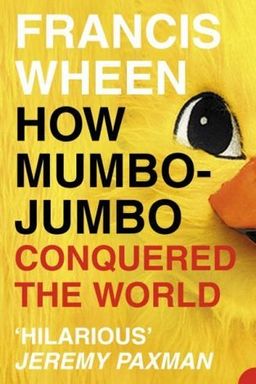
How Mumbo-Jumbo Conquered the World cover

How Mumbo-Jumbo Conquered the World

by Francis Wheen

Francis Wheen''s ''How Mumbo-Jumbo Conquered the World'' exposes the irrational philosophies shaping modern society. From neoliberal economics to self-help myths, Wheen unravels the deceptive ideologies that have distorted reason and fostered inequality. This thought-provoking exploration urges readers to challenge prevailing narratives and embrace rational discourse.

The Age of Unreason and Its Global Spell

How can entire societies fall under the spell of unreason while believing they are acting rationally? In How Mumbo-Jumbo Conquered the World, Francis Wheen argues that the late twentieth century was shaped by a peculiar faith: a return to myth and magical thinking disguised as modern progress. The spirit of the Enlightenment—science, rational debate and evidence—was quietly replaced by superstition, ideology and market theology. Wheen traces this transformation across politics, economics, culture and academia, showing how irrational ideas gained prestige at every level of modern life.

From 1979 to the Millennium: A Chain Reaction

You begin in 1979, a year Wheen sees as an ideological hinge. Ayatollah Khomeini’s return to Iran and Margaret Thatcher’s election in Britain exemplify two ‘messianic’ visions: religious fundamentalism and free-market fundamentalism. Each promised moral certainty after a decade of confusion. Khomeini’s revolution invoked a seventh-century utopia while relying on modern technologies to spread its message; Thatcher’s crusade wrapped monetarist economics in Victorian moral rhetoric. (Note: Wheen compares both leaders to prophets who fused divine mission with logistical prowess.) Their parallel ascents signaled global appetite for strong narratives to replace the compromises of twentieth-century pluralism.

Economic Faith and Political Theology

The ideology soon metastasized through neoliberalism. Reaganomics and Thatcher’s monetarism turned supply-side clichés into almost spiritual doctrine. Cutting taxes for the wealthy was said to increase revenue through mystical ‘Laffer effects’—a secular version of miraculous multiplication. When reality contradicted faith—rising deficits, speculative manias—the response was not correction but ritual reaffirmation. Wheen calls this “voodoo economics”: a belief system immune to evidence yet crowned as orthodoxy.

You see how deregulation produced the casino economy of the 1980s. Corporate raiders like Ivan Boesky and Michael Milken, junk bonds, leveraged buyouts, and Black Monday (1987) illustrate how greed was enthroned as creative virtue. The paradox is stark: apostles of market liberty repeatedly required government bailouts, revealing private enterprise’s dependence on public rescue.

Cultural and Intellectual Unreason

While politicians sanctified the market, intellectuals in universities sanctified complexity over clarity. Wheen shows how postmodern thinkers—Derrida, Foucault, Baudrillard—legitimized obscurantism by rejecting truth as ‘socially constructed.’ The Alan Sokal affair (1996), where a physicist exposed the gullibility of cultural theorists, became emblematic of scholarship that prized jargon over reason. This academic relativism seeped into public life: once experts proclaimed that truth itself was subjective, conspiracy, astrology, and pseudo-science could claim equality with fact.

The erosion of rational authority extended beyond campuses. Self-help gurus and management evangelists sold “recipes” for success—Tom Peters’s In Search of Excellence, Stephen Covey’s Seven Habits, Anthony Robbins’s firewalk seminars. Wheen argues these formulaic systems transformed complex realities into purchasable inspiration, echoing political slogans that promised transformation through feeling alone. What once required analysis now demanded enthusiasm, mirroring the emotional populism that would dominate politics in the Diana era.

Politics of Emotion and Spectacle

Wheen turns from ideas to emotions: the late twentieth century, he argues, made feeling its highest civic virtue. After Princess Diana’s death, mass mourning and media choreography substituted catharsis for deliberation. Tony Blair’s invocation of “the People’s Princess,” or Bill Clinton’s televised confessions, reveal how the emotive spectacle became political capital. Empathy displaced evidence; sincerity replaced competence. Sentimental politics, in Wheen’s view, is the perfect complement to neoliberalism and postmodernism—each privileges individual feeling over collective reasoning.

From Globalisation to Grand Theory

Wheen then surveys the big narratives that rationalize inequality and complacency. Fukuyama’s End of History declared liberal capitalism the final human system; Huntington’s Clash of Civilisations redrew global conflict as cultural destiny. For Wheen, both are comforting myths dressed as science, flattening complexity into inevitability. The same pattern animates Thomas Friedman’s globalization parables and management theories: anecdotes serve as universal truths, masking political choice as natural law.

Conspiracies, Catastrophes and the New Age Mind

The irrational impulse also expresses itself in popular prophecy. Media from The Jupiter Effect to The Man Who Saw Tomorrow, UFO cults and The Bible Code thrive on the appetite for cosmic certainty. From Nancy Reagan’s White House astrology to Roswell autopsies, superstition occupied elite and mass alike. Wheen demonstrates how the market profits from apocalypse: panic becomes product, catastrophe becomes entertainment.

Blowback and Realpolitik

Behind the spectacle, real institutions practice a comparable irrationality—strategic short-termism. Wheen’s case studies (the Kurdish betrayal, CIA coups, mujahedin funding) show how Realpolitik ignores moral causality and breeds blowback. Actions justified by ‘national interest’ create future crises; covert rationality becomes covert madness. The Afghan jihad funded by Western powers in the 1980s evolved into global terrorism by the 2000s. Thus the logic of unreason reaches geopolitics: modernity’s tools serve its own undoing.

The Enlightenment Defence

Having traced disorder across economics, ethics, and epistemology, Wheen’s conclusion is not despair but a call to arms. He urges you to reclaim Enlightenment principles—clarity, empirical method, secular tolerance—as the intellectual antidote to mumbo-jumbo. Superstition and relativism thrive when reason retreats; democracy depends on citizens who insist that facts exist, evidence matters, and authority must be earned by argument rather than charisma. His final message: the Enlightenment is not a spent force but a civic habit you must consciously defend.

Key Insight

Across politics, economics and culture, Wheen exposes a persistent drift from rational inquiry to faith-based certainty. The antidote is not nostalgia but vigilance: critical reasoning is civilization’s immune system, and its neglect invites contagions of myth, market, and mysticism.

If you follow Wheen’s narrative from 1979 through the millennium, you see modernity become a paradox: as technology and wealth surged, confidence in reason waned. The book’s warning is timeless—you inhabit an age that looks secular but thinks magical. Whether faced with prophets, CEOs, or pundits, Wheen’s advice endures: test every claim, resist charisma, and keep the Enlightenment flame alive.


Messiahs of 1979

Wheen opens with two figures who mirror each other across continents: Ayatollah Khomeini and Margaret Thatcher. Each promises a restoration of moral order in fractured societies. Khomeini’s return to Tehran in February 1979 unfolds like prophetic theatre; millions line the streets, chanting for divine justice. Thatcher’s May election the same year frames economic reform as moral crusade. The twin stories show how yearning for certainty—religious or market-based—can collapse complex modern anxieties into single charismatic solutions.

Time Travel and Moral Nostalgia

Khomeini’s idea of justice meant a migration backward in time, reviving seventh-century Islamic governance. Thatcher’s faith looked to Victorian discipline and thrift. Both equate virtue with regression: paradise lies behind us, not ahead. Yet both revolts depend on modern media and technologies—televised sermons and polling, aircraft and printing presses—to project archaic visions. Wheen uses these paradoxes to show that modern revolutions often rely on the tools they condemn.

The Birth of Political Theology

By interpreting these leaders as secular and sacred messiahs, Wheen reveals how twentieth-century politics shifts from negotiation to salvation. Khomeini offers divine simplicity; Thatcher offers economic virtue as faith. Each aligns political authority with moral certainty—a pattern that later spreads through Reaganism, Blairism and even corporate mission statements. (Note: Wheen’s comparison echoes Max Weber’s analysis of charismatic authority.)

Key Insight

Modern power often disguises itself as moral restoration. When leaders present politics as redemption, scepticism becomes heresy—and pragmatic reasoning withdraws.

Through these case studies, you see 1979 not as isolated coincidence but as spiritual inflection: the rupture that allowed ideology, religion and economics to merge into one hypnotic language of certainty—a tone that still echoes in populist and fundamentalist movements today.


Economics as Magical Faith

During the 1980s, you witness how economic theory itself becomes a form of religion. Monetarists and supply-side evangelists promise miracles through deregulation and tax cuts. Reagan and Thatcher proclaim that prosperity descends when the state withdraws. Wheen deconstructs this rhetoric to reveal how it replaced analysis with incantation: deficit growth and inequality were rebranded as proof of moral revival rather than policy failure.

The 'voodoo economics' era

Arthur Laffer’s curve acts as totem, Friedman’s monetarism as scripture. When fiscal results contradict promises, believers double down. Wheen recounts the spectacle of Ivan Boesky’s mantra “Greed is healthy” and the casino economy’s crash cycles—most notably Black Monday (1987). Speculation becomes virtue; regulation becomes sin. (Note: The irony parallels historian J. K. Galbraith’s critique of speculative manias.)

The Moral Paradox

Wheen’s deeper argument is ethical: neoliberalism sanctifies inequality by calling wealth a moral reward. Citizenship transforms into consumption; the market becomes arbiter of virtue. But when financiers implode, public funds step in—the exact opposite of the creed’s promise. Wheen calls this the cardinal paradox of neoliberal triumph: the rhetoric of freedom depends systematically on state intervention.

Key Insight

Economic ideology becomes superstition when it treats numbers as talismans and markets as moral saints. Evidence of failure no longer provokes reform—it demands greater faith.

When you look back on the Gilded Eighties, you see not merely excess but theology: money as miracle, CEOs as priests. Wheen’s critique invites you to treat every economic certainty with empirical caution and moral awareness.


Management Gurus and Bureaucratic Mysticism

By the 1990s, irrationalism acquires a professional sheen. Management gurus—Tom Peters, Stephen Covey, Anthony Robbins—trade charisma for consultancy. Wheen describes them as industrial mystics preaching salvation through numbered habits and motivational spectacle. Their slogans, backed by corporate marketing, promise transcendence without analysis. What began as business advice becomes cultural ritual: success equals faith in your own enthusiasm.

From Self-Help to Government

Wheen tracks how private-sector formulas infiltrate governance. New Labour’s adoption of Edward de Bono’s ‘thinking tools’ and Demos’s jargonised management theories replaces policy reasoning with pseudo-technical performance metrics. Civil servants start speaking in mantras: ‘benchmarking,’ ‘vision statements,’ ‘stakeholders.’ The promise of universal templates relieves institutions of hard debate but invites waste and corruption through consultancy addiction.

Cultural Consequence

Underneath the buzzwords lies anxiety: the wish to control complex reality through recipes. Wheen notes that management fashion feeds on the same need for certainty that drives mysticism and markets. The result is administrative theatre—appearing dynamic while avoiding substance. (Note: His tone resembles C. Wright Mills’s warning about “salesmanship replacing reason.”)

Key Insight

The management cult turns expertise into faith and reform into performance. When governments hire gurus to solve thought, bureaucracy becomes religion.

Wheen’s message to you is pragmatic: distinguish genuine evidence-based improvement from theatrical self-assurance. Administration should serve citizens, not consultants.


The Retreat from Reason

You enter the academic world that abandoned clarity for glamour. Postmodern theorists—Derrida, Foucault, Lacan—transform critique into relativism, arguing that truth is cultural construction. Wheen finds value in questioning power but sees danger when skepticism becomes nihilism. The Alan Sokal hoax exposes the rot: a blatantly meaningless essay accepted by a respected journal illustrates how intellectual vanity replaces critical scrutiny.

How Relativism Spills Into Public Life

Once elite discourse denies objective truth, public debates follow suit. Wheen draws links between campus relativism and mass gullibility—from creationism and UFOs to Bible Codes. When scholars treat Auschwitz or evolution as mere narratives, they erode moral and empirical foundations. He calls this ‘a civic risk’: the abdication of evidence empowers demagogues and conspiracy theorists alike.

Humanistic Recovery

Wheen defends the Enlightenment as both scientific and ethical tradition. Against Adorno’s claim that reason leads to domination, he counters that rational inquiry birthed the very language of rights that condemns domination. You are urged to reject both sterile positivism and self-indulgent obscurantism: reasoned debate, not fashionable ambiguity, sustains liberty.

Key Insight

Intellectual scepticism becomes destructive when it denies fact itself. The defence of reason is not elitist—it is the very condition of democracy.

Wheen’s appeal is clear: keep Enlightenment courage alive. Demand clarity from experts, question mystics, and measure claims against reality.


Prophecy, Conspiracy and the Culture of Fear

From the Jupiter Effect to Roswell, Wheen catalogues how media and markets profit from irrational fear. Predictive catastrophes and UFO exposés share the same formula: selective data, theatrical narrative, and profitable panic. Television specials about Nostradamus or The Bible Code turned superstition into mass entertainment; audiences suspended disbelief because they ‘wanted to believe.’

Superstition in High Places

Even elites succumb. Nancy Reagan’s astrology-assisted scheduling shows that irrationalism pervades government. When leaders consult stars, citizens feel licensed to do likewise. Wheen calls this evidence-free certainty—a disease of authority that prefers mystery to accountability.

Democratic Consequences

Belief without evidence corrodes civic judgment. Conspiracies and prophecies provide emotional clarity at the expense of truth. Wheen reminds you that democracy functions only when citizens can distinguish proof from pattern. When fantasy gains social respectability, cynics and demagogues thrive.

Key Insight

Information abundance does not guarantee enlightenment. In a saturated media culture, critical thinking—not access—is the true antidote to panic and myth.

If you want rational citizenship, Wheen urges disciplined scepticism: extraordinary claims require extraordinary evidence—and civility depends on that standard.


Realpolitik and Moral Blowback

Wheen’s political chapters expose how pragmatic states generate irrational outcomes through strategic cynicism. Realpolitik treats allies and enemies as tools, producing blowback that haunts global politics. From Kissinger’s Kurdish betrayal and the CIA’s Iran and Panama operations to mujahedin funding in Afghanistan, he reveals a consistent failure to foresee moral and strategic consequences.

The Mechanism of Blowback

Support insurgents today, abandon them tomorrow; arms circulate, ideologies mutate. Wheen reconstructs step-by-step how CIA and MI6 initiatives birthed later crises. Short-term triumphs mutate into long-term disasters—the logic of unreason hidden in cold geopolitics. (Note: The concept originates from CIA lexicon itself as ‘blowback.’)

Ethical Reckoning

You learn that moral detachment is not realism but denial. Democracies borrowing the moral calculus of covert empires lose integrity and accountability. Wheen’s narrative of Afghanistan—mujahedin funded by Western governments—foreshadows 9/11, an unintended harvest of cynical seed. The cost of ignoring principle is not just hypocrisy but danger.

Key Insight

Realpolitik without moral foresight is irrational by design. Strategic short-termism breeds the very instability it seeks to prevent.

Wheen’s advice is practical: in foreign policy, ask not only what is effective but who will bear the blowback. Morality, far from weakness, is preventive reasoning.


Sentimental Politics and Emotional Power

By the late 1990s, feeling itself becomes public ideology. Wheen dissects the rise of therapeutic politics where confession and empathy substitute for deliberation. The cult surrounding Princess Diana’s death and the emotional performances of Clinton and Blair exemplify this turn. Grief becomes moral currency; sincerity equals virtue.

From Catharsis to Control

Media and politicians exploit emotion for legitimacy. Blair’s phrase “the People’s Princess” preempts analysis, uniting the public through sentiment rather than debate. Clinton’s televised apology transforms scandal into ceremony. Wheen calls this sentimental politics—a system that pacifies criticism through collective tears.

Hazards of Emotional Democracy

When action yields to empathy, politics loses traction. The same pathos that fuels compassion also fuels hysteria: the 2000 paedophile manhunts show emotion’s darker side. True civic maturity, Wheen insists, requires pairing empathy with principle; otherwise democracy becomes a therapy group rather than a forum for reasoning.

Key Insight

Feeling is essential but insufficient. When leaders demand emotion instead of engagement, public life turns consolatory—not transformative.

Wheen’s critique helps you recognize emotional manipulation in modern politics and defend reasoned empathy—the combination of compassion and critical thought.


Globalisation and the New Pseudoscience

Globalisation, often touted as inevitable progress, receives Wheen’s most nuanced criticism. He dismantles its metaphors—Thomas Friedman’s Lexus and Olive Tree, McDonald’s peace theory—and replaces anecdotal glamour with evidence. Globalisation is not cosmic law but political arrangement, and its beneficiaries often write its theology.

The False Naturalism

Wheen shows how journalistic prophets convert corporate anecdotes into universal science. Yet history proves otherwise: nineteenth-century globalization was equally intense in migration and capital flow. Modern boosters ignore that what appears spontaneous is heavily regulated by powerful interests and institutions like the IMF.

IMF Orthodoxy and Its Crises

The 1997 Asian financial crash exposes the cost of blind liberalization—interest rates soaring to 170% in Russia and entire economies hollowed by austerity. Wheen cites critics like Ha-Joon Chang to argue that the Washington Consensus ‘kicked away the ladder’ formerly used by rich nations to develop. Globalisation, he writes, is neither inevitable nor fair—it is an ideology masquerading as natural evolution.

Key Insight

Treat globalization claims like any other prophecy: question who utters them, who profits, and whose data they omit.

If you adopt Wheen’s lens, you regain agency—seeing markets as human constructions subject to reform, not forces of fate.


Recovering the Enlightenment

At the book’s close, Wheen gathers his critique into a rallying cause: reassert the Enlightenment. Reason, evidence and open debate are not elitist relics but safeguards against unreason. He reminds you that secular liberalism freed humanity from despotic mysticism; abandoning it invites tyranny through confusion.

The Enlightened Habit

To think critically is to act morally. Wheen argues that fact-checking, scepticism and logical scrutiny are not cold detachment but civic compassion—the only way to protect both liberty and tolerance. Postmodern relativism and populist mysticism alike threaten these habits by making truth negotiable.

Practical Vigilance

You can defend rational culture daily: demand evidence from politicians, question management buzzwords, and resist emotional manipulation. Wheen’s defense mirrors Voltaire’s pleas for critical speech and Diderot’s defense of human curiosity: freedom depends on reasoned dissent.

Key Insight

The Enlightenment is not a period but a practice. Every generation must fight to keep clarity from being drowned by charisma.

Wheen’s closing appeal transcends polemic: it is civic humanism rediscovered. You are asked not merely to admire reason but to live by it—testing myths, balancing emotion, and sustaining dialogue in a world that increasingly mistakes noise for knowledge.

Dig Deeper

Get personalized prompts to apply these lessons to your life and deepen your understanding.

Go Deeper

Get the Full Experience

Download Insight Books for AI-powered reflections, quizzes, and more.