
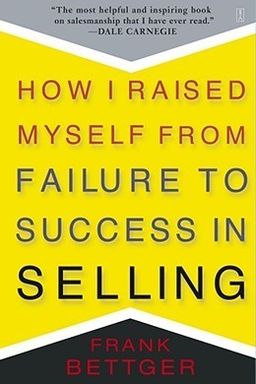
How I Raised Myself from Failure to Success in Selling cover

How I Raised Myself from Failure to Success in Selling

by Frank Bettger

Frank Bettger shares transformative sales strategies in ''How I Raised Myself from Failure to Success in Selling.'' Discover how enthusiasm, client-centered listening, and trust-building skyrocket your sales career. Learn to overcome objections and make clients feel valued for enduring success.

Raising Yourself from Failure to Success in Selling

Have you ever wondered why some people thrive in sales and others burn out in frustration? In How I Raised Myself from Failure to Success in Selling, Frank Bettger argues that selling greatness isn't born—it's built through enthusiasm, discipline, integrity, and a genuine interest in others. Bettger contends that success in sales (and life) comes down to mastering simple human behaviors—acting enthusiastic even when you don’t feel like it, organizing your time, asking powerful questions, and focusing on the other person’s needs instead of your own. Through dozens of stories from his own life, Bettger reveals how he went from a failed baseball player and struggling insurance agent to one of the most highly paid salesmen in America.

From Despair to Discovery

Bettger opens with the story of how he nearly quit selling after ten miserable months of failure. He had been a professional baseball player with the St. Louis Cardinals, but an injured arm ended his career. When he entered sales, he was terrified of rejection and could barely talk to people. What changed everything was a simple observation from his baseball coach: his lack of enthusiasm made him look lazy. That insight struck him like lightning. He decided to act more enthusiastic—and discovered that enthusiasm itself is a skill. By intentionally behaving with energy, he began feeling and radiating genuine confidence. Within ten days, his income increased 700%. That turnaround laid the foundation for every success and principle in the book.

The Power of Action and Attitude

At the heart of Bettger’s method is a deceptively simple truth: you can act your way into feeling. This philosophy—shared by thinkers like William James and Dale Carnegie—is repeated throughout the book. Fear, he writes, is conquered by action; enthusiasm emerges from motion, not mood. He combines emotional intelligence with practical steps: keep records, plan ahead, join a public speaking course, and organize time ruthlessly. These disciplines reshaped his mindset and produced predictable, measurable improvements.

Salesmanship as Human Understanding

Bettger shifts the reader’s understanding of selling: it’s not persuasion or manipulation—it’s service. The true salesperson becomes a trusted advisor who listens more than talks, asks “why?” and learns what the customer truly needs. To sell well is to understand humanity. In this way, Bettger foreshadows modern customer-centric business thinking (similar to Stephen Covey’s “Seek first to understand, then to be understood” from The 7 Habits of Highly Effective People). He calls this the fundamental secret of success: find out what the other fellow wants, and then help him get it.

Confidence, Character, and Connection

Bettger repeatedly links sales performance with moral character. Confidence isn’t swagger; it’s self-respect earned through honesty and knowledge. He quotes Karl Collings—“Yes, but I’ll know it”—to demonstrate integrity as the cornerstone of trust. Whether praising competitors, dressing professionally, or continuing education throughout life, Bettger’s principles elevate sales from a transactional act to a personal vocation. He reminds the reader that enthusiasm, sincerity, and gratitude are contagious—and people prefer to buy from individuals who embody these traits.

Self-Discipline and Continuous Growth

The book culminates in Bettger’s adoption of Benjamin Franklin’s thirteen-week self-improvement plan. Dividing his goals into weekly subjects like enthusiasm, order, sincerity, and service, he cycles through them four times a year. The habit of weekly focus became Bettger’s “track” for success, proving his belief that self-development is a lifelong, structured process—not an accident. This plan, he says, gave him “an inward power I had never known before.”

In this summary, you’ll discover these transformative lessons from Bettger’s story: how enthusiasm can multiply income, why planning conquers procrastination, how honesty and curiosity win confidence, and how self-improvement turns selling into a craft. Bettger’s timeless message is that personal growth and sales success are one and the same—and both begin when you decide to act with energetic purpose.


Enthusiasm: The Starting Point of Success

Frank Bettger’s career—and philosophy—begins with one word: enthusiasm. When he was fired from his first baseball team for being “lazy,” his manager told him to wake up and act like he cared. The problem wasn’t laziness, but fear. He looked timid and uninterested, even though he was nervous. To overcome the perception, Bettger decided to act enthusiastic even when he wasn't. The transformation was immediate. Within ten days, his income jumped from $25 to $185 a month, and reporters praised his energy and spirit. His nickname became “Pep” Bettger. The same principle later revived his failing sales job.

Act Enthusiastic, Feel Enthusiastic

The secret, Bettger explains, is that enthusiasm isn’t an emotion—it’s a habit. Acting enthusiastic triggers genuine feeling. He credits Dale Carnegie (his mentor and collaborator) for reinforcing this truth: emotions follow actions. Like William James at Harvard once said, “By regulating the action, which is under control of the will, we can indirectly regulate the feeling.” When you force energy—even fake—into your manner, your physiology changes. Your tone rises, gestures animate, eyes sparkle, and people respond with more warmth and engagement.

Contagious Energy

Bettger calls enthusiasm “by far the highest paid quality on earth.” It inspires others, fuels confidence, and makes even inexperienced salespeople attractive. He recounts how, after years of failure, his renewed energy led him to make his first big sale as an insurance agent. He didn’t rely on clever words—just unrestrained passion. His clients bought into his excitement before they bought his product.

Enthusiasm in Practice

Bettger even devised daily rituals to stay fired up. Each morning he would stand tall and repeat, “Force yourself to act enthusiastic, and you'll become enthusiastic!” He recommends testing it for thirty days. He points to successful figures like Walter P. Chrysler, who claimed that excitement—not knowledge—was the real secret to leadership. Similarly, Bettger’s friend Stanley Gettis repeated inspirational verses daily to spark motivation, proving that enthusiasm is both contagious and renewable.

Through enthusiasm, Bettger learned to overcome fear, connect faster with people, and attract opportunities. It wasn’t magic—it was motion. The more he faked energy, the more real it became. His advice is unambiguous: make enthusiasm a discipline.


Know Your Business and Keep Learning

One of Bettger’s most persistent lessons is that self-confidence comes from competence. The more you know, the calmer and more persuasive you become. He recounts his encounter with Dr. O.M. Marchman, a sixty-six-year-old ear, nose, and throat specialist in Dallas, who spent six weeks each summer attending lectures and clinics in Philadelphia to stay current. Bettger calls Marchman the model of lifelong learning—“the outstanding specialist in Dallas”—because he constantly studied his craft.

Similarly, Henry Ford’s famous quote—“Anyone who stops learning is old, whether at twenty or eighty”—anchors Bettger’s argument: growth requires constant renewal. Knowledge gives integrity and courage. When Bettger started subscribing to professional sales journals and information services, his results improved dramatically. His less-informed peers made excuses that they “couldn’t afford” such tools—while driving expensive cars. Within months, his modest monthly subscription had already paid for itself through one substantial sale.

Bettger observed that in every sales office he visited, the top performers were always the best informed. They studied law, psychology, industry trends, and even their clients’ businesses. He quotes Frank Taylor of General Motors: good buyers prefer dealing with salesmen who understand their product thoroughly and respect their time. Charm and polish might get you a $30-a-week job, as columnist Billy Rose quipped—but expertise earns big commissions.

So if you want unshakable confidence, Bettger says, stop worrying about charisma and start studying. Continuous learning isn't optional—it's survival. In a world that rewards specialists, education must never end.


The Power of Listening

In a chapter aptly titled “The Forgotten Art That Is Magic in Selling,” Bettger reminds readers that the essence of influence isn’t talking—it’s listening. He learned this after returning from a national tour with Dale Carnegie. Excited to recount his adventures, he visited a longtime client, a dairy company president in Philadelphia. Before he could launch into stories, he instead asked, “What have you been doing?” The man lit up, talked at length, and ended the meeting by handing Bettger a large order. Bettger never got to talk about himself—but he got the sale. Listening, he realized, makes others feel important and understood.

Creative Listening

Bettger describes “creative listening” as a skill requiring presence and curiosity. He recounts interviews with business leaders and preachers like Dr. Joseph Fort Newton, who emphasized that attentive listening is one of humanity’s rarest gifts. Even actors, Bettger notes, must master listening on stage to look genuine. Silence itself can be powerful. He recounts meetings where he learned to pause mid-sentence until the prospect spoke again—giving control back to the listener and discovering hidden needs or objections.

A Simple Rule That Wins Hearts

Bettger jokes that many salespeople talk themselves out of deals. His prayer became: “Lord, help me keep my big mouth shut until I know what I’m talking about.” He quotes Cicero’s ancient wisdom: “There is an art in silence, and there is an eloquence in it, too.” Modern psychology agrees: people are happier when they can share their own stories.

Listening transforms tension into trust. It opens space for the real issue to emerge. When you let people talk—especially about themselves—you not only sell more effectively, you gain insight into human nature itself. As columnist Dorothy Dix wrote, “The shortcut to popularity is to lend everyone your ears instead of giving them your tongue.”


Building Confidence through Integrity

Another turning point in Bettger’s life came from his mentor, the veteran salesman Karl Collings. Bettger admired how Collings radiated trustworthiness—how clients instinctively felt, “Here’s a man I can believe.” Once, Collings insisted on telling a customer the full truth about a policy’s minor limitation, even though it meant losing part of the commission. When Bettger asked why, Collings said quietly, “Because I’ll know it.” That phrase—simple, absolute honesty—became Bettger’s professional creed: deserve confidence.

Customers, he realized, may forget facts, but they never forget a person’s integrity. He later found a clipping he carried for years: “Not the best talker wins the sale—but the most honest talker.” In an age obsessed with persuasion tricks, Bettger’s emphasis on ethics feels timeless. Whether by acknowledging a competitor’s strength, admitting a product’s limits, or taking full responsibility when wrong, the salesperson strengthens credibility. “The real test,” Bettger writes, “is not whether the other person believes it, but whether you believe it.”

This idea parallels modern trust-based selling (as in The Trusted Advisor by David Maister): character is the ultimate close. Clients buy the person before they buy the product. For Bettger, every sale began with proving worthy of belief.


Overcoming Fear and Failure

Fear haunted Bettger early in his career—fear of rejection, public embarrassment, and failure. His breakthrough came when a mentor forced him to speak during a Dale Carnegie public speaking class. Terrified, he stumbled through—but afterward realized that facing fear in front of groups dissolved his fear of individuals. Public speaking became his cure for timidity. He discovered, “When I lost my fear of speaking to audiences, I lost my fear of talking to individuals.”

He later tied this lesson to a larger philosophy: courage is not the absence of fear, but its conquest. Bettger illustrates this with a vivid story about Babe Ruth. The baseball legend struck out 1,330 times yet became immortal for his 714 home runs. Failure, Bettger insists, is the price of achievement. Like Ruth and Ty Cobb, top performers keep swinging. Rejection is merely data—the raw material for the law of averages to work in your favor.

He also recounts how salesman Richard Campbell of Altoona, Pennsylvania overcame fear by self-discipline and record-keeping. When Campbell caught himself lying on his call reports out of shame, he decided to face reality, set goals, and measure results. The act of confronting failure honestly made him fearless. Bettger’s message: keep swinging. Success belongs to those who turn setbacks into determination.


Benjamin Franklin’s 13-Week Formula

Near the end of his book, Bettger shares what he calls “the track I ran on”: Benjamin Franklin’s thirteen-week plan for self-mastery. Franklin had chosen thirteen virtues—like temperance, order, sincerity, and humility—and spent one week focusing on each, cycling through them four times a year. This simple routine, Franklin claimed, was the foundation of all his success. Bettger adopted it and adapted the subjects to his profession: enthusiasm, self-organization, thinking in others’ interests, questioning, sincerity, knowledge, appreciation, smiling, remembering names, and closing the sale.

By carrying 3x5 pocket reminder cards each week, Bettger ingrained these habits until they became automatic. He echoed Franklin’s belief that progress is built not by grand resolutions, but by repeated small disciplines. This framework provided emotional stability and continuous growth. As he put it, “Although I fell short of mastering any of these principles, I found this plan a truly magic formula.”

The lesson is profound: self-improvement requires structure. You can’t rely on motivation alone; you must operationalize your values. Franklin’s humble checklist became Bettger’s compass—and can become yours as well. In his words, “There is no easy way, but it is a sure way.”

Dig Deeper

Get personalized prompts to apply these lessons to your life and deepen your understanding.

Go Deeper

Get the Full Experience

Download Insight Books for AI-powered reflections, quizzes, and more.