
Idea 1
Speaking How the Human Mind Listens
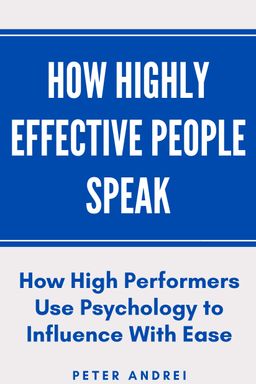
Have you ever wondered why some people seem to speak with effortless influence—why their words seem to stick, while others' fade within seconds? In How Highly Effective People Speak, Peter D. Andrei argues that great communication isn’t luck—it’s science. The best speakers, from John F. Kennedy to Winston Churchill, are unconsciously using predictable patterns of psychology that make their messages irresistible. His claim is simple but profound: if you speak the way the human mind is wired to listen, you’ll gain the power to inspire, persuade, and lead.
Andrei grounds his entire book in behavioral economics—the study of how people actually make decisions, not how we assume they do. He draws from the psychology of cognitive biases, those subtle shortcuts our brains take that shape how we judge, feel, and act. By mastering these patterns consciously, you can communicate as intuitively and effectively as the world’s top leaders.
Why Communication Shapes Reality
Andrei begins with a striking assertion: communication doesn’t just describe reality—it creates it. Every career, relationship, and mission depends on your ability to transfer the pattern of an idea from your mind to someone else’s. To fail at communication, he warns, is to fail at life’s main project. Like Martin Luther King Jr., Ronald Reagan, or Steve Jobs, highly effective people are those who matched good intentions with powerful expressions. Weak communication, he says, kills good ideas—and strong communication brings them to life.
The book opens with his own transformation—from a nervous, ineffective speaker trembling before a crowd of 200, to a calm, commanding communicator who now coaches leaders and executives. His journey shows that influence isn’t charisma you’re born with; it’s technique you can learn. “Speech is power,” he writes, echoing Ralph Waldo Emerson. “Speech is to persuade, to convert, to compel.”
Turning Psychology into Persuasion
How, then, does one speak this way? Andrei’s answer: use the unconscious biases that govern human judgment. Behavioral economics, often reserved for finance or politics, becomes a roadmap for influence. He reveals that every human mind is wired through shortcuts like the availability bias (we recall vivid stories more than dry facts), the anchoring effect (the first piece of information shapes all that follows), and the contrast effect (we decide what’s good based on comparison, not reason).
Each chapter decodes one of these biases and turns it into a rhetorical strategy. Instead of trying to sound ‘smart,’ you’ll learn how to sound memorable—by telling emotional stories, presenting powerful first impressions, setting logical anchors, and reframing uncertainty into confidence. As Andrei notes, even the greatest leaders—from Reagan’s storytelling to Kennedy’s cadence—unknowingly obeyed these scientific laws of mind.
The E.F.F.E.C.T.I.V.E. Framework
At the heart of the book is Andrei’s “E.F.F.E.C.T.I.V.E.” model, a mnemonic representing nine communicative biases: Make your message Enduring, First, Forceful, Exceptional, Confident, Trustworthy, Intuitive, Visceral, and Evident. Each corresponds to a psychological principle—for instance, making it Enduring leverages memory (availability bias), and making it Confident invokes our craving for certainty (zero-risk bias).
Through vivid examples—from Reagan’s Cold War rhetoric to Churchill’s wartime resolve—Andrei unpacks how each bias translates into persuasive action. Using this framework, you’ll not only know what to say, but how to structure, deliver, and repeat it so that it echoes in your audience’s mind long after you stop speaking.
From Ethical Influence to Moral Power
Unlike many persuasion manuals, Andrei grapples with the ethics of influence. Rhetoric, he says, is a neutral tool—it can serve Churchill or Stalin, freedom or tyranny. The moral dimension depends on the speaker’s character. Echoing ancient rhetoricians like Quintilian and Augustine, he insists that a great communicator must first be a good person skilled in speaking. He argues that bending truth for effect is not influence but manipulation—and that “truth needs great defenders who can fight falsehood with eloquence.”
This moral stance gives his framework depth. It’s not about slick arguments or tricks; it’s about shaping reality responsibly through words. For Andrei, effectiveness without ethics is power without direction. Together, they create what he calls “gentle power”—the ability to lead with authenticity and clarity of purpose.
Why It Matters Now
Andrei’s message resonates in an age of endless information and eroding trust. In workplaces, politics, and online debates, those who can frame ideas clearly command attention and shape belief. The book’s real promise lies in giving you the tools not only to articulate arguments but to build movements, lead teams, and bridge divisions. Whether you’re pitching an idea, leading a meeting, or writing a vision statement, Andrei reminds you that speaking well isn’t decoration—it’s leverage.
“Highly effective people shape the world by communicating big ideas in ways the human mind cannot resist.”
By uniting science and storytelling, How Highly Effective People Speak transforms the art of communication into a practical system—one that can elevate your confidence, your leadership, and your voice. Once you understand how people think, you can speak in ways that move them not by chance, but by design.