
Idea 1
Debt, Order, and the Five Forces
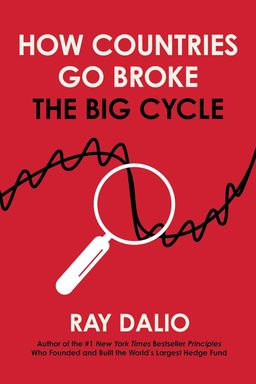
How can you anticipate the biggest economic, political, and market turns of your lifetime? In this book, Ray Dalio argues that you can read history as a set of repeating mechanics—especially the Big Debt Cycle—and as the interaction of five giant forces: debt/money, internal political order, international order, acts of nature, and technology. He contends that the economy works like a machine run by credit and debt, that short six-year business cycles stack up into ~80-year Big Debt Cycles, and that late-stage debt excess inevitably forces countries to choose between painful austerity/default or money printing/devaluation.
Dalio’s core claim is practical: if you learn the archetypes—how debt accumulates, how monetary regimes evolve (MP0–MP3), how crises tend to unfold in nine steps, and how to measure sustainability with a few key ratios—you can see what’s coming and prepare. He backs the framework with case studies (Japan’s multi-decade stagnation, China’s rapid rise and current deleveraging, the U.S.’s late-cycle fiscal trajectory) and offers policy fixes (a 3% deficit target via a three-part plan) along with investor playbooks. (Note: Dalio’s approach builds on his Principles series and his historical dataset, similar in spirit to Kindleberger’s Manias, Panics, and Crashes and Minsky’s financial-instability hypothesis.)
The machine: promises, money, and credit
At heart, money and credit are promises. Credit creation boosts spending, incomes, and asset prices; over time, promises outgrow the ability to deliver, and servicing costs squeeze the economy. Policymakers then face a fateful fork: let debtors default (deflationary pain) or print money (inflationary pain). Historically, leaders often print. That choice shapes the endgame of Big Debt Cycles and the fate of currencies and bondholders.
Core principle
“A debt is a promise to deliver money. A debt crisis occurs when there have been more promises made than there is money to deliver on them.”
The Big Debt Cycle and regimes (MP0–MP3)
Dalio maps a six-stage archetype from Sound Money → Debt Bubble → Peak → Deleveraging → Big Deleveraging (restructuring + monetization) → Return to Sound/Hard Money. Monetary regimes change accordingly: MP0 (linked to gold/hard money), MP1 (fiat with rate control), MP2 (QE/monetization at the zero bound), and MP3 (coordinated fiscal deficits + monetization). You should learn the markers of regime shifts: runs on reserves (MP0 stress), rates at zero (MP1 limit), balance-sheet explosions (MP2), and direct fiscal-monetary coordination (MP3). These transitions are not academic—they dictate which assets hold value.
Price mechanics: $/Q over supply-demand curves
Dalio reframes price as P = $/Q—total dollars spent divided by total quantity sold. If $ (money + credit) jumps faster than Q (capacity), prices rise broadly (“all boats rise”). This lens helps you interpret why large-scale QE lifts many asset prices together and why late-cycle inflation appears when $ expands into tight capacity. It also offers a simple forecasting heuristic: if $ growth slows while Q holds, prices fall by a similar magnitude.
Risk measurement and the nine-step crisis sequence
You evaluate sustainability using four ratios—debt/revenue, debt service/revenue, interest minus nominal growth, and debt relative to savings/reserves—and track long-term vs short-term risk gauges (think “heart attack risk” versus the attack actually happening). As debt builds, flows falter, and private buyers balk, countries typically follow a nine-step sequence from private distress to government monetization, restructuring, and eventual re-anchoring of the monetary order. The “beautiful deleveraging” balances deflationary restructuring with inflationary printing to reduce real burdens without depression or hyperinflation.
Five forces and where we are now
Debt/money dynamics interact with domestic polarization, great-power rivalry (notably U.S.–China), acts of nature (e.g., pandemics, climate shocks), and technology (AI, chips) to produce regime shifts. Dalio argues we are late-cycle (Stage 5): high debts, sharper domestic conflicts, fraying multilateralism, more shocks, and rapid tech change. That conjunction amplifies volatility and raises the odds of big transitions within a decade.
Cases, solutions, and what you can do
Japan shows the cost of delay (zombie loans, late restructuring, decades of malaise; post-2013 monetization aided growth but hurt bondholders versus USD and gold). China shows a rise built on reform and export surpluses now facing a property and local-government debt reckoning alongside tighter politics. The U.S. shows high long-term debt risk (elevated Z-scores on borrowing needs and debt service), even if short-term risk looks contained for now. Dalio’s prescription: a 3% of GDP deficit cut via three levers—modest spending cuts, modest tax increases, and lower real rates—phased over three years with monetary support; plus structural moves (mark public assets to market, consider a sovereign wealth fund, even explore a U.S.-backed stablecoin).
For you as an investor or policymaker, this framework is a map and a checklist. Identify the regime; measure sustainability with the four ratios; watch auctions and reserve flows; track polarization and U.S.–China signals; factor in climate shocks and AI advances. Then prepare both offense (opportunities in technology and real assets) and defense (diversification, inflation hedges, liquidity) for fast-moving, late-cycle terrain. (Note: Dalio’s emphasis on mechanics complements narrative histories; his edge is turning century-scale patterns into practical, monitorable indicators.)