
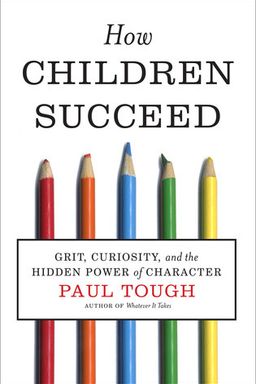
How Children Succeed cover

How Children Succeed

by Paul Tough

Explore the hidden power of character in ''How Children Succeed'' by Paul Tough. This insightful book reveals how traits like grit and curiosity, supported by nurturing parenting, play a pivotal role in a child''s success. Discover practical strategies to help children overcome obstacles and thrive in life.

Character, Resilience, and the Real Roots of Success

Why do some children thrive despite poverty and trauma while others struggle even with privilege? In How Children Succeed, Paul Tough argues that success depends less on early cognitive ability and more on character—qualities like resilience, curiosity, self-control, and optimism that govern how we respond to difficulty. Tough challenges the long-dominant “cognitive hypothesis,” which held that IQ, vocabulary, and academic drilling are the key to upward mobility. He reframes achievement through biology, psychology, and sociology: how stress shapes development, how caring relationships heal, and how institutions can cultivate persistence and purpose.

Beyond IQ: The Character Hypothesis

For decades, policymakers pushed early academic interventions based on studies like Hart and Risley’s “30-million-word gap,” which linked early vocabulary exposure to later success. Programs such as Kumon and Baby Einstein embodied the belief that more instruction equals better outcomes. But empirical puzzles—like James Heckman’s GED analysis, showing that GED recipients behaved like dropouts despite equivalent test scores—forced a rethink. The Perry Preschool study revealed that even when IQ gains faded, children benefited in employment, crime reduction, and health. Tough and Heckman concluded that noncognitive traits drive these long-term gains.

Stress, Biology, and the Hidden Cost of Adversity

To understand why poor children struggle beyond academics, Tough explores the biology of adversity. The Adverse Childhood Experiences (ACE) study showed that chronic stress—abuse, neglect, instability—disrupts the HPA axis, flooding the body with cortisol and creating “allostatic load.” This leads to physical illness and impaired learning. Pediatrician Nadine Burke Harris illustrates how trauma literally embeds itself in the body: trembling, insomnia, and anxiety stem from biological wear-and-tear. Poverty, in this model, becomes a physical state. You can’t drill your way out of toxicity; you must buffer it through stable relationships and environments.

Attachment as Biological Repair

Tough draws on Michael Meaney’s and Mary Ainsworth’s studies to show that sensitive caregiving can rewire stress biology. Rat pups raised by attentive mothers develop calmer, more resilient stress responses; cross-fostering proves nurture over nature. Human equivalents appear in attachment studies: securely attached infants become more self-regulated and socially competent decades later. Interventions like Mary Dozier’s Attachment and Biobehavioral Catch-Up (ABC) and Alicia Lieberman’s child–parent psychotherapy teach caregivers responsiveness and sensitivity, normalizing children’s cortisol rhythms and reducing behavioral problems. Caring parenting is not sentimental—it’s a biological intervention.

Teaching Character, Not Just Content

Schools like KIPP and Riverdale illustrate how education can cultivate character. KIPP teaches grit and self-control through structured habits (SLANT, character report cards) to help low-income students persist. Riverdale, serving affluent students, aims to instill productive failure and resilience against entitlement. Both borrow from Martin Seligman’s and Christopher Peterson’s taxonomy of virtues—curiosity, zest, optimism—and Angela Duckworth’s grit research. Yet as Tough notes, the lesson isn’t moral preaching; it’s practice. Adults must create experiences where students learn to fail constructively, recover, and reflect.

Building Habits and Identity

Character rests on both biology and habit. Walter Mischel’s marshmallow experiment and Gabriele Oettingen’s Mental Contrasting with Implementation Intentions (MCII) show that success relies on concrete self-regulation strategies: visualization, if/then planning, and routines. Conscientiousness—the tendency to “try hard even when unrewarded”—predicts life outcomes as strongly as IQ. Tough adds that identity and mindset matter: Claude Steele’s stereotype-threat research and Carol Dweck’s growth-mindset theory prove that belief in improvement fuels effort. Children internalize “I’m someone who works hard and improves,” not “I’m smart or dumb.”

Policy, Scale, and Systemic Reform

Individual grit must be supported by systems. Geoffrey Canada’s Harlem Children’s Zone (HCZ) demonstrates a cradle-to-college pipeline integrating parenting classes, charter schools, and community transformation. HCZ’s principle: when behaviors become the neighborhood norm, achievement accelerates collectively. Tough extends this logic to policy: typical teacher-quality reforms help moderately disadvantaged children but not the most vulnerable. The deeply at-risk need dense, coordinated supports—home visiting, trauma-informed care, executive-function curricula, and college-persistence programs like OneGoal. Only systemic, tiered investments can close generational gaps.

Core insight

Success grows not from early drills or innate genius but from the intersection of character, biology, and environment. To help children succeed, you must teach them to manage stress, connect deeply, think flexibly, and persevere in the face of setbacks. That reform begins not only in schools but in homes and public systems that nurture resilience from birth.


Stress and the Biology of Adversity

Tough invites you to see chronic stress as biology, not just hardship. Through the Adverse Childhood Experiences (ACE) study and neuroendocrine research, he explains how trauma reshapes children’s physiological systems. When stress responses remain permanently switched on, they impair immune, cardiovascular, and cognitive function—making it harder for children to learn or regulate behavior in school.

The ACE Study and Dose-Response Risk

Felitti and Anda’s survey of 17,000 adults revealed that two-thirds experienced at least one major childhood trauma. Those with multiple ACEs showed sharply increased risks of addiction, depression, heart disease, and suicide. Too much stress literally rewires the body. That’s why Nadine Burke Harris treats traumatized patients with both medical and psychological attention—like Monisha, whose panic and tremors reflect years of physiological overload. Tough shows that biology explains persistence of inequality across generations.

Allostatic Load and HPA Dysregulation

Chronic cortisol activation damages learning centers (the hippocampus and prefrontal cortex). Robert Sapolsky compares this to a fire department that answers too many false alarms—eventually, the trucks themselves break down. Children exposed to violence or neglect face both emotional uncertainty and bodily harm. They struggle with attention, working memory, and impulse control—core academic competencies that depend on stable neurochemistry.

Implications for Schools and Policy

You can’t treat poverty solely with tutoring. Stress-informed approaches must intervene early and integrate social, biological, and educational care. Calm classrooms, counseling, and predictable routines counteract threat responses. This science reframes the mission: education becomes emotional regulation plus instruction. (Note: Burke Harris’s later work proposes ACE screening in pediatrics—the next frontier of integrated policy.)

Takeaway

When you encounter disruptive behavior, see the biology behind it: stress reshapes the brain. Healing requires secure relationships and environments that let the body stand down from constant alarm.


Attachment and Emotional Security

Tough’s second biological pillar is attachment—the deep emotional bond between caregiver and child that shapes stress regulation and executive function. Sensitive parenting, he explains, is not a luxury; it is a biological buffer that determines whether adversity becomes toxic or tolerable.

From Rodents to Humans

Michael Meaney’s studies demonstrated that rat pups groomed frequently by their mothers showed lower stress responses. Cross-fostered pups mirrored the behavior of their adoptive mothers, proving environment over genes. The same biological mechanism—epigenetic switching—appears in maltreated humans, showing that parental care changes gene expression related to stress control. Sensitive caregiving literally turns protective genes on.

The Minnesota Attachment Study

Mary Ainsworth’s Strange Situation and Sroufe’s Minnesota longitudinal project tracked infants through adulthood. Securely attached children became socially skilled, academically successful, and more resilient. To Tough, this proves that emotional security outweighs early IQ gains. Resilience thrives when children feel consistently safe and valued—conditions often missing under chronic poverty or chaotic caregiving.

Interventions That Heal

Mary Dozier’s Attachment and Biobehavioral Catch-Up (ABC) and Alicia Lieberman’s child–parent psychotherapy show that attachment can be taught. Short coaching programs for foster parents normalized children’s stress hormones and increased attachment stability. Tough’s scene of a home visit—Jacqui and baby Makayla—illustrates how modeling responsiveness transforms mother–child interactions. Such interventions rival academic programs in long-term impact.

Key message

Caring relationships are neurological medicine. When you help parents attune to children’s signals, you are not just improving behavior—you are modifying the very biology of resilience.


Teaching Grit and Character in Schools

Tough’s exploration of education focuses on schools that intentionally teach character. KIPP Academy and Riverdale Country School stand at opposite ends of the socioeconomic spectrum but share a central goal: helping students develop the ability to persist, regulate emotions, and recover from setbacks.

The Character Taxonomy

Influenced by Martin Seligman and Christopher Peterson, educators classify virtues into performance traits (grit, optimism, curiosity) and moral traits (honesty, empathy). Angela Duckworth’s grit concept operationalizes perseverance—quantifiable through self-report scales. At KIPP, teachers turn these values into teachable skills via structured routines (SLANT) and feedback. Students earn “character report cards,” measuring behaviors alongside grades.

KIPP and Riverdale: Different Challenges

For KIPP’s low-income students, grit compensates for structural instability. For Riverdale’s affluent students, self-regulation counters overprotection and entitlement. Dominic Randolph found that wealth often shields children from failure, weakening persistence. Both contexts prove that character must be practiced, not preached.

Grit in Practice

Duckworth’s studies at West Point and the National Spelling Bee show grit predicts who endures long, difficult tasks. KIPP’s founders realized this after seeing college persistence lag despite strong test scores. To graduate, students needed optimism and commitment, so they learned routines to manage frustration and seek help. (Comparable to Carol Dweck’s growth-mindset work, grit reframes effort as identity.)

Essential point

Teaching character succeeds when schools create structured opportunities to fail safely, reflect honestly, and practice perseverance—habits that transfer well beyond academics.


Self-Control, Habits, and Motivation

Character formation depends on everyday self-control. Tough synthesizes psychological research on how people resist temptation, sustain motivation, and translate goals into action. He moves from Walter Mischel’s famous marshmallow experiment to Gabriele Oettingen’s Mental Contrasting with Implementation Intentions (MCII) and William James’s philosophy of habit.

From Marshmallows to Mental Contrasting

Mischel’s delayed-gratification test linked willpower to lifelong outcomes, but he found that strategy—not innate restraint—matters most. Successful children distracted themselves or reframed temptation. Later, Duckworth confirmed that self-discipline predicts grades better than IQ, yet motivation is the missing link; discipline without desire fails. MCII bridges that gap by pairing visualized goals with concrete if/then rules—for example, “If I feel lazy, then I’ll set a timer for ten minutes.”

Habit as Character

William James viewed virtue as habit made automatic. Routines reduce decision fatigue and strengthen persistence. KIPP’s rituals, morning mantras, and check-ins exemplify this behavioral engineering. As cognitive–behavioral practices spread through schools, students learn to slow down reactions, notice thoughts, and substitute better choices—replicating therapy principles in classrooms.

Motivation and Identity

Tough connects self-control to conscientiousness, identity, and mindset. Experiments by Carmit Segal show that effort, not raw ability, differentiates performers on dull tasks—a hallmark of conscientiousness. Claude Steele’s stereotype-threat findings and Carol Dweck’s growth mindset prove that identity beliefs shape motivation. Children who see themselves as learners who improve, not innate talents, act accordingly.

Actionable idea

Help students craft concrete routines and if/then plans rather than vague resolutions. Make perseverance habitual so effort feels automatic—even during stress.


Systemic Solutions and Policy Design

Tough concludes by expanding character from individuals to systems. Success requires environments that sustain resilience—from home-visit programs and trauma-informed schools to large-scale projects like Geoffrey Canada’s Harlem Children’s Zone (HCZ) and Jeff Nelson’s OneGoal initiative.

Harlem Children’s Zone: Neighborhood Transformation

HCZ integrates education, parenting, and health within a defined geographic area. Parenting workshops teach early attunement, Promise Academy offers rigorous schooling, and community centers promote positive norms. Canada’s idea: create a tipping point where successful behaviors become cultural default. Tough sees this as the prototype of population-level resilience—turning character development from isolated success stories into collective change.

OneGoal and College Persistence

Jeff Nelson’s OneGoal complements HCZ with a classroom-level model. Each teacher mentors the same students for three years, combining ACT prep with leadership training in resourcefulness, ambition, integrity, and professionalism. OneGoal’s pilot showed 84% college persistence among at-risk Chicago students, demonstrating how sustained adult mentorship translates noncognitive training into college success.

Policy and Tiered Interventions

Tough argues that teacher-quality reforms alone can’t overcome trauma. For the most vulnerable children—those in the bottom tenth of adversity—you need layered services: home visiting, pediatric counseling, and long-term educational supports. Heckman’s economic models show that early noncognitive investments yield the highest returns in adulthood. (Think of this as merging neuroscience with public policy.)

Final insight

Real equity demands systemic design that cultivates character and buffers stress from infancy to college. Tough’s lesson: if resilience is teachable, it must also be scalable.

Dig Deeper

Get personalized prompts to apply these lessons to your life and deepen your understanding.

Go Deeper

Get the Full Experience

Download Insight Books for AI-powered reflections, quizzes, and more.