
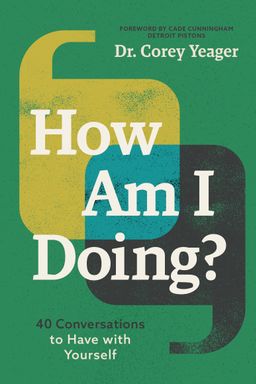
How Am I Doing cover

How Am I Doing

by Corey Yeager

How Am I Doing? invites you to engage in 40 transformative conversations with yourself. Each question is a stepping stone toward mending your inner self and discovering the path to your ideal future. Through introspection, gain clarity, confidence, and the tools necessary to shape your life as you envision.

The Power of Self-Awareness and Inner Conversation

When was the last time you asked yourself, “How am I doing?” Not the polite version you toss off to others, but the deep, soul-level question that stirs both curiosity and discomfort? In How Am I Doing?: 40 Conversations to Have with Yourself, Dr. Corey Yeager, well-known psychotherapist for the Detroit Pistons, invites you to turn that simple question into a transformative life practice. He argues that the quality of your relationship with yourself determines the quality of your life—and that self-awareness, vulnerability, and honesty are the foundation of genuine growth.

Dr. Yeager insists that we often outsource understanding of ourselves to others—friends, partners, mentors—forgetting that no one has more insight into us than we do. The book’s central argument is that deep self-conversation—through journaling, mirror work, visualization, and intentional reflection—can restore power, clarify values, and unlock your ‘genius,’ that inner distinctive ability unique to every person.

Awareness as the Root of Growth

At its core, Yeager’s philosophy is rooted in awareness. Drawing from his background in narrative-solution focused therapy, he likens personal change to digging out the roots of dandelions rather than mowing them down. In other words, surface-level fixes—like positive affirmations or quick hacks—don’t last. To transform your life, you have to get to the subterranean systems that keep unhealthy habits alive. That means tracing behaviors back to formative experiences, family patterns, and the stories you tell yourself.

Dr. Yeager weaves his own story through these lessons: losing his father at fifteen, stumbling academically after his football career, eventually finding his purpose in therapy and academia. Each story demonstrates the same principle: insight arises in the act of questioning and storytelling. When you start telling your own story—honestly, vulnerably, and curiously—you begin to write a new one.

Conversation as Therapy

Yeager’s sessions with NBA players provide the backdrop for his conversational tone. He teaches that therapy is less about advice and more about joint exploration. “Conversation is like a playground,” he writes: a space for curiosity, laughter, honesty, and sometimes tears. This metaphor carries throughout the book. The ‘playground’ isn’t always fun—it’s where self-confrontation and accountability happen—but it’s also where creativity and freedom emerge.

Each of the forty “conversations” in the book—ranging from “Who is the most important person in your life?” to “What mistakes have you learned the most from?”—acts like a doorway into new inner dialogues. Yeager shows readers how to talk with themselves the way he coaches professional athletes: with compassion, directness, and humor. Through practices like journaling, visualization, and mirror work, readers learn to build an inner dialogue based on truth rather than self-deception or doubt.

The Why Behind the Method

Yeager’s argument sits within a growing movement in psychology that prioritizes narrative, mindfulness, and internal systems of awareness (echoing frameworks from Carl Rogers to Internal Family Systems Therapy by Richard Schwartz). You can’t grow, he insists, without looking inward to examine what parts of you are speaking. Are you responding from your “core self” or from an outdated script inherited from childhood?

For Yeager, this internal excavation also has a cultural dimension. As a Black man working within predominantly white institutions, he explores W.E.B. Du Bois’s idea of “double-consciousness”—navigating between multiple cultural identities while staying rooted in integrity. His mission, and the book’s invitation, is to find harmony among your many selves without losing your core.

Themes that Resonate Beyond Therapy

Throughout the book, Yeager revisits recurring themes: vulnerability as strength, presence as power, joy as a choice, and forgiveness as freedom. He presents mental health work not as a sterile, clinical act but as a living, dynamic conversation that happens everywhere—from a locker room to a kitchen table. “We stumble into magic,” he writes, when awareness and curiosity meet.

Ultimately, How Am I Doing? is a conversation about authorship—how to reclaim your pen from other people’s hands. Yeager challenges you to define your values, clarify your non-negotiables, find your unique genius, and build resilience through laughter, grace, and meaningful relationships. Whether you’re reimagining your dreams, mending past wounds, or seeking daily intentionality, this self-dialogue becomes a radical act of self-respect.

"If you stay curious about yourself, you’ll realize you already have the answers you’ve been asking others for."

In this way, Yeager positions inner reflection not as self-absorption but as a blueprint for relational, professional, and spiritual wholeness. The more deeply you converse with yourself, the better you can converse with—and contribute to—the world.


Becoming the Author of Your Story

Dr. Corey Yeager asks a deceptively simple question early in the book: Who is writing your story? Most people, he argues, allow others—parents, teachers, society—to dictate the plotlines of their lives. But you can’t thrive until you pick up the pen and take authorship over your own narrative. This idea isn’t just poetic; it’s psychological empowerment in action.

From Failure to Authorship

Yeager’s story begins on the football field. After years of training to become a professional athlete, he made it to the NFL draft—only to be left unpicked. The failure shattered the narrative others had written for him: “You’re going to be a Kansas City Chief.” But this ending became a beginning. That painful gap between who he thought he was and who he could become opened the door to curiosity—and eventually led to academia, therapy, and a career helping others author their stories.

The heart of authorship lies in awareness and agency. You must first become aware of the narratives you’ve internalized—those unconscious plotlines that keep you living small—and then exercise your power to redirect them. In Yeager’s phrase, “You are condemned to be free,” quoting philosopher Jean-Paul Sartre: you may fear freedom, but you cannot escape it. Every day is a blank page, and every decision a sentence.

Practicing Narrative Ownership

Using a method inspired by narrative therapy, Yeager encourages you to shift from being a passive character to an active author. This means questioning the origins of your values, rewriting limiting beliefs, and creating new frameworks for identity. For instance, if you’ve been cast as the “reliable caretaker” or “underachiever,” it’s time to ask: Is that really who I am—or a role someone handed me?

An accompanying exercise asks readers to draw circles representing their different identities—parent, friend, leader, artist—and observe overlap and imbalance. Are any circles missing? Any dominating others? This visual storytelling becomes a map toward authorship. As you review it, you begin to recognize how roles either strengthen or dilute your essence.

Learning Through Dissonance

Yeager doesn’t shy away from conflict or mistakes—in fact, he frames them as editorial tools. Cognitive dissonance, he writes, is like musical tension: it sounds unpleasant, but it’s essential for harmony. When he and his wife, Carrie, debated how to discipline their children, the “battle” forced them to unearth buried values and forge a new joint narrative. Likewise, your inner battles—doubts, disagreements, revisions—are the forge of self-authorship.

Yeager’s approach aligns with Viktor Frankl’s Man’s Search for Meaning: you can’t control every circumstance, but you can always choose your response. Even when life edits your script unexpectedly, you can still choose the tone and trajectory of your next chapter. Authorship isn’t about perfection—it’s about persistence in telling the truth of your becoming.

"Every job I have today is the result of failure combined with curiosity—a dangerously fantastic combination."

The invitation, then, is clear: authorship means staying aware, facing dissonance head-on, and embracing curiosity. When you own your story, you move from surviving your past to creating your future.


Finding Your Genius and Essence

Everyone has a genius, Dr. Yeager claims—not just Einstein or Mozart, but you, too. Genius, he reminds us, didn’t always mean high IQ. Its original Latin meaning was “innate spirit” or “distinctive character.” Your genius is the thing that comes naturally and fills you with energy when you do it. And discovering it can change the course of your life.

The Origin of Genius

Growing up in Arkansas City, Kansas, Yeager lived within a strong African American collectivist community that operated as an extended family. Through the warmth of his “uncles” and “aunts,” he developed a relational genius: the ability to connect, mediate, and foster belonging. He recalls that his essence as a connector—his natural role—has guided every success he’s had, from football captain to team therapist.

By tracing his origins, Yeager models how you can identify your essence: look at what qualities have persisted through all your environments. Maybe you’ve always brought humor to tension, or turned chaos into order. That’s your fingerprint on the world, and understanding it helps you orient your choices around authenticity rather than imitation.

Flow, Passion, and Practice

Yeager links genius to psychologist Mihaly Csikszentmihalyi’s concept of flow—that state where you’re deeply absorbed in meaningful activity. Ask yourself: When do I lose track of time? What activities bring joy and purpose together? Once identified, the challenge is to use your genius in service of others. As Yeager says of his work with NBA players, “Knowing my genius allows me to use it to benefit others. That’s the best hope we have of making an impact.”

Crucially, essence and genius exist alongside limitation. Yeager admits he’s visionary but not detail-oriented; his wife balances him with precision. This partnership illustrates how essence thrives when recognized rather than resisted. By leveraging strengths and seeking complementary allies, you transform potential weaknesses into collaborations that enrich your genius.

"We see what we are because of the contrast to what we are not."

In the end, finding your genius means aligning your daily actions with your essence. It’s not about being extraordinary in someone else’s story—it’s about fully inhabiting your own, where joy and service intersect. You uncover this truth not through external validation, but through presence, curiosity, and courageous self-analysis.


Truth-Telling and Vulnerability as Freedom

Corey Yeager’s most radical message may be this: telling yourself the truth is the cornerstone of all transformation. Behind many of our challenges, he suggests, lies a subtle dishonesty—a story we tell ourselves to avoid fear. Whether it’s “I’m not smart enough,” “I have no choice,” or “Change is impossible,” these narratives keep us stuck.

Facing Untruths

For years, Yeager believed he was “only” a physical person, defined by strength and action. Returning to school in his thirties shattered this lie. With his wife’s encouragement, he realized intellectual life wasn’t foreign—it had always lived inside him. Studying community psychology gave him the vocabulary for the intuitive systems thinking he was already doing. “Being defined solely by my physical stature was a deeply rooted untruth,” he writes. Letting go of that story opened his future.

Breaking free from self-deception is uncomfortable because it demands vulnerability. You must confront not only what’s false but why you’ve clung to it. Sometimes we prefer limitation to liberation—it feels safer. But Yeager reframes vulnerability as the path to freedom. Like Brené Brown (whose research he references), he argues that admitting weakness is actually a sign of courage and maturity, not shame.

The Practice of Honesty

Yeager’s method for truth-telling involves what he calls the mirror: physically looking at yourself and conversing honestly. The mirror becomes a therapist, a confessor, and a companion. Before making decisions, he often asks his reflection simple questions—What are you afraid of? What would a truer choice look like?—and listens to the instinctive answers that surface before rationalization kicks in.

In practice, vulnerability also requires external support. Yeager urges you to assemble a “Supreme Court”—a small group of truth-tellers who challenge your perceptions kindly but firmly. Just as his mother refused to let him abandon a difficult college decision, these people remind you to make your choices right, not obsess over making the right choice. Vulnerability spreads through community, not solitude.

"You can’t grow without honesty, and honesty requires courage. It might hurt, but that’s the pain of becoming free."

By embracing vulnerability as freedom, you stop avoiding the unknown corners of your life. Yeager calls this courage “staying in the playground”—remaining curious, even when the game gets tough. The result is integration: the end of living half-truths and the beginning of genuine self-respect.


Intentional Living and Present Awareness

Intentionality, for Yeager, is the difference between reacting and living deliberately. Life may throw chaos your way, but you always have agency over your response. Borrowing from mindfulness psychology and sports metaphors, he teaches that intentional living means aligning thoughts, feelings, and actions with your values—like stepping back from the free-throw line to reset before taking the next shot.

The Practice of Pause

Every morning, Yeager takes a few minutes to review the previous day and set a daily intention—sometimes on paper, sometimes in the shower where reflection feels natural. He suggests finding your own immovable ritual. Maybe it’s your commute, your first cup of coffee, or three mindful minutes before sleep. These small anchors root your awareness in the present and remind you that you always have the power to choose your next move.

Athletes use similar moments of reset: one of Yeager’s players practiced lowering his heart rate by 20 beats in 23 seconds before a free throw. The takeaway? Conscious micro-moments matter. Even under pressure, intention can refocus your body and mind, reclaiming control from anxiety or distraction.

Balancing Aspiration and Acceptance

Intentional living also means accepting that not everything is within your control. When setting goals—graduating, securing a promotion, repairing a relationship—Yeager urges you to separate internal responsibilities from external outcomes. Control what you can: your energy, your humor, your focus. Then trust life with the rest. This approach, reminiscent of Stoic philosophers like Epictetus, transforms anxiety into calm productivity.

"Bring the ball into your court—because that’s where you can win."

Intentionality, ultimately, is presence plus purpose. It’s learning to pause, breathe, and act from your whole self rather than from impulse. Whether you’re meditating, leading a team, or chatting with your kids at bedtime, you have 23 seconds—or less—to decide who you will be in that moment. That’s enough time to change your day, and over time, your life.


Healing, Grace, and Generational Continuity

In the closing chapters of How Am I Doing?, Yeager turns his lens toward healing—not as an endpoint, but as a generative flow. Healing, he says, is an act of grace: a process of truth-telling, forgiveness, and compassion that keeps you in motion like a river rather than stagnant like a pond.

The Process of Healing

Healing begins with awareness that pain is part of growth. When we avoid it, we stay stuck; when we face it, we metabolize it into wisdom. Yeager shares candidly about loss—his father’s death when he was fifteen, his sister Sharon’s recent passing—and how silence around grief taught him what not to repeat. As an adult, he broke that generational silence by holding open conversations about death and love, transforming inherited pain into renewed connection.

This cycle echoes African wisdom traditions like sankofa, which Yeager invokes: “always moving forward, yet also looking back.” Healing isn’t forgetting; it’s integrating the past so you can flow forward with honesty and gratitude. Forgiveness—especially of yourself—becomes the bridge between the past and the present self.

Grace as Movement

Yeager’s final metaphor—the river versus the pond—captures his vision for a healed life. A pond grows stagnant, retaining poison; a river keeps flowing, transforming even toxicity into renewal. Movement, then, is not endless striving but staying psychologically and spiritually fluid. “We must be rivers,” he writes. “Continuously regenerating, going with the flow.”

Grace allows you to keep that flow. It’s the willingness to cover yourself with compassion the way you’d tuck in a sleeping loved one with a blanket. In Yeager’s closing reflection, he urges you to lay that same blanket of grace over yourself—to forgive mistakes, honor pain, and continue moving forward with curiosity. Healing doesn’t erase scars; it softens them into remembrance.

"Movement gives clarity. Movement gives moments of discovery. Be a river, not a pond."

Healing, for Yeager, completes the loop of self-awareness. It honors your past, frees you in the present, and prepares you to gift that freedom to others. As your story continues, grace ensures it flows—not with perfection, but with purpose and peace.

Dig Deeper

Get personalized prompts to apply these lessons to your life and deepen your understanding.

Go Deeper

Get the Full Experience

Download Insight Books for AI-powered reflections, quizzes, and more.