
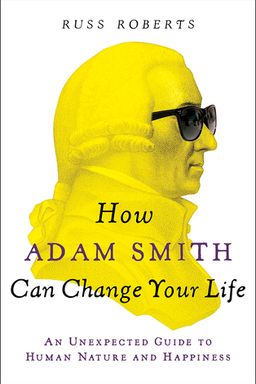
How Adam Smith Can Change Your Life cover

How Adam Smith Can Change Your Life

by Russell "Russ" Roberts

How Adam Smith Can Change Your Life explores timeless insights from Adam Smith''s lesser-known works, offering practical guidance on achieving happiness and virtue. Russ Roberts revives Smith’s philosophy to improve personal relationships and inspire societal change, urging us to embrace wisdom and moral behavior.

Rediscovering Adam Smith’s Guide to the Good Life

What does it mean to live “the good life”? Is it money, success, or something deeper tied to our moral nature? In How Adam Smith Can Change Your Life, economist Russ Roberts resurrects Adam Smith’s forgotten masterpiece The Theory of Moral Sentiments to explore what happiness and virtue really mean. Roberts argues that Smith—the father of capitalism—was also one of the most profound thinkers about decency, empathy, and inner peace. His message: happiness depends not on wealth or fame but on being both loved and lovely—respected and worthy of respect.

A Hidden Classic with a Modern Message

Two centuries after its publication, The Theory of Moral Sentiments is largely forgotten. Most know Adam Smith as the economist who wrote The Wealth of Nations, the foundation of free-market capitalism. But Roberts reveals that Smith’s lesser-known book offers an unexpected map for understanding human nature and finding serenity. In this earlier work, Smith explores how morality arises, why we act kindly even when selfish incentives point otherwise, and how we navigate the tension between self-love and compassion—the same struggles we face today.

Economics Beyond Money

Roberts insists that economics isn’t just about wealth—it’s about choice. Every decision we make—what career to pursue, how to treat others, how much we value time—reveals what we give up for what we gain. By framing Smith’s ideas through modern anecdotes (his podcast interview, his daughter’s soccer games, his reflections on gadgets), Roberts shows that economics teaches humility toward complexity and reminds us that money seldom leads to happiness. True success, for Smith, lies in understanding the moral emotions that drive our relationships and self-respect.

Being Loved and Being Lovely

At the heart of Smith’s philosophy—and Roberts’s book—is the idea that we desire not only to be loved but to be lovely. We crave approval from others and want that approval to be deserved. Lovely people act honorably, generously, and humbly; they are admired because their inner selves match their public selves. The pursuit of loveliness, Roberts contends, is the antidote to our obsession with recognition. Fame and wealth may amplify attention, but genuine happiness comes from the harmony between who we are and who we aspire to be.

The Impartial Spectator: Your Inner Judge

To live wisely, Smith says we must cultivate our relationship with the “impartial spectator”—the imaginary, objective observer inside us who evaluates our actions without bias. This spectator represents conscience, empathy, and humility. It reminds you that the world doesn’t revolve around your needs (“the Iron Law of You”) and helps temper impulses that might lead to cruelty, vanity, or deceit. By imagining how others would see your actions, you learn to know yourself, to act justly, and to polish the moral mirror you hold to society.

Self-Deception and Self-Improvement

Roberts admits that self-deception—the mysterious veil that keeps us blind to our flaws—is humanity’s most fatal weakness. We naturally overestimate our virtue, justify our choices, and twist logic to maintain self-admiration. This insight connects Smith’s eighteenth-century psychology with modern behavioral economics (Daniel Kahneman’s work on bias and Nassim Taleb’s critique of overconfidence). Seeing through self-delusion is painful, but necessary: only when we drop excuses and face the impartial spectator honestly can growth begin.

Why Fame and Fortune Fail to Satisfy

Smith’s insight into happiness demolishes the belief that more money or popularity guarantees fulfilment. As Roberts shows through the stories of Peter Buffett, Bernie Madoff, and Lance Armstrong, external admiration without internal loveliness brings torment. Wealth and achievement may be pleasant, but chasing them at the cost of integrity breeds emptiness. We end up “loved but not lovely”—and that disconnect corrodes our peace. The real challenge is to align who we are privately with who we claim to be publicly.

Virtue and Civilization

Ultimately, Roberts draws Smith’s moral wisdom into a modern blueprint for living. The virtues of prudence, justice, and beneficence—taking care of yourself, not hurting others, and helping others—form the moral DNA of a functioning society. These traits, multiplied by millions, create trust, kindness, and emergent order: a world built not by top-down rules but by small acts of decency. Civilization, Smith believed, thrives on such spontaneous cooperation—the same invisible hand that guides markets also nurtures moral harmony.

Why It Matters Today

Roberts offers a simple but radical claim: modern life’s moral confusion—fueled by ambition, technology, and constant comparison—requires rediscovering Smith’s vision. Happiness is not accumulation but alignment; virtue is not naivety but wisdom. Reading Smith, Roberts says, helps us become better friends, leaders, spouses, and citizens. It reminds us to stop chasing applause and instead act as if the impartial spectator were watching. The result is not only personal contentment but a ripple effect that, quietly and cumulatively, makes the world a better place.


Knowing Yourself Through the Impartial Spectator

Roberts begins with one of Adam Smith’s most striking observations: we care more about losing a little finger than about millions dying far away. That uneasy truth exposes our self-centered nature, which Smith terms self-love. Yet Smith reveals that morality arises because we imagine an internal judge—an impartial spectator—watching our actions. When we ask, “Would a decent person do this?” we awaken that spectator. It guides us toward empathy and reminds us that instincts of selfishness can and should be tempered by consideration for others.

The Iron Law of You

Smith’s “Iron Law of You” says we think more about ourselves than others ever will. You can’t escape this bias—but you can correct it. The impartial spectator offers a mental vantage point from outside your ego. By imagining how others see your words, mistakes, or anger, you make room for humility. This technique works in the smallest daily irritations: Roberts recalls snapping at his wife over a schedule mix-up, then realizing, through his inner spectator, that he had misplaced his frustration. Stepping outside himself allowed him to apologize and restore calm.

Conversation as a Mirror

Even ordinary conversation reveals how much we center ourselves. We love to talk but rarely listen. Roberts learned, through podcasting, that his dialogues improved only when he spoke less and let guests shine. Listening for understanding—not waiting for your turn—is moral training. The impartial spectator becomes the silent listener inside you, judging whether you dominate or harmonize with those around you.

Beyond Compassion: Acting from Honor

Smith insists that kindness isn’t simply altruism; it often springs from the desire to live honorably. You do the right thing not just because you love others but because you love what is noble. This insight reshapes ethics into self-respect. Even anonymous generosity—tipping well at a restaurant you’ll never revisit—becomes rational because it affirms your loveliness. (Jonathan Haidt’s The Righteous Mind echoes this idea, suggesting our moral instincts are partly innate.)

Exercising the impartial spectator transforms ethics into self-awareness. You begin to “see yourself as others see you,” gaining both humility and peace. Smith’s moral psychology thus fuses empathy with dignity: the spectator within doesn’t just correct bad impulses—it teaches serenity through understanding your smallness in a vast world.


The Trap of Self-Deception

We all want to see ourselves as good, yet Adam Smith warns that we are masters of self-deception. Roberts explores this “mysterious veil” that blinds us to our own flaws, arguing that it is the source of half the disorders in human life. We distort reality to protect our self-image, convincing ourselves that selfish acts are benevolent or rational. From Joan Baez rationalizing her decision not to attend her brother-in-law’s funeral to politicians convincing themselves of noble motives, Roberts shows how the desire to be lovely can twist truth itself.

Fooling Yourself First

According to Smith, our emotions often overpower reason. In the heat of desire or anger, the “man within the breast” reports what the ego wants to hear instead of what reality shows. We act wrongly, then justify it as right. Afterward, we filter memory to sustain the illusion of virtue. This pattern mirrors modern psychology’s “confirmation bias,” described by Daniel Kahneman—our tendency to embrace evidence that fits our worldview and ignore what challenges it.

Seeing Others, Seeing Ourselves

Struggles with others reveal our flaws more clearly than mirrors do. Smith and the mystic Baal Shem Tov agree: when a neighbor’s impatience irritates you, it may be your own impatience you’re seeing. Observing others gives hints about your hidden motives. Roberts turns this into advice—use irritation as introspection. Ask what the impartial spectator would notice about your reaction.

Modern Bias and Humility

Roberts connects Smith’s insight to the fallacies of modern science and economics. Researchers often see the world through ideology; their selective vision mirrors our moral blindness. He cites the stock market pundits who explain every swing after the fact—illustrations of our narrative fallacy. We prefer tidy stories to uncomfortable complexity. The cure is humility: realizing, as Feynman said, “You are the easiest person to fool.”

Overcoming self-deception requires courage more than intelligence. Smith calls it surgery—removing the veil hurts but heals. When you admit “I don’t know,” you practice wisdom. Roberts’s takeaway: honesty about your limits is not weakness, but liberation.


Defining Happiness: To Be Loved and Lovely

Smith’s formula for happiness—“Man naturally desires not only to be loved but to be lovely”—is the book’s foundation. Roberts unpacks this deceptively simple line to show that joy emerges from integrity. To be loved means receiving respect and approval; to be lovely means deserving it. Happiness, therefore, isn’t bought or bestowed—it is earned through virtue and authenticity. It is the alignment between outer admiration and inner truth.

Authentic Versus Artificial Love

We can fool others into loving us, but not ourselves. Roberts contrasts Warren Buffett’s genuine loveliness with Bernie Madoff’s fraudulent image. Madoff was admired but knew he was a fraud. That gap between reputation and reality produced torment long before his arrest. Wealth without integrity traps you in dishonored love. Smith even suggests that undeserved praise is more mortifying than criticism—it reminds us of what we could have been.

Flattery and the Illusion of Love

Roberts illustrates Smith’s warning about “strategic flattery”—fake praise offered to gain advantage. The boss whose jokes suddenly become hilarious or the student who compliments a professor before an exam are examples of false love contaminating sincerity. We crave validation so deeply that we mistake manipulation for affection. Recognizing this urge protects dignity and truth.

Authenticity in Action

Living loveliness means aligning actions with values. In relationships, it means giving without keeping score. In work, it means choosing honesty over image. Roberts’s marital anecdotes and Peter Buffett’s choice to pursue music over millions embody the same principle: peace comes when your internal self matches your external actions. These examples echo modern calls for “authentic leadership” (as discussed by Brené Brown and others)—Smith articulated them centuries earlier.

The pursuit of being both loved and lovely doesn’t guarantee fame, but it promises serenity. When your conscience and reputation agree, you can rest easily, even without applause.


The Virtues of Prudence, Justice, and Beneficence

What does it mean to be truly good? Smith’s moral triad—prudence, justice, and beneficence—defines how to live with dignity. Roberts modernizes these virtues into practical guidance: take care of yourself, don’t harm others, and help others when you can. These aren’t lofty ethics; they are daily habits that turn love of virtue into a lifestyle.

Prudence: Caring for Yourself Wisely

Prudence means self-care guided by discipline. Smith’s prudent person guards health, money, and reputation without vanity. He listens more than he boasts, prefers sincerity to spectacle, and speaks simply rather than self-promotional “quackish arts.” Roberts compares this to modern advice for digital modesty—resist endless self-branding; replace “look at me” with “let others discover.” Prudence demands restraint: say little, do much.

Justice: Doing No Harm

Justice, Smith says, is the foundation of social trust. It’s not heroism—it’s refraining from injury or deceit. When we jostle others in the “race for wealth,” the game of life collapses into resentment. Justice requires steadfast adherence to fairness, even in small things—returning borrowed money on time, keeping promises, honoring contracts. Loosening these rules, Smith warns, opens the door to self-justified corruption.

Beneficence: Doing Good

Beneficence—the virtue of kindness—has no fixed rules. Its boundaries are “loose and indeterminate.” You must improvise generosity with judgment. Roberts applies this idea to charity: it’s easy to write a check; harder to know when and how to help meaningfully. A smile, attention to a child, or holding your kid’s offered hand may carry equal moral weight. Beneficence challenges you to act selflessly without demanding perfection.

These virtues combine into a moral equilibrium. Prudence keeps you stable, justice makes you trustworthy, and beneficence makes you kind. Together they form the architecture of loveliness—and the foundation of social peace.


Making the World a Better Place Through Emergent Order

Ironically, according to Smith, civilization thrives not because someone designs it but because countless decent choices accumulate. Roberts calls this phenomenon emergent order: the moral equivalent of the invisible hand. Just as markets coordinate billions of traders without a master planner, human decency evolves through feedback of admiration and shame. You don’t need a grand crusade to improve the world; small acts of trust, kindness, and honesty ripple outward into a culture of goodness.

Order Without a Planner

Roberts compares moral evolution to language. No one decided Google should be a verb or that men should stop wearing hats—social norms arise spontaneously. Likewise, civility and trust emerge because we naturally reward honorable behavior and censure dishonorable acts. Smith calls humans “vicegerents” of God—each of us an informal judge shaping morality through response. Civilization, therefore, is co-created daily by our micro-choices.

Trust as the Hidden Currency

Trust is the heartbeat of emergent order. Roberts’s story of renting a cabin and leaving payment on the table illustrates faith in strangers. When trust circulates freely, society functions smoothly; when it erodes—as in corrupt economies—prosperity collapses. Economists like David Rose echo Smith here: moral norms sustain markets better than laws ever could. Every time you honor a promise or repay kindness, you invest in this invisible bank of civilization.

Small Acts, Great Consequences

Smith’s insight transforms moral ambition. You don’t need to reform nations—just live decently. Your kindness encourages others; your integrity becomes silent legislation. Roberts cites the Talmud’s reminder: “It is not up to you to finish the work, but you are not free to desist from it.” Each lovely act generates ripples that, together, sustain the order we inhabit. Civilization’s greatest works—trust, empathy, respect—are unhistoric acts by everyday people who choose decency again and again.


The Danger of the Man of System

While emergent order shows how goodness spreads naturally, Smith warns against its opposite: the arrogance of the “man of system.” This visionary believes he can rearrange society like chess pieces, ignoring that each human has “a principle of motion of his own.” Roberts interprets this as a caution against top-down utopian engineering—from dictators like Stalin and Mao to well-intentioned policymakers misreading human nature. Trying to force perfection breeds suffering and disorder.

The Chessboard Fallacy

The man of system imagines he can control people’s desires. But legislation cannot erase natural impulses. Roberts applies Smith’s logic to modern policies—the war on drugs, for example, fails because it ignores human propensity to pursue pleasure and profit. Like squeezing a balloon, suppression just shifts behavior elsewhere. Systems work best when they respect autonomy and evolve organically, not when they treat citizens as lifeless pieces.

Small Fixes Over Grand Designs

Roberts argues that true reform is local and personal. Changing laws matters less than modeling integrity for your children or colleagues. Politics, like parenting, often backfires when it ignores free will—the sun persuades where the wind commands. The moral of Smith’s parable: sometimes, leaving people alone leads to better outcomes than coercion. Complex societies thrive through humility, not hubris.

For anyone tempted to remake the world overnight, Smith and Roberts prescribe patience. The better world grows from compassion, not control. Focus on your immediate sphere; the ripple will follow naturally.


Love Locally, Trade Globally

Roberts ends with a luminous synthesis of Smith’s two masterpieces. The Theory of Moral Sentiments teaches how to live honorably with those close to us; The Wealth of Nations explains how strangers cooperate through markets. Together they form a complete philosophy for modern life. To thrive, you must inhabit two worlds: one intimate and moral, the other vast and commercial. Love locally, trade globally.

Two Spheres of Life

The family, Roberts says, is a socialist paradise—built on unconditional care and equality. The market, by contrast, is impersonal but creative. The same self-interest that Smith described in commerce fuels innovation and prosperity. Trying to impose family-style equality on markets leads to tyranny (a point later echoed by F. A. Hayek). But separating the two spheres lets both flourish: affection governs home life, efficiency governs exchange.

The Miracle of Specialization

Smith’s second insight—specialization—explains why prosperity demands cooperation among strangers. You can’t thrive on a deserted island, no matter how skilled you are, without sharing work and trade. The more people connect through exchange, the more creativity blossoms. Roberts celebrates this invisible web of interdependence—from pencils to smartphones—as modern civilization’s forgotten poetry.

Reconciling Heart and Market

Some lament capitalism’s coldness; Smith saw its potential warmth. Commerce allows billions to improve each other’s lives without requiring mutual affection. Markets embody organized empathy: though traders seek gain, their actions serve others. The clever artisan, surgeon, or coder may act from ambition, but their self-interest—guided by prudence and justice—advances collective well-being. Recognize this harmony and gratitude replaces envy.

Roberts’s closing image, bidding goodnight to Adam Smith, seals the lesson. Modern joy lies not in rejecting markets or morality but in uniting them. Learn humility from the impartial spectator, decency from everyday exchanges, and wisdom from the invisible hand. In a world of strangers and screens, the ancient recipe still applies: be lovely where love matters most, and trust people enough to trade beyond sight.

Dig Deeper

Get personalized prompts to apply these lessons to your life and deepen your understanding.

Go Deeper

Get the Full Experience

Download Insight Books for AI-powered reflections, quizzes, and more.