
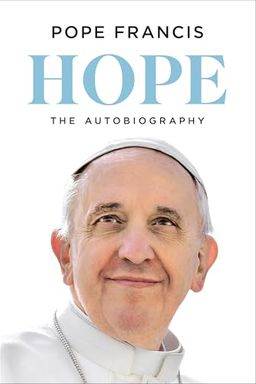
Hope cover

Hope

by Pope Francis With Carlo Musso

The late Pope Francis recounts details of his life from his childhood through to key moments of his papacy; translated by Richard Dixon.

Hope That Moves: Memory, Mercy, and Mission

How do you turn faith and biography into public courage? In this memoir-manifesto, Pope Francis argues that hope is not passive waiting but an active movement that fuses memory with utopia and blossoms into concrete mercy. He contends that you practice hope by walking—across oceans, barrios, borders, and bureaucracies—carrying the embers of memory into a future you dare to reimagine. To do so, you must learn to remember truthfully, to serve humbly, to encounter people at the margins, and to resist the logic of war and weapons with the patient architecture of peace.

Across the book, you witness how an immigrant family story in Buenos Aires becomes a moral grammar for global leadership. The Bergoglios’ ticket exchange that spared them the fate of the SS Principessa Mafalda; the gritty start of Almacén Bergoglio with a 2,000-peso loan from Father Enrique Pozzoli; the author’s sudden call on September 21, 1953 in San José de Flores; the disciplined Jesuit novitiate that trained gratitude and attention; clandestine interventions during Argentina’s dictatorship; and pilgrimages to Lampedusa, Redipuglia, Hiroshima, and Nagasaki—these memories form a school of hope that never stays still.

Memory and utopia in creative tension

Francis reframes recuerdo as a present that keeps passing through you. Memory is fuel, not nostalgia: it links the soil of Portacomaro to the streets of Flores and keeps family gratitude alive (“why not me?” after the Mafalda disaster). Utopia is not fantasy but a horizon that pulls you forward (compare Ernst Bloch’s “principle of hope”). You do not wait; you move. Small acts—opening a shop, visiting the sick, crossing a sea—make hope visible and contagious.

Mercy as method and identity

The core spiritual experience—Caravaggio’s Calling of Saint Matthew and the motto “miserando atque eligendo”—teaches that you become yourself by being forgiven and chosen. Mercy is not sentiment; it’s a method. You accompany people (the seven children of a poor widow), bless those who ask for God’s help (Fiducia supplicans), and distinguish persons from situations. Leadership becomes service: live at Santa Marta, keep the blue Ford Focus, and let symbols align with mission.

The culture of encounter

Hope grows in proximity. The Salesian oratory, Father Pozzoli’s pastoral ingenuity, Villa miseria priests, Pier Giorgio Frassati’s example, and volunteers at Lampedusa teach you to cross thresholds, listen first, and do small works of mercy that open political possibilities. Popular piety—processions, Marian devotions, a Native man reciting Saint Turibius’s catechism—becomes theology from below, a People of God breathing faith in everyday ways (note the “Theology of the People” current in Latin America).

From wounds of war to disarmament

The memoir threads World War I, the Sirio and Mafalda shipwrecks, and modern refugee drownings at Lampedusa into one moral map: war makes migrants, profits arm dealers, and robs the poor. Hiroshima and Nagasaki turn witness into principle. Arms are “thermometers of injustice”—resources siphoned from health and education to fuel “bad dreams.” You answer with remembrance, diplomacy, and budgets that heal.

Synodality, inclusion, and reform

Journeying together—synodality—means listening at all levels. Demasculinize structures: elevate Marian principles of care; appoint women to governance (Sister Raffaella Petrini, women at the Dicastery for Bishops). Replace clericalism with co-responsibility, share governance (Council of Cardinals), and let shame and gratitude ground reform instead of courtly pomp.

Youth, education, creation, and technology

Hope is biological medicine—expectation changes brains and bodies. Educate for centuries (Bauman), form minds, hearts, and hands, and let youth ask bold questions (Copacabana). Care for our common home; resist AI that hollows agency and floods minds with cognitive pollution. Think long-term: if weapons paused for a year, hunger could end; if we plant education now, future forests of mercy will grow.

Key idea

“Life is the art of encounter.” In Francis’s hands, encounter is how hope walks, memory speaks, mercy heals, and politics changes.

By the end, you see a single movement: from a family spared at sea to a Church sent to the peripheries; from a veteran’s trench memories to a pope’s plea for disarmament; from a shy teenager’s call to a leadership of humility; from tango, soccer, and laughter to a credible Christian joy. You are invited to walk the same path—remember, bless, encounter, and build peace in the ordinary.


Roots on the Move

Francis’s ethics of hope grows out of an immigrant story that teaches you to carry roots while moving. His grandparents, Giovanni and Rosa, left Piedmont on the SS Giulio Cesare on February 1, 1929, after a providential ticket exchange spared them from boarding the doomed SS Principessa Mafalda. That brush with catastrophe becomes a family examen: Why were we spared? How should we live now? Hope, here, is a decision to cross an ocean and begin again with the strength of what remains.

Rupture that preserves continuity

Migration uproots and re-roots. Nona Rosa arrives in humid Buenos Aires wearing a heavy coat lined with valuables—a portable treasury of memory. Port officials register them as migrantes ultramar with labels like comercio, casera, contador that reduce identity to bureaucracy. At home, dialects mingle: Piedmontese in the kitchen, Spanish in the street; Italian songs and Argentine tango stitch a hybrid belonging. You learn that identity is woven, not fixed, and that continuity can survive rupture when families guard memory.

Roots as strength, not anchors

Quoting Francisco Luis Bernárdez—“All that has blossomed on the tree / lives on that which holds it underground”—Francis reframes nostalgia as nourishing. He pockets soil from Portacomaro and keeps stories alive in Flores. These acts orient desire without paralyzing it. You can do the same: keep rituals, recipes, and languages alive so that children inherit both courage to leave and gratitude to remember (compare to Seamus Heaney’s “digging” with a pen).

Communities that scaffold reinvention

No migrant succeeds alone. The Salesian oratory, the Hotel de Inmigrantes, and kin networks (the Sívori relatives) provide jobs, loans, and moral support. Father Enrique Pozzoli baptizes the children and lends 2,000 pesos to start Almacén Bergoglio, a neighborhood grocery that becomes a microcosm of encounter. Institutions—however modest—turn survival into a social project. You are nudged to build such scaffolds for newcomers around you: mentorships, microloans, language circles, and parish kitchens.

Hybrid culture as moral classroom

The barrio is a school of coexistence: Italians, “Russians” (Jews), and “Turks” (Arabs) share markets, Carnival, and football pitches. Tango and soccer teach timing, teamwork, and neighborliness; Catholic devotions offer a common grammar for care. Out of this mosaic emerges a habit of dialogue that later shapes Francis’s interreligious encounters (e.g., Marian resonance with Muslims in Jakarta and Abu Dhabi). Your everyday culture—music, food, sport—can be catechisms of empathy.

Providence, gratitude, responsibility

The Mafalda near-miss functions like a family parable: saved lives carry obligations. Francis inherits a posture of grateful realism: fate’s mercies demand service. That sensibility colors later decisions—visiting Lampedusa to mourn drowned migrants, defending refugees at checkpoints, and advocating policies that treat migration as human dignity in motion rather than a problem to repel.

Practical takeaway

Preserve roots (stories, rituals, language), build bridges (community scaffolds), and reinterpret identity as a shared, evolving project. Hope doesn’t erase the past; it carries it across the sea.

By seeing migration as both wound and wisdom, you learn to honor the pain of departure and the creativity of arrival. The family’s small store teaches economy as care, the parish as kinship, and memory as the spark that keeps dreams alive when cash is scarce and accents are mocked. In that sense, the immigrant tale becomes a parable for the whole book: all is born to blossom, but only if you water roots while walking forward.


War’s Wounds, Peace’s Demands

Francis’s fiercest claims are about war and its machinery. You hear World War I through Nono Giovanni’s memories of the Piave and the Isonzo—absurd orders, comradeship across enemy lines, and 882 dead in his regiment. That personal testimony scales up to a moral axiom: war is folly, “the suicide of a continent” (Benedict XV). Its aftershocks—Nazism’s rise, poverty, resentments—seed new violence, migration, and social fragmentation.

From shipwrecks to Lampedusa

The book juxtaposes historic tragedies (SS Sirio, SS Frisca, SS Principessa Mafalda) with modern drownings off Lampedusa. The pattern repeats: conflict and structural injustice push people to perilous seas; richer nations respond with walls and “hostile architecture.” Francis’s 2013 visit to Lampedusa turns mourning into mission: to make the invisible visible, to say names, and to demand policies that serve life. You are asked to bridge compassion and policy—hospitality that scales.

Hiroshima, Nagasaki, and the moral nucleus

Francis draws energy from Father Pedro Arrupe’s witness in Hiroshima and from a single image he calls “The Fruit of War”: a boy carrying his dead brother to the crematorium after Nagasaki. He circulates this image as a handheld homily against nuclear logic. Weapons become “thermometers of injustice”—concentrating wealth and siphoning funds from health and education to arsenals that could destroy the earth many times over. Possession itself is an act against the future.

Remembrance as policy

Pilgrimages to Redipuglia and Hiroshima are not nostalgic; they are governance. Public memory restrains repeat offenses. Francis supports UN ceasefire efforts and argues that if weapons production paused, hunger could be eliminated—a rhetorical comparison designed to reset what you think “realism” means. Realism, he says, is caring for victims before budgets; anything else is fantasy dressed in security language.

Disarmament as a culture

You counter the arms economy by building a counter-culture: educate for peace, fund health over hardware, create humanitarian corridors, and practice grassroots reconciliation. Francis warns that armed societies breed “bad dreams,” turning children’s minds toward anger rather than tears. By contrast, communities that hold vigil, name the dead, and channel resources toward life cultivate a peaceable imagination (note affinities with John Paul II’s peace days and Dorothy Day’s works of mercy).

Moral claim

“The greatest producer of migrants is war—war in one guise or another.” Addressing migration without disarming conflict is treating symptoms while feeding the disease.

To live this chapter, you start small and argue big: advocate budgets oriented to health and education; support remembrance practices and museums; challenge local glorifications of violence; back treaties and verification regimes; accompany refugees whose lives are the receipts of our policies. Peace, in Francis’s vision, is not naïveté; it is the hard work of love armed only with mercy, memory, and organized courage.


Called by Mercy, Formed in Community

Francis’s vocation story is both sudden and slow. On September 21, 1953, in San José de Flores, he experiences a call so strong he says he “fell from his horse.” Yet he insists vocation ripens over years—through spiritual direction (Father Carlos Duarte Ibarra, Father Enrique Pozzoli), health crises (a lung operation in 1957), and a Jesuit novitiate that trains attention, humility, and service. You learn to expect flash and fermentation: a light that arrives quickly and a character that forms gradually.

Miserando atque eligendo

Caravaggio’s Calling of Saint Matthew becomes his theological mirror: God looks with mercy and chooses. Francis repeats, “I am a sinner”—not as theater but as identity. The forgiven become servants who resist triumphalism. Confession, gratitude, and concrete works of mercy become the daily grammar of priesthood. You are invited to locate your vocation in mercy received rather than talent displayed.

Formation as habit architecture

The novitiate’s rhythm—two daily examens, community prayer, shared work—turns virtue into muscle memory. Small courtesies (“please,” “thank you,” “sorry”) are treated as civic infrastructure. Mentors matter: Father Pozzoli baptizes the family and seeds the shop; Sister Cornelia Caraglio’s decisive care saves his life. Even painful corrections and humiliations are formative, sanding down pride and teaching resilience (compare to Ignatian pedagogy’s emphasis on review and repetition).

Humility that reforms leadership

Upon his election, Francis says he felt shame—a protection against self-importance. He rejects pomp: he keeps his episcopal ring, wears orthopedic shoes, lives at Santa Marta, and rides in a blue Ford Focus. These gestures are not branding; they are pedagogy: authority equals service. Governance follows suit—transparency with Benedict’s “white box,” a Council of Cardinals to decentralize decision-making, and a preference to be called “Bishop of Rome.”

A style that matches substance

Francis’s choices embody his message. He marries a couple mid-flight, asks bishops to redirect celebration funds to the poor, and plans simple funeral rites for himself. Shame, rightly received, keeps him near the ground; gratitude keeps him near his people. You can translate this into your context: interrogate honors, simplify habits, and align symbols with mission so that your life speaks before your words do.

Practice for you

Choose a daily examen, practice the three phrases, seek mentors who correct you, and pick one symbolic simplification that keeps your leadership honest.

This chapter convinces you that vocation is sustained by community and verified by style. Mercy kindles your call, formation stabilizes it, humility guards it, and concrete gestures transmit it. In Francis’s words and choices, you see a path you can walk: become the forgiven who serve, and let your habits do the preaching.


The Culture of Encounter with the Poor

For Francis, the Church is credible only if it smells like the sheep. He frames the Christian vocation around living with and for the poor—not as an ideological platform but as the method by which you and the Church become truly human. From nursing the sick in Córdoba to visiting shantytowns, from the Salesian oratory to the priests in the villas miserias, he turns Matthew 25 into a pastoral program you can practice today.

Proximity over abstraction

Father Pedro Arrupe’s line—“Only by being a man-or-woman-for-others does one become fully human”—anchors this ethic. You learn why direct contact with poverty matters: cleaning wounds, feeding patients, and seeing the raw mix of virtue and vice (like the flirting wife at a dying man’s bedside) puncture pious illusions and force moral clarity. Encounter begins in ordinary places: a neighbor’s shop, a parish hall, a hospital corridor.

Popular piety as theology from below

Guided by Father Miguel Ángel Fiorito and the Aparecida document, Francis honors popular religiosity—rosaries, processions, Marian feasts—as a locus of the Spirit. The faith of a Native devotee reciting Saint Turibius’s catechism in Salta becomes a doctoral seminar in dignity. You are challenged to learn faith as it is lived, not only as it is written (note: this aligns with the Latin American “Theology of the People,” distinct from but conversant with Liberation Theology).

Accompaniment and mercy

Francis’s pastoral practice privileges discernment over rule-keeping. He baptizes seven neglected children of a poor widow and patiently guides a Japanese economics graduate toward baptism. In Fiducia supplicans (December 2023) he authorizes non-ritualized blessings for people in irregular unions, clarifying that blessings are for persons seeking God, not endorsements of every relationship. You learn to distinguish people from situations and to lead with mercy.

Structures that favor the poor

Pastoral preference must translate into policies: reallocate funds from pomp to the poor, prioritize parish presence in peripheries, and support grassroots ministries. Francis admires the priests of the villas miserias who live among their people, evangelizing through accompaniment more than instruction. Your parish or community can mirror this by budgeting for presence—transport vouchers, legal aid, hot meals, and listening posts—before building projects.

Guiding phrase

“Life is the art of encounter.” In practice: listen first, bless generously, accompany patiently, and let the poor evangelize you.

To adopt this culture, ask: Who gets talked about more than talked with? Where are the peripheries around me? Then go. Offer a ride, help with paperwork, share a meal, pray together. The book’s witness is clear: encounter is not a photo-op but a habit that, repeated daily, turns mercy into social change.


Memory, Courage, and Human Rights

Francis refuses to let piety retreat from public life. The memoir’s middle sections read like a dossier on courage under dictatorship, where pastoral care becomes political responsibility. You meet Esther Ballestrino de Careaga, the Mothers of Plaza de Mayo, Sister Léonie Duquet, Sister Alice Domon, Orlando Yorio, Franz Jalics, Remo Carlos Berardo, and Bishop Enrique Angelelli—names that keep memory concrete and obligations sharp.

From solidarity to confrontation

Francis recounts efforts to hide people, move them through checkpoints (even disguised as a priest), pressure admirals and generals (Massera, Videla), and secure exile or release. These are not heroic myths but messy, risky acts where failure is common and fear is constant. The ESMA detention center, death flights, and clandestine burials reveal a state feeding on its people—echoing the Psalm, “They feed upon my people as they feed upon bread.”

Names, details, and moral memory

By naming the disappeared and how they suffered, the book turns memory into a civic sacrament. The forensic recovery of remains, testimonies recorded, and mothers marching weekly—these practices refuse amnesia. You learn that justice requires memory and that forgiveness without truth is sentimentality. Support for truth commissions is not optional piety; it is the Gospel’s demand that victims be seen and voices heard.

Pastoral ingenuity as protection

Francis shows how pastoral roles can shelter the vulnerable: hiding books and records, arranging passports, leveraging ecclesial networks abroad. He is frank about the costs—surveillance, slander, threats—and clear about the non-negotiable: the shepherd lays down his life for the sheep. You can translate this into your sphere: accompany whistleblowers, protect migrants from predatory intermediaries, and document abuses meticulously.

Justice and reconciliation

The end of violence demands more than trials; it needs mercy that does not erase truth. Don Primo Mazzolari’s warning that the poor are a “powder keg” pushes you to address structural injustice or face recurring cycles of rage. In policy terms: strengthen institutions that guard rights; in pastoral terms: hold spaces for lament and pardon. The book aligns with Catholic social teaching’s insistence that peace is the fruit of justice.

Action for you

Name the victims, support forensic truth, accompany survivors, and make your parish or workplace a sanctuary where fear loses its leverage.

By weaving human rights into pastoral practice, Francis protects the Gospel from privatization. Faith that forgets victims becomes ideology; faith that remembers becomes courage. The memoir invites you to choose the latter—publicly, specifically, and for as long as it takes.


Play, Art, Joy: Everyday Schools of Love

Francis insists that moral formation happens as much in plazas and cinemas as in chapels. Soccer, tango, and humor are not distractions; they are tutors of the heart. In Plazoleta Herminia Brumana, he learns teamwork as a goalkeeper with “two left feet”; at San Lorenzo’s Viejo Gasómetro, he shares joy and heartbreak with his father; in tango lyrics and the voices of Carlos Gardel and Carlo Buti, he hears the dignity of the beaten and the stubbornness of hope. These are not quaint memories; they are a school for encounter.

Sport as social pedagogy

Soccer teaches limits, generosity, and the art of the unexpected. Children learn to pass, forgive, and get up again—virtues that later enable civic friendship. Francis sees play as a whole-person act that educates bodies and hearts. You can replicate this by protecting safe play spaces, supporting local leagues, and treating sports as character formation rather than trophy extraction.

Tango, cinema, and empathy

Italian neorealism (Rossellini, De Sica, Fellini) and the Argentine comic tradition (Pepe Biondi, Niní Marshall) formed Francis’s imagination for suffering and forgiveness. Tango’s bittersweet stories model how to hold grief and humor together. Culture becomes an ecumenical bridge, easing dialogue across religious and ethnic lines—a habit that later aids interfaith encounters where Marian devotion resonates with Muslims. You are nudged to curate culture that humanizes: film nights, shared songs, street festivals.

Humor and childlike spirit

“We are made in the image of God who smiles.” Humor protects against clericalism, narcissism, and dour religion. Saints like Philip Neri wielded jokes as spiritual medicine. Francis invites comedians to the Vatican and delights in children who tug at his sleeves, reminding adults that the Kingdom belongs to such as these (Matthew 18). If your community feels heavy, check whether laughter has been exiled; then bring it back as a sacrament of sanity.

Domestic rituals and gratitude

Family artifacts—Nona Rosa’s embroidered gifts, shared meals, songs—train gratitude. Courtesy phrases (“please,” “thank you,” “sorry”) are small rites that stabilize love. In an age of screens, Francis recommends phone-free tables and storytelling that roots children in hope. Joy is not escapism; it is fuel for endurance, enabling communities to face suffering without turning bitter.

Practice for you

Host a neighborhood game, sing local songs, screen films that enlarge empathy, and make room for healthy humor. These small classrooms teach the generosity bigger projects require.

By rehabilitating play, art, and laughter as moral formation, Francis offers a gentle revolution: if you train joy, you train justice. A smiling Church is not unserious; it is credible—because it remembers mercy and knows how to dance after tears.


Synodality and a Demasculinized Church

Francis proposes synodality as the Church’s way of being—walking together with listening as your first act. This method rejects clericalism and extends co-responsibility to the whole People of God. It also demands a decisive inclusion of women, not as ornaments or tokens but as leaders whose Marian gifts—tenderness, care, and generativity—balance and convert a historically masculinized institution.

Listening as governance

“Synodality is not a fashion,” Francis says; it is practical listening at every level. He creates the Council of Cardinals to decentralize decision-making and foregrounds consultation in dioceses. The goal is mission over self-preservation: structures must serve evangelization and the poor, not protect privilege. You can practice this by building parish councils with real authority and by treating dissent as data rather than threat.

Women at the center

Concrete appointments back the rhetoric: Sister Raffaella Petrini as secretary-general of Vatican City State, women on the Dicastery for Bishops and economic councils, lay women shaping formation. Francis insists the Marian principle should weigh at least as much as the Petrine: the Church is mother before it is manager. Demasculinization is not “masculinizing” women but amplifying the gifts already present and long ignored (note: the 2024 Synod document advances this trajectory).

Beyond clericalism

Clericalism—spiritual worldliness dressed as sacred power—stifles mission. Francis counters with humility-as-style: the Bishop of Rome who rides in a Ford Focus and lives at Santa Marta signals that titles are temporary stewardship. When symbols change, cultures follow. You are urged to unlearn dominance: share homiletic preparation with lay teams, invite women and youth into decision-making, and measure leadership by service rendered, not robes worn.

Synodality meets mercy

Listening shapes pastoral outcomes. The same ear that hears the poor also hears those in complex situations: divorced, homosexual, and transgender persons. Francis’s practice—welcoming transgender visitors who leave in tears after being treated with dignity—shows synodality is not opinion polling but attentive accompaniment that leads to merciful action (see Fiducia supplicans for how listening becomes blessing without doctrinal shortcuts).

Practical implications

Share authority with lay people, especially women; embed listening processes; evaluate ministries by how they serve the poor and include the excluded.

In this vision, a more Marian, synodal Church does not dilute the Gospel; it reveals it. When you walk together, listen first, and serve humbly, the Church becomes what she proclaims—a mother and a field hospital, credible to a world hungry for both truth and tenderness.


Hope, Youth, Education, and the Future

The book closes where it began: with hope that moves. Francis treats hope as both spiritual virtue and neurobiological ally—expectation reshapes your brain’s chemistry, much like medicine. This claim fuels a long-term strategy: educate for centuries, empower youth to question, govern technology ethically, and protect the planet as common home. Hope is not a mood; it is disciplined action over time.

Education as seed-time

Citing Zygmunt Bauman, Francis urges you to “think in centuries.” Formation must integrate mind, heart, and hands: teach critical thinking, cultivate compassion, and train practical skills. His own years as teacher and novice master show formation as accompaniment, not indoctrination. You can build this by pairing classrooms with workshops, service-learning, and intergenerational mentorships.

Youth who ask and act

At World Youth Day on Copacabana, Francis tells young people that God likes questions. He asks adults to apologize for neglecting them and invites youth to help reform Church and society. The Uruguayan Andes survivors’ story—community cooperation, nightly rosaries, and skill-sharing—becomes a paradigm: hope survives in teams. Empower youth councils, fund their projects, and give them responsibility before applause.

Technology and AI with a soul

AI promises efficiency but risks dehumanization. Algorithms can centralize power, automate bias, and flood the public square with deepfakes—what Francis calls “cognitive pollution.” You must keep human judgment at the center: demand transparency, protect privacy, and ensure technologies serve people, not markets alone (note: echoes of Laudate Deum’s critique of technocracy).

Creation as covenant

Ecological urgency is non-negotiable. Francis praises youth for making climate a moral priority and warns that political delay kills (he cites art that shows politicians submerged, heads still arguing). Protect the Amazon and oceans, align budgets with ecological conversion, and treat ecological sin as neighbor-love failing writ large. If weapons paused for a year, hunger could end; if emissions paused, futures could thrive.

Field plan

Create intergenerational education pacts, youth-led eco-projects, parish tech-ethics forums, and civic coalitions that shift budgets from arms to life.

This is the book’s wager: train hope like a muscle, and you reshape biology, institutions, and landscapes. Hope is the art of starting now—one school, one question, one sapling, one policy at a time—trusting that “all is born to blossom” if you keep moving together.

Dig Deeper

Get personalized prompts to apply these lessons to your life and deepen your understanding.

Go Deeper

Get the Full Experience

Download Insight Books for AI-powered reflections, quizzes, and more.