
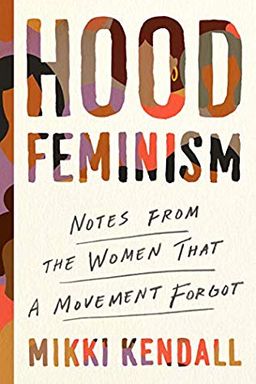
Hood Feminism cover

Hood Feminism

by Mikki Kendall

Hood Feminism by Mikki Kendall exposes the shortcomings of mainstream feminism, emphasizing the need for a movement that truly represents all women. By highlighting issues like poverty, racial inequality, and systemic bias, it urges a more inclusive feminist agenda that supports the most marginalized.

Hood Feminism and the Movement Women Forgot

What does it mean to be a feminist if your basic needs—food, safety, housing—aren’t met? Mikki Kendall asks this powerful question at the heart of Hood Feminism: Notes from the Women That a Movement Forgot, a provocative and deeply personal call to reimagine feminism from the ground up. She argues that mainstream feminism—often dominated by white, middle-class voices—has left behind poor women, women of color, and others who don’t fit tidy ideas of “respectability.” For Kendall, true feminism isn’t about corporate success or body hair debates—it’s about survival, equity, and community.

Kendall’s core contention is that feminism must be intersectional and grounded in the material realities of life in marginalized communities. Food insecurity, gun violence, housing instability, poor education, and healthcare inequity aren’t just social issues—they are feminist issues. By proposing an expanded framework, she demands a movement that stops focusing on privilege and starts fighting for survival. Feminism, she insists, must address what women actually need to live, and not simply what privileged women need to thrive.

The Hood as a Lens for Feminism

A key idea Kendall establishes early is that the “hood”—her South Side Chicago background—is more than geography. It’s a lens through which survival, solidarity, and systemic inequality are experienced daily. In the hood, feminism isn’t defined by university lectures or nonprofit slogans—it’s the practical, often invisible work of women keeping their families safe amid poverty and institutional neglect. Her grandmother, who lived through Jim Crow and raised daughters who never saw dropping out of school as an option, embodies this lived feminism. She may not have called herself a feminist, but in caring for her community and demanding education for all, she practiced it.

This is what Kendall calls “hood feminism”—a feminism born of necessity, not theory. It’s a politics of survival that includes feeding hungry kids, protecting girls from violence, and fighting for fair housing and schools. In this framing, the everyday struggles of poor women, Indigenous women, trans women, and disabled women are not side issues—they are the movement’s foundation. Feminism that ignores these realities can never claim to stand for all women.

The Problem with Mainstream Feminism

Kendall critiques how mainstream feminism centers the lives and comfort of white, middle-class women. Issues like wage gaps and corporate board representation dominate discussion, while hunger, gun violence, and education inequities fade into the background. When she launched the viral hashtag #SolidarityIsForWhiteWomen, she exposed how often white feminist solidarity is conditional—expecting women of color to support white women’s pursuits, but not vice versa. True solidarity, she argues, requires mutual respect, not saviorism or token representation.

For example, feminism’s obsession with empowerment ignores the systemic oppression that limits power in the first place. When white women tell others to “lean in,” they assume equal footing—something Black women without access to basic needs can’t do. Kendall’s feminism doesn’t reject empowerment, but she insists it must start with meeting basic needs. Equality between women can’t exist if some are still struggling to eat or survive violence.

Intersectionality as a Survival Tool

Kendall draws from Kimberlé Crenshaw’s concept of intersectionality—the understanding that race, class, gender, and other identities overlap to create unique forms of discrimination. But Kendall gives intersectionality a street-level urgency: it’s not abstract theory, but survival strategy. Marginalized women face overlapping threats—racism, police violence, sexism, poverty, and homophobia—and they can’t afford to wait for trickle-down equality from the privileged. She reminds us that “erasure is not equality.”

“Feminism isn’t just academic theory. It isn’t a matter of saying the right words at the right time. Feminism is the work that you do, and the people you do it for.”

In contrast to textbook intersectionality, Kendall’s view demands action—feeding children, protecting trans women, supporting victims of violence, and changing policy. Feminism’s greatest failure, she says, is that it often treats equity as optional and survival as someone else’s problem.

Expanding the Definition of Feminist Issues

Throughout the book, Kendall expands what counts as “feminist” concerns. Hunger and housing, gun violence and education, reproductive justice and parenting—these are all feminist causes because they disproportionately affect women. She shares vivid examples from her life: surviving gun violence as a child, navigating abusive relationships without legal protection, and feeding her son on food stamps while earning her degree. These lived experiences transform abstract social problems into urgent feminist priorities.

Her argument echoes bell hooks’ insistence in Feminist Theory: From Margin to Center that feminism must center marginalized voices. Like hooks, Kendall emphasizes community over individual success and collective liberation over representation. If feminism claims to speak for half the world, then women in the hood, the reservation, or the borderland must be at its heart—not its periphery.

Why It Matters Now

In an era of growing inequality and polarized activism, Hood Feminism reminds readers that feminism cannot ignore class and race. Kendall’s voice is urgent and unflinching: the movement’s future depends on whether privileged feminists are willing to confront their own complicity and redistribute their resources—political, financial, and social—to those most in need. As she writes, even “nice feminists” must learn when niceness is not enough. Change requires confrontation, not comfort.

Ultimately, Kendall’s vision is both a critique and a blueprint. Hood Feminism redefines feminist activism as the work of survival, justice, and solidarity. It challenges you to see feminism not as an identity but as responsibility—to care for every woman, not just the ones with privilege. The hood, she shows, doesn’t forget women. It teaches them to fight, build, and survive. The question is whether mainstream feminism will learn to do the same.


Solidarity Is Still for White Women

Mikki Kendall’s chapter “Solidarity Is Still for White Women” confronts the uncomfortable truth that the feminist movement often props up white supremacy instead of dismantling it. When she launched the hashtag #SolidarityIsForWhiteWomen in 2013, it exposed how mainstream feminism demanded unity while ignoring racial inequality. She argues that white feminism centers the comfort of privileged women while women of color, trans women, and poor women are told to wait their turn for equality.

False Solidarity and Selective Sisterhood

Kendall shows how white feminists rally around issues like leadership parity or reproductive rights for cis, middle-class women—but disappear when marginalized women face violence, discrimination, or poverty. She offers examples: white feminists stayed silent when Black girls were suspended for wearing natural hairstyles, and when Indigenous and trans women experienced disproportionate sexual violence. Even trans inclusion became a battleground where privileged feminists erased or demonized trans women of color. True solidarity, Kendall insists, isn’t about shared gender—it’s about shared struggles and mutual accountability.

(A parallel critique appears in Reni Eddo-Lodge’s Why I’m No Longer Talking to White People About Race, where Eddo-Lodge observes that white feminism often reproduces racial power dynamics under the guise of progress.)

How Privilege Silences Accountability

White privilege, Kendall suggests, operates even inside feminist spaces. When white women claim victimhood while ignoring their ability to harm others, they maintain dominance. Citing cultural moments—from Lena Dunham’s racially tone-deaf commentary to Amy Schumer’s victim narratives—Kendall unpacks how white tears wield disproportionate social power. A white woman’s discomfort can end a Black person’s career or cost a life, as historical cases like Carolyn Bryant’s lie about Emmett Till illustrate. Ignoring this power dynamic allows racism to thrive beneath feminism’s banner of sisterhood.

Intersectionality as Accountability

Intersectionality isn’t just an academic term for Kendall; it’s a corrective to white feminism’s blindness. She reminds readers of Professor Kimberlé Crenshaw’s original intent: intersectionality describes how race and gender combine to shape oppression, not to fragment activism. For a movement that claims to unite half the population, refusing to understand intersectionality is refusal to engage reality. Kendall calls on all feminists, especially the privileged, to stop demanding comfort and start confronting complicity. Accountability means listening when marginalized women speak, even if it means hearing harsh truths.

“Solidarity isn’t a one-way street. Sisterhood is mutual and messy. It means showing up for women who don’t look like you, even when their struggle isn’t yours.”

Reimagining Feminist Partnership

Instead of unity built on pity or charity, Kendall argues for partnership built on equality. Solidarity, she says, is not universal—it requires negotiation and humility. Some spaces are not for every woman to lead, and that’s okay. White feminists must learn to step back, amplify voices of color, and invest material support where they have privilege—jobs, platforms, safety—rather than expecting gratitude for token gestures. Her anecdote about writer Gail Simone’s mentorship illustrates what allyship looks like: using one’s power to open doors, not monopolize them.

In essence, Kendall calls out a feminist movement that has failed to heal from its racist origins in suffragism. She replaces hollow slogans of unity with a radical vision of cooperation rooted in justice. Feminism, she declares, will either become intersectional and equitable—or remain white, elitist, and irrelevant.


Hunger Is a Feminist Issue

When Kendall writes about hunger, she transforms an abstract social statistic into a lived feminist problem. After leaving an abusive marriage, she relied on food stamps, public housing, and a state medical card to survive and raise her son. Her experience revealed a simple truth: hunger isn’t a moral failing—it’s a policy failure. And ignoring hunger as a feminist concern perpetuates privilege disguised as empowerment.

The Politics of Hunger

Hunger affects 42 million Americans, mostly women and children. Yet when feminists focus on wage equity or glass ceilings, they rarely confront food insecurity as part of gender equity. Kendall argues that without food, no parent can pursue education, employment, or activism. The inability to feed one’s children due to systemic poverty—created by policies like low wages and inadequate welfare programs—is a distinctly feminist problem because women bear its brunt.

Respectability Won’t Fill a Refrigerator

Kendall dismantles respectability politics—the idea that poor women must be “good women” to deserve help. When welfare programs set moral or work-based conditions for assistance, they punish mothers who are already struggling. She cites Illinois’s paltry $412 monthly TANF allotment for a parent and child as an example of systemic cruelty. Feminist discourse that ignores this treats survival like an optional merit badge. True equity requires unconditional access to food, not charity filtered through judgment.

Why Soda Taxes Miss the Point

Kendall’s takedown of “food-policing” policies like soda taxes underscores how privilege blinds policymakers. For low-income families, soda is shelf-stable, affordable, and safe compared to lead-tainted tap water. Politicians boast about combating obesity while ignoring contaminated infrastructure and food deserts. This misdirected paternalism hurts the poor while making middle-class voters feel virtuous. Hunger, she insists, is not about poor nutritional choices—it’s about systemic deprivation.

Grassroots Feminism and Collective Care

In the absence of government reform, poor women build solutions themselves—community gardens, cooperatives, and mutual aid. Kendall celebrates their creativity but warns that without institutional support, these efforts remain bandages on a gaping wound. Feminism’s role, she says, is to move beyond charity toward policy advocacy: universal access to food programs, fair wages, and ending stigma. Food justice must sit alongside reproductive rights and equal pay in feminist agendas.

“You can’t be a feminist who ignores hunger. Especially not when you have the power and the connections to make it an issue for politicians in a meaningful way.”

For Kendall, the fight against hunger is a fight for dignity. Feminism must stop shaming the poor and start dismantling the policies that create hunger. A movement that claims to care for all women cannot keep claiming that basic survival is someone else’s problem.


Gun Violence and Gender Justice

Kendall’s narrative on gun violence begins with a vivid personal memory: as a child on Chicago’s South Side, she survived a gunfight that nearly killed her. She argues that gun violence is a feminist issue precisely because women live with its consequences—including intimate partner violence and unsafe neighborhoods. Guns amplify gender inequality by turning domestic abuse into murder, and public spaces into war zones for marginalized women.

Feminism and Everyday Violence

Mainstream feminism often frames violence as episodic—something distant, tragic, and rare. Kendall exposes gun violence as a daily reality in many communities. A gun in a domestic dispute makes a woman five times more likely to die. Black women, she notes, have the highest rates of gun homicide among women, largely due to intimate partner violence. Ignoring these statistics keeps feminist activism disconnected from the people it claims to serve.

The Hood and Trauma

Growing up in violent neighborhoods produces generations of traumatized children—girls living with PTSD from constant exposure to gunfire. Kendall’s story of hypervigilance, anxiety, and survival reflects what sociologists describe as “community-level trauma.” Feminism’s silence, she says, perpetuates emotional isolation. If we treat trauma as private, we miss how social inequality makes violence systemic.

Policing and Racism

Kendall also highlights state violence as part of the same continuum. Black women like Rekia Boyd are killed by police under the assumption that Blackness equals danger. Whether a cop mistakes a phone for a gun or a civilian calls the police on Black neighbors, racism fuels lethal outcomes. Feminism, she argues, must challenge these systems instead of equating safety with policing. True safety comes from community trust and justice, not surveillance and armed authority.

Policy and Prevention as Feminist Work

Kendall proposes reframing gun violence as a public health crisis that demands feminist intervention. That includes addressing domestic violence early, treating hate speech as a warning sign, and funding violence-prevention programs. Guns aren’t neutral tools—they’re instruments shaped by racism, patriarchy, and poverty. Feminists must understand that “violence against women” doesn’t end at home; it extends into streets, schools, and police stations.

By linking trauma, racism, and misogyny, Kendall calls for intersectional safety: community-led programs, survivor advocacy, and solidarity beyond respectability. Gun violence threatens autonomy for millions of women, and feminism cannot claim victory while they fear walking outside their doors.


Rethinking Respectability Politics

In “How to Write About Black Women,” Kendall satirizes white media’s treatment of Black womanhood before unpacking respectability politics—the expectation that marginalized women must manage how the world perceives them to be treated with dignity. These “rules” of respectability, she says, are rooted in white supremacy and function as social policing inside Black communities and beyond. They define worthiness through conformity, not humanity.

The Trap of the 'Good' Black Woman

From job interviews to classrooms, Black women are told to speak “professionally,” dress “appropriately,” and suppress anger. Respectability promises protection—but delivers exhaustion. Kendall connects these expectations to post-slavery “uplift the race” philosophies that demanded poor Black people demonstrate virtue to earn white respect. Today those same narratives thrive in feminist spaces that ask women of color to be polite and calm—even when confronting racism.

Code-Switching and Self-Erasure

Kendall explains how Black women perform endless emotional labor to fit into white-dominated workplaces or activist circles. Code-switching—altering speech, body language, and appearance to be deemed “safe”—comes at a psychological cost. It’s not professionalism; it’s survival. Yet feminist movements rarely acknowledge this burden. Erasing one's dialect or anger becomes a prerequisite for being heard, even among progressives who claim inclusivity.

Respectability as a Feminist Failure

Because mainstream feminism privileges comfort, it mistakes politeness for progress. Kendall argues that tone-policing turns justice into a performance. Women of color are told to “educate gently” while the oppressors stay unchallenged. This dehumanizes entire communities and slows activism to a crawl. Anger, she insists, is not the enemy—it’s evidence of humanity and awareness. (Audre Lorde’s essay “The Uses of Anger” makes a similar case for embracing rage as transformative power.)

Beyond Respectability: Radical Listening

Kendall calls for feminists to abandon respectability politics and prioritize radical listening. That means valuing authenticity, not assimilation, and refusing to mistake white norms for universal ones. Feminism can’t defend women’s autonomy while demanding they suppress identity to make others comfortable. True liberation requires embracing cultural difference as strength, not flaw.

“Respectability is the poisoned soil white supremacy gave us, not the hood.”

Ultimately, Kendall reframes respectability as a feminist issue of self-defense. To survive, marginalized women have been forced to edit themselves—but feminism’s role is to dismantle that necessity. The goal isn’t to be acceptable; it’s to be free.


Reproductive Justice Beyond Choice

Kendall’s exploration of reproductive justice begins with her own near-death experience: a high-risk pregnancy that ended in a lifesaving abortion. The ordeal exposed how medical systems treat Black women’s pain—delaying lifesaving care while interrogating their choices. Reproductive autonomy, she argues, is broader than abortion rights. It encompasses all aspects of healthcare: safety, dignity, and the right to live.

Beyond the Pro-Choice Binary

Feminist debate often pits “pro-choice” against “pro-life,” but Kendall insists the real issue is access and respect. Black, Indigenous, and poor women have long faced coercive sterilization and neglect. From the forced sterilizations of Puerto Rican and Native American women in the 20th century to modern prison abuses, these eugenic practices reveal a system deciding who deserves to reproduce. Reproductive justice means ensuring safe care for all bodies—not just defending legal rights for some.

Race, Disability, and Medical Bias

Kendall exposes how doctors’ racist and ableist assumptions shape outcomes. Maternal mortality rates for Black women are triple those of white women—even for wealthy patients like Serena Williams. Trans people face denial of basic treatment under “religious freedom” laws. Disabled women are sterilized without consent. These injustices prove that bodily autonomy remains conditional, tied to race and ability. Feminism must confront this medical apartheid, not just demand equal pay.

Bodies Worthy of Care

Kendall insists that care should not be contingent on moral approval or conformity. Pregnant poor women and parents of disabled kids must be supported, not pathologized. The rhetoric of “saving babies” often masks cruelty—defunding Medicaid, denying nutrition programs, and punishing mothers for surviving poverty. Pro-life hypocrisy hurts real families. She urges feminists to expand their advocacy to include health equity, childcare access, and economic justice.

In showing that reproductive freedom is a spectrum—from abortion to maternal care to disability rights—Kendall builds a bridge between activism and survival. Her message is simple but radical: if feminism leaves some women to die giving life, it has failed utterly.


From Allies to Accomplices

The final chapter, “Allies, Anger, and Accomplices,” crystallizes Kendall’s challenge to feminism: stop performing empathy and start sharing risk. Being an ally is easy—you can tweet support and attend marches. Being an accomplice means investing your privilege to dismantle oppression. Kendall argues that progress depends not on politeness but on partnership grounded in truth and courage.

Why Niceness Fails

Kendall contrasts “nice” feminists with angry ones. Nice feminists soothe white guilt, telling people they’re good while no power shifts. Angry feminists demand justice, even at the expense of comfort. Kendall embraces rage as feminism’s engine: a cleansing fire that exposes hypocrisy. Anger isn’t toxic, she says—it’s transformative. (Bell hooks and Audre Lorde similarly frame anger as political fuel, not emotional weakness.)

Performative Allyship vs. Real Support

Allies often center themselves, recounting their “good deeds” instead of listening. Kendall mocks the ritual CV of allyship: “I marched with Dr. King” or “I have Black friends.” True accomplices work quietly, redirecting resources, confronting racist peers, and stepping back from the spotlight. They respect boundaries and don’t demand education from those suffering oppression. Accomplices risk reputation and security to change power structures.

Anger as Moral Compass

Social media outrage, Kendall notes, reveals pent-up collective anger that elites dismiss as divisive. She reframes it as evidence of democratic voice. Suppressing anger for the sake of civility keeps oppression intact. Decorum, she writes, is a tool of control—a digital continuation of Jim Crow etiquette demanding deference. Instead of silencing dissent, feminism must make room for justified fury.

Accomplice Feminism in Practice

To be an accomplice feminist is to act daily against injustice. Kendall envisions feminists using privilege strategically—amplifying marginalized voices, defending protestors, and funding grassroots efforts. It’s not saviorism; it’s solidarity. When feminism stops protecting whiteness and starts protecting women, liberation becomes possible.

“We have to get past peak white feminism and into actual feminism.”

Kendall’s closing vision is both pragmatic and moral: feminism must transform from comfort culture into coalition work. Accomplices don’t wait for permission—they get to work dismantling inequity. Only then, she insists, can feminism truly claim to be for all women.

Dig Deeper

Get personalized prompts to apply these lessons to your life and deepen your understanding.

Go Deeper

Get the Full Experience

Download Insight Books for AI-powered reflections, quizzes, and more.