
Idea 1
The Collective Intelligence of Honeybees
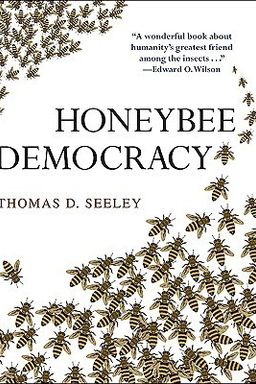
Have you ever wondered how a group with no clear leader can make smart, coordinated decisions? In Honeybee Democracy, biologist Thomas D. Seeley reveals that honeybees—those tiny, buzzing creatures we associate with honey jars and gardens—are masters of democratic decision-making. Through decades of fieldwork, experimentation, and collaboration, Seeley argues that a honeybee swarm behaves much like a well-run human committee: it gathers information collectively, debates options openly, and reaches agreement through consensus and quorum, rather than command.
At its core, Seeley’s argument is revolutionary: honeybee swarms function as a single intelligent entity—what he calls a superorganism—that uses democratic processes to make life-or-death decisions. When a colony becomes too crowded and swarms to find a new home, thousands of individuals must agree on one suitable nest site. Yet no queen issues orders; no central intelligence plots the route. The secret lies in how the bees communicate, weigh alternatives, and balance speed with accuracy—a model that, as Seeley contends, offers profound lessons for human decision-making.
A Scientist’s Unlikely Journey from Beekeeper to Biologist
Seeley’s fascination with bees began in childhood, when he marveled at their harmony and industriousness. As an undergraduate, he discovered that each hive was a miniature democracy. Under the mentorship of trailblazing biologists like Karl von Frisch and Martin Lindauer—pioneers who decoded the bees’ “waggle dance”—Seeley devoted his career to uncovering how these insects make collective decisions without leaders. His curiosity led him from the forests of upstate New York to the storm-battered rocks of Appledore Island, where decades of meticulous experiments revealed the bees’ remarkable cognitive sophistication.
Von Frisch had shown that bees could communicate precise directions to food sources through dances, while Lindauer discovered that swarms used the same language when searching for real estate. Building on their work, Seeley designed controlled experiments with artificial hives to uncover the mechanisms of this “honeybee parliament.”
The Swarm as a Thinking Organism
In late spring, when a colony grows too large, the old queen leaves with roughly two-thirds of the workers to start anew. They cluster temporarily on a branch—ten thousand bees hanging in a teardrop-shaped mass—while several hundred experienced scouts fly off to find a new home. These scouts behave like real estate agents, evaluating potential sites based on size, dryness, entrance shape, and exposure. They return to the swarm and perform vigorous dances to advertise their discoveries. Each dance’s vigor reflects the bee’s enthusiasm for a particular site—stronger waggles mean better prospects. Soon, multiple scouts are promoting competing sites, creating a buzzing debate on the swarm’s surface.
Over time, the swarm behaves like a neural network: support builds for the best site as scouts recruit others, weaker dances fade, and consensus grows around one option. Once a threshold number of scouts have visited the winning site—a quorum of about 15 to 30 bees—the entire swarm prepares to move. Piping signals ripple through the cluster, prompting thousands of bees to warm their flight muscles for departure. Minutes later, the swarm lifts off and flies straight to its new home, guided by the informed scouts acting as airborne “streakers.”
Lessons for Humans: Decentralized Wisdom
Seeley’s insight is striking: the swarm’s decision-making process mirrors the human brain. Each bee, like a neuron, possesses limited knowledge, but together they process information in a distributed and self-correcting way. The system operates through feedback loops, quorum sensing, and inhibitory signals—the same principles neuroscientists find in the primate cortex. This organization allows groups to combine independence (each bee inspects honestly) and interdependence (their dances influence others) to achieve remarkably accurate outcomes.
Seeley argues that human groups can emulate this natural brilliance. Whether in corporate boards, scientific teams, or local governments, effective decision-making thrives when diverse individuals engage openly, respect dissent, and aggregate knowledge through transparent communication. The bees’ process—evaluate, debate, and decide without domination—offers an inspiring counterpoint to both autocracy and chaos.
Why It Matters Today
In an era of misinformation and polarized politics, Seeley’s bees remind us that true democracy is not noisy conformism but informed consensus built on trust and diversity. Unlike humans, bees have evolved mechanisms that prevent groupthink: no bee exaggerates information, and all scouts retire automatically, leaving room for fresh evaluators. Their model points to simple yet radical design principles for improving human institutions—small, respectful groups, independent information gathering, and high thresholds for consensus.
Across its ten chapters, Honeybee Democracy shows how collective wisdom can arise from humble minds, how nature’s sensory systems mirror our own neural architectures, and how studying the swarm’s cognitive harmony can teach us to make better, fairer decisions. By the final pages, you realize Seeley’s message goes far beyond bees: it’s about rediscovering the power of collective intelligence—whether in a forest, a community, or a nation.