
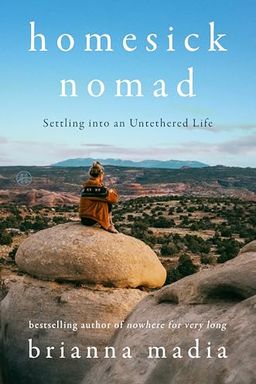
Homesick Nomad cover

Homesick Nomad

by Brianna Madia

The author of “Never Leave the Dogs Behind” navigates life decisions as she splits her time between the wild desert and suburbia.

Belonging Beyond the Map

Where do you feel most at home—inside four walls you can mortgage, or out on a dirt road that has no name? In Homesick Nomad, Brianna Madia argues that home, identity, and courage are not places you reach, but practices you keep choosing. She contends that real belonging is built the hard way—through risk, impermanence, and radical honesty—and that you discover who you are not by accumulating safety, but by learning to live with uncertainty and consequence.

Across a decade that stretches from a mildew-smelling sailboat in Connecticut to a hulking orange van named Bertha in the Utah desert, Madia learns to swap the grammar of “supposed to” for the vocabulary of enough. She leaves a mortgage meeting for a parking-lot handshake on a 1990 Ford van; trades tidy routines for stealth camping, frozen windshields, and office showers; and finds that freedom isn’t free—it charges interest in breakdowns, fear, and fallout. Alongside her husband Neil and their three dogs (gentle Bucket, feral-joy Dagwood, and later the puppy Birdie), she stumbles into the red rock country that will become her teacher, her sanctuary, and eventually, the nine acres she’ll call her own.

What this book is really about

Madia isn’t offering #vanlife porn. She’s interrogating a deeper wager: can you live a big, soul-right life without the rails of conventional success? And if you say yes, can you bear the exposure—weather, money scarcity, public opinion, your partner’s limits, your own? Her answer is hard-won. She learns the desert’s physics—flash floods, slot-canyon stemming, reading sky and wind—and simultaneously faces the internal geology of grief, class shame, and performance. When a catastrophic accident leaves Dagwood grievously injured and the internet rallies nearly $100,000 for his care, she’s forced to confront another truth: alternative lives still carry moral debts. Freedom includes accountability.

The journey you’ll follow

You’ll begin in Fairfield County, Connecticut—where wealth lines cut like surveyor’s strings through childhood. You’ll meet Bri’s mother, a woman of secret go-go boots and naked midnight swims; her father, a charismatic builder whose addiction and absence leave an ache Bri calls her “check engine light”; and Neil, the quiet, storm-bright sailor who becomes her partner. From their early years living aboard a thirty-three-foot boat (with Bucket and cockroaches) to moving west after Hurricane Sandy, the couple finds Utah: a valley rimmed by mountains, a desk job with an office shower, and weekends crammed with desert ferocity.

Then Bertha arrives—orange, enormous, unreliable—and everything accelerates. There are stealth nights outside daycares and mansions, office hallways padded by two muddy dogs, and lessons in social rules that policing can’t quite name (“I’d write you a ticket,” a guard admits, “but I don’t know for what”). The desert, though, becomes the real curriculum: Robbers Roost’s nameless roads; solo drives where storms rip the sky apart; canyoneering days lowering dogs off 80-foot drops; and one infamous slot where Madia and Neil bleed and cry their way out via high-stemming grit. In parallel, a digital audience gathers around her lyrical dispatches; fame, as it so often does, complicates everything.

Why it matters to you

If you’ve ever felt the tug to leave the conveyor belt—mortgage, promotions, picket fences—but also feared the unknown, Madia gives you a candid field guide. She doesn’t romanticize scarcity or danger. She names the privilege in choosing struggle (born closer to the “goalposts,” she writes, she still walks away), and she teaches the desert’s paradox: nothingness can be the richest teacher. Her story invites you to separate want from need, to let fear ride shotgun without driving, and to accept that “wild” has a price—mechanical, emotional, relational.

What you’ll take away

You’ll learn how a place can unmake and remake you; how animals can mirror your truest instincts (Dagwood, part Carolina Dog, embodies feral longing that modern life can’t hold); and how performance—on stage, in families, on Instagram—can both sustain and distort you. You’ll wrestle with the ethics of public storytelling when private guilt (the accident that nearly kills Dagwood) collides with public generosity. You’ll see a marriage fray under the weight of trauma and a woman choose to end it, then, amazingly, choose land—nine dusty acres—over wheels. And through it all, you’ll be asked to consider where your enough lives: in stuff and status, or in stories, scars, and a sky so big it silences you.

Signal from the book

“Of course you broke down,” a psychiatrist tells Bri about her long-ignored pain. The line becomes a thesis for vans and bodies alike: things seize when you pretend they don’t need care. The work is to listen earlier and love anyway.

By summary’s end, you’ll have a map that’s less GPS and more barometer. You’ll know how to navigate by values in whiteout conditions; when to stem rather than bulldoze; and how to build home—first in a vehicle, then in a canyon, finally on a mesa—by staying honest about the risks and faithful to your enough. (Note: This memoir was published as Nowhere for Very Long; the themes here reflect that text.)


From Suburbia to Salt and Sand

Madia begins with class lines etched across Fairfield County, Connecticut—one left turn to million-dollar homes, one right to subsidized housing. That split-screen childhood births a sharp skepticism of status and a craving for something wilder. Her mother is two people at once: the woman pruning medians to look respectable, and the midnight swimmer who shouts, “Who cares?!” as she floats naked in a mansion-lined creek. Those contradictions plant seeds. You likely have your own: places you learned to perform and places you learned to breathe.

Learning the in‑between

Bri calls herself a chameleon—“not quite rich, not quite poor.” She carries both shame (the smell of sawdust in Dad’s van, the used-car stigma) and entitlement (rejecting Mom’s sensible sedan for a Wrangler). Early on, she sees how appearances police belonging—at school, on Halloween, even on envelopes where Mom whispers that their address is “close enough” to the nicer town. The lesson will matter later when strangers project wealth onto a girl living on a boat: the optics of a hull and a mast can lie.

Meeting Neil, choosing the boat

At a Connecticut yacht club, Bri spots Neil—the storm-chasing sailor with a honeyed voice and a jagged scar from breaking his back at sea. Their romance is quick: letters, surprise campus visits, then a ramshackle apartment while he studies expeditionary skills (ice climbing isn’t a metaphor; it’s on his syllabus). When graduation arrives with $301 in her account and no safety net, they move onto his parents’ 33-foot sailboat, Satisfaction. Reality stinks—literally. There’s no running water, no AC, a pump toilet down the dock, and cockroaches with wings. But there’s also presence: rain on the hull like coins in a can, pelicans and fiddler crabs, and mornings measured by tide, not time.

Practicing voluntary simplicity

Life on the boat becomes apprenticeship in enough. One burner. One pan. Clothes stored in a storage unit you climb into by stepladder, changing by lantern light because fabric mildews in the cabin. They bathe with a hose in twilight. They “own” sunsets, swans, and a brindle hound named Bucket (adopted by fibbing on an application—“No, we don’t live on a boat”). The trade-offs sharpen Bri’s attention: when you can’t shut a door on weather, you hear every drop and feel every gust. It reads like Thoreau’s Walden in saltwater (but with more roaches and fewer metaphors).

Privilege and the choice to struggle

Crucially, Bri names the paradox: choosing “less” is easier when you were born closer to “more.” She watches 2008-era financiers choose death over downward mobility and decides to reject the ladder altogether. It’s a powerful distinction you can carry: austerity isn’t virtue by default; it’s meaningful only when paired with awareness and reciprocity. Later, that awareness will make her sensitive to the ethics of crowdfunding a dog’s medical care.

The westward turn

Hurricane Sandy knocks out power and forces a next step. With under $5,000 saved and National Guard trucks patrolling town, they point a topless Jeep toward Utah because rent is cheap and mountains feel like freedom. The first days are whiteout winter and a studio that feels like a snow globe. Then the clouds part and the Wasatch pierces the sky. Seated at a strip-mall stoplight, Bri’s tears come: she has never seen a city backdropped by such audacity. That image—ordinary life framed by immensity—becomes the book’s recurring composition. (For a similar east-to-west rebirth through land, see Cheryl Strayed’s Wild.)

This is your first invitation from the memoir: interrogate the forces that trained you to care about status; test the edges of “enough” in your body, not just your head; and let landscape—not LinkedIn—have a say in who you become.


The Van Called Bertha

The pivot from mortgage to van happens in a single week. One day Bri and Neil sit with a banker who speaks fluent APR and PMI as the room closes in; days later a guy named Joe plucks a single $20 from Neil’s wallet to hold an orange behemoth in a warehouse lot. Bertha—a 1990 Ford E350 with 33-inch tires, sagging steering column, and DIY paint drips—becomes the counter-offer to conventional adulthood. From that moment on, everything is about improvisation, not optimization.

Building a home on wheels

Bertha’s “build” is camp-chic: a futon mattress on a carpeted platform, Christmas-light interior, PVC roof pipe shower warmed by the sun, cooler that sometimes gets ice, and a tapestry cut into curtains. It’s sparse—more staging area than studio apartment. The dogs vibrate with devotion; Dagwood, the American dingo who once chewed through kennel hardware, sleeps pressed against the tires like a saint waiting for a pilgrimage. They christen the van with the Grateful Dead’s “Bertha”—“I was all night running, running, running”—and set out.

The rules you actually have to learn

Bri’s first winter in the van is not Instagrammable. She scrapes ice from the inside of the windshield with an expired credit card, scrunches frozen jeans at the foot of the bed to warm them, and figures out the taxonomy of illegal vs. merely unacceptable: cooking grilled cheese on a camp stove in a grocery lot isn’t unlawful, but it draws stares; washing armpits with a roof shower in a park isn’t ticketable, but families relocate. Stealth life becomes a game of urban hide-and-seek—daycare streets (creepy, she admits) and mansion-lined blocks where the soundtrack of “normal” wafts through van walls: snow shovels, bus pickups, retrievers called inside. It satisfies the chameleon kid who once pressed her face to the glass.

Work, money, and ethics

Bri negotiates her desk job into a trial run of full-time remote work with office-dog privileges and . . . access to the men’s shower. Co-workers split: some are charmed by “the old orange,” others are unnerved by a colleague with wet hair and a toothbrush. It’s a comic contrast that you, too, may face if you mix feral with corporate. Later, she quits after a mushroom-fueled desert epiphany (anchored by Alan Watts’ “life is like music” riff). It reads impulsive, but the subtext is practice: she’s been using weekends to rehearse what full-time wildness demands.

Safety and gender, re-learned

There are scares: a man on her roof at midnight falls eight feet when Bucket and Dagwood explode; a white van tries to wrench off her bike rack in daylight, sending her sprinting barefoot in a Stevie Nicks shirt after the plate. The news tells women to be afraid everywhere; Bri learns to be specific. “If I was going to do it alone,” she writes, “I had to do it afraid.” Fear becomes a parameter to manage, not a veto. (Compare to Caroline Paul’s The Gutsy Girl for this recalibration.)

What Bertha teaches

Bertha is both symbol and saboteur: a getaway car from “supposed tos,” and a machine that breaks down with theatrical timing. You learn the colors of fluids (green = antifreeze; pink = transmission) and the ethics of attention—Bertha attracts it, forcing Bri to answer questions she doesn’t always have language for. This is the heart of the chapter’s lesson to you: chosen freedom carries the mundane labor of keeping it running, the social friction of being visibly noncompliant, and the humility to accept help without surrendering the why.

A vanlife truth

“There are almost statistical certainties to vehicle living,” Bri jokes: if your house has wheels, you will eventually watch it get winched onto a flatbed. That isn’t failure; it’s dues.


The Desert as Teacher

The first time Bri turns off the pavement into Utah’s red earth, the world changes in ten minutes. Sandstone spires, petroglyphs, washes like petrified wind—nothing matches the cartoon desert she’d been sold. She finds what many seekers do (think Edward Abbey or Ellen Meloy): the desert’s emptiness is an invitation, not an absence. It asks you to earn your view and, in doing so, to earn your self-trust.

Learning to be alone

At Robbers Roost—a 265-square-mile hideout of slot canyons and cattle tracks—Bri makes her first true solo foray. She lets air out of tires to cross windblown dunes, celebrates alone in mosquito-cloud dusk, then wakes to a furnace of sun and the practical question of coffee. The skills are small but compounding: attaching a propane canister without blowing up, reading the topo by screenshot, balancing fear and competence. You can feel the apprenticeship: with every decision, the locus of authority moves a little more inside her.

Reading land like weather

The desert has physics you ignore at your peril. Flash floods don’t fill canyons like bathtubs—they send battering rams of logs, carcasses, and boulders down a stone hallway. Slot canyons narrow not only forward but at your feet, where a V-shaped crack begs to eat an ankle. Bri learns to forecast by sky color, varnish streaks, and the way sand stacks in eddies. In your life, translate that to organizational or emotional weather: don’t read the clouds; read the wind.

Dogs as mirrors of wildness

Dagwood, identified as a Carolina Dog (a primitive breed), is most himself out here. He runs beaver patrol, swims circles as if plotting, and disappears into junipers like they’re his real address. He’s a lesson: some creatures cannot be burned down to apartment-sized lives without protest. The family adapts by learning technical canyons as a pack—Ruffwear harnesses, tandem rappels with dogs in their laps, deadman anchors built from buried rocks. It’s ridiculous and oddly beautiful.

Stemming through panic

In one notorious slot—nine inches wide in places—Bri and Neil enter a “subway tunnel” of stone that pinches above heads and below feet. The only way out is up: high-stemming thirty feet with dogs clipped into their harnesses like cargo, Bri bleeding from knees and back, hyperventilating as Neil shuttles dogs and gear back and forth. The lesson isn’t bravado; it’s the math of persistence. Sometimes you make it not because you are fearless, but because you can’t bear the cost of stopping. (If you’ve read Peter Heller’s The River, you’ll recognize this wilderness calculus.)

A curriculum of presence

Bri names the desert as a teacher of simplicity because it strips away numbing: you can’t doom-scroll when you must decide whether to cross a wash or wait a day. That presence becomes transferrable—to writing, to crisis, to love. For you, the application is straightforward: put yourself somewhere that requires your full attention. It doesn’t have to be a slot canyon. It does have to be honest about consequences.


Love, Partnership, and Diverging Maps

Madia’s love story with Neil is tender and complicated: sailor and writer, expedition student and technical writer, both children of the same shoreline. They become field partners in boldness—early letters thick with drawings, a wedding under a flower crown, and desert Christmases with coyotes in the shadows. But alternative lives don’t cancel ordinary couplehood physics; they amplify them. The book is an anatomy of how values align, then drift.

Early alignment, shared audacity

When they’re young, danger is sexy because it’s elective. Neil teaches wilderness therapy, spends eight-day shifts in juniper-scraped heat, and returns with smoke in his hair. Bri packs the van, tops off fluids, and meets him at dirt-road junctions to extend adventure into Monday and Tuesday. Their unit is a four-body organism: two people, two dogs, one purpose—find the wild and let it shape us.

Invisible labor and roles

But look closely: the “sous-chef” metaphor Bri uses is revealing. She does the prep—stocking, route planning, stealth tactics—so the shared life can happen. She also does the on-camera work, becoming the storyteller and, soon, the brand. Neil, a reluctant subject, becomes both anchor and audience. Many couples will recognize this: the dream is joint; the labors are lopsided in ways you don’t feel until stress arrives.

When dreams diverge

The fault lines show up as questions of scale and exposure. Bri says yes to a van instead of a mortgage because her body says no to the bank’s airless script. Later she says yes to quitting a job to write and post full-time. Neil supports and follows, but each yes deposits a cost in his private ledger—more breakdowns, more public scrutiny, more emotional labor. After Dagwood’s accident (see next idea), those debits come due. As Esther Perel often notes, couples break not only from what happens between them, but from what happens inside each of them that never gets aired.

The slow unspooling

Post-accident, Neil retreats—beer cans in the shower, vomit by the bed, holes in drywall, then silence. Bri, a lifelong performer in a family of performers, retreats forward—into Instagram’s bright theater where love and rage and grief get likes. They don’t blame each other out loud. Maybe that’s part of the problem. By the time they meet at a copy shop in Moab to sign divorce papers (total: $309), the line that remains between them is a post-it of a blessing: “May the wind fill your sails.” The sailor sends her on with the only benediction he has left.

The lesson for you isn’t that “wild” ruins love. It’s that any chosen life will test your shared capacity to name, renegotiate, and redistribute what it costs. If you can’t have those conversations, the land will have them for you.


The Cost of Freedom: Dagwood’s Accident

The scene is a salt-flat lakebed on the Oregon-Nevada border. The dogs are let out to run. Bucket grabs Dagwood’s scruff, he stumbles, and Bertha’s rear tire rolls over him. The rest is triage at 70 mph: a dead phone line to a rural vet, a 140-mile drive to Burns, then a haunted push to Bend under the glow of IV bags clipped to a curtain wire. Dagwood is held together by morphine, a primitive will to live, and two people repeating, “Please don’t” into the dark.

What actually happened—and what was said

In the panic, Bri posts that Dagwood has been hit by a car, which is true—but not the truth. She cannot yet say, even to herself, that they hit him. The internet surges: #TalkToDagwood, tens of thousands of viewers, food deliveries to the hospital, flowers tucked into Bertha’s door, and a GoFundMe cresting toward $100,000. A vet tech named Stella becomes family, her own dog bleeding into Dagwood’s veins.

The moral math of public help

Here the memoir turns ethically electric. Bri names the shame of a half-truth: she lets a “car accident” stand because she fears the money will vanish and, with it, Dagwood. Simultaneously, she’s flayed by comments that brand her reckless. She accepts the insults as penance. “Hurt me. I deserve this.” This is where the book is bravest: it presents an unclean human equation and refuses to tidy it. Your take-away is not verdict; it’s vigilance. When you live publicly, your words are scalpel and suture. Use them carefully, especially under anesthesia of grief.

After the miracle

Against long odds, Dagwood survives: five surgeries, MRSA, transfusions, amputation of his tail, and a prognosis overturned (he walks out on four legs, continent, radiant). The couple drains their accounts and their reserves. The internet’s love feels both holy and heavy—they are now debtors to thousands of strangers. It changes how Bri sees Bertha (a machine that maimed and a home she can’t look at) and how they see each other (one collapses inward, the other outward). The accident becomes the black box that, when finally opened, reveals the stress fractures everywhere else.

Hard counsel

Public generosity doesn’t erase private responsibility. If you ask the village to help carry your story, tell them the whole thing as soon as you can bear to.

If you’ve ever been tempted to outsource shame to ambiguity, this chapter will stop you gently but firmly. You can survive the truth, and the people who love you will too.


Fear, Honesty, and the Check‑Engine Light

Long before vans and canyons, Bri sits strapped to a gurney in an ambulance because she can’t stop sleeping. In college, the pain of her father’s disappearance metastasizes into Ambien days; a psychiatrist names the pattern: your warning light came on years ago, and you kept driving. That sentence becomes the book’s quiet diagnostic tool—for grief, for vehicles, for marriages. The task isn’t to be unbreakable; it’s to stop ignoring knocks and heat.

Doing it afraid

Bri learns to distinguish storybook fear from useful fear. News cycles teach generalized dread; the desert teaches specific risk. She decides she won’t wait to be fearless—she’ll act with fear in the passenger seat. This resolves in small practices: parking where she can leave fast, keeping dogs close when coyotes yip, learning the scrape-sounds of a man on her roof. It also resolves in big ones: driving to Mexico in a barely functioning van because warm water and time together matter more than waiting for ideal conditions.

Performance vs. truth

Raised in a family of performers (a painter grandfather, a band-playing father, a mother who hides rebellion in plain sight), Bri’s default is to be seen—first in yearbooks and yacht clubs, later on Instagram’s stage. Performance feeds courage at first; then it threatens to replace it. In your life, ask: am I doing the thing, or doing the thing-shaped story of it? The distinction matters most in crisis, when applause is loud and shame is louder.

Rewriting scripts of safety

Bri refuses the catechism that safety equals mortgages and monogamy to one zip code. Yet she does not glorify danger. She notes how often “conventional” lives are unsafe in their own ways—men jumping from windows during financial crashes; hidden addictions and betrayals in “perfect” houses. Her alternative is not “unsafe”; it’s differently risked, with visibility as a trade-off. The skill you can borrow is risk literacy: name the risks you’re taking, then decide with eyes open.

Ultimately, this idea asks you to maintain your inner mechanic. Listen for knocks. Pull over sooner. And when something breaks, say it out loud before the smoke obscures the road.


Home, At Last—on Nine Dusty Acres

After the marriage ends, Bri doesn’t run back to walls; she runs toward ground. A slapdash real-estate listing leads her up switchbacks to a mesa rimmed by juniper, prickly pear, and coral-pink petrified dunes. There’s no driveway, well, septic, or grid—just a sandstone alcove warm to the back and miles of sky. The chameleon from Connecticut signs the papers. The woman who believed home was a vehicle plants roots.

Claiming ground as a woman alone

Buying land isn’t a retreat from risk; it’s a reconfiguration. She’ll need to learn wells and solar arrays like she once learned high-stemming. The help she imagines—her carpenter father, sober now, flying out to build the foundation—is a bridge between child and adult selves. When he texts, “How’d you get to be so cool?!” she laughs at the time it took to earn that line. Sometimes the home you build is also a truce with your origin story.

A new pack and a new practice

Birdie, the freeway-found pup, becomes the reason to get up when grief wants horizontal days. Bucket grows gray; Dagwood moves in a “three-and-three-quarter-legged” gait. The rituals are small: calling bats with pebbles, sitting in a river chair to survive triple-digit heat, talking to stars that feel closer than the moon. A white horse—scarred and unbranded—circles Bertha one afternoon like a visitation. It looks out of place and perfectly right. So does she.

What home becomes

Home is now three things at once: a past you honor without reenacting (parents’ hands on wedding-day elbows, “just one more story” forever unsaid); a present you maintain (solar, sand, dog meds); and a future you’re brave enough to draft (a living will that asks to scatter ashes at the Wedge overlook). The picket fence on the loan folder’s cover is a joke the land is in on. Her fence line is cryptobiotic soil that remembers every footprint and grows anyway.

A final image

She lies naked under a Milky Way that looks like torn silk and thinks about a little girl in a car whispering, “Who would want to live all the way out here?” The answer is: she would. Maybe you would too.


Stories, Performance, and Telling the Whole Truth

Madia’s memoir is also an ars poetica—a meditation on what stories cost and why we tell them. She comes from performers: a painter grandfather, a band-playing father in snakeskin boots, a mother who smuggled rebellion in a backpack. She learns early that being seen can feel like being loved. On Instagram, she turns captions into essays and builds a community that sends tacos to vet-techs and whiskey to waiting rooms. Then she learns the other half: performance can become a mask you forget you’re wearing.

The ethics of visibility

When Dagwood is hurt, the internet’s gaze is a blessing and a burn. Bri lets a partial truth stand because the full one feels lethal to the mission (save the dog). Later, she circles back to tell the whole story and face what she owes. This is the craft note for every storyteller—including you: urgency doesn’t absolve accuracy, but it explains it. If you must publish in grief, build in a second telling when your hands stop shaking.

Writing as reckoning

Her prose does what desert days taught her: it looks directly, names specifically, and doesn’t rush the reader past discomfort. She refuses tidy morals. A marriage ends; she still loves the boy on the sailboat. A dog is hurt; she still drives the van. Freedom breaks things; she keeps choosing it—differently. If you’re writing your own nontraditional life, study her stance: confessional but not exhibitionist, lyrical but not coy, accountable without self-immolating.

Why these stories matter

Alternative lives are often flattened into inspiration posters or cautionary tales. This book gives you a third category: case study. It’s for people who want to live with more agency and less autopilot—and who understand that agency cuts in two directions: more freedom, more responsibility. In that sense, Madia’s work sits beside Krystal A. Sital’s Secrets We Kept or Jedidiah Jenkins’ To Shake the Sleeping Self—memoirs where adventure is the lab, not the point.

By the final page, you’re left with a simple craft-and-life rule: tell the truth soon enough to steer by it, long enough to learn from it, and tenderly enough that the people in it can bear to be seen.

Dig Deeper

Get personalized prompts to apply these lessons to your life and deepen your understanding.

Go Deeper

Get the Full Experience

Download Insight Books for AI-powered reflections, quizzes, and more.