
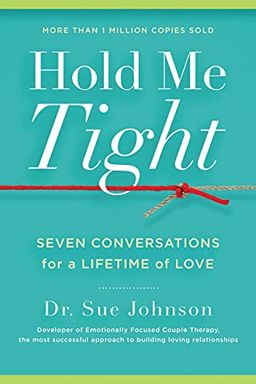
Hold Me Tight cover

Hold Me Tight

by Dr Sue Johnson

Hold Me Tight by Dr. Sue Johnson reveals how to create lasting and intimate relationships by understanding key emotional moments. Through Emotionally Focused Couple Therapy, learn to navigate conflicts, heal past traumas, and nurture a passionate connection with your partner.

Love as Our Most Basic Need

Have you ever wondered why arguments with a partner feel like life and death? Dr. Sue Johnson’s groundbreaking work Hold Me Tight argues that the intensity of romantic conflict is no accident—it’s rooted in our most fundamental human need: the need for safe emotional connection. Johnson’s theory, known as Emotionally Focused Therapy (EFT), reframes love not as a mystery or a power struggle, but as an act of bonding and survival. She contends that adults, much like children, are biologically wired for attachment. When that bond feels threatened, our brains trigger panic—what she calls ‘primal panic.’

This isn’t just poetic language; it’s science. Drawing on the work of John Bowlby, Mary Ainsworth, and modern neuroscience, Johnson shows that being securely attached to a partner doesn’t make you weak or dependent—it makes you stronger, more resilient, and healthier. Love isn’t an indulgence; it’s a survival code. Throughout the book, she dismantles the myths of independence and self-sufficiency that dominate Western ideas of maturity. Instead, she argues that true strength lies in emotional responsiveness—the ability to reach for and respond to your partner with warmth, presence, and care.

Why Relationships Feel So High-Stakes

Most couples come to therapy believing they’re fighting over practical issues—money, kids, sex, chores—but beneath those arguments lies the same unspoken question: “Are you there for me?” When your partner turns away emotionally, your brain reads it as a threat to your safety. That’s why you might find yourself yelling, criticizing, or retreating, even when you know it isn’t helping. According to Johnson, these reactions form predictable negative cycles she calls ‘Demon Dialogues.’ Partners aren’t battling each other as much as they’re both fighting against disconnection. The more one protests and pushes, the more the other distances or shuts down—and round and round they go.

These patterns are not signs of incompatibility, Johnson argues, but signs of distress in the emotional bond. Recognizing and repairing these moments of disconnection is the key to lasting intimacy. In the EFT framework, love is less about solving problems and more about creating security within the relationship. Secure couples can disagree, even fight, without losing their sense of connection.

The Science of Love and Bonding

Drawing from attachment theory and neuroscience, Johnson connects emotional intimacy with physical well-being. Research cited in the book reveals that happy marriages protect against disease, lower blood pressure, and even speed wound healing. Conversely, emotional isolation triggers the same neural pathways as physical pain. Functional MRI scans show that rejection activates the brain’s anterior cingulate cortex—the same area that processes bodily harm. Connection isn’t metaphorically vital—it is biologically vital. When we feel loved, our brains release oxytocin, the ‘cuddle hormone,’ which calms stress and increases trust. Without that sense of connection, cortisol spikes, immune function drops, and life feels harder at every turn.

By understanding this biological dance, couples can stop seeing conflict as moral failure and start seeing it as a call for closeness. When one partner reaches out in panic or protest, the other’s responsiveness—touch, eye contact, empathy—isn’t just romantic sentiment; it’s an evolutionary act of reassurance that regulates both nervous systems. In other words, love literally keeps us sane and balanced.

The Seven Conversations That Change Everything

To help couples move from fear to connection, Johnson distills decades of clinical work into seven transformative conversations, each designed to strengthen what she calls A.R.E.—Accessibility, Responsiveness, and Engagement. These conversations guide partners through key moments in every relationship: recognizing destructive cycles, exploring wounds from the past, finding emotional safety, forgiving injuries, rekindling intimacy, and sustaining connection over time. Unlike traditional couple therapies that focus on communication skills, EFT focuses on vulnerability and emotional attunement. Johnson shows that lasting change comes not from logic or technique, but from experiencing moments of genuine emotional resonance.

Why This Approach Matters

In a world that idolizes independence and efficiency, Hold Me Tight is a cultural correction. It reminds us that needing others is not weak—it’s human. Couples who learn to connect more deeply not only strengthen their relationships but transform their capacity for compassion in all areas of life. Secure attachment doesn’t just make for happier marriages; it fosters empathy in families, resilience in children, and kindness in communities. As Johnson writes, love is the cure for loneliness, the foundation of emotional health, and perhaps the final frontier of human evolution.


The Science of Emotional Attachment

Dr. Sue Johnson builds on the pioneering work of John Bowlby, the British psychiatrist who first developed attachment theory in the mid-20th century. Bowlby argued that humans, like infants who seek comfort from their caregivers, are wired for connection. Adult romantic relationships, Johnson asserts, are not so different from those early bonds. They fulfill the same need for safety, acceptance, and belonging.

When couples fight or grow distant, they’re reenacting these ancient survival scripts. The brain's amygdala sounds the alarm at the first hint of emotional separation. Suddenly, a partner’s busy day or dismissive tone feels catastrophic. Beneath every argument lies the primal question: “Are you there for me?”

How Attachment Shaped Human Survival

Bowlby’s research on children separated from caregivers after World War II showed that love is not a luxury—it’s a necessity. Without emotional connection, children exhibit ‘failure to thrive,’ even when their physical needs are met. Psychologist Harry Harlow’s famous experiments with infant monkeys reinforced this: the babies chose soft, comforting ‘mothers’ over wire frames that offered milk. From infancy onward, comfort takes precedence over sustenance.

Johnson argues that the same holds true in adulthood. Adults require emotional closeness to manage life stress and maintain mental health. Those without secure attachments are more prone to depression, anxiety, and physical illness. As she puts it, “Love is our best survival mechanism.”

The Cost of Disconnection

Modern life, Johnson warns, undermines our innate need for connection. Longer work hours, social media dependence, and cultural ideals of self-sufficiency separate us from deep relationships. Citing Robert Putnam’s Bowling Alone, she notes that we’ve traded community for isolation. The result? Chronic loneliness, anxiety, and ‘primal panic.’

Neuroscientific research supports this. Studies show that emotional rejection activates the same brain regions as physical pain. Conversely, loving touch releases oxytocin and suppresses stress hormones like cortisol. In couples, touching, gazing, and responding empathetically literally synchronize heart rates and brain waves—a phenomenon psychologists call “resonance.”

Security as Strength

In our culture, we often glorify independence and see emotional need as weakness. Johnson flips this idea on its head. She introduces the concept of effective dependency—the idea that relying on others appropriately makes us stronger, not weaker. People in secure relationships explore more, take more risks, and perform better in their personal and professional lives because they know they have a safety net.

This echoes the findings of researcher Brooke Feeney, who discovered that partners who feel securely connected are more independent and confident than those who feel alone. Love, Johnson concludes, fuels autonomy. Emotional safety frees us to be our fullest selves.


When Love Goes Wrong: The Demon Dialogues

If love is about safe connection, then disconnection is the heart of relationship distress. Johnson identifies three self-perpetuating patterns that trap couples in cycles of pain and misunderstanding. She calls them the Demon Dialogues. These aren’t random fights—they’re predictable feedback loops born from fear of separation. Recognizing them, she says, is the first step to reclaiming your emotional bond.

Find the Bad Guy: Blame and Counter-blame

In this first pattern, partners trade accusations to protect themselves from hurt. Think of Pam and Jim, who begin a session arguing about support and end up attacking each other’s character. Each sees the other as the enemy, not realizing that both are fighting for the same thing—acknowledgment and care. Johnson calls this a deadly dance of mutual defensiveness. Each partner thinks, “If I can prove I’m right, I’ll be safe,” but the result is alienation.

The Protest Polka: Pursue and Withdraw

This is the most common—and painful—of all. One partner pushes, criticizes, or demands while the other retreats. The “protester” is terrified of abandonment; the “withdrawer” is terrified of failure. Johnson illustrates this with Mia and Ken: she nags for connection, he shuts down from overwhelm. The more she pleads, the more he hides—until both feel hopeless. Their fight isn’t about chores or parenting; it’s about reassurance. Mia’s angry poking is really a plea: “Please, come closer.”

Freeze and Flee: When Both Give Up

When couples have danced the Protest Polka too long, they grow numb. No one protests anymore—it’s all silence. Johnson describes Carol and Terry, a couple who coexist politely but have lost all intimacy. Having decided that closeness is futile, they retreat into parallel lives. This is the most dangerous stage because there’s nothing left to fight for. Disconnection has become the norm, and with it comes emotional anemia—depression, guilt, resignation.

“The test of love is not how passionately we fight, but how readily we repair.”

Recognizing which Demon Dialogue you engage in is like naming a storm: once you can identify it, you can prepare for it. Johnson teaches couples to view the pattern—not each other—as the enemy. She coaches them to pause the argument, name the pattern (“Here we go again”), and step out of the loop long enough to reconnect emotionally. Over time, couples replace the Demon Dialogues with conversations of accessibility, responsiveness, and engagement—the antidotes to emotional exile.


The Power of Emotional Responsiveness

According to Johnson, love flourishes on one core behavior: emotional responsiveness. It’s the capacity to tune in, stay open, and respond to your partner’s emotional signals. This is what forms and maintains secure attachment. Couples often think they need better communication or compromise strategies, but what they truly need is attunement—the ability to read and soothe one another’s emotional cues.

Accessibility, Responsiveness, and Engagement (A.R.E.)

To simplify this concept, Johnson uses the acronym A.R.E.: Are you Accessible, Responsive, and Engaged? Accessibility means being emotionally open and available. Responsiveness means recognizing and validating your partner’s feelings. Engagement means being fully present—your partner can feel your attention. When all three are present, the relationship becomes a safe haven. When they’re absent, love begins to erode.

Consider Tim and Sarah, a young couple drowning in misunderstanding. Sarah accuses Tim of being emotionally absent, while Tim feels criticized and retreats into logic. Through EFT, they learn to see their fights as missed connections rather than moral failings. As Tim slowly becomes more emotionally available—telling Sarah, “I shut down because I’m afraid I’m failing you”—Sarah softens, realizing his withdrawal came from fear, not indifference. That moment of emotional honesty changes everything.

Why Responsiveness Heals

When partners respond to each other’s emotional needs, their brains release oxytocin, creating a feedback loop of safety and warmth. This builds what psychologists call “earned security.” Even if you grew up without stable relationships, repeated experiences of care and responsiveness can rewire your attachment patterns. Johnson has found that 70–75% of couples who complete EFT move from distress to satisfaction, a higher success rate than almost any other form of therapy.

The essence of this transformation lies in emotional presence. You can forgive conflicts, navigate differences, and sustain passion because your nervous systems synchronize through trust. Emotional responsiveness turns love from a gamble into a refuge.


Healing Injuries and Restoring Trust

Every couple experiences moments that shatter trust—what Johnson calls attachment injuries. These are not everyday slights but deep betrayals that occur when one partner fails to respond in a moment of profound need. Unlike surface arguments, these injuries linger beneath the surface of the relationship, eroding safety until they are directly healed through emotional reconnection.

When “Never Again” Takes Hold

Take Helen and Conrad, one of Johnson’s most striking examples. When Helen believed she had breast cancer, she reached for Conrad in terror. Instead of comforting her, he retreated into logic—telling her to calm down and not “overreact.” Though she survived cancer, the emotional wound never healed. Years later, when Conrad tried to reconnect, Helen froze. Johnson calls this the Never Again moment—the point when our hearts decide the relationship isn’t safe.

The Six Steps of Forgiveness

Healing begins when partners face the injury together. Johnson outlines six steps: (1) the injured partner names the pain without accusation; (2) the injurer stays present and acknowledges the hurt; (3) both soften defenses and reverse ‘Never Again’; (4) the injurer takes responsibility with genuine remorse; (5) both engage in a new, healing “Hold Me Tight” conversation; (6) they create a new story that integrates the injury as one of growth, not destruction.

In Helen’s case, Conrad finally confessed how afraid and useless he had felt that day—his withdrawal wasn’t indifference but panic. When she saw his remorse and fear, her frozen anger thawed. This mutual vulnerability turned pain into connection. In EFT, forgiveness is not intellectual—it’s embodied through emotional attunement.

Through this process, couples rediscover something profound: love’s deepest truth isn’t perfection but repair. Healing strengthens a relationship more than the absence of mistakes ever could.


The Bond Between Sex, Touch, and Security

Johnson reframes sexual intimacy as an extension of emotional bonding—not as a performance, but as a dialogue of closeness and reassurance. She distinguishes between three sexual styles that reflect levels of attachment security: Sealed-Off Sex, Solace Sex, and Synchrony Sex.

Sealed-Off Sex: Avoiding Emotion

Here, sex becomes a form of escape—about lust, not love. Partners use physical pleasure to avoid emotional vulnerability. For instance, Kyle admits that when his marriage turned distant, sex became “mechanical.” He focused on physicality because emotional openness felt too risky. Johnson likens this to “putting on armor in bed.” While temporary excitement can mask hurt, it ultimately deepens isolation.

Solace Sex: Seeking Reassurance

In this attachment-driven form of lovemaking, partners use sex to reassure themselves they’re still wanted. It’s driven by anxiety, not affection. Mandy and Frank, for example, have sex primarily to reduce Mandy’s fear of rejection. The moment Frank declines intimacy, Mandy spirals into panic. Solace Sex may temporarily soothe fears but can’t create lasting trust.

Synchrony Sex: The Fusion of Emotion and Desire

In contrast, Synchrony Sex arises from secure emotional connection. Partners are open, responsive, and able to be playful without fear. They communicate desires and fears freely, creating physical and emotional harmony. Johnson describes a couple, Elizabeth and Jeff, who rediscover passion after decades of marriage through playful role-playing and mutual vulnerability. As she writes, “The best sex arises when we feel emotionally safe enough to let go.”

When couples learn to use sex as a vehicle for emotional engagement, desire becomes renewable rather than fleeting. Secure attachment keeps passion alive—not novelty or technique. As Johnson cites, research confirms that married couples in emotionally secure relationships report more satisfying, frequent, and adventurous sex than singles or casual partners.


Healing Trauma Through Love

Trauma—whether from war, abuse, or loss—can shatter a person’s ability to trust. Yet Johnson’s research shows that loving connection can be the most powerful medicine for survivors. Attachment offers not only comfort but also a path toward rebuilding shattered self-worth and restoring faith in others.

Love as a Secure Base After Trauma

In stories of soldiers, firefighters, and accident survivors, Johnson demonstrates how trauma isolates us and how love draws us back to life. She tells of Dan and Mavis, a couple rebuilding after Dan’s debilitating stroke. They grieve together, weep together, and in that mutual vulnerability find resilience. “We just held each other and cried for two months,” Mavis recalls. That shared mourning becomes their healing ritual.

Facing the Monster Together

The worst effects of trauma come when survivors face pain alone. Many, especially men trained to suppress feelings, isolate themselves out of shame or fear. Johnson documents how avoidance erodes both relationships and recovery. In contrast, partners who share their emotional worlds—who can say, “I’m scared,” and be met with empathy—recover faster. Love regulates the nervous system just as surely as medicine or therapy.

One of her most poignant cases is Doug, a Vietnam veteran tormented by guilt. Convinced his wife would reject him if she knew his past, he shut her out until EFT sessions helped him confess his fear: “You wouldn’t love me if you knew what I did.” Her embracing response—“You did your best. I love you more for your honesty”—becomes a turning point. After decades of nightmares, he finally sleeps peacefully.

As French theologian Teilhard de Chardin wrote, “Someday we will harness the energy of love, and for the second time in history, humanity will have discovered fire.” Johnson agrees: love isn’t just emotional—it’s elemental.


Keeping Your Love Alive

Even after couples repair their bonds, love must be nurtured deliberately. Johnson’s final conversation guides partners on how to sustain security and passion over a lifetime. Like a language, emotional connection must be spoken every day—or it fades. The key, she insists, is mindful attention and ritualized reconnection.

Rituals of Connection

Johnson encourages couples to create daily habits that reaffirm love: morning kisses, evening check-ins, goodbye hugs. These small gestures remind partners, “You matter to me.” She also recommends “A.R.E.” conversations—asking, “Are you there for me?” and reflecting on danger points where insecurity tends to arise. By revisiting these moments with curiosity rather than blame, couples prevent small hurts from festering into disconnection.

Creating a Resilient Relationship Story

One powerful exercise Johnson uses is for each couple to co-author a “Resilient Relationship Story.” It’s a shared narrative of how they faced conflict, reconnected, and continue to grow. For example, Nicole and Bert title their story “How N & B Conquered Demons and Created the Ultimate Cuddle.” By remembering both their struggles and triumphs, they reinforce the belief that love is something they can rebuild again and again.

Love as Continuous Creation

Johnson reminds readers that love is a living process. As Ursula K. Le Guin wrote, “Love does not sit there like a stone; it has to be made, remade all the time, made new.” Partners change, life changes, and relationships must evolve too. The goal isn’t perfection but resilience—the confidence that you can find your way back to each other no matter what storms arise. Practicing accessibility, responsiveness, and engagement isn't just maintenance; it’s the art of staying alive together.

Dig Deeper

Get personalized prompts to apply these lessons to your life and deepen your understanding.

Go Deeper

Get the Full Experience

Download Insight Books for AI-powered reflections, quizzes, and more.