
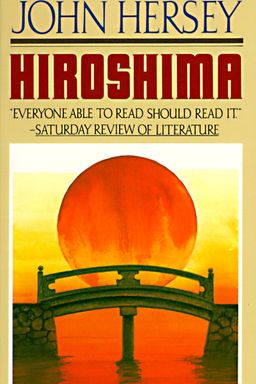
Hiroshima cover

Hiroshima

by John Hersey

Hiroshima by John Hersey delivers a riveting account of six survivors of the 1945 atomic bomb attack. Through their eyes, witness the profound human impact of the event and the enduring strength required to rebuild a shattered existence. Hersey''s narrative is a testament to resilience and the complexity of survival.

Human Endurance in the Face of Atomic Destruction

What happens when an entire city is annihilated in an instant—and yet life insists on continuing? John Hersey’s Hiroshima poses that haunting question by following six ordinary survivors of August 6, 1945, when the first atomic bomb detonated over Hiroshima. Far from a detached historical chronicle, Hersey’s narrative sinks deeply into the intimate lives of these men and women who experienced humanity’s most devastating technological act. Through their perspectives—Dr. Sasaki, Miss Sasaki, Mrs. Nakamura, Father Kleinsorge, Dr. Fujii, and Reverend Tanimoto—Hersey reconstructs the moment the bomb fell, the chaotic aftermath, the invisible scourge of radiation, and the uneasy moral reckoning that followed.

Hersey’s central argument is not about physics or politics—it is about human resilience and moral ambiguity. The book contends that what defines people in catastrophe is not merely their suffering but their capacity for compassion, resourcefulness, and faith. Even more strikingly, Hersey refuses to demonize or sanctify anyone. Instead, he invites you to confront the truth: that the victims were not just casualties of war, but mirrors of our shared vulnerability. He shows how, amid unimaginable destruction, individuals found grace, kindness, denial, and endurance—the raw materials of moral survival.

Hersey’s Documentary Humanism

What set Hersey apart was his pioneering blend of reportage and narrative empathy. Originally published in The New Yorker in a single issue in 1946, Hiroshima read like a novel yet reported every verified detail. This form, sometimes called "literary journalism" or "nonfiction narrative," changed modern storytelling. Hersey uses this form to collapse the distance between reader and subject—you are not watching the bomb fall from above, you are inside the hospital corridors, the cramped shelters, the flooded rubble, with the survivors themselves. His approach echoes works like Svetlana Alexievich’s Voices from Chernobyl or Primo Levi’s If This Is a Man, fusing history with moral witness.

Six Lives, One Collective Testimony

The six central figures are your lens into Hiroshima’s agony and endurance. Reverend Kiyoshi Tanimoto, a Methodist pastor, embodies selfless compassion, frantically ferrying the wounded across rivers of fire. Mrs. Hatsuyo Nakamura, a seamstress and widow, clings to survival for her children while her city turns to ash. Father Wilhelm Kleinsorge, a German Jesuit, battles both illness and moral crisis, eventually finding renewed faith in service to others. Dr. Masakazu Fujii and Dr. Terufumi Sasaki, both physicians, face the grim irony of being healers in a city where medicine itself collapses. And Miss Toshiko Sasaki, trapped and maimed under falling books, endures physical disfigurement and spiritual rebirth. Each witnesses not only the biological effects of nuclear war but its spiritual aftermath—the slow redefinition of what it means to be human when everything human-made vanishes.

Why This Story Still Matters

For contemporary readers, Hiroshima goes beyond historical empathy. It asks whether technological progress inevitably carries moral regression. In a world still armed with nuclear weapons—and, as Hersey predicted, facing new ethical crises around power and governance—the book’s relevance has only deepened. It invites you to consider how easily people normalize catastrophe, and how dignity persists under ruin. The survivors’ quiet strength, politeness, and endurance—their whispered “mizu, mizu” (water)—reveal not only cultural grace but a universal psychological truth: in disaster, ordinary acts of care hold the weight of salvation.

A Silent Irreparable Witness

At its heart, Hiroshima is not a book about death—it is about the irreducible continuance of life. Hersey’s survivors become embodiments of collective conscience, their suffering extending far beyond 1945. In the months after the blast, mysterious illnesses (later recognized as radiation poisoning) surface, while survivors return to rebuild amidst green shoots of "panic grass and feverfew." The fragile rebirth of nature mirrors human endurance. Yet Hersey leaves us suspended between admiration and unease: can moral progress ever keep pace with technological power? By turning statistics into stories, he forces you to see the atomic age not as an achievement, but as a warning branded into the flesh of real people whose ordinary mornings became history’s blackest noon.


Six Survivors, Six Portals to Humanity

Instead of chronicling generals or politicians, Hersey gives voice to six civilians whose lives intersected through catastrophe. Through them, he transforms mass tragedy into intimate testimony. Each survivor illuminates a different facet of human behavior under extreme duress—duty, faith, guilt, endurance, and compassion—all unfolding without melodrama.

Reverend Kiyoshi Tanimoto: Compassion in Motion

Tanimoto, once accused of being pro-American, begins the day in fear of raids, only to end it ferrying half-dead strangers through flaming rivers. His ceaseless efforts—carrying water to the dying, apologizing for his own uninjured body—embody a moral urgency bordering on guilt. His refrain, “Excuse me for having no burden like yours,” captures both the humility and the shame of survival (a theme echoed in Primo Levi’s reflections on Auschwitz). For readers, Tanimoto personifies active empathy—the choice to serve amid despair.

Mrs. Hatsuyo Nakamura: A Mother’s Pragmatic Courage

Buried under her collapsed house, digging to free her children, Mrs. Nakamura stands for domestic heroism. Her concern for trifles—retrieving a sewing machine, dressing her children even as fire grows—becomes the language of sanity. Later, as radiation sickness and poverty shadow her family, her endurance reveals the quiet persistence of the everyday. Her story reminds you that survival often demands not grand heroism but unrelenting daily will.

Father Wilhelm Kleinsorge: Spiritual Wounds and Moral Grace

Foreign, frail, and doubting, the German Jesuit’s ordeal transforms faith from abstraction into compassion. Through endless small ministrations to the wounded, he reclaims purpose as servant, not theologian. His later radiation illness tests his endurance, yet he continues to translate suffering into service—finding redemption in action, not argument. In this, Hersey aligns with Camus’s notion in The Plague: holiness must be lived through compassion, not doctrine.

The Doctors: Healing Amid Ruin

Dr. Masakazu Fujii, the worldly physician whose clinic collapses into the river, and Dr. Terufumi Sasaki, the young surgeon at the Red Cross Hospital, illustrate opposite temperaments under crisis. Fujii, trapped and bewildered, begins as a symbol of professional pride undone; Sasaki, though half-blind from lost glasses, becomes a frontline automaton treating thousands. Their exhaustion transforms medicine into moral endurance. Hersey’s depiction resonates with modern accounts of healthcare workers during disasters—from Chernobyl to COVID—where healing collides with helplessness.

Miss Toshiko Sasaki: From Trauma to Transcendence

Pinned under a mountain of books, her leg shattered, Miss Sasaki experiences not only physical trauma but social erasure in a culture that shames disability. Her eventual conversion to Catholicism under Father Kleinsorge’s guidance becomes a metaphor for postwar Japan’s spiritual search: how does one rebuild meaning after moral and physical annihilation? In her suffering, she moves from resignation to devotion—offering a second redemption mirroring the first bomb’s destruction.

Through these six intertwined lives, you see a mosaic of post-traumatic identity taking shape. Hersey reminds you that history is not statistics or ideology—it is lived through individuals, each bearing fragments of humanity’s broken mirror. In their ordinariness lies their universality: the human spirit persists, not by erasing suffering, but by enduring it.


The Moment the World Changed Forever

Hersey opens with an almost cinematic perspective—the minute-by-minute ordinariness preceding apocalypse. It’s 8:15 a.m. The city hums with domestic chores and morning commutes. Then, as if reality blinks, a blinding white light eliminates the line between the living and the dead. What Hersey masterfully renders is the paradox: the bomb arrives noiselessly, yet the silence becomes its own sound. You, too, can feel the deceptive peace of that morning shattered without cause.

A Noiseless Flash: The Anatomy of a Second

Each survivor’s perspective converges on that moment of blinding radiance. Dr. Sasaki drops a vial of blood. Miss Sasaki is crushed under bookcases. Dr. Fujii is catapulted into the river by the collapsing foundation of his clinic. Father Kleinsorge, in his underwear reading a magazine, finds himself outside without memory of moving. The simultaneity of these personal dislocations mirrors a rupture in civilization itself—time divided into before and after. What Hersey created here, before the term existed, was a human-scale chronicle of existential rupture.

Silence and the Psychology of Shock

One reason Hersey’s description is so haunting is that it highlights the absence of expected cues. There’s no explosion, no thunderclap—only unbearable light. Psychologically, this silence represents the mind’s refusal to process abrupt annihilation. Survivors, thinking multiple bombs fell, search for meaning where meaning has ended. You experience what psychologist Viktor Frankl later called “tragic meaning”—the need to impose order on chaos, even in suffering.

From Flash to Firestorm

Within minutes, air becomes flame. Houses ignite from overturned stoves. Winds surge in conflicting directions, birthing tornado-like whirlwinds. Fire joins radiation and shock as the city’s third apocalypse. The survivors’ small decisions—running one way instead of another, carrying water or stopping to pray—determine life or death. Through their fragmented awareness, Hersey reveals how catastrophe reverts society to primal endurance: choice, compassion, and fear in their rawest forms.

By stretching one moment into pages, Hersey does not just narrate an event—he immortalizes the human mind’s confrontation with the unimaginable. The flash still echoes, not because of sound, but because its silence demands you imagine it yourself.


The Fire That Consumed Everything

In the hours after the flash, Hiroshima becomes a landscape beyond comprehension—blazing ruins, rivers choked with bodies, and skies that rain black ash. Chapter II, “The Fire,” turns from the instant of destruction to the onset of awareness, showing how people transformed paralysis into motion. Here, survival becomes improvisation in a city devoid of help. The title could easily mean both literal and spiritual fire—the force that purges and tests humanity.

Chaos Without Comprehension

None of the six survivors initially know what happened. Tanimoto, seeing a column of smoke where his church once stood, supposes the Americans dropped fuel tanks. Mrs. Nakamura worries her children are cold and irrationally dresses them in coats amid flame. This denial, Hersey shows, is a defense mechanism: comprehension would mean collapse. It’s how trauma first protects itself. The detail that stands out—the neighbors’ politeness even while buried alive, crying “tasukete kure” with formality—marks both cultural grace and surreal detachment.

Doctors and the Collapse of Care

Nowhere is the disintegration of civilization more visceral than inside hospitals. Dr. Sasaki, the only uninjured surgeon at the Red Cross, becomes an “automaton,” dressing wounds mechanically as thousands flood the corridors. He cannot triage, only react. Out of 150 doctors, two-thirds are dead; nearly all nurses are wounded. Medical systems, symbols of rational modernity, crumple completely. Yet amid this, Sasaki’s blind determination reframes heroism—not triumph, but persistence. (In later sociological studies, like Rebecca Solnit’s A Paradise Built in Hell, similar spontaneous cooperation arises in disaster zones.)

The River as Refuge and Tomb

The rivers of Hiroshima become both sanctuary and grave. Thousands leap into them for relief from unbearable heat, only to drown or die of burns. Tanimoto and Father Kleinsorge ferry survivors while the tide literally rises over the wounded. The images Hersey records—skin slipping from bodies like gloves, people begging for “mizu”—turn abstract suffering into physical immediacy. Nature itself becomes complicit: the same river that sustains life now absorbs the city’s dead.

Through such relentless realism, Hersey refuses sentimentality. The horror accumulates not through adjectives but through simple catalogues of human endurance. He restores individuality to what war had turned into numbers—one face, one wound, one whispered thank-you at a time.


The Invisible Aftershock: Radiation and Memory

Weeks after the explosion, when the fires die and survivors begin to rebuild, an unseen enemy remains. Hersey devotes “Panic Grass and Feverfew” to chronicling the slow revelation of radiation sickness. Unlike the visible destruction of buildings, this new threat attacks from within, a metaphor for the lingering contamination of modern war itself.

A Mystery of Illness

Mrs. Nakamura’s hair falls out. Father Kleinsorge’s small wounds reopen. Tanimoto collapses with fever. Miss Sasaki’s leg infection festers. The irony is devastating—those who survived the blast now die of something invisible. Doctors initially have no name for it. They call it “atomic malaise.” Hersey captures the confusion of science catching up to suffering. The atomic bomb becomes not just a weapon, but a prolonged experiment whose subjects are unwitting civilians.

Science Meets the Unthinkable

As Japanese scientists measure residual radiation, they discover permanent shadows burned into concrete—a literal imprint of vanished bodies. Hersey turns these images into moral icons: matter remembers what memory forgets. The atomic age begins not with understanding but with blindness disguised as mastery. (Rachel Carson’s Silent Spring would later echo this theme: humanity inventing destruction faster than it can comprehend it.)

The Body as History

What makes radiation terrifying is its intangibility. Hersey shows how illness erases the boundary between event and aftermath. Even in recovery, survivors remain laboratories of historical consequence. Miss Sasaki’s shortened leg and Father Kleinsorge’s chronic anemia symbolize the persistence of the bomb inside living flesh. The human body becomes an archive—a breathing monument to Hiroshima’s ongoing detonation.

By weaving science and suffering together, Hersey teaches you that technological progress without moral wisdom radiates destruction long after the fire is out. The unseen fallout is not just physical—it’s ethical, ecological, and generational.


Moral Reckoning and Postwar Renewal

After the bomb’s immediate horrors fade, Hersey turns to what remains: the moral and spiritual reconstruction of a defeated people. Japan’s surrender follows, but questions begin that resonate to this day. Was the bomb justified? What defines justice in total war? Hersey records multiple voices rather than imposing a verdict, compelling you to navigate ambiguity yourself.

Between Vengeance and Forgiveness

Some survivors, like Dr. Sasaki, express rage, wishing the decision-makers tried as war criminals. Others, like Mrs. Nakamura, simply murmur “Shikata ga nai”—it can’t be helped. Father Kleinsorge refuses moral simplification; he ministers equally to all, Japanese or foreign, guilty or not. This spectrum of responses reflects the complexity of postwar Japan: collective trauma coexisting with stoic serenity. Hersey never editorializes—he lets silence indict where words might politicize.

Faith, Conversion, and Rebirth

Perhaps the book’s quietest triumph is Miss Sasaki’s conversion to Catholicism. Her suffering transforms from futility into vocation; she becomes Sister Dominique Sasaki. Her physical deformity parallels spiritual refinement—broken body, awakened soul. This echoes the book’s recurring motif: destruction as prelude to renewal. Hersey ends not with bitterness but with fragile redemption, symbolized by green “panic grass and feverfew” sprouting through the ashes.

The Unending Question

Even a year later, Hersey concludes, none of the six lives are fully restored. Each carries an unfinished sentence. The book closes on a larger uncertainty—will humanity learn compassion equal to its power? Hersey’s restraint, his refusal to moralize, is itself a statement: truth alone obliges responsibility. In that sense, Hiroshima remains less an elegy than a mirror, asking you to measure your ethics against what science has made possible.

Thus, the story that began with blinding light ends with dim reflection—survivors rebuilding gardens, tending wounds that never fully close. The silence at the end, like the silence at 8:15 a.m., is not absence but warning.

Dig Deeper

Get personalized prompts to apply these lessons to your life and deepen your understanding.

Go Deeper

Get the Full Experience

Download Insight Books for AI-powered reflections, quizzes, and more.