
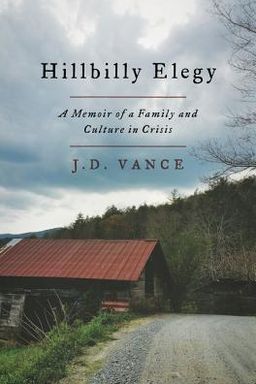
Hillbilly Elegy cover

Hillbilly Elegy

by JD Vance

Hillbilly Elegy is a raw and inspiring memoir by J.D. Vance, chronicling his journey from a troubled Appalachian upbringing to success in Silicon Valley. It explores themes of resilience, family influence, and the socio-economic challenges faced by working-class America.

The Struggle for Upward Mobility in America's White Working Class

Why is it so hard to climb out of poverty even when the path seems straightforward—work hard, get educated, stay sober? In Hillbilly Elegy, J.D. Vance contends that the obstacles facing the white working class in Appalachia and the Rust Belt are not just economic but deeply cultural. The book is part memoir, part sociological exploration, and part emotional reckoning with how family dysfunction, cultural pride, and learned helplessness conspire to hold people down even in a country built on the promise of upward mobility.

Vance’s story begins in Middletown, Ohio, where he grew up in a blue-collar family haunted by the ghosts of Appalachian poverty. His grandparents—Mamaw and Papaw—had fled Kentucky’s coal country in search of better jobs, yet they carried cultural baggage: a fierce loyalty, violent honor traditions, and a reflexive distrust of outsiders. Their proverbs shaped J.D.’s early worldview—for instance, Mamaw’s maxim that God helps those who help themselves became a cornerstone of his eventual success. But his childhood was chaotic, defined by instability, addiction, and a revolving door of stepfathers. The triumph he eventually achieved through the Marine Corps, college, and Yale Law School is presented not as proof of individual genius but as an anomaly made possible by rare familial intervention and luck.

Understanding the Hillbilly Paradox

The heart of Vance’s argument lies in the contradiction he calls the hillbilly paradox. The people of his world value family, religion, loyalty, and patriotism, yet these same values often fuel resentment, tribalism, and denial. His family’s motto—never betray your people—translates into a resistance to change. As the reader discovers, this dogged loyalty makes it hard for hillbillies to adapt to modern society. They defend their culture even when it harms them, refusing to acknowledge that their communities are collapsing under drug addiction, broken families, and economic stagnation. This emotional barrier—choosing pride over reflection—is, according to Vance, one of the most destructive forces in the white working class.

Culture and Family as Both Burden and Salvation

At the book’s emotional core is the figure of Mamaw, Vance’s maternal grandmother, who embodies both the violence and the love of Appalachian life. She cursed liberally, carried a pistol, and once set her husband on fire for coming home drunk—yet she also gave J.D. stability, teaching him self-discipline and love. Her contradictory toughness and tenderness saved him from the chaos of his mother Bev’s addiction and endless romantic turmoil. Through her, Vance argues that family can either perpetuate dysfunction or provide the scaffolding to escape it. In one striking passage, Vance writes that children in unstable homes long not for perfection but for peace. Mamaw’s home gave him something rare in his culture: consistency.

Why the American Dream Feels Broken

Vance insists that the true crisis of America’s working class isn’t just economic decline but a moral one. Factories like Armco Steel disappear, jobs vanish, yet social behavior fails to adjust. People who claim to value hard work routinely quit jobs or refuse opportunities, blaming government or globalization instead of themselves. Sociologists call this learned helplessness: the belief that personal effort won’t change outcomes. The result is an identity crisis—people see themselves as victims of external forces while failing to acknowledge self-destructive habits. (This echoes Charles Murray’s observation in Coming Apart that class culture, not income, drives the gap between thriving and failing communities.)

The Broader Lessons

Vance’s journey from a chaotic childhood to Yale Law School offers more than an autobiography—it’s a meditation on identity, resilience, and society’s limits. The book explores the intersection of personal responsibility and structural disadvantage: poverty is sustained not only by lack of opportunity but by inherited behaviors and emotions. For readers, the lesson is urgent: success is possible, but only by confronting uncomfortable truths about one’s culture, habits, and self-narrative. Hillbilly Elegy forces you to ask whether cultural pride can coexist with honest self-assessment, and whether upward mobility in America still depends less on systems and more on the stubborn, unexpected love of one person—a Mamaw—who refuses to give up on you.


Family Chaos and Culture of Survival

One of the book’s most vivid portraits is Vance’s depiction of his family’s emotional ecosystem—an environment both violent and loyal. This chaos wasn’t random; it emerged from a culture shaped by Appalachian pride and historical poverty. His grandparents, the Blantons and the Vances, were hill people with a code that blended fierce honor and generational trauma. They raised children in an atmosphere where loyalty meant everything and disrespect could spark literal gunfire.

The Generational Echo of Violence

Mamaw and Papaw’s marriage reflected this paradox. Mamaw, who once nearly shot a thief for stealing her family’s cow, later poured gasoline on Papaw when he came home drunk. Yet they loved each other deeply and eventually reconciled after decades of marital warfare. Vance uses their story to explain how violence becomes normalized as passion—a cultural pattern that confuses self-destruction with devotion. This environment taught children to equate rage with love, leading to cycles of addiction and abuse that ripple across generations. In his own home, shouting matches were common; furniture flew, and forgiveness arrived as quickly as fury. The result was emotional whiplash—a survival culture that prized toughness but punished vulnerability.

Learning to Fight as a Way of Life

For young J.D., fighting was moral education. His grandmother taught him to defend his family’s honor, even if it meant throwing punches. The physical violence in his world wasn’t viewed as cruelty but as proof of courage. Later, he learned that such behavior transfers easily into adult conflict—people yell, quit jobs, and break relationships as readily as they once swung fists. By showing how childhood stress rewires the brain’s chemistry, Vance echoes research from Dr. Nadine Burke Harris and the Harvard Child Development Study on adverse childhood experiences (ACEs). Long-term exposure to fear, he notes, builds a hyperreactive nervous system—the body constantly bracing for the next blow.

The Dual Legacy of Mamaw

Mamaw transformed this chaos into stability for her grandson. Her toughness became discipline; her anger became protection. When J.D.’s mother spiraled into addiction, Mamaw gave him three rules: work hard, study, and help her with chores. She was his terminator, his guardian angel in a gun-toting disguise. This balance of chaos and love forms Vance’s central insight: family dysfunction can destroy—but love, even violent and messy love, can also redeem. The tools for survival are the same tools for salvation, depending entirely on who wields them and why.


Education and the Power of the Marines

By the time J.D. reached high school, he was drowning in academic failure and emotional instability. What rescued him wasn’t school—it was the Marine Corps. Vance calls it the place that finally taught him discipline, financial literacy, and self-respect. It served as a cultural detox from chaos and self-pity, proving that structured institutions can reprogram the mindset of learned helplessness.

The Military as Reprogramming Ritual

Boot camp was the moment J.D. realized how deeply his environment had conditioned him to doubt himself. When a drill instructor slapped cake from his hands and called him “fat-ass,” Vance learned that toughness and humiliation could coexist without hate. Every obstacle—rope climbing, financial planning, physical exhaustion—taught him what psychologist Martin Seligman defines as “learned willfulness.” Where his hometown taught powerlessness, the Marines taught personal agency.

Discipline, Money, and Responsibility

The Corps demanded order even in civilian routines: bank accounts, car purchases, cleaning rooms. It replaced chaos with systems. The Marines required him to open a credit union account, comparison shop for loans, and manage medical checkups. These habits broke the cycle that plagued his peers—those who wasted paychecks or wrecked cars from impulse. For Vance, this institutional mentorship replaced the parenting he never had. It proved that the very behaviors his community mocked—obedience, learning, and consistency—could change a life.

Emotional Healing Through Service

His time in Iraq reinforced gratitude rather than cynicism. Seeing children beg for pencils taught him how lucky he was to be American and alive. The Marines reshaped his worldview: patriotism became not a defensive myth but a daily act of appreciation. This transformation completed what Mamaw had begun—giving J.D. both moral and emotional armor. His later success at Ohio State and Yale Law was not primarily academic but psychological: he’d learned that the deck may be stacked, but effort is still the only card worth playing.


Education, Yale, and Social Capital

The leap from Middletown to Yale Law was Vance’s cultural moonshot. At Yale, he discovered a world not just of wealth but of invisible networks—what sociologists call social capital. Nearly every peer came from intact, educated families. They understood how to dress, dine, and network. Vance, meanwhile, showed up for interviews in Marine boots and a lime-green shirt. Yet his struggle wasn’t intelligence—it was navigation.

The Hidden Curriculum of Success

Vance realized that elite success depends less on grades and more on comfort within systems of privilege. His classmates knew how to speak the language of opportunity: light talk at cocktail parties, polite confidence in job interviews, and access to mentors who could make introductions. For him, every social rule—from utensil choice to wine order—was an education in itself. Professor Amy Chua, who became his mentor, decoded this world, teaching him that power is transmitted through networks, not just effort. (Note: This parallels Malcolm Gladwell’s discussion of “cultural capital” in Outliers.)

Learning to Ask for Help

At Yale, Vance also learned that connection multiplies opportunity. A professor’s recommendation or friend’s advice could alter a career path. When he sought prestigious clerkships, Chua intervened, reminding him not to chase credentials but meaning: prioritize relationship and stability over prestige. Her counsel—alongside the emotional support of his girlfriend, Usha—helped him break free from the hillbilly reflex of prideful isolation. Asking for help became his new form of courage.

Culture Shock and Belonging

Yet success came with alienation. Vance felt torn between two worlds: the elite that saw him as exotic and the working class that would call him a sellout. This internal divide—the struggle to belong in both yet fully in neither—is one of the book’s most painful themes. It exposes the emotional toll of mobility. Upward movement, he learns, means leaving behind not just poverty but identity. The cost of success is not financial debt but cultural orphanhood.


The Psychology of Learned Helplessness

Vance argues that while external forces—globalization, automation, inequality—contribute to working-class decline, the deeper problem is psychological: a learned belief that effort doesn’t matter. This mindset poisons everyday behavior, from job performance to parenting, and ultimately undermines hope itself.

The Cycle of Powerlessness

In his childhood town, Middletown, people blamed government or immigrants for their struggles even when personal laziness was evident. Vance cites examples of neighbors quitting jobs out of boredom, then complaining about politicians. This pattern forms a feedback loop: when failure is externalized, ambition dies. Mamaw called this “bullshit thinking”—the belief that life is rigged, so you might as well not try. Vance learned to resist it, though he admits that the habit of self-pity runs deep.

The Science of Stress and Emotion

As adults, those raised in chaos carry stress responses that never turn off. Harvard researchers call this hypervigilance—a psychological switch permanently set to fight-or-flight. For hillbillies, every emotional disagreement feels like survival. This explains why conflict, especially in relationships, echoes home violence. Breaking this pattern requires emotional reprogramming. Usha’s influence helped Vance do that, teaching him that communication isn’t combat and apologies aren’t weakness.

Recovering Personal Agency

Ultimately, learned helplessness is learned avoidance. The only antidote is choice—small, daily proof that effort brings change. For Vance, joining the Marines, working multiple jobs, and finishing college were acts of rebellion against psychological captivity. His story offers proof that altering the inherited script of failure starts not with policy but with mindset. The lesson isn’t just about Appalachia—it’s about anyone conditioned to believe that improvement is out of reach.


Faith, Patriotism, and Cultural Identity

Religion and patriotism serve as twin pillars of hillbilly identity. Mamaw’s faith was raw and personal—no organized church, just prayer, Scripture, and conviction that God rides shotgun. Vance contrasts this sincerity with institutional decline: Appalachia remains devout in speech but detached in practice. Churches have become emotional theaters rather than social anchors, leaving poor families without the communal support that once kept them afloat.

Faith as Comfort and Escape

When Vance lived with his biological father, Don Bowman, he joined a Pentecostal congregation that fused strict moral codes with literal theology. He found belonging there but also learned how religion can isolate rather than empower. The preachers warned against secular science, gay rights, and worldly corruption—teaching fear instead of growth. Yet faith also offered structure and sobriety, keeping Bowman’s family cohesive. Religion was paradoxical: a restraint that preserved morality but sometimes discouraged curiosity.

The Decline of Communal Life

Vance shows how the erosion of religious institutions parallels the collapse of civil society. When church attendance dropped, so did volunteerism and neighborly trust. In Mamaw’s day, church groups provided child care and sobriety support; by Vance’s youth, they provided only rhetoric. The gap left people searching for meaning in conspiracies and resentment. Patriotism filled that void—America became the hillbilly God. Yet the modern loss of national faith, especially during the Obama years, felt like a spiritual betrayal to people who once saw the flag as divine.

A Faith Worth Keeping

By book’s end, Vance retains Mamaw’s brand of religion: humble, grateful, self-directed. He still tears up at patriotic songs and credits America as both savior and home. But his faith evolves from superstition to responsibility—the idea that spiritual life and civic duty depend on care, not complaint. You can honor your country and God, he argues, only by embodying their best traits: compassion, integrity, and hope.


Breaking the Cycle: Personal Responsibility and Community Renewal

In his conclusion, Vance rejects magical solutions—no government policy or economic reform can heal cultural wounds overnight. The real change must begin within families and communities. His plea to readers is both pragmatic and moral: stop blaming elites and start rebuilding from the inside out.

Family and Accountability

Vance identifies responsibility as the missing value in modern working-class life. Mamaw always told him that success meant owning your mistakes. Her advice contrasts starkly with neighbors who stole food, skipped work, or stayed home on welfare while congratulating themselves for “working harder.” He argues that honesty within families—acknowledging addiction, neglect, and toxic behavior—is the first step toward renewal. Sympathy must coexist with tough love; sugarcoating dysfunction perpetuates it.

Policy as Limited Medicine

Vance supports policies that strengthen family structures—like flexible foster laws allowing relatives to care for children—but he warns against expecting bureaucracy to substitute for kinship. Government can help at the margins; culture must fix itself. When he revisits Middletown years later, he’s struck by how anger toward outsiders masks the communities’ unwillingness to confront internal decay. People chase scapegoats instead of solutions.

Hope Through Honest Reflection

The core message of Hillbilly Elegy is not despair but accountability. Vance’s journey—from abused child to Yale graduate—demonstrates that progress requires facing your own reflection, however painful. His call to action echoes the advice Mamaw once gave him: “You can do anything you want to, but first you’ve got to stop being a lazy piece of shit.” In the end, that blunt wisdom is both the morality and the medicine that working-class America still needs.

Dig Deeper

Get personalized prompts to apply these lessons to your life and deepen your understanding.

Go Deeper

Get the Full Experience

Download Insight Books for AI-powered reflections, quizzes, and more.