
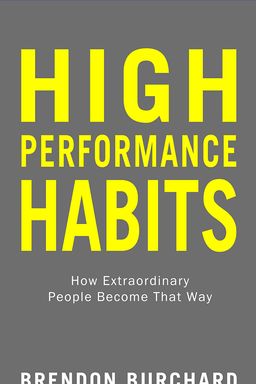
High Performance Habits cover

High Performance Habits

by Brendon Burchard

High Performance Habits reveals the secrets behind the world''s most productive individuals. Brendon Burchard uncovers six essential habits that transform ordinary lives into extraordinary achievements. Learn how clarity, energy, and courage can propel you toward unparalleled success.

The Six Habits of High Performance

What makes some people sustainably excellent while others fade after bursts of effort? In High Performance Habits, Brendon Burchard argues that extraordinary success is not about talent, personality, or luck—it's a result of six deliberate, trainable behaviors. These habits emerged from decades of global research with thousands of high achievers. The core message: high performance is behavioral and learnable, not genetic or accidental.

Burchard calls them the HP6: Seek Clarity, Generate Energy, Raise Necessity, Increase Productivity, Develop Influence, and Demonstrate Courage. Each habit represents a set of learnable practices that, together, create extraordinary results and deeper well-being. They are universal—they work whether you are an athlete, entrepreneur, teacher, or parent.

Why Habits Matter More Than Traits

Early in his coaching career, Burchard received an email from Tom, an INTJ achiever frustrated with self-help labels. That note hit home: personality frameworks describe tendencies but not sustained success. Burchard concluded that relying on fixed traits limits growth. Instead of waiting for strengths to save you, you deliberately practice habits that predict success.

High performers across cultures proved this. His High Performance Indicator (HPI), validated with 30,000 people from 195 nations, revealed that sustained excellence correlates not with demographics or personality, but with daily behavioral patterns. You can train them, measure them, and improve them.

The Six Core Habits

Seek Clarity: You define who you want to be, what you value, and how you wish to interact. High performers script their future identity and revisit it weekly. They decide in advance what emotions they want to feel during key moments (for example, choosing calm before high-stakes meetings). They connect clarity with meaning by aligning enthusiasm, connection, satisfaction, and coherence.

Generate Energy: You nurture physical, emotional, and mental vitality. Through simple rituals—like the Release Meditation Technique, mindful transitions between tasks, and daily joy triggers—you recharge instead of burning out. Physical movement and sleep hygiene become performance assets, not chores.

Raise Necessity: You turn desire into duty. High performers act like what they must do is non-negotiable. They combine internal identity (“I’m the kind of person who finishes what I start”) and external obligations (“People depend on me”). The synergy of identity, obsession, duty, and urgency lifts performance beyond motivation.

Increase Productivity: You produce prolific quality output (PQO) instead of busyness. Focus narrows onto five pivotal moves that drive major goals. You protect deep-work blocks, use frequent resets, and concentrate on completing high-impact projects rather than multitasking shallow tasks. The rhythm of effort becomes deliberate and sustainable.

Develop Influence: You serve and uplift others to create mutual success. This is social mastery—the ability to teach people how to think, challenge them to grow, and role-model desired behaviors. Leadership becomes service, not dominance, and courage becomes contagious through example.

Demonstrate Courage: You take meaningful risks despite fear. Courage isn’t recklessness—it’s consistent willingness to act honorably even when it’s hard. To “honor the struggle,” as Burchard says, is to view hardship as growth instead of misfortune.

Evidence-Based and Universal

Unlike vague motivational advice, the HP6 rests on metrics, interviews, and scientific validation. People who practice these habits score higher in confidence, health, and life satisfaction. The system also integrates with cognitive models of deliberate practice (Anders Ericsson) and mindset theory (Carol Dweck)—both emphasizing that mastery grows through structured repetition and feedback.

Every habit can start small. High performers use prompts, journaling, and accountability triggers. They prime themselves—alarms with aspirational words, questions before meetings, meditation between tasks—to stay deliberate. Over time, these habits compound into stability and excellence.

The Outcome: Sustained Excellence

The promise of High Performance Habits is liberation from randomness. Success becomes predictable. You don’t need to be fearless or gifted—you need structured intention. The HP6 forge clarity, energy, productivity, and courage into a disciplined way of living. Burchard’s coaching data shows that people who commit to them not only achieve more but also experience greater health, happiness, and confidence.

Bottom Line

High performance is not natural—it’s intentional. If you treat these six habits as daily practices rather than traits, your growth accelerates exponentially. The world’s best are not different kinds of people; they are people practicing different kinds of habits.

Once you see that, excellence stops being mysterious. You can start building it immediately, one habit at a time, no special personality required.


Seek Clarity

Clarity is the foundation habit—the compass that directs every other performance behavior. Without it, you drift. Burchard reveals that high performers constantly refine their vision in four domains he calls the Future Four: self, social, skills, and service. Together, these shape identity and direction.

Envision Yourself and Define the Future Four

Start by articulating who you want to be. High performers describe their future selves vividly and act accordingly. Kate, a case study executive, reignited enthusiasm when she anchored her days to three aspirational words—alive, playful, grateful—and set reminders during her workday. You can do the same. It’s less introspection and more identity design.

Next define your social clarity—how you want others to experience you and what legacy you’ll leave in relationships. Then clarify skills (short-term mastery for impact and long-term growth), and service (how your work serves others). These become your weekly journaling anchors to keep meaning alive in motion.

Choose Emotions Deliberately

Burchard differentiates emotions (automatic reactions) from feelings (chosen interpretations). High performers decide beforehand what emotional states they want to experience. Before calls or workouts, they ask, “How do I want to feel?” They then act in ways that produce those emotions—often transforming stress into calm readiness. Olympians visualize and practice those states until they’re habitual responses under pressure.

Attach Meaning: The Energy Multiplier

Meaning integrates the Future Four into one motive. Burchard defines it through a formula: enthusiasm + connection + satisfaction + coherence = meaning. When you regularly reconnect with what excites and aligns you, motivation becomes sustainable. Meaning is the antidote to burnout—it reminds you why effort matters.

Weekly Clarity Prompt

List your Future Four priorities and ask: “What feelings do I want to generate this week?” This single reflection creates agency and course correction.

Clarity expands with repetition. The more often you define who and how you want to be, the less reactive you become. It’s not a one-time epiphany—it’s a lifelong calibration of meaning and intention.


Generate Energy

If clarity gives direction, energy fuels execution. Burchard defines energy broadly as mental vibrancy, emotional positivity, and physical vitality. The best don’t wait for good days—they manufacture them through practice.

Master Transitions

High performers protect their focus between tasks using the Release Meditation Technique. Close your eyes, say “release” for about 60 seconds to drop tension, then state your next intention (“I’ll bring joy and patience into this meeting”). Arjun, a tech founder, rebuilt family harmony by doing this ritual in his car before entering home—it literally changed his evenings.

Bring the Joy

Joy is not an accident; it’s a performance choice. Burchard sets reminders (e.g., “BRING THE JOY”) and asks morning questions: “What can I be excited about today? Who can I appreciate?” These triggers measure emotional engagement as seriously as time management does tasks. Clients report that after a month, energy and creativity skyrocket.

Optimize Health

Movement, rest, and nutrition form the biological base. The top 5% of high performance respondents exercise more often and sleep more regularly than their peers. You don’t need extremes—two strength and two cardio sessions weekly suffice. Prioritize sleep duration over gadgets, and treat physical vitality as asset management.

Energy Reset Checklist

  • Do 60-second releases between major tasks
  • Answer three joy questions each morning
  • Move four times weekly, sleep seven hours nightly

Energy is cumulative. If you ritualize transitions, prime joy, and protect your health, vitality becomes predictable, not accidental. That steadiness distinguishes high performers from merely busy achievers.


Raise Necessity

Necessity converts desire into discipline. When goals become personal imperatives, excuses evaporate. Burchard breaks it down into the Four Forces of Necessity: identity, obsession, duty, and urgency.

Identity and Obsession: Internal Fuel

High performers link performance to identity—“This is who I am.” They check alignment frequently. Combined with healthy obsession—deep curiosity and fascination—it creates sustained focus. Obsession here is positive persistence, not unhealthy addiction. It’s what drives mastery long after external praise fades.

Duty and Urgency: External Pressure

You often act more strongly for others than yourself. Burchard urges leveraging duty—someone needs you to be excellent. Urgency adds time-bound consequence. The Marine Isaac, who recovered from severe injury, found strength through duty to his squad and identity as a Marine. This mix birthed unstoppable resolve.

Raise Necessity Daily

Use desk triggers (“Who needs me on my A game?”), public commitments, and peers who expect excellence. Social contagion raises performance. Surround yourself with people who lift your standards without replacing compassion.

Necessity Reminder

Declare why your effort matters today, out loud. Hearing your reason strengthens resolve and makes excellence inevitable.

Necessity redefines motivation. Instead of seeking inspiration, you create obligation—internal and external. When excellence feels required, consistency follows naturally.


Increase Productivity

Productivity is not about doing more—it’s about producing what matters. Burchard’s formula is Prolific Quality Output (PQO), directed toward your primary field of interest (PFI). The process eliminates distraction and replaces busyness with strategic focus.

Chart Your Five Moves

Ask: if you could accomplish your next big goal through just five major actions, what would they be? Each move becomes a project with milestones and deadlines. Burchard used this method to reach bestseller status by focusing only on writing, list building, bonuses, promotion pages, and partnerships. That clarity breeds momentum.

Optimize Deep Work and Renewal

Time blocking anchors productivity—protect about 60% of your week for Five Moves and the rest for collaboration. Every 45–60 minutes, pause to stretch and breathe. These micro resets maintain focus and prevent cognitive exhaustion. Real deadlines (not arbitrary preferences) sustain urgency without chaos.

Refine Through Progressive Mastery

Aligned with PQO, Burchard introduces progressive mastery—structured skill growth that attaches meaning, tracks metrics, and teaches others. His own path in public speaking—from full script to note-free delivery—proved that deliberate, measurable effort accelerates competence faster than repetition alone.

Weekly Focus Prompt

Write your five moves, schedule deep work blocks, and ask, “Is what I’m doing producing PQO?” Efficiency matters only when output is meaningful.

You reclaim confidence when your schedule reflects priorities. Productivity becomes character in motion—discipline expressed through choices that protect your most significant work.


Influence and Courage

The social dimension of high performance lies in how you lead and serve. Burchard’s final habits—Influence and Courage—extend the individual journey into collective impact. Influence spreads behavior; courage sustains authenticity.

Influence: Teach, Challenge, and Model

Influence grows from service, not control. You shape how people think, challenge them to grow, and role-model the standard. Juan’s story illustrates transformation: instead of dominating meetings, he applied Burchard’s Ultimate Influence Model, taught his team to think collaboratively, invited rivals to present, and shifted culture by example. Teaching reframes identity; modeling proves credibility.

Influence multiplies when you connect emotionally first, then raise ambition. Ask others better questions, offer challenges that build character and connection, and display vulnerability. Leadership through example turns trust into action.

Courage: Honor the Struggle

Courage means doing the right thing despite discomfort. Brendon’s mantra—honor the struggle—frames adversity as the path to growth. Courageous acts are small: speak up, ask for help, reveal your goals. Sandra’s story, leaving an abusive relationship after one honest video, shows how simple truth-telling can save lives.

To build courage, choose one hardship to confront, one ambition to declare, and one person to fight for. You transform fear into duty, and struggle into strength.

Courage Anchor

Fear isn’t the enemy—inaction is. Each brave microstep compounds confidence until action becomes character.

Influence and courage reinforce each other. Influence without courage lacks conviction; courage without influence lacks scale. Practiced together, they turn excellence into leadership and impact.


Avoiding Decline and Building Confidence

Sustained success requires vigilance. Burchard identifies three traps—superiority, dissatisfaction, and neglect—that erode performance, and three pillars—competence, congruence, and connection—that build resilient confidence.

Beware the Three Traps

Superiority isolates you. The story of Dreadful Don, a VP whose arrogance broke rapport, warns that pride destroys feedback loops. Dissatisfaction leads to burnout—celebrate progress instead of chasing endless comparison. Neglect stems from imbalance—ignore health or relationships and results eventually collapse.

Antidotes include humility rituals (asking questions even of juniors), gratitude journaling, and weekly life reviews across domains to keep perspective balanced.

The Confidence Formula

Confidence grows behaviorally through the 3 C’s: competence, congruence, and connection. Competence means deliberate skill building—the same progressive mastery methods fuel it. Congruence means living your declared identity; each consistent action reinforces self-trust. Connection means open curiosity and service toward others. Together, they compound belief in your own capability.

Aurora’s green-room vignette shows how recalling past successes and aligning with purpose instantly rebuilds state-based confidence. It’s proof that mental reframing can restore performance in minutes.

Confidence Equation

Curiosity × (Competence + Congruence + Connection) = Confidence. Each habit supports the others until belief becomes self-sustaining.

Vigilance keeps growth alive. If you maintain humility, gratitude, balance, and deliberate confidence-building habits, your success becomes stable and your influence expands naturally over time.

Dig Deeper

Get personalized prompts to apply these lessons to your life and deepen your understanding.

Go Deeper

Get the Full Experience

Download Insight Books for AI-powered reflections, quizzes, and more.