
Idea 1
Maximizing Managerial Output in a Complex World
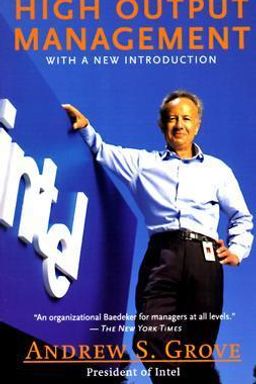
How can you multiply your team’s performance without simply working harder? In High Output Management, Andrew S. Grove, legendary CEO and co-founder of Intel, argues that the true measure of a manager is not what they directly produce, but what they enable others to produce. He contends that productivity in management—like in manufacturing—depends on designing effective systems, measuring results, and focusing on leverage: the activities that yield the greatest impact for the time spent.
In Grove’s own words, “A manager’s output equals the output of their organization plus the output of the organizations under their influence.” This deceptively simple formula captures the essence of his philosophy: managers succeed not by doing more, but by amplifying the effectiveness of the people, processes, and decisions around them. It means the best managers focus their time like engineers focus on optimizing systems—maximizing throughput, reducing bottlenecks, and preventing waste.
From Semiconductors to Systems Thinking
Grove’s insights stem from decades leading Intel through explosive growth, intense competition, and technological revolutions. Drawing on his engineering background, he insists that management is a process like any other production line—one that can be measured, optimized, and improved. He uses vivid analogies to make this concrete, such as the “Breakfast Factory,” where boiling an egg becomes a metaphor for identifying and managing limiting steps in a production flow. Whether you are delivering software code, selling products, or educating students, you’re running some variant of a factory that converts inputs (time, knowledge, raw materials) into valuable outputs.
The Three Core Ideas: Output, Leverage, and Motivation
Grove builds his book around three interconnected pillars. First is output orientation—treating managerial work as a production system whose performance can be measured by the results of the group, not the effort of the individual. Second is leverage—the principle that not all managerial actions are created equal. Some activities, like effective meetings, training, or decision-making, produce impact hundreds of times larger than the time invested. High-output managers consciously choose and design these high-leverage activities. Third is motivation—the human side of performance. Drawing inspiration from Abraham Maslow and sports psychology, Grove argues that managers must create environments where people are driven by purpose, not fear, and aim for their personal best.
A Manual for the Modern Middle Manager
Although Grove ran one of Silicon Valley’s most powerful companies, his book focuses on an often-overlooked group: middle managers. They are, he insists, “the muscle and bone” of every organization. In a globalized, fast-moving economy, middle managers face competing demands—strategic decisions from above and operational pressures from below. Grove equips them with mental models and tools: how to run effective meetings, how to make clear decisions under uncertainty, and how to plan like a production engineer. He reframes management as a team game, where the goal is not perfection but adaptability—“let chaos reign, then rein in chaos.”
Why These Ideas Still Matter
Decades after its publication, High Output Management remains a foundational text for leaders from Silicon Valley startups to multinational firms. Ben Horowitz, in his foreword, calls it “the best book on management ever written” because it teaches not just how to manage competently, but how to be great. Grove’s emphasis on systems thinking, transparency, and continuous learning anticipated today’s agile practices, OKRs (Objectives and Key Results), and data-driven decision making. His philosophy—rooted in disciplined execution, candid feedback, and relentless improvement—captures the DNA of high-performing organizations like Google, which built its management framework directly from Grove’s methods.
“If you don't know where you’re going, any road will get you there.” — Andrew S. Grove
In the chapters ahead, Grove takes readers on a journey from the factory floor to the executive boardroom, from tactical techniques to philosophical principles. He shows how to structure work like a system, manage teams as interconnected units, decide with clarity, and lead people to achieve their best. The lessons in High Output Management are not about managing for control—they are about managing for results. In the process, Grove transforms management from an abstract art into a rigorous, teachable discipline.