
Idea 1
Hidden Valley Road and the Genetics of Madness
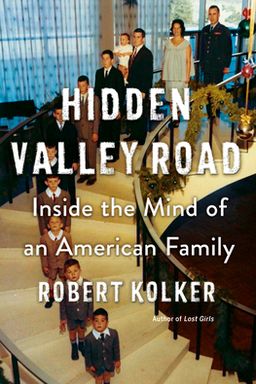
How does one family become both a tragedy and a cornerstone of psychiatric science? In Hidden Valley Road, you follow the Galvin family of Colorado Springs—Don and Mimi and their twelve children, six of whom develop schizophrenia—and watch as their private suffering becomes public data that transforms mental health research. The author situates their story not just as a narrative of illness but as a living case study through which questions of nature, nurture, trauma, and scientific progress intertwine.
A Family at the Crossroads of Science and Stigma
From the 1940s through the 1990s, the Galvins’ home on Hidden Valley Road becomes a microcosm of the field’s evolution. In an era when Freudian thought dominated psychiatry, mothers were blamed for their children's delusions. Mimi Galvin, exacting and ambitious, became the archetype that mid-century analysts would have called a “schizophrenogenic mother.” But decades later, geneticists saw her family differently—a powerful real-world laboratory that signaled inherited vulnerability rather than parental fault. The six brothers’ psychosis drew researchers like Lynn DeLisi and Robert Freedman, who preserved their blood, compared affected and unaffected siblings, and helped guide psychiatry toward a biological model of mental illness.
From Household Chaos to Genetic Insight
You see schizophrenia not as a set of abstract charts but as lived experience: Donald’s fiery religious hallucinations, Jim’s violent mood swings, Brian’s suicidal despair, and Peter’s alternating lucidity and psychosis. Meanwhile, Mimi and Don navigate the impossible—pretending before neighbors that the family is fine while locking doors at night and rushing children to state hospitals. This dual reality—public poise, private terror—mirrors society’s discomfort with mental illness: a need to contain, medicate, and conceal.
The Search for Biological Markers
The Galvins become one of the most studied multiplex families in psychiatry. Their participation leads to discoveries like Freedman’s double-click auditory test, which measures sensory gating deficits linked to the CHRNA7 gene and α7 nicotinic receptor—a physiological clue explaining why some brains can’t filter stimuli effectively. Such findings reshape schizophrenia from a mysterious “split mind” into a measurable neural disorder. Later advances, like DeLisi’s identification of an SHANK2 mutation in the family’s DNA, build on this groundwork, showing how shared genetic patterns can isolate rare variants that influence synaptic signaling.
The Cost of Discovery
Science’s dependence on the Galvins carries ethical costs. Their DNA and medical histories circulate in labs long after the siblings themselves fade from public memory. For them, participation offers no cure—only the uneasy honor of being indispensable. Yet their cooperation pushes the field toward a shift in thinking: from blaming families to understanding them as partners. The story reveals a paradox: the same household that was stigmatized for madness ultimately gave psychiatry a blueprint for understanding it.
Beyond Biology: Trauma, Healing, and Generational Change
Hidden Valley Road is also about what science overlooks. Beneath the measurable genes lie layers of trauma: sexual abuse, violence, secrecy, and a culture of silence that damaged the sisters, Margaret and Lindsay, as deeply as psychosis harmed their brothers. When Lindsay finds therapy with Louise Silvern and later becomes her brothers’ caregiver, you witness survival’s quieter form—the work of making sense of chaos and turning inherited pain into compassion. The next generation embodies cautious hope: better therapy, earlier interventions, and the possibility that understanding vulnerability can prevent repetition.
Central theme
The Galvins’ story argues that schizophrenia is neither pure biology nor pure trauma but a dialogue between the two—and that progress, whether scientific or personal, begins when stigma and secrecy finally yield to open inquiry and empathy.
Through its mix of family narrative and scientific detective work, the book becomes both heartbreaking and instructive: a mirror for how mental illness shapes identity, family, and the moral responsibilities of science itself.