
Idea 1
Mathematics, Race, and the Making of American Flight
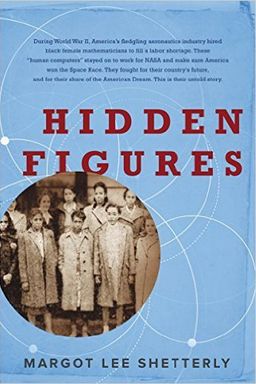
What happens when a war-driven scientific revolution meets the boundaries of segregation? In Hidden Figures, the story of the West Computers at Langley Memorial Aeronautical Laboratory reveals how African American women mathematicians transformed both aeronautical research and civil rights. The book argues that the struggle for equality and the pursuit of technological progress evolved in parallel—each feeding the other in surprising ways.
This narrative traces the journey from World War II’s desperate demand for mathematicians to the dawn of the Space Age. You follow how women like Dorothy Vaughan, Mary Jackson, and Katherine Johnson entered the nation’s most elite research spaces under the banner of wartime necessity and stayed to shape American aerospace dominance. Alongside them, you witness a broader transformation: the federal government’s wartime pragmatism forcing cracks in Jim Crow and the rise of a meritocratic ideal that, though imperfect, slowly eroded old barriers.
Wartime Opportunity and the West Computers
Langley’s expansion during World War II created an urgent need for human computers—people trained to perform the mathematical calculations engineers required. Melvin Butler’s 1943 telegram for more labor, combined with A. Philip Randolph’s activism and Roosevelt’s Executive Order 8802, opened the door for Black women mathematicians from institutions like Hampton Institute and West Virginia State. The result was the segregated West Area Computing unit, staffed by women whose talent quietly defied social prejudice.
Dorothy Vaughan left teaching to join this group; others like Miriam Mann and Lessie Hunter followed. They worked within a separate building, with separate bathrooms and cafeteria tables labeled “COLORED COMPUTERS.” Yet from this segregated corner, they computed data that underpinned crucial projects such as the P-51 Mustang and B-29 Superfortress, contributing directly to Allied victory. Their presence in the laboratory became both an act of service and subtle resistance—proof that intellect recognized no color line.
Postwar Expansion and Emerging Careers
After the war, Langley remained a crucible of innovation and opportunity. The so-called “computers” moved from rotating assignments in central pools to permanent positions in specialized divisions: Compressibility, Flight Research, and Stability Analysis. Mentorship and technical proximity mattered—those who worked directly with engineers earned credibility and coauthorships. Dorothy Hoover collaborated on swept-wing theory with R.T. Jones; Mary Jackson’s on-the-job experience in supersonic tunnels led to engineering promotion; Katherine Johnson’s skill in trajectory analysis positioned her for the space program.
Langley functioned less like a workplace and more like a scientific apprenticeship system. Women attended night classes, studied physics from instructors like Kaz Czarnecki, and turned wartime training programs into steppingstones to engineering. This framework prepared them for the coming revolution—the arrival of electronic computers and space exploration.
Technology Meets Civil Rights
The saga of the West Computers runs parallel to the Black freedom struggle. Community activism, the Double V campaign, and legal challenges like Morgan v. Virginia formed the moral backdrop of these women’s quiet defiance. At Langley, Miriam Mann’s removal of the cafeteria’s “COLORED COMPUTERS” sign embodied small acts of courage that prefigured the larger civil rights movement. Each mathematical report and removed placard chipped away at the same barrier by different means—one political, the other institutional.
By the 1950s, as Richard Whitcomb’s Area Rule reshaped transonic flight, Dorothy Vaughan foresaw the next challenge: the rise of electronic computation. She trained herself in FORTRAN programming and prepared her staff to transition from hand calculators to room-sized IBM machines—a masterclass in adaptive leadership. Her transformation sustained her career and kept Black women integral to NASA’s computational future even as the nature of work changed.
From NACA to NASA: Integration and The Space Race
Sputnik’s launch in 1957 redefined American science. In the rush to close the perceived “missile gap,” Langley’s expertise became central to spaceflight. Civil rights concerns now intersected with Cold War optics; racial inequity contradicted the image of American democracy. Integration accelerated under this pressure. When NACA became NASA in 1958, a one-line memo from Floyd Thompson dissolved West Area Computing. Segregation quietly ended—though at the cost of Dorothy Vaughan’s section head role.
Katherine Johnson rose within this newly integrated world. Insisting on her right to attend editorial meetings, she broke both procedural and cultural barriers. Her 1960 paper, “Determination of Azimuth Angle at Burnout,” coauthored with Ted Skopinski, became foundational for the trajectory calculations that enabled spaceflight. Two years later, when John Glenn refused to fly without her verifying the IBM 7090’s orbital data, her authority equaled that of machines and men alike.
Legacy and Cultural Visibility
In the 1960s, as Langley helped direct Mercury and Apollo missions, its calculations traveled through a new global tracking network linking Goddard, Bermuda, and worldwide ground stations. Behind this infrastructure stood the same human intelligence once confined to the West Area. Yet even as astronauts became household names, the contributions of women like Johnson, Vaughan, and Jackson were obscured. The public myth of the lone white male hero overshadowed collective, interracial teamwork—the “hidden figures” of progress.
By the time the civil rights movement crested, Mary Jackson had redirected her engineering success into advocacy, mentoring students and managing the Federal Women’s Program to ensure others advanced beyond her. This full-circle moment reveals the book’s moral arc: excellence, courage, and persistence make history, but only visibility completes justice. The intersection of race, gender, and science at Langley shows that progress—technological or social—is rarely linear; it is computed, contested, and earned in both equations and everyday acts of dignity.