
Idea 1
Making Advertising That People Actually Want
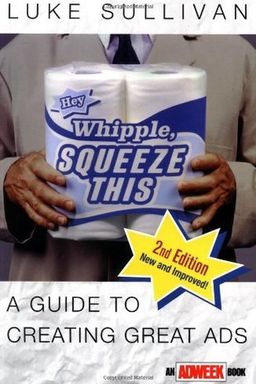
Why do people hate ads that still sell? Luke Sullivan’s Hey Whipple, Squeeze This explores one of modern marketing’s most enduring contradictions—the constant push-and-pull between creating advertising that persuades and advertising that humiliates, interrupts, or manipulates. Sullivan argues that you don’t have to sell out to sell; you can sell by telling the truth, by respecting intelligence, and by crafting messages that reward attention rather than steal it.
The central paradox of advertising
From the start, Sullivan contrasts two archetypes: the blunt sales tactic epitomized by Mr. Whipple (whose annoying Charmin ads sold billions of rolls), and the enduring creative revolution led by Bill Bernbach, who made people love ads again with wit, humanity, and truth. Bernbach’s Volkswagen “Lemon” and Alka-Seltzer campaigns showed that honesty and charm can move products just as effectively as hammering repetition. The choice between cynicism and craft determines whether your work builds trust or betrays it.
From manipulation to persuasion
Sullivan’s thesis is that good advertising starts with respect—for both product truth and audience intelligence. You aren’t trying to trick people or shout louder; you’re trying to help them see clearly. He shows how creatives can dramatize real benefits with wit rather than hyperbole. The “Avis: We’re only No.2” campaign didn’t fake confidence—it admitted weakness and turned it into a reason to buy. That honesty, and a distinct voice that preserves dignity, builds long-term equity rather than shallow attention spikes.
The creative struggle and process
Producing those ideas isn’t neat. Sullivan’s description of creativity—"washing the pig"—captures the chaotic, nonlinear nature of idea work. The five-step method borrowed from James Webb Young (gather, attack, incubate, Eureka, implement) provides a loose system but warns you not to expect assembly-line inspiration. You’ll fail constantly, feel lost often, but breakthroughs happen when your subconscious connects fragments you collected earlier. The emphasis: tolerate uncertainty, persist through the wash, and trust your intuition to surface strong ideas when you least expect them.
Building ideas from truth
Truth anchors everything. Sullivan’s recurring metaphors—the “pill inside the baloney” and “brand = adjective”—reinforce that clarity and honesty drive persuasion. The pill is your sales message; the baloney is entertainment or packaging. If the pill disappears inside the joke, the ad fails. Likewise, defining a brand as an adjective (“Volvo = safe,” “Nike = active”) simplifies every creative decision. You no longer sell a list of features; you dramatize one emotional word across executions, turning complexity into memorability.
Content and conversation
As media shifts to interactive and digital, Sullivan reframes advertising as something people seek out rather than avoid. “Content is king, conversation queen” explains how value-driven experiences—apps, films, stunts, and tools—replace interruption. Intel’s “Museum of Me,” Nike+’s community, or Old Spice’s interactive video responses show how brands can connect through involvement and reciprocity, not exposure alone. You design for participation, not passive viewing.
Experiences across media
The book concludes that media must follow ideas, not the other way around. Map the customer’s day, find real touchpoints, and give each medium a purpose—from print to app to store. Sullivan’s “press release test” asks: can you summarize your idea in one sentence worthy of headlines? If yes, it’s probably newsworthy enough to live across channels. The most powerful work doesn’t live in a single ad; it evolves into experiences, product changes, and cultural events—Burger King’s Chicken Fries, Dove’s “Evolution,” and Nike’s sensor kit are proof that creativity extends far beyond copy.
Ultimately, Sullivan wants you to rediscover why people liked advertising in the first place: because it entertained, enlightened, and respected them. Your goal isn’t just revenue; it’s relevance. Sell without selling out means proving truths in delightful ways, building ideas that earn attention, and staying faithful to craft even amid deadlines, metrics, and committee edits. Advertising at its best becomes not manipulation, but imagination in service of commerce—and that is the art Bernbach started, and Sullivan continues.