
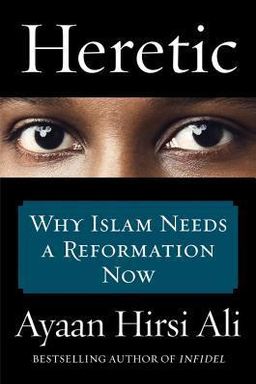
Heretic cover

Heretic

by Ayaan Hirsi Ali

Heretic by Ayaan Hirsi Ali is a provocative exploration of Islam''s need for reformation. It delves into the challenges of reinterpreting religious texts to eliminate violence and promote peace, offering hope for a global shift towards modernity and tolerance.

Reforming Islam for the Modern World

How can a centuries-old faith with 1.6 billion adherents come to terms with the twenty-first century? In Heretic: Why Islam Needs a Reformation Now, Ayaan Hirsi Ali confronts this urgent question with bold clarity. Once a devout Muslim, she evolved into one of Islam’s fiercest critics, arguing that the only path to peace—both within Muslim societies and between Islam and the modern world—is reforming the faith itself.

Hirsi Ali contends that what many in the West call Islamic "extremism" isn’t a fringe deviation but a legitimate, literal reading of Islamic doctrine rooted in the Qur’an and the Prophet Muhammad’s teachings. Islam, she argues, is not a religion of peace distorted by radicals—it contains both peaceful and violent elements, and unless those violent teachings are reinterpreted or rejected, violence in its name will persist. The problem, she insists, is not Muslims themselves but the ideology embedded in the religion’s foundations.

Islam’s Multiplicity and the Three Types of Muslims

Hirsi Ali begins by acknowledging that Islam is not monolithic. Rather than the usual Sunni-Shia division, she identifies three broad sociological groups: the Mecca Muslims, who are peaceful believers focused on personal piety; the Medina Muslims, fundamentalists who see violence and theocratic rule as religious obligations; and the Modifying Muslims, dissidents and reformers striving to reconcile faith with modernity. The first group represents the quiet majority, the second the violent minority grabbing headlines, and the third a small but courageous minority fighting for Islam’s soul.

In her view, the Medina Muslims are currently winning—through their certainty, global organization, and theological coherence. But she believes this dominance can be reversed by empowering Modifying Muslims and supporting liberal thought within Islamic societies, especially through the free exchange of ideas and open theological debate.

The Five Points of Reformation

Just as Martin Luther’s 95 Theses sparked Christianity’s Reformation, Hirsi Ali calls for five theological transformations to modernize Islam:

  • Open Muhammad and the Qur’an to interpretation—stop treating them as infallible and literally binding.
  • Prioritize life before death, shifting focus from the afterlife to worldly well-being.
  • Shackle sharia law, placing secular laws above religious edict.
  • End the practice of commanding right and forbidding wrong—Islam’s culture of social control and moral policing.
  • Abandon jihad as a literal call to arms, preserving inner spiritual struggle but rejecting holy war.

These five reforms are radical in theological terms but, Hirsi Ali insists, essential for the survival of Islam itself. They would move the Muslim world from the seventh century’s tribal values toward democratic, humanistic principles compatible with modern civilization.

The Stakes for the West

Hirsi Ali argues the West has a moral and strategic stake in Islam’s transformation. Liberal intellectuals, she claims, have failed by condemning criticism of Islam as “Islamophobic” while tolerating illiberal practices such as gender inequality and violent suppression of dissent. The West’s silence and misplaced tolerance, she warns, enable the Medina Muslims and imperil freedom of speech—the very value that made reform in Christianity possible centuries ago. Drawing analogies to the Cold War, she insists that Western societies must stop appeasing fundamentalism and instead ally themselves intellectually and morally with dissident Muslims pressing for change.

Ultimately, Heretic isn’t merely polemic—it’s a manifesto for intellectual emancipation. Hirsi Ali calls on Muslims to embrace reason, critical inquiry, and humanist ethics, and on Western liberals to stand with reformers rather than clerical enforcers of orthodoxy. The core message? Just as Christianity and Judaism were forced by history, reason, and revolt to reform, so too must Islam, if it hopes to coexist with freedom, equality, and modernity.


From Devotion to Dissent

Ayaan Hirsi Ali’s journey from a Somali Muslim childhood to outspoken critic of her faith is not only deeply personal—it’s emblematic of the conflicts millions of Muslims navigate today. In her memoir-like first chapters, she shows how devotion, fear, and rebellion shaped her understanding of Islam and why reform isn’t theoretical but existential.

A Childhood in Faith and Fear

Growing up in Somalia, Saudi Arabia, and Kenya, Hirsi Ali experienced Islam both as a source of ritual comfort and as a mechanism of control. From her grandmother’s Qur’anic recitations under the “talal tree” to her mother’s frequent invocations of hellfire, she internalized a God defined by punishment and fear. Early religious schooling blended rote memorization with corporal discipline—students who erred were struck while chanting verses about divine torment. This duality—the poetic and the punitive—was her first sign that Islam could nurture faith and cruelty in equal measure.

Later, living in Mecca and Riyadh, she saw sharia enforced literally: public beheadings, amputations, and stonings after Friday prayers. Her father, a more moderate man who stressed learning, clashed philosophically with her mother’s rigid devotion. This tension mirrored the broader split between Islam’s spiritual side and its political, coercive form—the same “Mecca versus Medina” framework that animates the book.

Embracing Fundamentalism

As a teenager in Nairobi, desperate for moral purpose, Hirsi Ali joined the Muslim Brotherhood. Inspired by a charismatic teacher, Sister Aziza, who presented Islam as both rational and empowering, she adopted the full hijab and its ideology. Religious identity gave her control and dignity amidst uncertainty—an emotion many young believers recognize. “Finally,” she writes, “I could please Allah, not just my family.” Yet this righteousness soon hardened into intolerance: she agreed that Salman Rushdie deserved death and considered violence against unbelievers moral. (This psychological conversion, she notes, mirrors the radicalization pathways of many recruits today.)

The Break with Faith

Her doubts began not from Western influence but from personal curiosity. As a girl she asked why women were valued less than men and was rebuked harshly. Only later, after fleeing an arranged marriage and seeking asylum in the Netherlands, did education unlock her skepticism. Studying political science at Leiden University, she encountered the Enlightenment thinkers—Descartes, Locke, and Mill—who emphasized reason over revelation. Seeing Dutch society’s peace and gender equality, she realized that a secular moral order could nurture virtue far better than religious fear. The terrorist attacks of September 11, 2001, became her tipping point: she saw the hijackers not as aberrations but as faithful adherents to the Medina model of Islam.

By the time she entered politics and co-created the documentary Submission (which led to filmmaker Theo van Gogh’s murder), Hirsi Ali had become what she calls a “heretic”—someone who loves truth more than tribe. Her story illustrates the psychological cost of apostasy—exile from family, death threats, and social ostracism—but also the liberation of using reason against inherited dogma. For her, leaving Islam was not betrayal but integrity. As she concludes, there must be a “third way” for Muslims: not submission or violence, but critical faith compatible with freedom.


Why Islam Resisted Reformation

Why did Christianity undergo a seismic Reformation while Islam, older and once at the forefront of science, has remained resistant to change? Hirsi Ali’s answer blends history, theology, and sociology: the problem is the fusion of religious and political power and the sanctification of the Qur’an as literal divine law.

Religion and Power Interwoven

Unlike Christianity, which developed a distinction between church and state, Islam from its inception married the spiritual and the political. The Prophet Muhammad was not just a preacher but also a ruler and warrior. This legacy persists in the concept of the ummah—a single community under divine law. As a result, questioning religious authority threatens political order. The ulema, or clerical scholars, view dissent as apostasy because it risks unravelling this theocratic unity.

Christianity’s Reformation, Hirsi Ali notes, succeeded because of historical circumstances: the printing press spread new ideas; urban merchants financed reform; and secular rulers found it politically useful to challenge papal authority. Islam, by contrast, suppressed its rationalist strain early on—when the Mu’tazilites, who championed reason, were crushed by traditionalists. From then on, “innovation” became a sin, and religious creativity stagnated. (Scholars like Patricia Crone and Bernard Lewis have documented this historical closure.)

Failed Modern Reformers

Hirsi Ali revives the forgotten stories of twentieth-century reformers like Ali Abdel Raziq, who argued for separating mosque and state, or Mahmoud Mohammed Taha, who urged Muslims to live by the tolerant verses of Mecca rather than the militant ones of Medina. Each was vilified or executed for heresy. Similarly, Iranian philosopher Abdolkarim Soroush and Egyptian scholar Nasr Abu Zayd faced exile for suggesting the Qur’an was partly human-authored. Their persecution, she argues, shows how Islam self-polices reform through a “doctrine of fear,” epitomized by the cleric Yusuf al-Qaradawi’s admission that without punishing apostasy, “Islam would not exist today.”

Even in modern universities, as Hirsi Ali’s own Harvard seminar revealed, Muslim students often treat theological inquiry as taboo. When she taught a study group on political Islam, several students interrupted her lectures to “correct” her, declaring that Islam cannot be questioned. This behavior, she notes, reproduces the medieval mindset that first silenced dissent.

Signs of Change

Yet Hirsi Ali detects early tremors of transformation. Technology, urbanization, and political necessity may now achieve what Luther’s printing press once did. She points to Egypt’s President Abdel Fattah el-Sisi’s 2015 call for a “religious revolution,” urging clerics at Al-Azhar University to revise Islam’s doctrines, as historic. Similarly, Muslim-majority countries such as the UAE and Tunisia are tentatively promoting moderation to counter extremism. In her view, these developments signal that a Muslim Reformation isn’t a utopian dream but a brewing cultural inevitability driven by disillusionment with militant Islam’s failures.

Still, she cautions: without honest theological debate—without confronting the texts themselves—political reform will remain superficial. The Muslim world must not only modernize its politics but also its metaphysics. Just as Luther opened the Bible to interpretation, Muslims must open the Qur’an to reason.


The Prophet and the Book

At the heart of Islam’s crisis, Hirsi Ali argues, lies the double sanctification of Muhammad and the Qur’an. Christians may worship a divine man, Jews a divine book—but Muslims worship both. This dual infallibility makes internal reform nearly impossible and external criticism deadly.

Muhammad: The Sacred Chieftain

Muhammad, as described in Islamic tradition, was not just a prophet but also a political leader and conqueror. His life in Medina enshrined tribal norms—patriarchy, honor, and warfare—into eternal religious law. Thus, practices like jihad, slavery, or polygamy that began as seventh-century expedients became moral ideals. Hirsi Ali contrasts this with Jesus, whose powerless suffering produced pacifism, or Buddha’s renunciation of power. Because Muhammad wielded the sword, authority and faith fused in Islam’s DNA.

This legacy still legitimizes intolerance. Questioning Muhammad’s perfection, as Saudi writer Hamza Kashgari did with a mild Twitter post, can provoke death fatwas. Hirsi Ali tells Kashgari’s story to illustrate how even symbolic irreverence triggers theocratic rage: “For tweeting that he wanted to shake the Prophet’s hand, he was jailed eight months.” This fear of blasphemy, she says, is incompatible with scientific and cultural progress.

The Qur’an: Text Beyond Time

No reformation can occur while the Qur’an is treated as God’s uncreated and final word. Muslims are taught that every syllable was dictated by Allah through Gabriel, making it immune to interpretation. Hirsi Ali recounts how any criticism of the text, even by respected theologians like Abu Zayd, leads to trials and exile. She reviews Western scholarship that challenges this rigidity, citing historians such as John Wansbrough and Fred Donner who suggest the Qur’an evolved over time and was compiled decades after Muhammad’s death. Such findings, though academic, could be revolutionary if accepted inside Islam.

For Hirsi Ali, the doctrine of abrogation—where later, more violent verses supersede earlier peaceful ones—is crucial. The Meccan verses call for spiritual patience; the Medinan ones for war. By sanctifying the latter, Islam embedded violence as divine. Reform would mean reversing the hierarchy—reclaiming Mecca’s compassion over Medina’s conquest. “If Muslims wish their religion to be one of peace,” she writes, “they need only abrogate the Medinan verses.”

The End of Blind Faith

To break this cycle, Muslims must accept what Catholic reformer Erasmus once said of scripture: that it belongs to its readers, not its guardians. Hirsi Ali calls for treating Muhammad and the Qur’an as historically situated, human phenomena—once radical but not timelessly binding. Until that happens, she warns, jihadists will always find divine ammunition for their violence. Reason must replace reverence as Islam’s highest virtue.

In this, she channels Enlightenment thinkers like Spinoza, who reinterpreted the Bible in historical terms, and insists the same intellectual courage is possible—indeed necessary—for Islam. The choice is stark: worship the Prophet and his book as unchallengeable or reclaim them as moral teachers open to scrutiny. Between these poles lies Islam’s future.


Sharia and the Chain of Constraint

For Hirsi Ali, sharia—the Islamic legal code derived from scripture—is the institutional heart of Islam’s stagnation. She likens it to a social straitjacket, designed to preserve seventh-century tribal norms at the expense of human freedom, especially women’s.

Law as Divine Decree

Sharia differs from Western law in purpose and spirit. Where modern legal systems regulate society while protecting individual rights, sharia treats legislation as a sacred duty enforcing morality. Its sources—the Qur’an, hadith, and juristic consensus—define not only crimes but personal behavior: dress codes, diet, marriage, and belief. This fusion of sin and crime, Ali argues, leaves no room for conscience or reform. Those who doubt or leave Islam can be killed not for harming others but for “harming God.”

The case of Sudanese woman Meriam Ibrahim exemplifies this cruelty. Pregnant and married to a Christian, she was sentenced in 2014 to death for apostasy and 100 lashes for adultery. Her baby was born while she was chained to a prison wall; her only path to freedom was to renounce Christianity. International outrage saved her, but only diplomatic pressure—not justice—freed her. Such punishments, Ali shows, stem not from extremism but from textual mandate: Qur’an 5:38 authorizes amputation; 5:33 sanctions crucifixion. To “shackle sharia,” Muslims must accept human law as superior to divine decree.

The Gendered Architecture of Control

Sharia enshrines patriarchy. A woman’s testimony counts half of a man’s, daughters inherit half their brothers’ share, and men may beat wives who “disobey.” Child marriage is sanctified by the Prophet’s example; divorce favors men; and laws against adultery require four male witnesses to prove rape. In practice, Ali notes, this becomes a license for impunity. The “guardianship” system in Saudi Arabia legally confines women to perpetual dependence on their fathers or husbands. Many defenders argue these rules protect women’s virtue; Ali calls it theocracy’s most refined form of slavery.

Culture of Fear and Honor

Beneath legalism lies the deeper mechanism of honor. Because family reputation replaces individual conscience, women’s bodies become symbols of male status. This fuels “honor killings,” where fathers or brothers murder daughters for alleged impropriety. In Pakistan alone, over a thousand such killings occur yearly. Yet clerics invoke sharia to excuse the perpetrators: the Qur’an warns men to control their wives and daughters. Thus, law and custom reinforce each other, perpetuating cruelty under the banner of virtue.

Hirsi Ali’s prescription is blunt: Muslims in the West must live under secular law, and Western governments must reject any accommodation of sharia in their legal systems. Human rights are indivisible. A legal order that condones rape by silence, slavery as “guardianship,” and murder as moral duty cannot coexist with modern values. To defend tolerance, we must stop tolerating oppression disguised as faith.


The Culture of Command and Conformity

Islam’s informal enforcement system—“commanding right and forbidding wrong”—is, to Hirsi Ali, one of the most potent tools of social control. It’s not about personal morality but policing others. Every believer becomes a vigilante of virtue, shutting down questioning before it begins.

Moral Policing as a Civic Duty

Derived from Qur’anic verses (3:104, 3:110, and 9:71), the injunction obliges Muslims to intervene when they see sin. Over centuries, it evolved into a theology of surveillance—precisely the function of Saudi Arabia’s mutaween (religious police) and Iran’s morality squads. In her Harvard classroom, Hirsi Ali recognized the same impulse: students interrupting to “correct” peers or professors in the name of piety. This reflex, she says, prevents not only reform but reason itself. How can free inquiry thrive when every deviation from orthodoxy is a communal crime?

Violence and the Family

Hirsi Ali traces the idea back to her own adolescence, when a half-sister reported her for questioning prayer rituals. In Muslim societies, she notes, repression starts at home. Daughters are beaten for disobedience; brothers kill sisters to “cleanse dishonor.” The same principle animates militants who punish apostates or gays: they’re “forbidding wrong” in divine defense. She cites chilling cases—a young man in Britain distributing fliers advocating death for homosexuals, and girls in Raqqa enslaved by ISIS women enforcing the hijab. Even murderers of women or apostates often claim religious justification, confident the community will protect them.

Silencing in the West

This culture didn’t stay confined to the Middle East. Among Western Muslim immigrants, Hirsi Ali documents rising cases of honor violence: Noor Al-Maleki run over by her father in Arizona; Amina and Sarah Said shot by theirs in Texas; Aqsa Parvez strangled in Canada. Communities often call such murders “private family matters” or accuse Western authorities of Islamophobia for intervening. At universities, moral intimidation appears in softer form—students opposing lectures critical of Islam under the pretext of “hate speech.” For Hirsi Ali, these are all manifestations of the same moral code that values conformity over freedom.

Her call to action is simple but urgent: Muslims must abolish the idea that enforcing virtue is a religious duty. Morality must become a matter of individual conscience, not community coercion. And Western liberals must stop confusing this enforcement with cultural “authenticity.” The true test of tolerance, she concludes, is whether we defend people’s right not to believe, obey, or conform.


Jihad and the Allure of Death

Few chapters are as chilling as Hirsi Ali’s analysis of jihad. While the West interprets it as a spiritual struggle, she shows that Islamic scripture and history define jihad primarily as warfare to expand the faith. In today’s globalized age, this doctrine fuels a transnational cult of death masquerading as heroism.

The Scriptural Arsenal

Verses like Qur’an 9:5 (“slay the pagans wherever you find them”) and 8:60 (“strike terror into the enemies of Allah”) form jihad’s core mandate. Across fourteen centuries, these words have legitimized conquest from Andalusia to Afghanistan. The transition from inner piety to armed struggle was completed in Medina, where Muhammad the statesman supplanted Muhammad the preacher. Modern ideologues like Sayyid Qutb and Abdullah Azzam revived this ethos, teaching that holy war is every believer’s duty until global Islamic rule is established. This ideological lineage, Ali argues, connects al-Qaeda, Boko Haram, and ISIS directly to canonical Islam, not to misinterpretation.

Jihad’s Western Recruits

In case after case—the Boston Marathon bombers, British soldier Lee Rigby’s killers, the Canadian shooter Michael Zehaf-Bibeau—Hirsi Ali finds the same pattern: the attackers were not impoverished but educated, often Westernized youth seduced by jihad’s promise of purpose. In social media’s echo chambers, war became self-expression: “a giant selfie,” she quips. Fighters like the Egyptian student Islam Yaken tweeted glamorous battlefield images; women like "Umm Layth" blogged about the bliss of waiting for news that their husbands had been martyred. Jihad, once a duty, had become a lifestyle brand.

Beyond Poverty and Politics

Contrary to Western pundits, Hirsi Ali insists jihad is not caused by poverty, alienation, or colonial grievances but by ideology. Citing the Qur’an and jihadist manifestos, she demonstrates how literal faith promises paradise to those who kill and die for God. Saudi and Qatari funding, she notes, has globalized this theology. Even Saudi Arabia’s “rehabilitation” programs for jihadists—offering ex-fighters cars, jobs, and wives—fail because they preserve jihad as a sacred concept while merely redirecting it. De-radicalization without doctrinal reform is, she warns, “like treating fever without curing infection.”

The Necessary Decommissioning

To end jihad, the world must disarm the idea itself. “Just as we decommissioned nuclear weapons after the Cold War,” she writes, “we must decommission jihad.” That means persuading clerics to declare armed holy war haram—religiously forbidden—just as slavery and usury were once outlawed. She calls on moderate Muslims, especially Western imams, to stop denying jihad’s textual basis and instead reinterpret it as purely spiritual striving. If Christianity could relinquish its Crusader ethos, Islam can too.

Until then, she warns, as long as believers look into the barrel of their gun and “see heaven,” the world will remain hostage to a theology that sanctifies death over life. True reform will reverse that vision: salvation, she insists, must come from creating good in this world, not from destroying it.


The West’s Crisis of Tolerance

Hirsi Ali closes the book by turning her lens toward the West itself. While Islam’s rigidity fuels violence, she argues that liberal democracies’ hyper-tolerance and moral relativism allow extremism to flourish unchecked. Freedom of speech—the engine of reform—is being sacrificed to the fear of offending religious sensibilities.

Silencing the Heretics

Her own experience—being disinvited from Brandeis University for “Islamophobia”—illustrates this inversion of liberal values. Western feminists, gay rights activists, and academics, eager to appear inclusive, often side with conservative Muslim voices rather than dissidents who challenge them. This, she warns, amounts to moral suicide: “We protect the oppressors from criticism while abandoning their victims.” Just as the medieval Church branded blasphemers, modern universities label critics “racists.”

She draws historical parallels: when Enlightenment thinkers like Voltaire and Locke defied Church authority, Europe advanced. Today, when reformers like Malala Yousafzai, Irshad Manji, or herself defy Islamic orthodoxy, Western liberals often mute or condemn them. This hypocrisy, she says, erodes the foundations of free thought. Quoting Voltaire’s famous pledge—“I disapprove of what you say, but I will defend to the death your right to say it”—she urges a revival of principled liberalism that distinguishes criticism of ideas from hatred of people.

A Global Struggle of Ideas

The battle is not military but ideological. Jihadists fight with conviction; liberals respond with apologies. Citing the Cold War’s “Congress for Cultural Freedom,” which used art and literature to expose Soviet totalitarianism, Hirsi Ali proposes a similar cultural campaign against Islamist ideology: fund moderate scholars, support women’s rights in Muslim countries, and broadcast reformist voices through modern media. This “war of ideas,” she suggests, would cost a fraction of military expenditures yet deliver lasting change.

Her final plea is for courage—not only among Muslims who dare to reform but also among Westerners who must support them. Tolerance cannot mean indifference to intolerance. Freedom cannot survive if blasphemy becomes a crime again. Whether in the killing of Charlie Hebdo journalists or the censorship of dissenting scholars, she sees the same battle: between those who choose sacred texts over human liberty, and those who defend the right to question everything. Her hope rests on the heretics—for in every age, it is they who light the path to progress.

Dig Deeper

Get personalized prompts to apply these lessons to your life and deepen your understanding.

Go Deeper

Get the Full Experience

Download Insight Books for AI-powered reflections, quizzes, and more.