
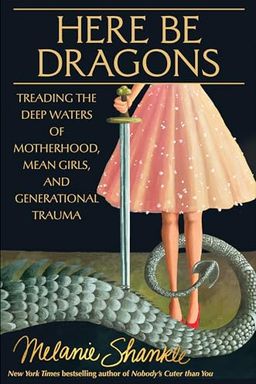
Here Be Dragons cover

Here Be Dragons

by Melanie Shankle

A co-host of the podcast "The Big Boo Cast" examines her faith and family dynamics.

Raising Warriors in a World of Dragons

What does it take to raise a daughter who can face down the dragons of mean-girl culture and inherited family pain without losing herself? In Here Be Dragons, Melanie Shankle argues that you don’t evade the monsters of modern girlhood—you name them, face them, and teach your daughter to do the same. She contends that the path to emotional and spiritual health runs straight through honesty about generational wounds, intentional boundaries, and a lived faith that’s sturdy enough for the real world.

This is a candid mother–daughter journey that toggles between two timelines: Melanie’s unsteady upbringing with a brilliant, beautiful, and deeply wounded mother (Suzanne), and her years raising her only child, Caroline, through high school trials, including a brutal sophomore-year free fall with mean girls. The book’s title nods to old maps that warned sailors with the inscription “Here be dragons.” That’s both metaphor and marching orders: parenting a girl is uncharted water, but you can still chart your bearings—if you’re honest about what you’re up against.

What the Book Argues

At its core, Shankle argues three things. First, cycles can be broken. You can grow up amid deception, addiction, and emotional volatility and still build a steady, loving home. Second, boundaries are not betrayal; they’re mercy—for you, your marriage, and your children (echoing themes from Henry Cloud and John Townsend’s Boundaries). Third, taking your faith seriously isn’t about never failing; it’s about encountering a Jesus who can hold all your mess and transform it into strength (more “Emotionally Healthy Spirituality” than performative religion).

Why It Matters Right Now

We’re raising girls in a time of algorithmically amplified insecurity. Shankle cites the sobering reality behind Caroline’s high-school experience—texts that said “maybe you should just die,” bathroom confrontations, and the silent social warfare that leaves girls isolated (the CDC later reported record sadness among teen girls). You can’t fight what you won’t name. This book says you can love your daughter fiercely and still equip her to stand up, speak up, and walk away when needed.

How the Story Unfolds

Shankle begins with Caroline’s birth and a mother’s vow: to raise a daughter who doesn’t carry her mother’s burdens. That vow is forged in the furnace of Melanie’s past—her mother’s beauty-queen upbringing, a family line colored by vanity and mental illness, a divorce riddled with lies, and a string of men who complicated everything. When her mom’s behavior escalates (anonymous blog comments, manipulative offers, explosive voicemails), Melanie chooses the hardest thing: she cuts off contact to protect her young family. She does it without bitterness, asking God to help her forgive even as she amputates the source of pain—an image she later sees mirrored in the family dog’s lifesaving leg amputation. The lesson: sometimes healing requires removal.

A Parenting Playbook With Teeth

What makes Here Be Dragons so useful is how specific it gets about the teenage years. Caroline’s sophomore-year meltdown with her friend group reads like a primer on today’s social dynamics: private group chats weaponized, bathroom ambushes, performative kindness in public and knives in the group text. Melanie and Perry try everything—comfort, prayer, and restraint—until it’s clear that restraint is being misread as weakness. Then Perry gives their daughter permission to fight back the right way: document, report, escalate. He tells her plainly, “This is war.” With that blessing, Caroline stops trying to appease her bullies and holds her line. The school intervenes; the harassment stops. She doesn’t become hardened—she becomes seasoned.

Faith as Operating System, Not Accessory

Shankle emphasizes a Jesus you can actually live with. Her own turning point comes through Breakaway at Texas A&M—where she learns about grace, not just guilt. Parenting becomes a prayer practice: late-night feedings as intercession, tearful carpools as laments, and hard choices as obedience. She returns to Scripture as a map—Joshua and Caleb entering the Promised Land (Numbers 13), Isaiah’s promise of “streams in the wasteland,” and Psalm 128’s “olive shoots around your table.” Faith here isn’t a backdrop; it’s how you decide when to pull your daughter from the fire and when to let her forge steel in it.

What You’ll Learn in This Summary

You’ll see how to identify and interrupt generational cycles; how to differentiate forgiveness from reconciliation; how to raise for resilience, not performance; how to spot mean-girl tactics and decide when to intervene; and how to make faith livable on Monday morning. You’ll also see how to grieve complicated relationships without cynicism and how to launch your daughter with open hands—confident in the One who writes her story. Along the way, you’ll get candid stories—an anonymous blog ambush on her dad’s birthday, a wedding-day dress standoff, a second family hidden in plain sight—and a mother–daughter victory lap in Jackson Hole that feels like redemption made visible.

Bottom Line

This is a field guide for moms who refuse to let fear, family history, or social drama define their daughters. It’s tender, funny, and bracingly practical—equal parts Anne Lamott’s “tell your stories” courage and Brené Brown’s clarity about boundaries and belonging, anchored in Scripture and real life.


Breaking Generational Cycles

Shankle’s core conviction is that you can stop what you didn’t start. To do that, you have to see the pattern, name the wounds, and choose a different path—over and over. Her maternal line was a complicated cocktail: beauty-as-worth (sequins, majorette costumes, and a relentless emphasis on thinness), mental illness (depression, bipolar symptoms, addiction), and secrecy (a baby surrendered in 1966 that her mother never told her about). The fallout wasn’t theoretical. It looked like gaslighting (“If you were better about staying in bed, maybe we’d still be married”), triangulation (pitting the girls against their dad with lies), and volatility that made home feel like an emotional game show: What’s Behind Door #2?

Seeing the Pattern

The wake-up moment comes not from a therapist’s office but from a rocking chair. After Caroline’s birth, Melanie realizes viscerally: “My mother didn’t love me like I love this baby.” That’s not self-pity; it’s clarity. From there, the breadcrumbs form a trail—the divorce reframed as Dad’s abandonment (even though he called every night for years), the stepdad with carnations in blue foil and a bedroom sign that read “Adults at play,” the Sunday-morning tornado where her cries for help go unanswered. These moments aren’t random; they’re part of a system that teaches girls to perform for love and mistrust their own perceptions.

Naming the Wounds

Naming becomes the leverage point. Melanie learns the truth about the divorce directly from her mother—who admits she was the one who cheated and initiated it. She discovers the hidden half-sister (and even reads a draft email where her mother calls her daughters “a disappointment”). She remembers her mom arriving late to her wedding, blaming a “chiropractor emergency,” then criticizing her dress as “too plain.” None of this cataloging is revenge; it’s accurate diagnosis. As Brené Brown notes, clarity is kindness—to yourself and others. Without precise names, you’ll medicate vague pain instead of healing it.

Choosing a New Path

Choosing differently looks unglamorous: declining financial help for a bucket-list Israel trip because it will come with strings, documenting manipulation (anonymous attacks on her blog about her dad), and refusing to let chaos camp in her guest room when a baby is on the way. It also looks like asking God to remake reflexes—away from people-pleasing and toward principled love. In this sense, the book echoes Lisa Damour’s counsel about adolescent development (Untangled): you can’t rescue your daughter from discomfort, but you can build a family system where discomfort teaches, not destroys.

The gift of breaking cycles isn’t just that you feel better; it’s that your daughter inherits a different starting line. When Melanie hears Caroline’s college testimony—“God’s goodness overwhelmed me… my life did a one-eighty”—she recognizes a living, breathing olive shoot (Psalm 128), nourished by a new root system. That is the fruit of choosing differently long before the blossoms show up.

Try This

Map your generational patterns in three columns: What was modeled? What did it cost? What do I want to model instead? Then pick one behavior to interrupt this month (e.g., venting as connection, body-shaming humor, financial strings attached to gifts) and one practice to plant (e.g., blessing your daughter’s real self, direct apologies, shared boundaries in writing).


From Victim to Boundary‑Setter

Shankle’s turning point isn’t cinematic; it’s cumulative. After years of anonymous online digs (“Your dad isn’t the hero you think”), guilt-laced offers (“Let me pay for that dream trip”), and eruptions (“I’m so damn sick of you”), she reaches the line that won’t move. She writes a six-page letter documenting the harm, doesn’t send it, prays instead—and then walks away. The decision is costly, lonely, and—according to some church ladies who wrote her—un-Christian. But it saves her marriage, protects her daughter, and opens a floodgate of healing she didn’t know was possible. This is boundaries-as-love in practice (see also Cloud & Townsend’s Boundaries).

Why Boundaries Are Love

Melanie frames boundaries not as punishment but as stewardship. She references Jesus’ “by their fruit you will know them” (Matthew 7): if contact consistently produces chaos, slander, and fear, then the fruit tells the truth. Her metaphor lands with force: the family dog, Piper, develops a severe infection in her leg; multiple attempts to treat it fail; amputation seems drastic—until she’s walking, even running, within hours of surgery. Some relationships are like that leg. You don’t cut to spite; you cut to live.

Forgiveness Without Reunion

A sermon line becomes her anchor: “You can have forgiveness without reconciliation.” She doesn’t demonize her mother; she refuses to be devoured. Over time, she stops checking the lock and starts sleeping through the night. She prays for her mother’s peace, resists public shaming, and answers slander with silence. It’s not performative sainthood; it’s a disciplined refusal to let bitterness take root. (Pete Scazzero’s Emotionally Healthy Spirituality makes a similar distinction between forgiveness and restoration.)

The Aftermath—and the Peace

Boundaries invite backlash. Her mom wages a PR blitz—calling friends, leaving comments, even reaching out to Beth Moore’s office. Ironically, she never contacts Melanie directly. Over time, the noise fades. The peace remains. Years later, with her mother terminally ill, Melanie prays, “Is this about my peace or hers?” She visits. The reunion is tender and brief—“Both my girls,” her mom says, then, “Sometimes we just need some time to work things out”—followed by a final, quirky Garth Brooks lyric. Closure, not cure. Mercy, not make-believe.

If you’re wondering whether you’re “allowed” to set a hard boundary, Shankle’s story gives you permission and a pattern: document the harm, invite God into the decision, communicate clearly (or, when clarity isn’t safe, close the loop without more words), and pursue forgiveness without pretending. That’s love with a backbone.

Boundary Litmus Test

After interactions, do you feel smaller, afraid, or constantly confused? Do your spouse and kids brace when the phone rings? If “yes,” it’s time to consider an amputation-level boundary. Mercy for you is not meanness to them.


Parenting for Resilience, Not Perfection

Shankle doesn’t try to raise a mini-me; she raises Caroline. That subtle distinction changes everything. From toddlerhood, Caroline is a force—funny, blunt, strong-willed (she spits on the floor during time-outs but stays seated because she knows the rules). Rather than crush that will, Melanie and Perry aim it. Their operating principle: Don’t raise a princess who needs rescuing; raise a warrior who can fight dragons.

See the Child You Have

Melanie learns quickly that her daughter isn’t the pink-tutu version she once imagined. Caroline prefers the Crocodile Hunter truck to Barbies, loves mud and soccer far more than ballet, and will remove bows from her hair at preschool with a polite “No, thank you.” Instead of fighting her design, Melanie blesses it. She prays Isaiah 44 over her at night, asks God to use Caroline’s strengths, and builds guardrails to smooth the rough edges (less snark with refs, more empathy with friends).

Calibrate Warmth and Backbone

Perry and Melanie balance one another. She admits a tendency to over-cushion because of her own childhood; he brings necessary grit. His “bucket” parable lands: a ten-year-old Caroline tries to hand him a heavy pail at the ranch; he tells her lovingly, “You have to carry your own bucket.” Harsh? Maybe. Helpful? Definitely. Later, in high school, when kindness and silence don’t stop harassment, Perry looks his daughter in the eye: “This is war.” It’s not permission to be cruel; it’s permission to stop being prey.

Practices that Build Resilience

Three rhythms stand out. First, prayer as oxygen—not a last resort. Late-night feedings, morning drives, and midnight tears become prayer gyms where muscles form. Second, a safe home as harbor—clear boundaries (even the school office knows her mother can’t pick her up), warm meals, ridiculous laughter, and the non-negotiable sense that “We are for you.” Third, honest coaching—apologize when you blow it, describe what you see (“You’re strong and brave and sometimes blunt. Let’s steward that”), and give your girl the scripts she’ll need (how to push back, document harm, and ask for help).

In a culture obsessed with performance and polish, Shankle’s playbook feels like a reset. Your job isn’t to remove hardship; it’s to produce humans who can handle it. That starts with letting your daughter be fully herself—and standing ready to help her use her power for good.

Try This Tonight

Affirm one strength your daughter shows that sometimes gets her in trouble (e.g., stubbornness, bluntness). Name its superpower side, then discuss a boundary for its use. Pray one specific Scripture over her design.


Navigating Mean‑Girl Culture

Shankle describes sophomore year like a soccer ball to the face—a brutal foreshadowing from Caroline’s earlier game. What begins as a close friend group devolves into factions, jealousy, and digital warfare. Two dynamics make it modern: the weaponization of group texts (accidentally including Caroline while plotting to ruin her socially) and bathroom ambushes that escalate verbal abuse to implied physical threat. The cruelty gets unthinkable: “The world would be better off without you.” This is the playbook of mean girls—high school edition—and, as Melanie admits, it echoes the patterns of her first mean girl, her mom.

Recognize the Playbook

Mean girls have signatures: gaslighting (“You’re too sensitive”), image targeting (“You’re an anorexic whore”), threat inflation (hinting at self-harm to control you), and public-private whiplash (sweet in hallways, vicious in texts). Naming these tactics helps your daughter see that what’s happening is not about her worth. It’s about broken people offloading pain. (Compare Rosalind Wiseman’s Queen Bees & Wannabes for archetypes and counterplays.)

When to Intervene

Shankle tries every rung on the ladder: listen, pray, coach scripts, encourage direct conversations. When nothing changes—and when harms intensify—she calls a parent. The dismissive response (“Just girls being girls”) crystallizes a truth: our kids become what we allow. At that point, she and Perry help Caroline draw a hard line: report harassment, involve school leadership, and accept consequences if it escalates. It works. The bullying stops. Caroline isn’t rescued; she’s released to advocate for herself.

Teach Walk‑Away + Advocacy

Two skills matter most. First, the walk-away reflex: you can exit groups that shred your soul. Caroline eventually prunes old ties, and college becomes her bloom. Second, advocacy: document, escalate, and refuse to be isolated. Caroline later uses those muscles in a college organization facing toxic leadership—speaking up not for herself alone but for the health of the whole.

Shankle pairs this with a cultural critique: parents who normalize underage drinking and status-chasing replicate patterns their kids will inhabit. If we praise charisma over character, we shouldn’t be surprised when cruelty grows. The fix begins at home—with what we celebrate, correct, and refuse to excuse.

Bathroom Rules for Daughters

1) You don’t have to endure ambushes. 2) If confronted, say, “I’m documenting this and going to admin.” 3) If you feel unsafe, leave immediately and text a parent/ally. 4) Tell a trusted adult the same day. Peace is not appeasement.


Faith as the Operating System

For Shankle, faith isn’t a thin glaze on hard things; it’s the logic underneath decisions. Her own pivot away from performative religion happens at Breakaway—a campus ministry where she finally hears about a Jesus who isn’t repulsed by mess. That reframing lets her trade shame for honesty and try grace on in real time. Parenting then becomes a lived theology: we ask, we wait, we obey.

Reframing God

Growing up, church sometimes felt like “Sinners in the hands of an angry God.” As an adult, she encounters the tenderness of a God who “pours water on the thirsty land” (Isaiah 44)—a verse she stumbles into while pregnant with Caroline. That shift—from appeasing an angry deity to walking with a good Father—changes how she prays, apologizes, and decides. Doubt isn’t the enemy; pretending is. (She nods to today’s “deconstruction,” but offers reconstruction rooted in Scripture and lived practice.)

Parenting by Prayer

Prayer isn’t magic; it’s muscle. Night feeds become intercession for courage and friends. Soccer fields turn into sanctuaries where she prays character over outcomes. When she and Perry don’t know whether to pull Caroline from school mid-crisis, they wait for God’s nudge. It comes softly: Be still; help her stand. Later, when college loneliness hits, prayer frames pep talks and fuels trust in delays (like Caroline’s mountain-laurel season—no blooms for years, then sudden abundance).

Waiting for Blooms

Shankle’s most beautiful faith image isn’t a sanctuary—it's a sidewalk tree. After years of pruning a stubborn mountain laurel that refused to flower, she rounds a corner to find it lavished in purple. That’s how God often works, she says: silently, beneath the bark, until one morning you wake to fruit. The same pattern plays out in Caroline’s life—after a barren high-school stretch, freshman year at Texas A&M explodes with friendship, mission, and joy, culminating in her serving as a counselor for Impact, the very camp that welcomed her.

Faith, for this family, becomes both compass and cadence. It informs boundaries, fuels forgiveness, and steadies launch seasons. Less a list of dos and don’ts; more a lived confidence that the Author of the story is also the Guide through the wilderness.

A Prayer to Borrow

“God, this one is Yours. You are the Author of her story. Give us wisdom to know when to fight for her and when to let her fight. Grow fruit we can’t yet see.”


Telling the Truth, Gently and Out Loud

Shankle believes stories heal—when told honestly and held wisely. She learned to love words with Erma Bombeck’s humor and honed her voice on an early “mommy blog,” then books, then a long-running podcast. But truth-telling cost her. When she posted a birthday tribute to her dad, anonymous comments (likely from her mother) tried to smear him. She didn’t clap back online; she deleted the comments, called her mom, got gaslit, and made a choice: truth without theatrics.

Story as Map

The Anne Lamott epigraph—“You own everything that happened to you. Tell your stories”—is the book’s spine. Shankle doesn’t write to settle scores; she writes to make sense and offer a map to others. When she names the exact words that wounded, it helps you recognize similar patterns in your own life. When she laughs at herself (cutting bangs on her wedding day), you relax enough to do your own inventory without shame.

Public Candor, Private Care

She’s careful where it matters. The school front office knows: do not release Caroline to her grandmother. She doesn’t blast that on Facebook; she writes it into the record at school. Later, she won’t post her mother’s death on Instagram; she lets a few friends know and takes a family trip to grieve. It’s a template for digital-age parenting: you can be honest with the world without making your child or your pain a brand.

Modeling Truth-Telling at Home

In the house, truth sounds like apologies and precise language. When Caroline bombs a quiz, Shankle says, “This is part of the process.” When the girls betray her, Melanie doesn’t respond with “They’re jealous”; she describes the specific tactics and why they hurt. Then she equips Caroline to respond from conviction, not reactivity. This is how kids learn to narrate their lives faithfully—a key resilience skill (see Karen Reivich & Andrew Shatté’s The Resilience Factor on “explanatory style”).

The point isn’t to publish everything; it’s to refuse the family code of silence that keeps harm in power. Tell the truth, hold the tender parts close, and use your voice to build—not burn—bridges your daughter will need later.

A Family Practice

Institute weekly “What’s true?” check-ins. Each person shares one hard thing (named specifically), one good thing (named specifically), and one next step. No fixing; just listening and blessing next steps.


Letting Go and Launching Well

Graduation is both ending and ignition. Shankle bawls in the car after Caroline’s last varsity soccer game, mourning a thousand miles of cleats and ER visits and game-winning goals. Then she spends the summer stockpiling dorm essentials and pep talks, resisting the urge to hover. On move-in day, she channels a line from The Electric Horseman: “Make something of yourself now.” It’s not a shove; it’s a benediction.

Mark the Endings

Part of launching well is grieving what was. Shankle doesn’t rush past the ache of “lasts.” Naming the goodness of the soccer years—the teamwork, the leadership Caroline honed—helps her see that the hard parts weren’t wasted; they were training. As G. Michael Hopf notes, “Hard times create strong men [and women].” This reframing keeps melancholy from morphing into fear.

Trust the Author of Their Story

Freshman fall proves what they’ve prayed: the tree is ready to bloom. Caroline finds friends through Impact, gets sick from too many all-nighters camping for football tickets, cries over a fifty on a quiz, and learns recovery is part of growth. She becomes who she is in a bigger pond. Shankle learns the art of the “free bird”: less play-by-play control, more sideline coaching and intercession. As Perry puts it with a grin, “We can be coordinators, but we’re not in the game. I trust my player—and our Head Coach.”

What Changes, What Doesn’t

The pantry is quieter. The mind is not. Mothering continues—texts about loafers for a new job, carpool-level conversations about adult choices, and periodic interventions (“You can’t walk around coughing in a pandemic world”). The core calling stays: see her clearly, bless her courage, tell the truth, and pray like it matters. Launching well isn’t detachment; it’s a wise recalibration of presence.

In Jackson Hole, the week her mother dies, Shankle watches Caroline and Perry glass a ridgeline for elk as the Tetons flame at dusk. She cries—not from fear, but from fullness. Every dragon faced—childhood lies, sophomore-year cruelty, complicated grief—has formed a woman who can stand in her story. That is what letting go, done well, looks like.

Launch Ritual

Before drop-off, speak three blessings out loud: 1) What you’ve seen God build. 2) What you believe she’s ready for. 3) What you’re entrusting to God. Then write them down and tuck them in her bag.


Complicated Grief, Final Mercy

What do you do when the person who wounded you most is dying—and you’re finally well? Shankle asks God if visiting her mother is about her peace or her mother’s. The answer frees her feet. She goes. The scene is simple and seismic: a hospital bed, gray hair where glam once reigned, and the softest words Suzanne speaks in the book—“Both my girls… Sometimes we just need some time to work things out.” No tidy bows, only mercy.

Preparing the Heart

Years of quiet forgiveness make the visit possible. There’s no fantasy of rewriting history in an afternoon; just the hope of telling the truth with tenderness. Shankle doesn’t go alone; she goes with her sister, Amy, who carried so much of the caregiving in later years. They laugh about the last wild Walmart escape with a scooter and a best friend. They honor the footnotes of a complicated life.

The Visit

What matters here is tone—no ledger, no gotchas. They sit on the narrow bed, listen, and answer what’s asked. When Shankle says, “I love you,” it isn’t denial; it’s decision. Suzanne meets her there with the most coherent sentence she can offer. Then a final wink from a life that loved spectacle: a Garth Brooks lyric about rodeos and dust. It’s imperfect, human, and oddly fitting.

Grieving What Never Was

The day Suzanne dies, a neighbor texts Shankle a prayer over a leftover bouquet: “Whole and healed.” Those words become a benediction over a complicated relationship. Grief in this case isn’t for what was lost; it’s for what never existed and for the glimmers that could have been. Her earlier boundaries didn’t prevent this mercy; they made it possible. Healthy distance gave her back the capacity to show up at the end without collapsing.

If you’re carrying a similar ache, here’s the quiet encouragement: you can hold your ground and hold out hope. Sometimes the only possible reconciliation is the one that happens in a hospice room with a hand squeeze and a sentence that finally tells the truth: we needed time. God was patient. So were you.

A Grief Practice

Write two letters you’ll never send: one that names the harm, one that names the good. Read them aloud to God. Ask for “whole and healed” over you, and—if you dare—over them.

Dig Deeper

Get personalized prompts to apply these lessons to your life and deepen your understanding.

Go Deeper

Get the Full Experience

Download Insight Books for AI-powered reflections, quizzes, and more.