
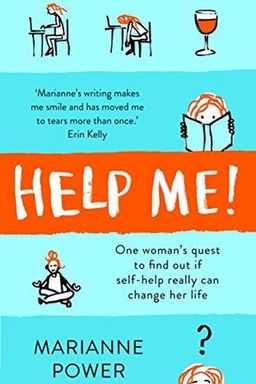
Help Me! cover

Help Me!

by Marianne Power

Help Me! chronicles Marianne Power''s humorous and heartfelt journey through self-help books in search of a better life. As she bravely tackles personal fears and financial insecurities, Marianne uncovers profound truths about happiness, perfection, and self-love, offering readers a fresh perspective on personal transformation.

A Year of Living Self‑Help

What happens when you stop reading about change and start testing it? In Help Me! Marianne Power transforms herself from a self‑help junkie into a field researcher of personal growth. Her experiment is simple in design but radical in practice: read one self‑help book each month for a year and apply its lessons fully to real life. The result is a funny, fearless and ultimately profound exploration of what works, what hurts and what healing actually looks like when you put theory to the test.

The wake‑up moment

It begins with a hangover and a harsh inner voice. Power, a successful freelance journalist in her mid‑thirties, wakes one Sunday amid empty coffee cups and existential dread. Outwardly, she has everything — industry glamour, a solid career, enviable trips — yet she feels stuck in cycles of anxiety, overspending and self‑doubt. The dissonance pushes her toward doing something wild: stop reading self‑help for comfort and start experimenting with it for transformation.

The experiment: twelve books in twelve months

Each month Power selects a different self‑help bible — from Susan Jeffers' Feel the Fear and Do It Anyway to Tony Robbins' Unleash the Power Within, Rhonda Byrne's The Secret, Kate Northrup's Money, a Love Story, and Eckhart Tolle's The Power of Now. She doesn’t just read; she executes. Cold swims, public speaking, Toastmasters, vision boards, exposure therapy, retreats, firewalks, angel cards — every recommendation becomes an experiment.

This active, almost journalistic method turns self‑help into a science of lived experience. She collects data on mood, behaviour and consequence. The outcome is messy yet authentic — a portrait of the psychological highs and lows that accompany relentless self‑examination.

From fear to surrender

The arc of the year mirrors an inner journey. In the early months, action‑focused books dominate. Feel the Fear gets her out of her head and into cold ponds; Money, a Love Story makes her face her £15,000 debt with spreadsheets rather than shame; The Secret challenges her skepticism about visualization and shows how imagination can prime behaviour. These external trials build momentum — but as the experiment continues, she learns that meaningful change also requires letting go, forgiving herself and finding stillness.

Later months introduce this inner pivot. John Parkin’s irreverent F**k It leads her to Italy, where she learns surrender as a skill — saying no to needless effort and yes to peace. Eckhart Tolle’s The Power of Now helps her quiet the inner critic, seeing thoughts not as truth but as noise. Brené Brown’s research reminds her that vulnerability and connection, not perfection, dissolve shame. The juxtaposition of control and release becomes the year’s core paradox: self‑help begins as mastery but ends as acceptance.

Costs of transformation

Change has receipts — both emotional and financial. Power discovers that self‑help is also an industry: Robbins’s events cost up to £1,200, retreats add travel and supplement expenses, and small purchases (NutriBullets, green powders) pile up into debt. The money lessons circle back painfully when she finds herself £3,200 overdrawn and facing overdraft charges. The practical cure becomes the ultimate test of maturity: accountability, budgeting, and disciplined work ethic.

Emotionally, transformation strains friendships. Her new boundaries and obsessions confuse loved ones; moments of enlightenment coexist with breakdowns. Yet each collapse clarifies that growth isn't a straight line — improvement often looks like failure before integration arrives.

Integration and meaning

By year’s end, Power no longer seeks a single secret formula. She realizes that each method — courage training, visualization, surrender, presence, connection — contributes a fragment of truth. Fear teaches action; debt forces accountability; letting go restores peace; vulnerability builds love. What endures is not bliss but grounded self‑knowledge: she can now face life’s chaos with humour and presence.

Essential insight

Real growth begins when you stop outsourcing wisdom. Every book can offer a spark; only lived practice turns that spark into light.

Her story, part memoir and part social experiment, reveals that personal development is not a ladder but a spiral. You face fear, stumble, surrender, reconnect and keep circling closer to authenticity. Through humour and hard truth, Power delivers one of the most candid portrayals of modern self‑help: flawed, expensive, life‑changing and, paradoxically, worth it when you finally learn to help yourself.


Action Over Anxiety

The first phase of Power’s journey shows the transformative force of doing. Inspired by Susan Jeffers’ classic Feel the Fear and Do It Anyway, she discovers that fear rarely disappears — you act not to erase it but to prove you can handle it. Each small victory becomes data that rewires your sense of self‑efficacy.

Micro‑exposures and courage training

Power’s early months highlight the psychology of exposure therapy. She challenges herself with parallel parking, public speaking at Toastmasters, and stand‑up comedy workshops. These micro‑exposures mimic cognitive‑behavioural techniques: each act contradicts the catastrophic predictions her brain offers. Fear transforms into evidence of growth.

(Note: This mirrors clinical CBT principles where progressive exposure reduces anxious conditioning.) By repeatedly “doing it anyway,” you prove to yourself that discomfort is temporary and survivable.

Breaking the “when/then” delusion

Jeffers warns that waiting for confidence before taking action traps you forever. Power realizes that change begins with the smallest courageous step taken before you're ready — calling a friend, swimming in winter water, or sending an intimidating email. Each moment of action shrinks avoidance into manageable effort. This discipline of courage sets the tone for later experiments.

Key lesson

Confidence comes from accumulated proof, not wishful waiting. You earn peace through motion, not meditation on fear alone.

By month’s end, she has built momentum through behavioral courage. The lesson for you: treat fear as a workout, not an obstacle. Begin with small, repeatable acts that scare you just enough to stretch, not snap. Courage compounds like interest.


Money, Work, and the Price of Hope

Power’s financial experiments uncover one of the book’s most grounded lessons: avoidance breeds chaos. Through Kate Northrup’s Money, a Love Story she faces debt as a mirror of self‑worth, and through bitter experience she learns how the self‑help industry monetizes your pain.

Facing the figures

Northrup’s exercises force Power to track her spending history and emotional associations. She recalls her father throwing money in the air as a joke — a formative “money story” that cemented belief in chaos and guilt around cash. Only once she calculates her full £15,109.60 debt does agency return. Knowing the number breaks magical thinking.

From there, she makes tangible changes: cancelling unused subscriptions, negotiating bills, and selling extraneous status items. Money management becomes emotional hygiene — each spreadsheet line substituting clarity for shame.

When self‑help becomes a debt spiral

Ironically, the pursuit of growth triggers a financial crash. Big‑ticket seminars, retreats, supplements and books add up until she finds herself £3,200 overdrawn. The realization that she’s paying £3 per day in overdraft fees humiliates her into pragmatism. The fix isn’t spiritual; it’s logistical — call the bank, open mail, work more. By combining StepChange advice, Rejection Therapy for new pitches, and relentless freelancing, she climbs back toward solvency.

Practical truth

Hope is priceless, but programs that sell it often aren’t. Before you invest in betterment, check your balance — self‑help shouldn’t bankrupt you.

The financial chapters broaden the theme: real empowerment pairs inner healing with adult responsibility. Enlightenment without budgeting is fantasy. Facing your statements and your shame — that’s where maturity lives.


Exposure and Rejection

Building on her courage work, Power dives into Jason Comely’s Rejection Therapy, learning that social fear shrinks only through repetition. The task is elegant: each day, invite a potential rejection. Ask for a discount, a favour, or permission likely to be denied. The outcome doesn’t matter; survival does.

Rewiring social fear

The first refusals sting, but soon she realizes most strangers are kinder than expectation predicts. A barista refuses her free coffee politely; a musician hands her his bass to play. Every time she survives embarrassment, her tolerance for uncertainty grows. The method functions as social exposure therapy, teaching the nervous system to stop pairing visibility with danger.

Grief, perspective, and comeback

Midway through this phase, a family death interrupts her experiment. Loss contextualizes the petty fears — what’s a “no” compared to real grief? Returning later, she finds deeper motivation: if rejection is survivable, so is almost anything. This produces tangible shifts — new freelance work, a rekindled social life, even a spontaneous date sparked by courage to speak first on the Tube.

Applied rule

Treat rejections as data, not verdicts. Confidence is statistical: the more trials you run, the smaller any single failure feels.

For readers, this section translates fear of exposure into measurable progress. Start with one bold ask a day. Whether it’s a pitch, a compliment, or a request, you practice being seen — and that visibility builds freedom.


High Energy and the Limits of Hype

Power’s encounter with Tony Robbins marks the experiment’s most theatrical phase. Unleash the Power Within delivers sound, sweat and spectacle: four days of collective hypnosis built from storytelling, movement and ritual. There she learns two crucial lessons — the power of physiology to shift mood and the danger of mistaking a weekend high for permanent transformation.

The anatomy of peak state

Robbins builds intensity through music, crowd synchrony and embodied techniques like “priming” and the firewalk. Power, initially sceptical, ends up chanting and crossing hot coals. The act feels absurdly easy afterward — proof of how state change alters limits. She learns Robbins’s six human needs framework (certainty, variety, significance, connection, growth, contribution) and sees how unhealthy habits often meet legitimate needs in distorted ways.

The seminar’s sensory architecture produces momentary transcendence, what psychologists call a peak experience. Yet she notices the energy fading within days, underscoring the importance of integration. Transformation feels real; sustaining it requires systems.

Takeaway

Emotion can launch change but cannot maintain it. Pair every breakthrough with a ritual that grounds it into daily life.

Through this experience, Power understands both the genius and the gimmick of the self‑help industry: it manufactures insight through spectacle. The real mastery lies in bringing that heightened energy home to the small, unfilmed habits that actually build a life.


Letting Go and Finding Presence

After months of effort and exposure, Power’s experiment takes a reflective turn. Through John Parkin’s F**k It and Eckhart Tolle’s Power of Now, she explores the radical opposite of self‑improvement: letting go. This phase teaches that surrender is not failure but the final frontier of control.

Surrender as active skill

At a retreat in Italy, she practices breathing, floating and saying “F**k It” to anxieties large and small. The insight lands viscerally: loosening effort paradoxically restores motion. Exercises like the resisted arm pull (where relaxed movement wins while force fails) demonstrate tension’s futility. Emotional release follows — tears, laughter, and connection with fellow participant Geoff — showing that surrender can heal body and psyche together.

Silencing the inner tormentor

Tolle’s teachings refine this lesson. Observing the mind instead of identifying with it, Power learns to ask, “Is there a problem right now?” Nearly always, the answer is no. By practicing presence — feeling feet on pavement, watching thoughts pass — she weakens the critic’s control. Presence becomes emotional first aid, rescuing her from recursive shame cycles.

Guiding thought

Peace is not found by improving the moment but by inhabiting it. Quiet attention heals what effort cannot.

Together, Parkin and Tolle dismantle the cult of constant striving. Their chapters show that growth sometimes means daring to stop, breathe and let life move without your micromanagement — a wisdom far subtler than any dopamine‑charged seminar.


Faith, Vulnerability, and Connection

The year concludes with experiments in belief and belonging — where spirituality meets psychology. Power dabbles in angel cards through Doreen Virtue’s teachings and confronts her loneliness through the Hoffman Process and Brené Brown’s vulnerability research. Beneath both lies a single longing: to feel held, by the universe or by other humans.

The comfort and caution of belief

Angel therapy promises divine reassurance. Power conducts automatic writing, draws cards and occasionally encounters eerie coincidences — a “Romance angels” card followed by a text from Geoff. But she recognizes that these voices may simply echo her own intuition. Angels, she concludes, personify the inner voice we often ignore. Used wisely, such rituals encourage reflection; used blindly, they reinforce passivity.

Healing through honesty

The Hoffman Process offers the antidote to isolation. In group confession circles and cathartic exercises, Power confronts the shame beneath all her self‑improvement. “I’ve never been in love,” she says aloud, expecting disgust but meeting compassion. That empathy cracks open transformation more real than any book: connection as cure. She reconciles with her friend Sarah, proof that vulnerability, not performance, rebuilds trust.

Emotional insight

Shame shrivels when spoken. The love you seek through self‑help often arrives the moment you stop hiding your imperfect humanity.

By the final chapter, Power’s self‑help odyssey reveals an unexpected moral: connection is the master key. Whether divine or human, being seen and held — not fixed — is what truly heals.

Dig Deeper

Get personalized prompts to apply these lessons to your life and deepen your understanding.

Go Deeper

Get the Full Experience

Download Insight Books for AI-powered reflections, quizzes, and more.