
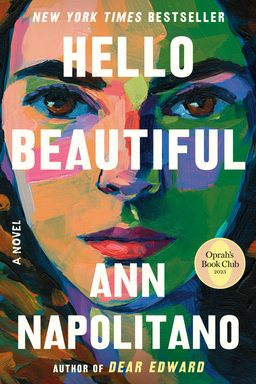
Hello Beautiful cover

Hello Beautiful

by Ann Napolitano

Hello Beautiful by Ann Napolitano is a captivating novel of love, family, and sisterhood. Follow William Waters and the Padovano sisters as they navigate life''s unexpected challenges, uncovering the transformative power of love, resilience, and storytelling. A heartfelt journey awaits.

Love, Loss, and the Architecture of Family

How do love, loss, and silence structure the families we inherit and build? In Hello Beautiful, Ann Napolitano examines how grief and tenderness shape generations of the Padavano and Waters families. At its center, the novel argues that beauty is inseparable from brokenness: you cannot form durable love without confronting what your family refuses to name. Every decision—whether William’s struggle with identity, Sylvie’s ethic of care, or Julia’s fierce planning—grows out of that tension between concealment and connection.

You begin inside absence: Caroline’s death defines William’s early world as a house of avoided grief. That silence plants fragility in him, later expressed through sport, ambition, and literature. When William meets Julia Padavano—a planner and maker of order—their marriage joins two family legacies: one defined by quiet avoidance, the other by structured love. Yet those same impulses, built to protect, unravel under stress. Julia’s drive to fix and William’s inability to speak his pain collide, refracting through the wider Padavano system of sisters trying to hold one another together.

The Pattern of Silence and Inheritance

Grief is the invisible engine of the story. William’s parents never name Caroline, and Rose Padavano enforces moral silence as discipline. You see this approach replicated and resisted across generations. Each sister learns that hiding pain perpetuates damage—Rose’s exile to Florida after Cecelia’s pregnancy is both punishment and escape. Napolitano insists that silence is survival only until it becomes poison. (Note: similar to Celeste Ng’s exploration of generational secrecy in Everything I Never Told You.)

The novel makes you feel how ordinary acts—refusing to attend a wedding, sending a terse check, preventing conversation—shape destinies. Grief becomes an inherited strategy, not an isolated event. You live in a quiet house until one day the quiet is unbearable, and someone—usually a daughter—breaks the code.

Identity, Collapse, and Rebuilding

William’s character embodies the book’s question about identity: what anchors you when your defining practice fails? His basketball career begins as refuge and discipline but collapses after injury and emotional exhaustion. His attempted drowning is the narrative’s emotional fracture point—the moment when inherited silence, bodily failure, and mental illness merge. The rescue by teammates and the subsequent hospital care show how individual collapse demands communal intervention. Napolitano renders recovery as both clinical and moral architecture: routines, honesty, and accountability as structural repairs for a lost self.

Sylvie’s care during this phase opens the book’s counter-story: love and repair grounded not in romance but in presence. Her reading of William’s manuscript teaches her how writing itself becomes confession and survival—a bridge between what cannot be spoken and what must be understood.

Sisterhood and Shared Labor

The Padavano sisters form the book’s living fabric. Julia engineers, Sylvie dreams, Cecelia creates, and Emeline nurtures. Their dynamic dramatizes collective endurance—the idea that love can be plural and adaptive. Through shared housing, childcare, painting, and emotional management, they reinvent family as a form of communal labor rather than hierarchy. This ensemble structure echoes Virginia Woolf’s depiction of family consciousness in The Waves: multiple voices seeking unity amid divergence.

Julia’s transformation from wife to independent professional, Sylvie’s balance between longing and ethical restraint, Cecelia’s art as theology, and Emeline’s domestic leadership together argue that family repair depends not on conventional morality but on continued engagement. It’s not who apologizes first but who keeps showing up.

The Ethics of Honesty and Forbidden Love

The most contested act in the novel—Sylvie and William’s love—reveals honesty as both medicine and wound. After years of avoidance, their relationship emerges from mutual recognition, not betrayal alone. But when Kent insists on disclosure, truth becomes destructive before it heals. Napolitano resists neat moral sorting; she shows how love can save and devastate simultaneously. The mantra “no bullshit and no secrets,” given by Dr. Dembia, becomes the novel’s hinge: honesty as ongoing practice, not one-time confession.

Art, Memory, and the Work of Renewal

Art redeems silence. Cecelia’s murals and Sylvie’s writing translate private loss into public witness, ensuring that Caroline, Sylvie, and others remain visible. In this way, Hello Beautiful argues that storytelling and art-making are not decoration; they are civic acts of survival. What begins as family tragedy becomes Chicago community legend—the playground mural with faces of Caroline and Alice is testament to how creativity transforms mourning into belonging.

Mortality and the Continuum of Care

Sylvie’s terminal illness tests whether love can persist when its keeper disappears. The sisters rally, the city participates, and rituals evolve beyond Catholic strictness into creative remembrance. Napolitano closes the book with renewal through ordinary work—retiling walls, feeding children, reading manuscripts—arguing that life after loss depends on shared, practical tenderness. As Emeline whispers, “Grief is love.” It’s the line that defines the novel’s purpose: to show that beauty endures not by denying pain, but by integrating it into daily labor.

Key understanding

Napolitano’s families teach that survival is relational. Grief demands witnesses, honesty demands courage, and love demands continual reconstruction. Hello Beautiful is less about redemption than about sustaining one another inside imperfection.


Grief and Family Fragmentation

Grief in Hello Beautiful functions not as a singular emotion but as an organizing force. From the opening death of Caroline to Charlie Padavano’s funeral, loss repeatedly triggers silence, shame, and relocation. You can see how entire households rearrange themselves around pain. The Padavano sisters shift roles after their father’s death; Rose moves to Florida; William recoils into internal exile. These are not random reactions—they represent cultural patterns of handling sorrow through withdrawal and control.

Inherited Silence

William’s parents preserve grief as image—a portrait of Caroline—but forbid narrative. That absence teaches William to equate emotion with danger. Rose’s refusal to discuss her daughters’ perceived transgressions mirrors that logic, enforcing silence as the moral language of the household. This creates generations of emotional illiteracy: children who master practicality but not vulnerability.

Consequences and Mobility

When Charlie dies, every daughter redefines space: Sylvie leaves, Cecelia rents, Rose sells the house. The novel makes geography an expression of grief—physical moves demonstrate emotional dislocation. You also witness the economics of mourning: bank loans, job shifts, and barter systems mark how sorrow reshapes material realities. Napolitano ties domestic imbalance to emotional scarcity, portraying loss as a total ecosystem.

Core insight

Unspoken grief doesn’t dissolve—it metastasizes into habit. Families that refuse to name pain eventually express it through control, absence, or miscommunication.


Identity, Collapse, and Recovery

William Waters embodies the novel’s meditation on identity. His sense of self starts on a basketball court—discipline as language, movement as validation. When injury and emotional disruption remove that structure, his life implodes. You can see his collapse as a metaphor for anyone whose selfhood depends on external performance. Napolitano dissects how physical incapacity exposes emotional emptiness.

The Court and the Void

Basketball offers William the first space where attention feels safe. His kneecap fracture breaks more than bone—it shatters continuity. He moves from athlete to scholar, then to patient. Each role reveals dependency: his body on routine, his psyche on approval. The manuscript he writes about basketball history becomes confession disguised as research, where footnotes whisper despair (“What am I doing?”). Sylvie’s discovery of those footnotes mirrors how writing can unwittingly reveal private chaos.

Rebuilding Through Honesty

William’s entrance into therapy—and Dr. Dembia’s mantra, “no bullshit and no secrets”—marks the pivot to recovery. His regimen illustrates how tangible habits anchor emotional healing: medications, consistent communication, and community accountability through Kent and Arash. The story turns self-help into collective practice, showing recovery as a team sport. (Compare Viktor Frankl’s notion in Man’s Search for Meaning that duty can sustain survival.)

Practical lesson

You rebuild identity by replacing performance with truth. Movement alone doesn’t save; witnessing and accountability do.


Julia’s Reinvention and the Limits of Control

Julia Padavano demonstrates agency as both salvation and trap. She turns chaos into charts—her wedding planning, job networking, and move to New York are acts of survival. When William departs, her disciplined pragmatism shields her from despair. Yet the novel questions whether planning alone heals: Julia’s rational choices often silence emotional complexity in herself and others.

Planning as Love

For Julia, organizing equals caring. From sequencing cookies at her wedding to designing consulting workflows, structure becomes affection’s language. She uses schedules to manage uncertainty. But the same control that saves her also alienates those who don’t share her logic—William’s collapse exposes the limits of managerial compassion.

Motherhood and Moral Claim

Julia’s motherhood transforms her drive into purpose. She channels loss into nurturing Alice while using independence as ethical armor. Her reinvention in New York shows mobility as moral act: distance can rebuild dignity. Still, Napolitano reminds you that autonomy doesn’t erase history—Julia’s absence leaves a vacuum later filled by Sylvie’s misplaced devotion.

A reflective note

Agency is crucial, but empathy must accompany it. Control without openness becomes another form of silence inherited from Rose.


Sylvie’s Longing, Ethics, and Imagination

Sylvie Padavano, shaped by literature, embodies both yearning and boundaries. Her imagination—her “third doors”—creates alternatives to binary family norms. When she encounters William’s vulnerability through his writing, that literary empathy becomes dangerous and transformative. Their emotional bond tests Sylvie’s philosophy that love should expand rather than consume.

Romantic Integrity

Sylvie practices self-reflection as ethical exercise. Reading William’s manuscript triggers intimacy but also moral clarity; she moves out when tempted, choosing distance over secrecy. Later, she visits him in the hospital, demonstrating that care need not cancel boundaries. These scenes contrast passive romance with active conscience—Sylvie’s love insists on truth even when painful.

Forbidden Love and Consequence

The eventual relationship between Sylvie and William merges longing with moral exposure. When their truth surfaces, it fractures Julia’s world but also begins family evolution. Through Kent’s intervention and community honesty, the affair becomes an arena for ethical reconstruction. The marriage in the library cements that duality—love as scandal and sanctuary.

Inner theme

Sylvie teaches that empathy requires bravery. To love fully, you must face unintended harm and still choose honesty.


Communal Care and Shared Responsibility

Napolitano extends compassion beyond family to community. Care in the novel is distributed: teammates, neighbors, and professionals substitute for failed parents and institutions. Kent and Arash personify friendship as moral action; Mrs. Ceccione and Mr. Luis embody everyday solidarity. The novel redefines responsibility as participatory, showing that healing is collective labor.

Networks of Assistance

When William vanishes, friends move faster than family. Their search illustrates loyalty as lived ethics. Local exchanges—laundry for dresses, loans for tuition—create an invisible economy of moral support. Institutional care (hospital, university) works only when human agents bend its rules toward compassion. You are reminded that bureaucracy stabilizes, but kindness heals.

Gender and Emotional Labor

Women shoulder visible and invisible care tasks: Emeline’s daycare work, Julia’s domestic management, Sylvie’s advocacy. Yet men like Kent also enact care through direct intervention. Napolitano blurs gender boundaries, portraying caregiving as shared moral duty rather than assigned role.

Essential truth

Community becomes a character in itself—the collective conscience that rescues when family structures collapse.


Art, Memory, and the Work of Witnessing

In Hello Beautiful, art replaces silence with visibility. Cecelia’s murals and Sylvie’s manuscript turn grief into permanent record, creating civic memory where personal loss occurred. Through creative labor, the novel links individual healing with public storytelling, offering readers a vision of art as moral testimony.

Murals and Public Memory

Cecelia’s paintings rescue the forgotten. By including Caroline and Alice in neighborhood murals, she restores erased lives to communal sight. William’s request to paint Caroline shows how visual art externalizes redemption; color supplants guilt with shared acknowledgment.

Writing as Private Continuity

Sylvie’s manuscript captures the family’s history in detail, acting as archive and inheritance. Its eventual delivery to Izzy and Alice connects past and future voices. Napolitano transforms storytelling into intergenerational restoration, arguing that memory must be maintained collectively and artistically.

Creative moral insight

Making art is an act of care. To preserve beauty is to honor pain and invite others into remembrance.


Mortality and Renewal

Death concludes the book’s cycle, but not its message. Sylvie’s brain tumor compresses time and clarifies purpose. Her final months model how to confront inevitability without despair. Napolitano presents death not as closure but as communal rehearsal for continuity.

Facing the End

Sylvie meets mortality with grace: she returns to poetry, eats ice cream, and tells partial truths. Her family learns that honesty matters most when time runs short. The sisters’ reactions—Cecelia’s art, Emeline’s rituals, Julia’s temporary reappearance—illustrate multilayered mourning.

Renewal Through Action

After Sylvie’s death, the Padavanos convert grief into motion. Rebuilding bathrooms, hosting meals, and caring for foster infants become acts of resurrection. Work is love translated into endurance. Emeline’s phrase “Grief is love” crystallizes Napolitano’s thesis: to mourn is to continue creating connection.

Final reflection

Renewal doesn’t erase pain; it translates it into living ritual. The novel ends where it began—with family puzzle-piecing themselves back into coherence.

Dig Deeper

Get personalized prompts to apply these lessons to your life and deepen your understanding.

Go Deeper

Get the Full Experience

Download Insight Books for AI-powered reflections, quizzes, and more.