
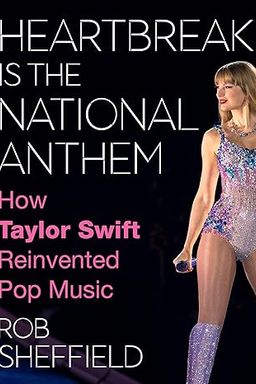
Heartbreak Is The National Anthem cover

Heartbreak Is The National Anthem

by Rob Sheffield

A Rolling Stone journalist looks at the life and music of the pop icon Taylor Swift.

Building Planet Taylor

When was the last time a song or a show didn’t just entertain you, but rearranged how you see yourself? In Heartbreak Is The National Anthem, Rob Sheffield argues that Taylor Swift has done exactly that—at mass scale, for nearly two decades—by fusing world‑class songwriting with a fan-first culture that has redrawn the boundaries of pop. He contends that nothing in modern music truly explains Swift’s sustained ascent: she’s simultaneously a diarist and a myth‑maker, a scholar and a chaos agent, a cultural mirror and a catalyst. To grasp why, you have to understand the engine under “Planet Taylor”: songs that invite you to hear your own life, a community that behaves like coauthors, and a star who keeps changing the rules while daring you to follow.

In this guide, you’ll discover how Swift made the fangirl the center of pop (and why that matters if you’ve ever needed a song to say how you feel). You’ll then learn how her writing systems, codes, and literary obsessions turn listeners into detectives, and why Track Five—and especially “All Too Well”—became Swift’s emotional truth serum. We’ll follow her high‑risk reinventions from country prodigy to new‑wave auteur, through the “villain era” and Reputation bait‑and‑switch, into the quiet revolution of folklore/evermore and the audacious business jujitsu of Taylor’s Version. Finally, we’ll step inside the Eras Tour, where all those micro‑confessions become a mass ritual of catharsis.

A pop outlier who keeps peaking

Sheffield opens by stating the obvious that isn’t: Taylor’s peak has lasted eighteen years. The Beatles’ recording life spanned eight; most icons plateau then fade. Swift keeps compounding—seven No. 1 albums in the 2020s, a billion‑dollar tour, a fourth Album of the Year Grammy (a record), and the power to make a years‑old deep cut (“Cruel Summer”) turn into a fresh No. 1. Explanations that reduce her to boyfriends, fashion, or marketing miss the core: she’s a songwriter first, relentlessly studying and synthesizing pop history, then making songs where millions hear themselves.

Sheffield’s thesis

“Taylor is the one who made the pop girl the center of music—not a genre, not a fad. She reinvented pop in the fangirl’s image.”

Songs as confession—and construction

Swift’s catalog invites fiercely autobiographical listening while withholding definitive answers. That tension is the point. Sheffield maps her “pens” (Fountain/Glitter Gel/Quill) to explain how she toggles between plainspoken confession (“Fountain”), gleeful pop maximalism (“Glitter”), and literary immersion (“Quill”). The codes, Easter eggs, and intertextual threads (Emily Dickinson, Dante, Shakespeare, Carly Simon) don’t distract; they recruit you. You’re not a passive consumer—you’re a sleuth, reading your life in her mirrorball.

Community as co‑creation

Sheffield’s parking‑lot vignettes and friendship‑bracelet swaps make a simple claim: Swift turned fandom into an art form. From the Speak Now arm‑lyrics (Joni Mitchell to Tom Petty) to the Eras Tour’s nightly “first bridge,” fans are addressed as apprentices and collaborators. He traces the line from eight‑year‑old Taylor asking LeAnn Rimes, “Did you get my letters?” to the grown superstar designing shows that tell sixty thousand people: I can see you.

Conflict, reinvention, and receipts

Sheffield does not airbrush the mess. He dives into the Grammys “Rhiannon” debacle, the Kimye snake storm, the 2016 neutrality misread, and the petty calculus Taylor herself jokes about (“Therein lies the issue”). But he reframes Reputation as a romance album disguised as celebrity shade; spotlights folklore/evermore as the Quill Pen summit; and treats Taylor’s Version not as a grudge but a new authorship model. The point isn’t sainting Swift—it’s showing how the trying, failing, revising energy is the source of the work’s power.

Why this matters to you

If you’ve ever needed music to articulate a feeling before you had the words, Sheffield’s argument lands: Swift normalized that desire and handed it to younger artists (Phoebe Bridgers calls it “The World: Taylor’s Version”). The book becomes a guide to using art as an emotional toolkit—how to turn your “tiny, secret agonies” into something you can sing with strangers in the dark. In a culture that tells women to be nice, she writes women who are strategic, needy, defiant, literary, petty, generous—and loudly alive. That contradiction isn’t a flaw of Planet Taylor; it’s the climate.


Fangirl Power as Method

Sheffield’s boldest claim is also his simplest: teenage girls make show business. If you start here, Swift’s career stops looking like a fluke and starts reading like a blueprint. She didn’t court the girls to later trade up to “serious” audiences (the classic pop-star bait‑and‑switch); she built with them and refused to abandon them. That decision reverberates through pop today, where the norm is young women writing, producing, and setting the emotional agenda.

From “Did you get my letters?” to “I can see you”

At eight, Taylor screamed through a banner at a LeAnn Rimes concert: “I love you, LeAnn.” When Rimes recognized her—“I sure did, Taylor”—it didn’t just thrill a kid; it taught a future star what contact feels like. Sheffield shows how that memory becomes praxis: pre‑ and post‑show meet‑and‑greets, pit passes mysteriously appearing in a tween’s hands, and the line that floors his niece—“Well, honey, I guess that means we grew up together.” These aren’t random kindnesses; they are design.

(Context: This people‑first muscle is what Paul McCartney learned in the early Beatles years—he wrote “Thank You Girl” for girls. Swift grafts that ethos onto a 21st‑century creator economy.)

The Swiftie commons

The Eras Tour parking lot is Sheffield’s field site: mirrorball dresses, “NYU cap and gown,” cowgirls, a couple costumed as “Wide‑Eyed Gays,” and a security guard asking, “You the guy with the tissues?” A fan hears “All Too Well” and drops to her knees for the whole ten minutes—no irony. These scenes aren’t cute cutaways; they’re evidence that Swift created a place where grief, crushes, and pettiness are not just allowed but scored for mass sing‑along.

Why this matters to you

If you’ve ever felt ridiculous for caring so much about art, this community insists you’re not ridiculous—you’re doing it right. The bracelet trades, the wild‑card songs, the shared lore lower the barrier to entry and raise the ceiling for meaning.

Girls at the center, artists downstream

Phoebe Bridgers testifies that teenage her thought she needed “adult” life to write songs—until she heard Swift’s Fearless and realized she could just tell the truth. That revelation—women’s ordinary interiority is headline material—flows into a generation (think Olivia Rodrigo, Sabrina Carpenter, SZA’s narrative candor). Sheffield calls it reinvention “in the fangirl’s image,” and shows how pop caught up to Swift rather than the other way around.

A method you can use

You don’t need a stadium. Treat your people like coauthors: invite them into process (Swift’s arm‑lyrics on Speak Now, the Midnights track‑by‑track TikToks), design rituals they can own (the “first bridge,” friendship bracelets), and speak with them, not at them (“I was hoping it would be cool with you if I told a few of my stories”). The art improves because the audience isn’t an afterthought—they’re the form.


Songwriting, Codes, Mirrors

Sheffield treats Swift’s catalog like a literary universe. She writes as Fountain Pen (direct, diaristic), Glitter Gel Pen (campy, hook‑drunk), and Quill (old‑world textures and characters). Those modes interact with a second system: codes. Capital letters in early liner notes, costume clues, lyrical callbacks, place names (“Cornelia Street,” “Coney Island”), and even punctuation become breadcrumbs. The effect? You become a detective, and the case is your own life.

Three pens, one voice

Fountain Pen crafts plainspoken gut‑punches (“I feel you forget me like I used to feel you breathe” in “All Too Well”). Glitter flirts and winks (“Spelling is fun”—and the entire universe of “ME!”). Quill builds rooms you can smell—the lace‑curtain breath of “the lakes,” the harmonica‑dusted street in “betty.” You hear all three in a single album (Midnights pairs “Anti‑Hero” Fountain voice with Glitter “Karma” and the Quill‑ish hush of “Labyrinth”).

The detective story

Swift tells a 2006 radio host she’d be a CSI if not a singer. Sheffield runs with that: the Swiftverse rewards close reading. “Invisible string” links “Starlight” to “Last Great American Dynasty” with the single word “marvelous.” The “refrigerator light” becomes a motif across years (“All Too Well,” then a sly nod in Harry Styles’ “Two Ghosts,” then back again). Like Dante’s Pilgrim, you track Taylor Pilgrim through circles of desire; like Emily Dickinson, she writes by lantern and dares you to decode.

(Comparison: This is Beatles‑level intertext—think the Abbey Road medley—combined with the TV‑show puzzle box logic of Lost.)

Mishearing as meaning

Fans argue over “Starbucks lovers,” “lights and boys are blinding,” or “a hundred donuts and peaches” (“The Archer”). Sheffield blesses the chaos: your bad lyric is a truth—about how you hear yourself—sneaking in. The point isn’t settling debates; it’s licensing ownership. When you scream “pretty little devil,” you’re annotating your own diary.

Mirrorball logic

Sheffield’s favorite metaphor is Swift’s mirrorball: she reflects your angles back at you. The codes aren’t gotchas; they’re prisms. They don’t prove who a song is “about”; they multiply who it can be about—including you.

Try it yourself

When a line floors you, trace its “string.” Where else has that image lived in her work—or yours? If “leaving like a father” in “cardigan” stings, ask what earlier songs (say, “Mine”) it re‑frames. You’ll hear your own story gain chapters.


Track Five, All Too Well

Sheffield names a Swift law: Track Five is where the blood is. From “White Horse” and “Dear John” to “My Tears Ricochet,” it’s the album’s moral center. The apex is “All Too Well,” which evolves from hushed piano remembrance to volcanic testimony—then, a decade later, doubles in size and force to become the longest No. 1 in Billboard history.

A song that wouldn’t die

It begins as a soundcheck rant, filtered with co‑writer Liz Rose into a five‑minute deep cut on Red (2012). It becomes a cult oath at shows. In 2021, Red (Taylor’s Version) unveils the 10‑minute draft, now sharpened with adult rage (“I’ll get older, but your lovers stay my age”). Swift premieres a short film, nodding to Pablo Neruda and the final scene of Barbara Stanwyck’s Stella Dallas (watching a life through a window she can’t enter). What was private grief turns into transpersonal ritual.

Why it breaks you

Sheffield pinpoints the gearshift at the end—changing “I remember it all too well” to “You remember it all too well.” That pronoun flips shame to indictment. He recounts trudging Brooklyn snow with only “All Too Well” and “Dear John” in his ears, needing their lumbering weight to match the day. The scarf becomes an altar—like Stevie Nicks’ missing velvet jacket—because grief needs relics.

Track Five as covenant

“All Too Well” codifies the Track Five pact: these cuts don’t chase radio; they chase reckoning. Sheffield’s list spans eras—“Delicate,” “The Archer,” “You’re on Your Own, Kid,” “So Long, London.” Track Five is the page where Swift stops negotiating with her image and writes the line she can live with. That’s why you cling to them when you need moral weather reports.

How to listen

Play the 5s in sequence. You’ll hear a woman re‑teaching herself how to remember, forgive, confront, and outgrow—album by album. If you’re stuck, this playlist is a compass.


Risk, Pivot, New Romantics

Sheffield’s favorite whiplash is the 2014 swerve: after Red perfected her country‑pop guitar barrage, Swift torched the template with 1989—synths, Pet Shop Boys shimmer, New Romantic swagger. Industry logic said don’t; she did it anyway. Even he wondered on her Tribeca couch: “Am I hearing my favorite artist blow up her career?” That doubt is the fuel; the album is the explosion.

What the pivot did

It reframed Swift not as a country crossover, but as a pop architect. Jack Antonoff enters as a primary builder. “Style” compresses the first Erasure LP into a lipstick‑smeared drive. “New Romantics” (a bonus track that becomes a mission statement) plants Swift in the Duran Duran/Culture Club lineage of radical surface: “We show off our different scarlet letters—trust me, mine is better.” Sheffield, a lifelong Duranie, hears not cosplay but craft.

Lead‑single misdirection

Swift loves to decoy. “Shake It Off” (or later, “Look What You Made Me Do,” “ME!,” “Anti‑Hero”) primes a narrative she’ll then upend. It’s a Thriller move—release “The Girl Is Mine” to make “Billie Jean” feel like a solar flare. Sheffield argues this trolling is philosophy: don’t let the sales pitch define the art. If you feel tricked, good—you’re ready to hear the album.

Tour as proof

The 1989 tour makes maximalism a virtue—guests from Mary J. Blige to Nelly; neon typography; the runway strut. But nestled inside are songwriter flexes (“You Are in Love,” “Clean”) and city‑specific tributes. Sheffield recalls a night when a local downpour aligned with the “Please don’t be in love with someone else” coda of “Enchanted.” Coincidence—or a star who knows how to tune nature to pop?

How to apply the lesson

If your audience expects Red II, give them 1989. Risk is not disruption for its own sake; it’s hospitality to your future work.


Petty, Villain, Reputation

Sheffield doesn’t sanitize Swift’s messy side—he celebrates its artistic yield. Petty Taylor is the one who will “inconvenience myself to prove a point,” who says “therein lies the issue,” who writes “Karma” as a sing‑song ledger of enemies vanishing on their own. The culture tried to cancel her in 2016; Reputation answered with a bait‑and‑switch: lead with venom, deliver love songs.

The snake pit

The Kimye “Famous” saga, Snapchat snippets, and snake emojis turn Swift into “the thinking person’s least favorite pop star.” Sheffield details the whiplash: her AOTY speech about men taking credit is eye‑rolled; her Election Day neutrality photo is read as MAGA; a Vice “Nazi idol” hoax sticks. Then the unedited call leaks in 2020 and vindicates her. Instead of spiking the football, she drops a pandemic charity link—before promptly writing “thanK you aIMee.”

Reputation’s trick

“Look What You Made Me Do” is a clunker that—strategically—lets the world think the album is all score‑settling. The record itself is synth‑dark romance: “Delicate,” “Call It What You Want,” “Getaway Car.” Sheffield hears “New Year’s Day” as its thesis: sweeping glitter on the morning after and choosing, mundanely, to stay. Petty Taylor fuels the headlines; Private Taylor writes the keepers.

The “nice” trap

Swift keeps using the word nice—a taboo for serious writers—precisely because it’s gendered. “Standing in a nice dress,” “You don’t know how nice that is,” “This Is Why We Can’t Have Nice Things.” Sheffield argues that she both resents and redeploys niceness, bending it into a weapon or a wink. If you’ve been policed by “be nice,” these songs are a toolkit for flipping the script.

Practical takeaway

Let the public fight misdirect. Put the best material where pettiness can’t reach it—on the record, in the tender songs.


Quill Peak: Folklore/Evermore

Locked down, Swift trades stadium thunder for cabin hush and delivers her artistic summit. Folklore and evermore are Quill Pen masterclasses—Aaron Dessner’s pianos and pulses, Jack Antonoff’s spectral glitter—full of characters who pace beaches after the party ends. Sheffield calls folklore her “Nebrasterisk” (like Springsteen’s Nebraska): the album skeptics are allowed to love.

Characters as mirrors

The teen triangle (Betty/James/Augusta) maps desire from three angles; “illicit affairs” traces shame to a parking lot; “mirrorball” admits “I’m still trying everything to get you laughing at me.” On evermore, “Marjorie” stitches a grandmother’s soprano into the outro—“What died didn’t stay dead”—turning memory into collaboration. Sheffield’s own grief (listening to “The Archer” through a parent’s decline) becomes part of the reading; these records invite that.

Long Pond and the FolkGlare

In folklore: the long pond studio sessions, Swift sits in flannel between Antonoff and Dessner and explains the math (“I was so ahead of the curve, the curve became a sphere”). The camera captures the “FolkGlare” as she sings “mad woman”—less pyrotechnic than the Eras Tour, more surgical. Side‑one cassette ends on “This Is Me Trying”—the ka‑chunk feels earned.

Why it lasts

Because it reduces the distance between your interior and the song’s. You don’t need to be at MetLife to have a breakdown to “tolerate it.” If you’ve ever looped a restaurant in your mind, “right where you left me” names that paralysis. These records are not diversions from Taylor’s stardom; they’re the clearest account of how she keeps it human‑sized.

Listening prompt

Pair “The 1” with “peace,” “invisible string” with “the lakes,” then the Teen Trilogy. You’ll hear a novelist tightening her braid.


Ownership: Taylor’s Version

When Big Machine sold Swift’s masters to Scooter Braun, many assumed her threat to rerecord six albums was a PR bluff. Sheffield admits he thought it was a waste of time—until Fearless (Taylor’s Version) landed and the project snapped into focus: not revenge theater, but a new authorship model where artist, audience, and catalog move forward together.

Art and audacity

The rerecordings aren’t facsimiles; they’re restorations. Her adult voice thickens “You Belong With Me,” the band is bigger, the air clearer. Vault tracks (“Mr. Perfectly Fine,” “You All Over Me,” the 10‑minute “All Too Well”) remake the past as living space rather than museum. When a line no longer fits (“mattress” in “Better Than Revenge”), she rewrites—provoking debate, but asserting the principle: the author is alive.

Business as story

Sheffield quotes The Godfather Part II: “I don’t feel I have to wipe out everybody… just my enemies.” But the more interesting move is cultural. Fans switch streams; syncs follow; the market rewards the new files. SZA calls it the biggest “F‑you” to the establishment she’s seen. The saga that began in contract clauses ends as a participatory art project.

What you can borrow

Reclaiming old work isn’t backsliding if you bring your present craft to it. If your “old you” is held hostage by bad terms or old expectations, a re‑version isn’t nostalgia—it’s narrative control. The anthropological lesson: invite your people to move their attention with you; value flows where meaning does.

Tiny detail, big feeling

On “We Are Never Ever Getting Back Together (TV),” the way she sneers “Trust me” rings with nine extra years of men asking for exactly that. The rerecords aren’t just legal wins; they’re emotional edits.


Eras Tour, Ritual, Afterlife

Sheffield treats the Eras Tour as the Rosetta Stone—three‑plus hours where all the Taylors argue, flirt, and harmonize. It’s part rock opera, part stadium séance, part group therapy (“Female Rage: The Musical” once Tortured Poets slots in). Friendship bracelets become sacrament; surprise songs, scripture; the “first bridge,” a rite of passage.

A culture that sings back

“All Too Well” leaves people fetal on concrete stairs and somehow ready for another ninety minutes. “’Tis the Damn Season” summons a security guard looking for the Tissue Guy. “Karma” is updated live (“guy on the Chiefs”), turning TMZ fodder into stagecraft. Sheffield’s favorite moment: a Vienna cancellation turns into spontaneous street choruses of “Wildest Dreams” and “Fearless”—proof the show exists even when the stage doesn’t.

Cinema and the commons

The concert film releases like an album drop (Friday the 13th, tickets at $19.89/$13.13). In Sheffield’s screening, a stranger asks the room for permission to sing; another answers, “Sing loud and proud, sister.” Mid‑movie quip—“Greatest films of all time were never made” / “Until now!”—captures the joke: the crowd completes the text.

Afterlives of songs

“Cruel Summer” becomes the hit it was born to be—four years late—because the tour’s bridge ritual turns it into a social object. Tortured Poets arrives mid‑run and feathers into the set as a new mood chapter rather than a reset. The moral isn’t that Taylor is everywhere; it’s that the songs have a communal metabolism that keeps them traveling.

A way to live with art

If music has saved you privately, the Eras ritual suggests the next level: let it save you together. Trade a bracelet. Learn a bridge. Join the choir.

Dig Deeper

Get personalized prompts to apply these lessons to your life and deepen your understanding.

Go Deeper

Get the Full Experience

Download Insight Books for AI-powered reflections, quizzes, and more.