
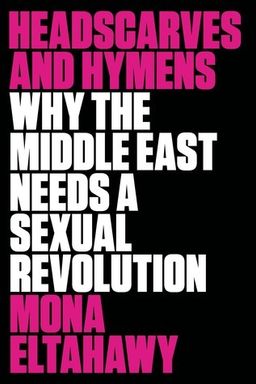
Headscarves and Hymens cover

Headscarves and Hymens

by Mona Eltahawy

Headscarves and Hymens exposes the harsh realities of misogyny in the Arab world and the brave feminist movement fighting for change. Mona Eltahawy''s powerful narrative calls for a sexual revolution, urging both Arab women and Western allies to stand together in the battle for equality and human rights.

Reclaiming Women’s Bodies and Voices in the Arab World

What happens when half the population is taught that their bodies are sinful, their voices dangerous, and their freedom blasphemous? In Headscarves and Hymens, Mona Eltahawy confronts this question head‑on. With the fervor of an activist and the precision of a journalist, she argues that women in the Middle East and North Africa face a “double revolution”—one political and one sexual—and that neither can succeed without dismantling the patriarchy that controls women’s bodies, faith, and speech.

Eltahawy’s core argument is simple but bold: Arab women live under a toxic mix of culture, religion, and politics that work together to keep them obedient—through dress codes, virginity tests, female genital mutilation, and countless acts of violence at home and in public. Yet she contends that true liberation cannot be imported or imposed by outsiders. It must come from within, from women themselves refusing silence, reclaiming their sexuality, and rewriting what faith and freedom mean.

Breaking the Silence

Eltahawy roots her call to rebellion in her own experience. Born in Egypt, she spent her teenage years in Saudi Arabia—“traumatized into feminism,” as she puts it—after witnessing women reduced to shadows under layers of black cloth. Her personal stories of being groped even during pilgrimage to Mecca and later assaulted by Egyptian police show how state and street collude in policing women. These stories are not isolated; they are emblematic of a larger system that equates female modesty with morality and uses religion as a weapon against autonomy.

The Politics of Hatred

In chapters such as “Why They Hate Us,” Eltahawy flips the narrative popular in Western media. Men in her region do not hate women because women are free, she writes; they hate women because they fear what happens when women stop being controlled. This “misogyny of necessity” extends from clerics who preach that women’s desires must be cut away through female genital mutilation to governments that condone domestic violence as “discipline.” Examples abound: Saudi laws that infantilize women under guardianship, Egyptian legislation allowing husbands to beat their wives “with good intentions,” and sanctioned virginity tests against activists.

A Double Revolution

Eltahawy insists that political change alone—removing tyrants like Mubarak—means little if the “Mubaraks of the mind” remain intact. Every revolution must therefore include a sexual component. She recalls how, even amid the hope of the Arab Spring, women were sexually assaulted in protest squares by fellow revolutionaries. Without confronting misogyny’s roots in religion and culture, political uprisings will always betray women.

Faith, Feminism, and Fearlessness

Throughout the book, Eltahawy draws strength from predecessors like Huda Shaarawi—who unveiled publicly in 1923—and thinkers such as Fatima Mernissi, Leila Ahmed, Nawal El Saadawi, and Gloria Anzaldúa. Her feminism bridges East and West, insisting that criticism of misogyny within Islam is not a plea for Western rescue but a demand for internal reform. (In this way, her approach echoes bell hooks’ vision of intersectional feminism that fights both racism and sexism.)

The author’s voice is conversational yet incendiary, daring Arab women to “be immodest, rebel, disobey.” The headscarf and hymen, she argues, symbolize two pillars of patriarchal control—one visible, one hidden—that must be shattered for freedom to blossom. Her manifesto closes with a vision: women toppling not only the dictators in palaces but also the patriarchs in homes, mosques, and minds.

“We might have removed Mubarak in Egypt,” she writes, “but until we topple the Mubaraks in our bedrooms and on our street corners, our revolution has not even begun.”

If you’re asking yourself what freedom really means—beyond the right to vote—Eltahawy’s book gives an uncompromising answer: Freedom begins when women own their bodies, speak their desires, and refuse to fear the word sex. Headscarves and Hymens is not only analysis but also a battle cry for a world where liberation is both political and intimate.


Why They Hate Us: The Anatomy of Misogyny

Eltahawy begins with a simple yet electrifying declaration: “Yes, they hate us.” She confronts the reader with the unvarnished truth that women in the Middle East and North Africa live in cultures fundamentally hostile to them, upheld by men’s contempt and reinforced by religion and law. Her retelling of Egyptian writer Alifa Rifaat’s story “Distant View of a Minaret”—where a woman prays calmly after her husband dies mid‑coitus—encapsulates the lethal triad of sex, death, and religion that defines Arab misogyny.

State and Street: Partners in Crime

From Saudi police who grope women even beside the Ka’aba to Egyptian soldiers conducting “virginity tests” on female activists, Eltahawy exposes how the state and the street collude to punish women for claiming public space. Both use sexual violence—literal and symbolic—as a tool of discipline. Women daring to protest or even drive are branded sinners. In Saudi Arabia, even a baby girl’s urine was once ruled impure compared to a boy’s—a grotesque example of theological sexism.

Culture and Religion: A Toxic Mix

Eltahawy refuses the polite fiction that misogyny stems solely from “culture” or “misinterpretation.” The alliance of patriarchal clerics and authoritarian regimes, she argues, sustains both religious control and political stagnation. She quotes clerics like Yusuf al‑Qaradawi, who supports female genital mutilation “to reduce temptation,” exposing how even so‑called moderates normalize cruelty. Egyptian law codifies male violence—stating that if a husband beats his wife “with good intentions,” damages cannot be claimed.

The Cost of Obedience

When over 90% of married Egyptian women have been mutilated in the name of purity and 99.3% face sexual harassment, silence becomes complicity. Eltahawy calls out both Western cultural relativists, who stay quiet in fear of appearing imperialist, and Western conservatives, who exploit Muslim women’s suffering to justify racism. Both, she says, betray the fight. Real solidarity means acknowledging that misogyny anywhere—whether in Cairo or Kansas—is interconnected.

Through statistics, stories, and outrage, this chapter lays the foundation for her thesis: unless the hatred of women embedded in faith, family, and national identity is named and challenged, revolutions will always fail. It’s not better than you think, she insists. It’s much, much worse—but it’s not irreversible.


Headscarves, Niqabs, and the Politics of Dress

Few topics ignite as much debate as the hijab. Eltahawy dedicates an entire section to dissecting the intricate web of meanings that surround women’s veiling—from personal faith to political symbolism. Having worn the hijab for nine years and later removed it, she explores what it means to be defined by a piece of cloth in societies obsessed with controlling women’s visibility.

The Veil’s Many Faces

For some women, veiling is a choice rooted in piety or identity; for others, it’s coercion disguised as virtue. Eltahawy traces its history back to pre‑Islamic civilizations where veiling distinguished free women from slaves—a powerful reminder that the practice predates Islam. Scholars like Fatima Mernissi and Leila Ahmed (both cited extensively here) reveal that the Qur’an’s mention of “hijab” originally referred to a curtain separating private and public spaces, not a mandatory head covering.

A Personal Unveiling

Eltahawy’s own journey mirrors that of countless women torn between faith and autonomy. She recalls first donning the headscarf in Saudi Arabia to feel safe in a hyper‑religious environment where even teenage girls were groped during pilgrimage. Later, feminist readings and encounters with Egyptian activists helped her peel back both the cloth and the fear it symbolized. “I realized,” she writes, “that I wasn’t the Hijab Poster Girl I thought I was. I was just a hijab.”

Beyond Choice and Bans

Eltahawy rejects both forced veiling in the East and reactionary niqab bans driven by racism in the West. True feminism, she argues, supports women’s autonomy, not ideological mandates. Yet she controversially endorses bans on the niqab—the face veil that erases identity—when imposed by patriarchal ideology, calling it “a bizarre reverence for the disappearance of women.” In this stance, she aligns with debates on freedom versus oppression similar to those explored by Iranian scholar Azar Nafisi in Reading Lolita in Tehran.

Whether worn or removed, the veil becomes a battleground for meaning. The real issue, Eltahawy reminds you, is not cloth but control: Who decides how visible a woman should be? Her answer is unequivocal—only she does.


Purity Culture and Sexual Violence

Why are women always blamed for men’s sins? Eltahawy’s exploration of sexual harassment and purity culture reveals the twisted morality that equates female modesty with male civility. In Egypt, 99% of women report harassment. Yet instead of punishing perpetrators, society tells women to cover, stay home, and stay silent.

Blaming the Victim

Eltahawy recounts absurd justifications offered by clerics and lawmakers. In Egypt’s penal code, a man may beat his wife with “good intentions.” In Saudi Arabia, over 86% of men blame women’s “excessive makeup” for molestation. This logic turns women into guardians of male purity, a theme echoed in Christian “purity movements” Eltahawy compares to U.S. Evangelical chastity pledges. Both rest on the idea that women’s sexuality must be regulated to preserve community morality.

State‑Sanctioned Violation

From the 2005 assaults on Egyptian female journalists to the infamous 2011 “virginity tests” under the military junta, Eltahawy shows how governments weaponize women’s bodies. Soldiers stick fingers into vaginas to prove “innocence.” Police turn sexual humiliation into punishment for dissent. The slogan “The army and the people are one hand,” she writes bitterly, becomes “one hand united against women.”

Breaking Shame’s Grip

In describing her own assault during protests—leaving her with broken bones but unbroken spirit—Eltahawy transforms trauma into activism. Her story and others reveal how shame is the regime’s most effective weapon. Yet as more women speak publicly, from activists to ordinary citizens, the taboo crumbles. Groups like HarassMap and Tahrir Bodyguard in Egypt exemplify this shift: they reclaim public space and remind society that women’s bodies are not public property.

Purity culture, she concludes, sustains the paradox of oppressed virtue. Women are told to save themselves while men are never told not to violate. Until we flip this narrative—teaching men accountability rather than women fear—freedom will remain unfinished.


The God of Virginity and Female Genital Mutilation

Eltahawy calls the worship of virginity the region’s most perverse religion. “Our hymens are not ours,” she writes, “they belong to our families.” The obsession with chastity manifests in female genital mutilation (FGM), hymen reconstruction surgeries, and virginity tests—rituals that mutilate girls both physically and psychologically to appease a god of control.

Cutting for Purity

With clinical detail, Eltahawy cites WHO classifications of FGM—from clitoridectomy to infibulation—and shares stories of mothers holding down their daughters while midwives cut. She quotes Nawal El Saadawi’s haunting recollection of being cut at six as her mother smiled nearby. Love becomes betrayal. The practice, she notes, persists even among educated families in Egypt, Sudan, and Yemen, because a mutilated daughter means marriageability.

Religion Misused

Though not mentioned in the Qur’an or Bible, FGM endures through false religious authority. Clerics declare it “beautification.” Even when Egypt criminalized FGM in 2008, some Muslim Brotherhood officials opposed the ban. Eltahawy mocks their hypocrisy: the same faith that celebrates foreplay and mutual pleasure during sex has been distorted to justify the denial of those very pleasures to women.

Survivors and Revolutionaries

Yet amid darkness, she spotlights courage. Sudanese surgeon Nahid Toubia, Kenyan sisters Edna and Beatrice Kandie, and Ethiopian bride Genet Girma turned personal suffering into activism, publicly rejecting cutting and changing laws. Eltahawy calls their defiance “holy blasphemy.” Like the broader sexual revolution she demands, ending FGM requires defiance of both family and faith.

Ultimately, she dismantles the myth that mutilation maintains virtue. True virtue, she argues, lies in compassion and consent—not the silence of bleeding girls. Until the god of virginity is dethroned, there can be no liberation.


Breaking the Patriarch’s Rule at Home

Eltahawy insists that patriarchy is not just political—it’s domestic. She recounts horrifying examples of men beating or killing their daughters and wives under laws that treat women as property. In Saudi Arabia, a cleric who tortured and raped his five‑year‑old daughter received a mere three months in jail. In Lebanon, a husband murdered his wife with a pressure cooker while police dismissed it as a “family matter.”

Law and Custom Collide

Across the Arab world, personal status laws enshrine obedience: wives must “obey,” husbands may discipline. Female guardianship systems infantilize adults, making fathers and even sons gatekeepers of marriage, travel, and divorce. Eltahawy’s comparison of Saudi and Lebanese legal reforms exposes the hollowness of ‘anti‑abuse’ measures that criminalize violence but excuse marital rape as a “right.” Religious courts, she writes, protect families—not women.

Marriage as Captivity

The patriarch’s grip tightens through marriage laws and child brides. Girls as young as eight are sold as “wives” to middle‑aged men in Yemen and Saudi Arabia. Rape victims are forced to marry their rapists under Jordan’s Article 308, a phenomenon Eltahawy calls “rape turned wedlock.” Mothers defend these unions in the name of honor—a tragic inheritance of fear.

Revolutions Inside Walls

Yet Eltahawy finds hope in women defying domestic dictators. The Egyptian women’s support groups she helped found give victims the courage to speak, leave, and fight. Their micro‑rebellions—removing headscarves, filing lawsuits, refusing abusive marriages—are as revolutionary as street protests. “Home is where the hurt is,” she writes, “and home is where we must start to heal.”

By linking domestic violence to national authoritarianism, Eltahawy challenges you to see every slap, every legal clause, as political. The revolution isn’t only in Tahrir Square; it’s at the dinner table.


The Call for a Sexual Revolution

What would happen if women spoke the truth about their lives? Eltahawy’s closing chapters answer: the world would split open. She argues that genuine change demands a sexual revolution that liberates both desire and dialogue. Without reclaiming sexuality, feminism remains half-born.

Owning Desire

Eltahawy shares her own journey—waiting until twenty‑nine to have sex, feeling guilt rooted in religion, and finally declaring pleasure a form of resistance. By uniting personal confession with political critique, she resembles writers like Audre Lorde and Malika Mokeddem, who treat eroticism as power. “Freedom begins when we speak of desire without shame,” she writes.

Speaking the Unspeakable

She salutes women like Egyptian activist Aliaa Elmahdy, who posted a nude photograph online to protest sexual repression, and Lebanese skier Jackie Chamoun, attacked for topless photos. Their bodies, Eltahawy says, became battlegrounds for hypocrisy: societies that tolerate rape were outraged by nudity. Art and protest fuse in works like Nadine Hammam’s Tank Girl, where a woman astride a pink tank tells patriarchy to “Go Love Yourself.”

Knowledge as Liberation

The final chapters demand sex education, linguistic reform, and the dismantling of taboos around homosexuality and extramarital relations. Eltahawy notes that most Arab youths learn about sex through pornography or clerics—two extremes devoid of empathy. Teaching consent and pleasure, she argues, is as revolutionary as toppling dictators.

Her concluding vision is fierce and tender: women uniting across borders to demand “Bread, Liberty, Social Justice, Human Dignity” both in the streets and bedrooms. The sexual revolution she calls for is not indulgence—it’s reclamation. To speak, to feel, to disobey: these acts, she insists, are the foundation of freedom.

Dig Deeper

Get personalized prompts to apply these lessons to your life and deepen your understanding.

Go Deeper

Get the Full Experience

Download Insight Books for AI-powered reflections, quizzes, and more.