
Idea 1
Living a Beautiful, Terrible Life
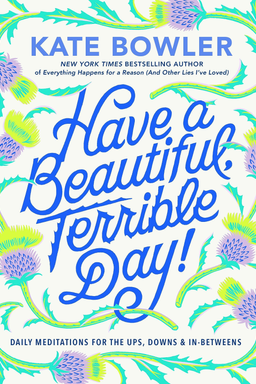
Have you ever stood at the edge of an ordinary day, realizing it was both breathtakingly beautiful and painfully hard? In Have a Beautiful, Terrible Day!, Kate Bowler invites you into precisely that paradox—the coexistence of gratitude and grief, peace and panic, joy and suffering. Her writings are blessings for anxious souls who want to be awake to life as it really is, not as they wish it to be.
Bowler’s core argument is that life refuses to be tidied. You cannot fix it, optimize it, or stay above its turbulence. Fear, uncertainty, pain—they are not malfunctions but conditions of being human. Yet, amid this chaos, faith and love persist. Drawing on her own experiences living with stage IV cancer and chronic pain, Bowler contends that our vulnerability is not a defect; it’s an opening through which grace arrives.
The Honest Paradox of the Beautiful and the Terrible
Bowler begins by naming what we all feel: these are beautiful, terrible days. You might be worrying about school shootings and global unrest one minute, then noticing the mischievous grin of your child or the warm glow of a sunset the next. Her prose alternates between poetic awe and raw honesty. We’ve lost control of ordinary rhythms—our moods are no longer "middle of the road" but swinging wildly between dread and wonder.
Through this lens, Bowler dismantles modern self-help culture’s promises of stability and positivity. The slogans of “faith not fear” or “manifest abundance” ring hollow against the reality of pain and loss. The Christian life, she reminds us, is not about escaping fear but about holding faith and fear in the same trembling hands.
Naming Our Fears: Three Forms of Awareness
Bowler identifies three faces of modern anxiety: apocalyptic awareness (when the world itself threatens collapse), anxious awareness (the personal churn of worry and vigilance), and painful awareness (our intimate confrontation with suffering). Each one magnifies our sense of precarity—the fragility of living in a world without guarantees. We are made, she says, of both feather and stone.
Her reflections draw gently from Scripture and theology. The Greek root of “apocalypse” means not just destruction but revelation. Fear, then, can reveal truth: the world’s brokenness and our dependence on grace. And that revelation can be sacred if we learn how to stand within it, eyes wide open.
Dependence as Holy Ground
As her health deteriorated, Bowler discovered what she calls the “religion of involuntary dependence.” She describes how her Mennonite family rebuilt a broken shed after her cancer diagnosis—a symbolic story of communal love. She realized that independence is not divine; interdependence is. Our survival, both spiritual and physical, relies on others and on a God who works through them.
She explores this idea through the concept of precarity—a Latin-derived word meaning “obtained by prayer.” A precarious life is not merely vulnerable; it is relational. It relies on grace, generosity, and divine sustenance. To seek security above all is, paradoxically, to miss the presence of God amid instability.
Being Carried by Others
Bowler describes how she learned to be carried—literally and spiritually. Drawing from the Gospel of Luke, she recalls the friends who carried a paralyzed man to Jesus by tearing off a roof to let him down. This scene becomes her metaphor for faith itself: we are healed through community, through others who carry our stretcher when we cannot walk. To be carried, she says, is not shame; it’s liberation from the myth of self-sufficiency.
Her conclusion is both tender and defiant: the roof will always cave in. Whether by illness, injustice, or heartache, our structures—our plans and independence—will break. But through each collapse shines the enduring truth of resurrection hope. Even amid broken shingles and chemotherapy fatigue, love keeps doing its miraculous work.
A Blessing for Our Own Beautiful, Terrible Days
Every reflection and prayer in this book forms part of Bowler’s larger theology of realism and tenderness. She teaches us to bless both our despair and delight—to name what is true without forcing it into optimism. Her recurring refrain captures this radical acceptance: “Blessed are we, the anxious, the aware, the hopeful, the grateful.” Our fear is not faithlessness; it’s evidence that we care deeply about what’s sacred.
Ultimately, Bowler contends that the only sane way to live in such a world is to admit fear, accept love, and remain awake to the miracle and tragedy of being alive. The beautiful and terrible are two faces of the same grace. This book insists: you can have faith and be afraid; you can suffer and still marvel; you can live honestly, even when the roof caves in.