
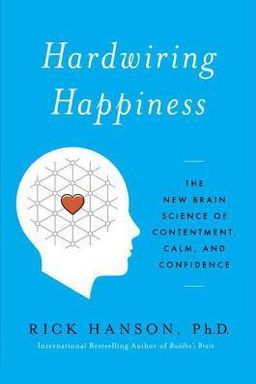
Hardwiring Happiness cover

Hardwiring Happiness

by Rick Hanson

Hardwiring Happiness explores the neuroscience behind our inherent negativity bias and provides practical techniques to rewire our brains for positivity. Discover how to focus on the good, heal past traumas, and cultivate a happier, more relaxed life.

Rewiring the Brain for Lasting Happiness

Have you ever wondered why bad experiences seem to stick while good ones slip away? In Hardwiring Happiness: The New Brain Science of Contentment, Calm, and Confidence, neuropsychologist Rick Hanson argues that this imbalance isn't your fault—it's how the human brain evolved. Our minds are wired for survival, not joy, making them like Velcro for the bad and Teflon for the good. But Hanson contends that by intentionally focusing on positive experiences and helping them sink in, you can literally change your brain’s neural structure—what he calls “self-directed neuroplasticity.”

The heart of Hanson's book revolves around turning fleeting good experiences into durable inner strengths—qualities such as resilience, confidence, and peace. His central message is both radical and empowering: happiness isn't a temporary state; it's something you can hardwire into your brain through deliberate mental practice. You don’t have to rely on big life events, achievements, or perfect circumstances. Instead, Hanson shows that ordinary moments—a kind word, a sense of accomplishment, a quiet cup of coffee—can transform your mind and body if you give them the attention they deserve.

The Problem: A Negativity Bias

Drawing from evolutionary psychology, Hanson explains that for millions of years survival demanded constant vigilance. Our ancestors who focused more on potential threats than on peaceful moments were more likely to stay alive—but not more likely to be happy. As a result, modern humans have inherited a built-in “negativity bias.” This means the brain is more sensitive to negative experiences, reacts more intensely to them, and stores them more easily. A hurtful comment lingers longer than ten compliments. A stressful incident at work colors your whole day while pleasant moments fade away.

This bias explains why you might end the day thinking more about what went wrong than what went right. Hanson's metaphor—Velcro for bad experiences and Teflon for good—captures how strongly negative emotions shape neural pathways compared to fleeting positive ones. If you want to be less reactive and more resilient, you need to flip this bias by consciously strengthening your brain’s ability to learn from the good.

The Solution: Taking in the Good

The core of Hanson's approach is a simple yet transformative method he calls HEAL: Have a positive experience, Enrich it, Absorb it, and optionally Link it to negative material so the positive can soothe or replace the negative. In short, rather than rushing from one event to another, Hanson suggests pausing for a dozen seconds when something good happens to truly feel it—letting it register in your brain long enough to move from short-term awareness into long-term memory.

These moments of mindfulness are not about artificial “positive thinking.” Unlike repeating affirmations or denying pain, Hanson's method is grounded in neuroscience. When you repeatedly dwell on feelings of calm, love, or accomplishment, neurons that fire together wire together—embedding the experience into your neural network. Over time, the brain becomes more receptive to peace and joy.

The Science: Experience-Dependent Neuroplasticity

The mechanism behind Hanson's claims comes from what scientists call experience-dependent neuroplasticity. This process means that every thought and emotion subtly reshapes your brain's physical structure. Repeated patterns of attention and feeling strengthen certain neural circuits while others fade away. Through sustained attention, a fleeting feeling of gratitude can become a lasting trait of gratefulness.

Hanson compares this process to water carving channels through stone: every time you take in the good, you deepen the pathways that support healing, calm, and confidence. Conversely, dwelling on worry or anger deepens pathways of stress and hurt. So, what you rest your mind on becomes what your brain turns into. This idea echoes mindfulness principles found in works like The Mindful Brain by Daniel Siegel and The How of Happiness by Sonja Lyubomirsky, yet Hanson’s contribution lies in connecting these ideas directly to structural changes in the nervous system.

The Goal: Cultivating a Responsive Brain

Hanson identifies two basic modes of mind: the reactive brain, which is fearful, grasping, and conflicted; and the responsive brain, which is calm, contented, and loving. His goal is to help you spend most of your time in the green, responsive mode rather than the red, reactive one. When you feel safe, satisfied, and connected, your body refuels and repairs itself, and your relationships naturally become more harmonious.

“The mind takes its shape from what it rests upon.”

Hanson urges readers to rest their minds on good experiences—pleasant sights, accomplishments, moments of gratitude—so the brain itself reshapes into resilience and peace.

Why It Matters

In a time when stress and distraction dominate, Hanson's message offers hope and practicality. You don’t need to withdraw to a monastery or achieve enlightenment to feel better. You just need a dozen seconds, repeated throughout your day, to help good experiences settle into your brain. Those seconds accumulate, gradually transforming your mental landscape from anxiety and discontent into confidence and peace.

As Hanson reminds us, the work is small but profound: by changing the focus of your attention, you change the architecture of your happiness. You become the sculptor of your own emotional brain, turning passing pleasures into lasting strengths. The rest of the book unpacks this process in detail—teaching you how to notice good experiences, create them, install them, and use them to heal old pain and strengthen your life’s foundation.


Growing Inner Strengths Like a Garden

Rick Hanson begins by sharing his own story as a shy, nerdy boy who often felt invisible. What changed him wasn’t grand therapy or spiritual revelation—it was something he stumbled upon in college: lingering for a moment with good experiences. When someone invited him to pizza or a woman smiled at him, he learned to pause and let that good feeling sink in. Over time, those small acts filled “the hole in his heart.”

The Garden Metaphor

Hanson uses the metaphor of the mind as a garden with three possible approaches: Let be (simply observe), Let go (weed out negativity), and Let in (cultivate positivity). His book focuses on the third—growing flowers rather than fighting weeds. You can’t control every storm, but you can choose what to plant and nurture. Each good experience—calmness, accomplishment, gratitude—is like a seed that grows inner strength.

Inner Strengths Defined

These strengths range from resilience and confidence to peace and love. While about one-third of these traits are innate (based on temperament and genes), two-thirds can be cultivated. You develop determination by repeatedly experiencing perseverance, or self-compassion by consciously appreciating moments of kindness. Hanson calls this process installing traits: turning temporary mental states into durable neural traits.

Experience-Dependent Neuroplasticity

At the root of this process is neuroplasticity—the brain’s ability to change through experience. Hanson illustrates this with extraordinary examples: London taxi drivers’ hippocampus enlarges as they memorize city streets; long-term meditators thicken regions related to attention and empathy. Likewise, when you repeatedly rest your mind on positive experiences like calm or worthiness, new neural pathways form that make these feelings easier to access in the future.

Planting Flowers Everyday

You don’t need dramatic events to grow happiness. Taking twenty seconds to savor the relief after finishing a project, the gratitude for a friend’s text, or the warmth of sunlight can begin wiring your brain for joy. Over time, those moments compound, making your brain “stickier” for positive experiences. Hanson’s advice boils down to four words: Have it, Enjoy it.

“You can use your mind to change your brain—to change your mind for the better.”

Instead of running laps through worry and regret, rest your mind on calm and confidence. What you rest upon becomes who you are.


The Brain’s Negativity Bias

In one of the book’s most memorable explanations, Hanson describes how evolution shaped a brain that pays ten times more attention to danger than to delight. He calls this our “Stone Age brain”—designed to keep us alive, not to make us happy.

From Carrots and Sticks to Modern Stress

Our ancestors had to get carrots (food, shelter, mating opportunities) and avoid sticks (predators, starvation, conflict). Missing a carrot was inconvenient; missing a stick could mean death. So the brain gave more weight to painful stimuli. Today, that same system makes us dwell on criticism rather than praise, setbacks rather than progress.

The negativity bias operates through neural mechanisms: the amygdala’s alarm system reacts stronger to threats than rewards, flooding the body with stress hormones. Negative experiences are fast-tracked into memory, while positive ones require sustained attention to make any lasting impression.

Velcro for Bad, Teflon for Good

Hanson’s “Velcro vs. Teflon” metaphor captures this perfectly. Pain sticks; pleasure slides off. Unless you consciously hold a good experience for ten seconds or more, it dissipates before your brain can encode it. This explains why stress management trainings or simple mindfulness practices often fail—they generate positive moments that aren’t internalized.

The Vicious Circle of Cortisol

Repeated negative experiences make the amygdala hypersensitive, while cortisol erodes the hippocampus—the part that helps calm emotional responses. Over time, this creates a self-reinforcing loop: stress breeds more reactivity, making further stress inevitable. Breaking this cycle means teaching the brain to learn from positive events as efficiently as it learns from threats.

By practicing “Taking in the Good,” you tilt the brain’s learning curve toward positivity, leveling the evolutionary playing field. Hanson’s insight parallels Barbara Fredrickson’s research on positive emotions, which finds that they broaden attention and undo physiological stress. Both suggest that happiness is less about avoiding pain and more about reeducating your neural networks to recognize safety and satisfaction.


Green Brain vs. Red Brain

Perhaps Hanson’s most elegant model divides the brain’s functioning into two modes: Responsive (the “green” brain) and Reactive (the “red” brain). These correspond to peace versus fear, contentment versus frustration, and love versus heartache. You experience the red brain when stressed, threatened, or disconnected; the green brain when feeling safe, satisfied, and connected.

Three Core Needs

Every human being has three evolutionary needs: safety (avoiding harms), satisfaction (approaching rewards), and connection (attaching to others). These needs correspond to systems in the brainstem, subcortex, and cortex, roughly mirroring our reptilian, mammalian, and primate heritages. When these needs are met, the corresponding system shifts to its green, responsive mode—calm, confident, and loving. When they’re unmet, the brain shifts red—anxious, frustrated, or hurt.

Biology of the Modes

In the green mode, oxytocin and other soothing neurotransmitters flow freely. The body refuels, heals, and replenishes itself. In the red mode, fight-or-flight cortisol dominates, draining your energy and impairing immune function. Modern life—with constant alerts, noise, and time pressure—keeps most people chronically red.

Developing a Responsivity Bias

The goal is to rewire the brain toward a responsivity bias—spending most days on green. Every time you experience peace, contentment, or love, and consciously take it in, you strengthen neural circuits that sustain these states. Hanson emphasizes that this practice not only calms stress but transforms relationships, motivating empathy and generosity. He likens “taking the fruit as the path”—each positive experience you internalize both rewards and cultivates your capacity for happiness.

Over time, green replaces red as your brain’s default, bringing you home to your natural state of equilibrium. Peace becomes not the absence of problems but a stable foundation for meeting life’s challenges.


HEAL: The Four-Step Path to Installation

At the core of Hanson's method is the HEAL process—a simple, systematic way to turn good experiences into lasting inner traits. The acronym stands for Have, Enrich, Absorb, and Link. Each step activates or strengthens neural wiring.

Step 1: Have

You begin by noticing or creating a positive experience. It could be as simple as joy in a meal, gratitude for daily safety, or completing a task. If no moment feels good enough, create one—think of someone who loves you, recall a success, or appreciate a beautiful view. The goal is embodied experience, not just positive thinking.

Step 2: Enrich

Stay with the feeling for at least 10–20 seconds. Savor it. Let it fill your body, finding aspects that matter personally. Hanson identifies five enhancers of learning—duration, intensity, multimodality, novelty, and relevance—each increasing neural engagement. For example, combining gratitude with sensory richness and personal meaning helps neurons fire together more robustly.

Step 3: Absorb

Imagine the experience sinking into you like golden dust settling in your heart. Sense it as a lasting resource. Hanson likens this to taking a mental snapshot—making sure the moment leaves a neural imprint. Just as the body assimilates nutrients from food, your mind assimilates emotional nourishment.

Step 4: Link (Optional)

Once anchored in positivity, gently bring a related pain into awareness. Let the positive interact with the negative, soothing or replacing it. Hanson calls this “flowers pulling weeds”—the integration of healing into the very neural circuits where distress lives. This method mirrors techniques in modern therapy, including coherence therapy and EMDR, which pair positive states with trauma memories to rewire emotional responses.

Together, these steps turn happiness from an experience into an enduring capability. Hanson demonstrates that moments of peace can become structural features of your brain—a skill available to anyone willing to practice.


Taking In the Good in Everyday Life

Hanson emphasizes that taking in the good is not reserved for meditation cushions or therapy sessions—it’s meant for real life. The practice can seamlessly integrate into waiting in line, washing dishes, or tucking your child into bed. Each ordinary moment offers a seed of transformation.

Noticing and Creating Positive Experiences

In chapter 5, Hanson reminds readers that good experiences are everywhere if you train your attention. You can notice a pleasant sensation, like the warmth of water, or create one, like recalling a kind interaction. Most opportunities for happiness are small and fleeting; paying attention to them, even for a dozen seconds, rewires the emotional baseline.

He urges you to treat yourself as a good friend—allowing yourself to savor rewards instead of dismissing them. Whether enjoying a meal, feeling competent at work, or hearing laughter, pause and acknowledge that it feels good. These micro-moments compound over time into macro-changes.

Overcoming Blocks

Many people, Hanson notes, resist feeling good due to guilt, fear, or habit. Cultural messages—especially in competitive workplaces or self-sacrificing families—tell us that relaxing or savoring is selfish. Hanson counteracts this: being happy doesn’t diminish others’ happiness; it enhances your ability to care, succeed, and contribute.

He identifies common blocks, from overanalyzing moments to fearing disappointment, and provides antidotes: kindness toward oneself, gentle focus on physical pleasures, and reframing joy as strength rather than indulgence. “It’s moral to seek the welfare of all beings,” Hanson says, “and that includes the one wearing your name tag.”

The Law of Little Things

Small efforts accumulate. Hanson’s “law of little things” asserts that dozens of minor positive experiences—each reinforced for a few seconds—reshape your nervous system. You don’t need dramatic epiphanies. A minute of gratitude before sleep, a brief savoring of morning light, or a moment of warmth toward a friend—all hardwire lasting well-being.

“Drop by drop, the pot is filled.”

This Buddhist verse, cited by Hanson, captures his method perfectly: gathering joy bit by bit until your inner reservoir overflows.


Using Positive Experiences to Heal Emotional Pain

In later chapters, Hanson explores how linking positive and negative material can transform deep wounds. He explains that painful memories—especially from childhood—form neural coalitions that reactivate under certain triggers. But because memory reconstruction is dynamic, these circuits can be rewired.

Flowers Pulling Weeds

When you recall a hurtful memory while grounded in a strong positive state, neurons representing safety and love fire together with those representing fear or shame. This process changes associations in the brain, weakening the emotional charge of the negative. Over time, the positive gently overtakes the negative—like flowers pulling weeds from the garden of the mind.

Two Mechanisms of Change

  • First, overwriting—the positive experience soothes and reframes the negative memory.
  • Second, erasing—during the brain’s “window of reconsolidation,” the link between pain and its triggers weakens or dissolves.

Hanson gives examples of readers healing childhood rejection by linking memories of humiliation with present feelings of being cared for. One woman imagined two corgis licking her face—a vivid experience of unconditional love—while recalling her grandmother’s cruelty. The positive rewrote neural tracks of fear with affection.

Antidote Experiences

Every pain has an antidote: safety for fear, satisfaction for frustration, connection for rejection. Hanson provides detailed tables of these matches, guiding readers to use exact emotional medicine for each wound. By practicing HEAL repeatedly, you don’t erase your history—you reshape how your brain carries it. Memories lose toxicity, replaced by calm understanding.

“The hurt may remain, but its power fades.”

Through repeated positive installation, pain loses its control. The past’s shadow shortens in the light of present goodness.


The Global Meaning of Hardwired Happiness

In his afterword, Hanson widens the lens. He argues that the same neuropsychological mechanisms that create individual suffering also drive collective conflict. Humanity’s “reactive mode” fuels nationalism, exploitation, and war—the social equivalents of the brain’s red state. “We’ve armed a Stone Age brain with nuclear weapons,” he warns.

From Personal to Planetary Healing

If enough people learn to rest in their responsive, green brain—feeling safe, satisfied, and connected—its ripple could transform societies. Hanson imagines a world where millions live more often in calm rather than conflict, generosity rather than fear. This is not utopian optimism; it's neurological realism. The brain evolved to be kind when it feels secure. By cultivating inner peace, we contribute to outer peace.

The Vision

Hanson envisions a tipping point when widespread mental practice changes human history. Families would be less reactive, workplaces more cooperative, nations less hostile. His closing wish is deeply simple: come home to the natural resting state of your brain—peace, contentment, and love. It’s both a neuroscientific method and a moral vision.

“Imagine a world where a billion human brains spend most of each day in the green zone.”

Hanson’s closing invitation is not just personal—it’s planetary. Hardwiring happiness could hardwire compassion itself.

Dig Deeper

Get personalized prompts to apply these lessons to your life and deepen your understanding.

Go Deeper

Get the Full Experience

Download Insight Books for AI-powered reflections, quizzes, and more.