
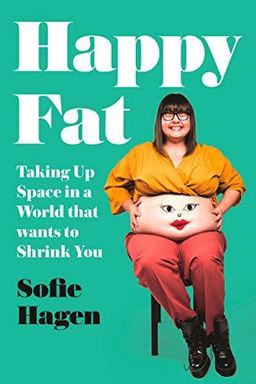
Happy Fat cover

Happy Fat

by Sofie Hagen

In ''Happy Fat,'' Sofie Hagen confronts societal fatphobia, dispelling myths about health and body image. Through personal stories and incisive analysis, Hagen encourages readers to embrace their bodies, challenge discrimination, and reject the diet industry''s harmful narratives.

Fat Liberation, Not Body Fixing

When was the last time you apologized to your body? In Happy Fat, comedian and fat activist Sofie Hagen invites you to stop apologizing entirely. Hagen argues that society’s obsession with weight loss has nothing to do with health or self-improvement—it’s an instrument of control. The book contends that fat people are entitled to the same dignity, equality, and happiness as everyone else, and that freeing ourselves from fatphobia is not just personal healing—it’s political resistance.

Hagen blends memoir, activism, and humor to show how systemic discrimination against fat people shapes nearly every institution—from medicine and media to fashion and friendship. Through stories spanning childhood trauma, disastrous diets, and liberation epiphanies, she builds a case for loving one’s body as an act of rebellion in a capitalist world that profits from our shame. The book’s argument is both urgent and tender: self-love alone won't topple fatphobia, but it can be the first step toward dismantling an oppressive system built on body hatred.

The Central Idea: Fat Is Not the Problem

At the heart of Happy Fat is a radical claim: fatness is not unhealthy, immoral, or inferior. Hagen uses scientific studies, historical manifestos, and intimate anecdotes to dismantle the idea that weight equals worth. She argues that society’s obsession with thinness harms everyone, fat or thin, by enforcing impossible ideals—especially women, queer people, and marginalized communities. The true health crisis, Hagen proposes, isn’t obesity—it’s systemic discrimination and chronic shame.

Drawing on the Fat Liberation Manifesto (1973) by Judy Freespirit and Aldebaran, Hagen ties her personal awakening to a global movement. These early fat feminists demanded constitutional equality, denounced "reducing industries," and linked their struggle to fights against racism, sexism, and imperialism. Nearly fifty years later, Hagen updates that call to action for the social media age: reclaiming fatness is not vanity—it’s revolution.

A Blend of Memoir and Manifesto

Hagen’s life serves as both a case study and a roadmap. We meet the eight-year-old Sofie, chastised by a nurse for a “dangerous” chubby body; the teenage Sofie cycling through starvation diets, bulimia, and Atkins-style regimes; and the adult Sofie confronting medical bias, dating humiliation, and airline “fat taxes.” Through these stories, the reader witnesses the transformation from internalized self-loathing to radical self-acceptance.

“Fat” becomes just another adjective—like “tall” or “freckled”—stripped of its venom. Hagen insists on using the word unapologetically, challenging euphemisms like “curvy” or “plus-size.” Her approach aligns with activists such as Roxane Gay (Hunger) and Virgie Tovar (You Have the Right to Remain Fat): to call yourself fat without shame is to remove the weapon from your oppressor’s hand.

Health, Capitalism, and the Myth of Control

Hagen exposes the myth that we can “earn” health through weight loss. She cites research from the Journal of the American Medical Association showing that nearly all diet programs fail long-term and that physical activity—not body size—is the best predictor of longevity. The real danger, she argues, lies in the corporations and institutions profiting from weight anxiety: diet pills, bariatric surgery, “fitspiration” media, and even doctors who confuse thinness with wellness. She calls this economy “death by fatness industrial complex” —a machinery that convinces people they’re broken so they’ll keep paying to be fixed.

By redefining health as multidimensional—mental, social, spiritual, and physical—Hagen confronts the moral hierarchy that glorifies the “healthy” and devalues the sick or disabled. Her message to readers: you do not owe health to anyone. Your value is not a transaction based on BMI or gym hours; your worth is inherent.

Body Love as Activism

While Hagen’s pink-haired humor keeps the tone accessible, her politics are sharp. Drawing parallels to feminism, anti-racism, and queer liberation, she argues that fatphobia is a tool of patriarchy and capitalism. The demand that people—especially women—shrink themselves keeps them obedient, exhausted, and small. As Naomi Wolf once argued in The Beauty Myth, dieting is “the most potent political sedative in women’s history.” Hagen updates this idea with memes, manifestos, and well-timed comedy: loving your body is not self-indulgence—it’s defiance.

By the end of Happy Fat, you understand why Hagen’s laughter matters. Her humor doesn’t dismiss pain—it transforms it. To laugh at fatphobia is to puncture its authority. The book closes not on a note of isolation but of collective power: from FatSwap clothing exchanges to fat-positive clubs to online communities, liberation comes through connection. When you choose self-acceptance, you create space for others to do the same. Fat people, Hagen insists, “deserve to be here”—joyfully, visibly, and without apology.


The Making of Fat Shame

Hagen devotes much of the book to showing how the world teaches you to hate fatness before you can even spell it. Her childhood in Denmark reads like a case study in learned shame. A nurse branded her body ‘dangerous’ at age eight, marking the first incision of fatphobia into her psyche. Teachers humiliated her during gym class—one physically forced her to shower in front of classmates—and bullies made her internalize that she was unworthy of kindness. From that point, her battle with food became a battle with identity.

Diet Culture as Indoctrination

By adolescence, Sofie had joined the global religion of dieting. Each Monday was a baptism of hope: new rules, new forbidden foods, new promises of thin salvation. She tried Doctor Atkins, SlimFast, calorie counting, and starvation, only to binge later from hunger and shame. Hagen notes that these cycles aren’t personal failures—they’re the predictable outcomes of an industry predicated on relapse. Dieting trains you to distrust your body’s hunger cues and equates morality with restraint. “The worse you feel,” she writes, “the more they profit.”

Medical Bias and Misuse of Science

Hagen recounts a brutal encounter with a doctor who refused her birth control prescription until she lost weight and insisted on checking her BMI—dubiously calculated and long discredited—and ignored the patient’s mental health needs. She connects this to studies showing widespread anti-fat prejudice in healthcare: nearly half of nurses admit feeling “repulsed” by fat patients, and bias contributes to misdiagnosis and neglect. In one tragic example, a woman’s fatal tumor went undetected for years because doctors attributed her symptoms to “obesity.” Fat people, Hagen argues, often die not from their bodies but from being denied proper care.

This critique echoes the work of researchers like Dr. Linda Bacon (Health at Every Size), who demonstrate that weight stigma itself—through chronic stress and social exclusion—produces many of the diseases falsely blamed on fatness. Hagen amplifies this paradigm shift: instead of “fat causes illness,” think “fat oppression causes illness.”

Media Stereotypes and Symbolic Annihilation

Hagen likens media representation to a hall of mirrors: thin bodies look heroic, while fat ones are ridiculed or erased. From Ursula the Sea Witch to Fat Monica in Friends, larger characters serve as moral lessons or comic relief. She draws on feminist media theory’s term “symbolic annihilation”—when groups are underrepresented or trivialized until they seem invisible. As she quips, “There are more murdered women on TV than fat women.” This absence breeds collective discomfort: if you never see someone like yourself portrayed with dignity, how can you imagine a future where you exist unpunished?


The Myth of Fat Equals Unhealthy

In one of the book’s most evidence-rich chapters, Hagen tackles the perennial question: “But what about health?” With wit and an arsenal of studies, she reveals that the so-called obesity epidemic is as distorted as a funhouse mirror. Health, she insists, cannot be measured by size alone.

Debunking Pseudoscience

Hagen traces how the 1993 McGinnis and Foege study on American mortality was twisted by media and policymakers into blaming “obesity” rather than “diet and activity patterns.” Later, inflated figures—claims of 400,000 deaths per year—were exposed as flawed extrapolations funded by the weight-loss industry. CDC researcher Katherine Flegal’s 2005 correction lowered the number to less than 26,000. Yet, the myth of fat as a killer persists because it sells billions in diets, drugs, and surgeries.

Fitness, Not Fatness

Summarizing decades of research, Hagen highlights the “obesity paradox”: physically active fat people exhibit similar mortality rates to active thin people. A long-term study of 20,000 participants found that “fit fat” individuals had half the diabetes risk of “unfit” thin ones. Health outcomes, she writes, “are determined more by lifestyle conditions than by scale numbers.” Stress, poverty, discrimination, and genetics influence wellbeing far more than BMI.

Stress, Shame, and Cortisol

Hagen introduces the work of Peter Muennig at Columbia University, who shows that discrimination and body dissatisfaction elevate cortisol—the hormone that regulates stress responses and fat storage. Paradoxically, the shame society inflicts on fat people produces the very health issues it claims to prevent. To shame someone for health, Hagen declares, “is like trying to make someone smell less of piss by pissing on them.”

Health as a Privilege, Not a Moral Duty

Hagen dismantles the “healthism” narrative—the idea that health is a moral obligation or a marker of virtue. Not everyone has equal access to nutritious food, safe spaces for exercise, disposable income, or time. Chronic illness, disability, trauma, and caretaking all shape daily choices. “You do not owe anyone your health,” she insists. Caring for your wellbeing can be a personal choice, but it should never be demanded as proof of worthiness. In her recurring refrain: get the fuck out of my health.


Capitalism, Beauty, and Control

Why does the world want us to shrink? Hagen argues that body hatred is a capitalist strategy. The beauty, diet, and fashion industries thrive on self-loathing, turning people—especially women—into lifelong customers chasing unattainable perfection. “The worse you feel,” she reminds us, “the more they profit.”

The Economics of Self-Hatred

From “bikini body” ads to slimming teas, every product promises relief from shame. Hagen calls out how corporations manufacture insecurity only to sell the cure. The modern “body-positivity” movement, she warns, has been co-opted—softened from Fat Liberation’s radical demand for justice into a consumer-friendly slogan selling lotions and yoga pants. This echoes Naomi Wolf’s critique in The Beauty Myth: a culture fixated on thinness isn’t obsessed with beauty but with obedience.

The Tyranny of Thinness

Diet culture trains bodies to be tractable. Women spend years starving, counting calories, and apologizing for appetite—energy that might otherwise fuel rebellion. Hagen frames thinness as a form of social currency: those who can “afford” the time and money to meet beauty standards signal class privilege. Those who cannot are deemed lazy or undeserving. It’s no coincidence, she notes, that the ideal body resembles economic elites: thin, white, controlled.

Body Currency and Internalized Capitalism

Adapting Jes Baker’s concept of “body currency” from Things No One Will Tell Fat Girls, Hagen explains how physical appearance has become a capitalist marketplace. When a fat person refuses to participate—posting unedited photos, wearing crop tops, or simply existing happily—it devalues that currency. “You have what others paid for,” she writes, “without doing any of the work.” Hence the fury fat joy provokes: it bankrupts an economy built on suffering.

Ultimately, Hagen calls for economic rebellion: support brands with real size inclusivity, boycott those profiting from fatphobia, and remember that self-love is free—and therefore profoundly unprofitable. She challenges readers to imagine a world where happiness cannot be bought, only lived in your unapologetic skin.


The Politics of Visibility

To be fat in public, Hagen writes, is to exist under surveillance. Every seat, photograph, and doctor’s office becomes a site of judgment. She urges readers to counteract this erasure by making fat bodies visible—on beaches, stages, and screens.

From Shame to Spectacle

Through often hilarious anecdotes—ordering two burgers while strangers stare, instructing a photographer to shoot from below, posting a mirror selfie of her stomach—Hagen transforms everyday exposure into activism. The “crop-top rebellion” becomes a metaphor for visibility: breaking the unspoken law that fat people must minimize or hide themselves. Each public act of joy challenges the psychic violence of invisibility.

Representation in Media and Art

Hagen calls out Hollywood’s allergy to fat bodies: the abundance of thin heroines but absence of fat protagonists beyond comic sidekicks. Her viral tweet “We need a fat Disney princess” sparked global debate and trolling—evidence, she notes, of how threatening fat visibility remains. By comparison, she praises photographers like Substantia Jones’s Adipositivity Project and Shoog McDaniel’s lush portraits of fat nudity, which reframe softness as sacred art.

Community as Counter-Visibility

Beyond imagery, Hagen finds salvation in community. She promotes online groups like “Flying While Fat,” FatSwap events where body-diverse people exchange clothes, and conferences such as “Fatties: Politics of Volume.” Visibility, she reminds readers, is not about exposure for its own sake; it’s about connection and shared safety. When one fat person dares to be seen, others glimpse themselves reflected too.


Intersectionality in Fat Liberation

Fatphobia, Hagen stresses, doesn’t exist in isolation. She amplifies marginalized voices—black women like Stephanie Yeboah, trans activists like Kivan Bay, disabled playwrights like Matilda Ibini—to demonstrate how size discrimination intersects with racism, ableism, classism, sexism, and transphobia.

Race and Colorism

Through Yeboah’s perspective, the book confronts how body positivity has been whitewashed. Originating in the activism of fat black women of the 1960s, the movement has been commodified by lighter-skinned influencers. Within black communities, “acceptable” curves often still conform to Eurocentric beauty ideals—hourglass but not round, light-skinned but not dark. As Yeboah says, she had to choose between fighting racism and fighting fatphobia, often at once.

Trans and Queer Embodiment

Kivan Bay, a trans man, describes how fatness complicates gender identity: when he was misgendered as a woman, fatness was “masculinizing”; once he came out as male, it was deemed “feminizing.” His story exposes how fatphobia enforces rigid gender binaries—policing who is allowed to be seen as “real” men or women. Bay’s insights echo the broader “queering of fatness”: to be fat and visibly joyful already disrupts societal norms about beauty, gender, and desire.

Disability and Access

Playwright Matilda Ibini reframes disability through the social model: her wheelchair isn’t the limiting factor—society’s lack of accessibility is. Similarly, Hagen notes that most gyms, airplanes, and medical facilities aren’t built for fat bodies. True liberation requires structural redesign, not personal shrinkage. Intersectionality, then, is not academic jargon but a lived necessity: until all marginalized bodies are free, none are.


Community, Friendship, and Allyship

In her later chapters, Hagen turns outward: how can thin people—and less-fat people—be genuine allies? The answer lies in empathy, education, and action. Every thin friend has power in spaces where fat people are ignored or harmed.

Understanding Thin Privilege

Hagen explains thin privilege simply: if you can find clothes in any store, fit comfortably into a bus seat, and see representations of people your size on TV, you’re living with unearned ease. Recognizing that privilege is the first step, but guilt alone accomplishes nothing. She urges readers to use that privilege to dismantle the barriers themselves—whether by requesting armless chairs for events or defending a fat colleague against a “harmless” joke.

What Good Friends Do

To be a good friend to fat people, she says, means not commenting on their bodies, their food, or their health. It means questioning your biases before offering unsolicited advice. And sometimes, it means simple logistical kindness: calling restaurants ahead of time to ensure accessible seating, speaking up if someone mocks a stranger, or amplifying fat voices on social media. “We don’t need your witness statements,” she quips, “we need your actions.”

Ultimately, allyship demands humility—knowing when to speak and when to step aside. Thin allies shouldn’t center themselves in fat liberation but should help shift shame’s weight off those carrying it. Hagen’s model of friendship is grounded in solidarity: liberation is something we learn to do together.


Relearning Love for Your Own Body

The longest and most intimate part of Happy Fat is Hagen’s practical guide to self-love—a manual for rebuilding the relationship you have with your body. She calls it “unlearning to hate yourself,” and it begins not with kale smoothies but with compassion.

Mirror Work and Self-Touch

Hagen describes looking at herself naked in a mirror for the first time without flinching. She recommends this daily ritual: observe every part of your body—the “floppy arms,” the “squishy thighs,” the folds you’ve been told to despise—and offer them small apologies until they become affection. Touch your stomach, breathe into it, thank it for carrying you. This isn’t indulgence; it’s recovery from years of disassociation and cultural poison.

Breaking the Rules

Every fat person, Hagen notes, internalizes unspoken commandments: “Don’t wear crop tops,” “Don’t eat in public,” “Don’t take up space.” Defying these rules—ordering dessert, posting bikini photos, dancing at parties—is how you reclaim freedom. She recounts eating two burgers in front of judgmental diners “as an experiment in power”—and winning.

Community Healing

Hagen emphasizes that self-love is not solitary. Online and offline communities remind fat people they are not broken anomalies but part of a global majority of bodies. Support networks like “Fat Girls Travelling” and “Club Indulge” provide what society denies: solidarity and joy. Even liking another fat person’s selfie can be political; visibility heals.

The process isn’t linear—there will still be days of discomfort, mirrors, and relapse—but as Hagen assures, “You are already whole.” The ultimate act of resistance is to live as if you believe it.


From Body Autonomy to Collective Revolution

Hagen ends on a rallying cry: loving your body is necessary but not enough. The final goal is liberation—for all bodies. The closing chapters transform self-acceptance into political action, linking fatphobia to capitalism and patriarchy and calling for nothing less than systemic overhaul.

From Individual to Structural Change

She argues that focusing solely on personal confidence keeps power structures intact. Body positivity can become a neoliberal trap: “They made us hate ourselves so we would buy the cure.” Real change demands dismantling industries that weaponize shame—from advertising to healthcare—and replacing them with equity and care. Voting for inclusive policies, supporting anti-fascist movements, and funding accessibility aren’t side quests; they are the revolution.

The Power of Humor and Defiance

In one emblematic scene, two men shout “Fat cunt!” at Hagen on a street. Instead of crying, she laughs—a loud, uncontrollable laugh that disarms her abusers. Laughter, she realizes, is her weapon: “The opposite of shame is joy.” This moment encapsulates her manifesto: refuse silence, refuse smallness, choose audacity.

Her closing advice to readers feels simple but revolutionary: hold your stomach, smile at its softness, and whisper, “We got this.” Because liberation begins with believing that we do.

Dig Deeper

Get personalized prompts to apply these lessons to your life and deepen your understanding.

Go Deeper

Get the Full Experience

Download Insight Books for AI-powered reflections, quizzes, and more.