
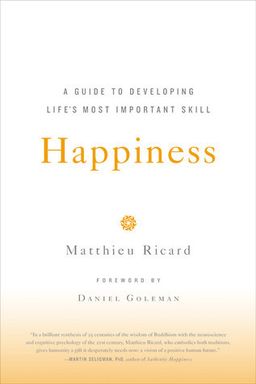
Happiness cover

Happiness

by Matthieu Ricard

Happiness by Matthieu Ricard is a compelling guide to achieving true, lasting happiness by focusing on inner well-being. Discard the myth that external success brings joy and embark on a journey to cultivate profound happiness from within, guided by Buddhist principles and practical insights.

The Science and Art of Happiness

How can you become truly happy—not just temporarily delighted or distracted, but deeply fulfilled? In Happiness, Buddhist monk and scientist Matthieu Ricard explores this essential question, blending Eastern contemplative wisdom with Western psychology and neuroscience. He argues that happiness is not a fleeting emotion granted by external fortune, but rather a state of inner being cultivated through training the mind. Ricard’s core claim is radical yet practical: lasting happiness arises when you transform your consciousness through clarity, compassion, and mental discipline—not when you rearrange circumstances outside yourself.

Ricard’s unique perspective stems from his dual identity as a molecular biologist trained at France’s Pasteur Institute and a long-time Buddhist monk living in the Himalayas. His journey—from the laboratories of Paris to the wisdom traditions of Tibet—embodies the bridge between science and spirituality. He uses this synthesis to propose a kind of moral and psychological alchemy: we can turn suffering into serenity, confusion into clarity, and selfishness into altruism.

The Core Theory: Happiness as a Skill

Ricard’s central premise is that happiness is a skill, not a gift. Just as one trains the body through exercise, one can train the mind through awareness, meditation, introspection, and ethical living. Happiness, in his words, is an optimal state of being, what Tibetan philosophy calls sukha, a sense of deep flourishing founded on inner freedom and wisdom. This distinguishes authentic happiness from mere pleasure or excitement, which fade quickly and depend on external conditions. Sukha, by contrast, persists even through suffering and change.

To cultivate this skill, we must learn to recognize and eliminate the mental toxins—hatred, greed, jealousy, and confusion—that pollute perception and generate misery. The Buddhist tradition sees these afflictions as temporary distortions, not intrinsic features of the mind. Once we cleanse the mirror of consciousness, happiness shines naturally as its innate radiance.

Bridging Science and Contemplation

Ricard is not satisfied with philosophical reflection alone. His decades of collaboration with scientists such as Richard Davidson, Paul Ekman, and Daniel Goleman have produced pioneering studies on how meditation changes the brain. Their findings suggest that compassion and mindfulness can reshape neural pathways and strengthen immune function—a scientific validation of what Buddhist practice has taught for centuries. Meditation, he proposes, serves as an interior laboratory for observing and transforming mental phenomena in real time.

Through these collaborations at the Mind and Life Institute, Ricard helped demonstrate that trained meditators generate unusually high gamma-wave activity, reflecting greater mental coordination and positive emotion. The implications are profound: happiness is not accidental chemistry but cultivated neuroplasticity. The mind can literally sculpt the brain toward serenity and altruism.

A Path Beyond Self-Centeredness

Ricard insists that we must overcome the illusion of the ego—the fixation on “I” and “mine”—that separates us from others and from reality. True happiness is inseparable from altruism because compassion dissolves the boundaries of the self, freeing us from fear and isolation. The happiest people, he suggests, are not those who accumulate pleasure, but those who sincerely wish others well. Inner peace and kindness reinforce one another like two wings of a bird.

This insight links to a broader ethical vision. Happiness is not selfish indulgence but the fruit of wisdom and virtue. It entails renouncing mental habits that enslave us—resentment, craving, and pride—while cultivating humility, patience, and generosity. To become happy is therefore a moral act, not just a psychological one.

Why This Matters

Ricard’s argument carries urgent relevance for modern life. We live in a world rich in material comfort yet crowded with unhappiness—an epidemic of depression, anxiety, and isolation. His message reverses the usual equation of success: happiness does not come from acquiring, consuming, or dominating; it comes from being—from clarity of mind and benevolence of heart. As Daniel Goleman remarked, Ricard invites readers to see happiness not as mere pleasure but as profound contentment born of compassion. This outlook challenges Western skepticism about joy and offers an antidote to cynicism.

Over the course of Happiness, you’ll explore how to distinguish happiness from pleasure, fear, desire, and false friends; how to turn suffering into transformation; why altruism and ethics are the foundations of well-being; how meditation literally rewires the brain; and what inner freedom and contemplation can teach us about living meaningfully, even in the shadow of death.

Ricard’s ultimate conclusion is both philosophical and practical: happiness is not a destination but a daily practice—a way of inhabiting life itself. You do not wait for perfect conditions; you learn to cultivate mental clarity and kindness whatever the conditions. In doing so, you begin to turn the alchemy of suffering into the gold of serenity and compassion.


Defining True Happiness

Ricard begins by asking a deceptively simple question: What is happiness? Everyone wants it, yet few can define it clearly. For some, happiness means pleasure; for others, success, relationships, or peace. But Ricard argues that genuine happiness is not an emotion or mood—it’s an enduring state of inner flourishing, a mind that’s free from conflict, confusion, and hatred. He contrasts this with fleeting pleasures that vanish as soon as circumstances change.

Happiness vs. Pleasure and Joy

Pleasure, Ricard writes, is deceptive. It burns like a candle: bright for a moment, then extinguished by repetition or excess. Eating a fine meal, skiing, or listening to music all produce delight—but none guarantee lasting contentment. Happiness, by contrast, is self-sustaining. It’s not bound to external stimuli but arises from within a calm and lucid mind. Pleasure can coexist with selfishness, cruelty, and even violence; happiness cannot. “Pleasure is the happiness of madmen, while happiness is the pleasure of sages,” he quotes Jules Barbey d’Aurevilly.

He also distinguishes momentary joy from the deeper radiance of happiness. Joy is often reactive—a surge of feeling linked to triumph or beauty. Happiness endures through calmness and compassion. While a child’s laughter or a sunset may awaken it, true happiness remains steady long after the stimulus fades.

The Wisdom of Sukha

In Buddhist philosophy, happiness is best understood through sukha, which Ricard calls “the state of lasting well-being that manifests when we have freed ourselves from mental blindness.” Sukha rests on insight: seeing things as they truly are, beyond illusion and ego. It doesn’t deny suffering but transforms the way we experience it. A person anchored in sukha remains serene during loss or success because she knows both are transient. Her joy comes from the depth of awareness, not the surface of events.

Reality and Mental Perception

Ricard explains that unhappiness arises from “reading the world wrong.” We see things as permanent and separate, when in fact all phenomena are interdependent and impermanent. This misreading—what Buddhism calls ignorance—causes us to cling to pleasure, resist pain, and fear change. As Rabindranath Tagore wrote, “We read the world wrong and say that it deceives us.” Once we recognize this distortion, the mind ceases to battle reality and rests in clarity. Happiness, then, is the result of insight, not indulgence.

He illustrates this truth through simple scenes: one friend crossing a muddy courtyard and complaining about every brick, another laughing joyfully as she hops across the same path. “Two people, two ways of looking at things; six billion human beings, six billion worlds,” Ricard observes. Happiness depends not on circumstances but on perception—a reminder echoed by Viktor Frankl in Man’s Search for Meaning, who claimed that the last of human freedoms is to choose our attitude.

The Foretaste of Happiness

From fleeting “moments of grace”—like walking in nature or watching the stars—we can glimpse the peace that genuine happiness would offer if it were sustained. These experiences teach that harmony is possible even amid chaos. As Ricard writes: “Every being has the potential for perfection, just as every sesame seed is permeated with oil.” Happiness is not luck or luxury; it’s the natural fragrance of a clear mind. The task is to access it through awareness, compassion, and freedom from illusion.


The Alchemy of Suffering

Ricard doesn’t avoid pain—he examines its transformation. “They suffer, Majesty,” a sage tells a king in a Persian parable. That universal suffering, Ricard argues, is the starting point for wisdom. It includes visible pain—illness, loss, death—and invisible pain—anxiety, loneliness, guilt. But while suffering seems unavoidable, our relationship to it determines whether it poisons us or purifies us. His central message: suffering can be alchemized into compassion and insight.

Three Types of Suffering

Buddhism identifies pervasive suffering (the subtle unease of existence), the suffering of change (pleasure turning into pain), and the suffering of suffering (acute distress). Ricard explains that affliction comes not only from what happens to us but from how we interpret it. Invisible suffering, born of ego and ignorance, is the hardest to cure because it lurks beneath comfort and pleasure. It’s the restless dissatisfaction of never feeling “enough.” Awareness transforms this suffering, revealing that pain is transient and meaning can arise even in hardship.

Lessons from Endurance

Ricard recounts extraordinary examples. The Dalai Lama’s imprisoned physician Tenzin Choedrak survived decades of Chinese labor camps yet displayed kindness and serenity afterward. Tibetan nun Ani Pachen spent twenty-one years in prison, including nine months in total darkness, sustained by meditation and compassion. These stories prove, Ricard writes, that “it is possible to maintain sukha even under repeated torture.” Suffering, when met with awareness, can reveal the mind’s indestructible purity. It’s what psychiatrist Victor Frankl called “tragic optimism”—the ability to find meaning despite pain.

Transforming Pain through Compassion

One of Ricard’s most powerful practices is tonglen—“exchanging happiness and suffering.” In meditation, you imagine sending happiness to others with every exhale and taking their pain into your heart with every inhale, dissolving it with your love. This exercise trains the mind to shift from self-centered fear to courageous empathy. “Why dwell on pain?” he asks. “When we embrace the suffering of others, ours becomes lighter.” Compassion, paradoxically, is the most effective medicine for despair.

Suffering and Growth

Outward problems may persist—wars, illness, loss—but the inward space of serenity remains possible. Ricard concludes that suffering can serve as a teacher: it clarifies life’s priorities and awakens wisdom. The goal is not to glorify pain but to use it as fertilizer for compassion. “If there is a cure, what good is discontent? If there is no cure, what good is discontent?” he quotes Shantideva. By practicing awareness and love, every wound can become a doorway to peace. That is the true alchemy of suffering—turning poison into purity.


The Veils of the Ego

One of Ricard’s most challenging ideas is that our ego—the cherished sense of “I” and “mine”—is the main source of unhappiness. He describes the ego as a veil that distorts reality, breeding attachment, aversion, pride, and fear. Under its illusion, we think the world revolves around us; in truth, everything is interdependent. To be happy, we must understand and gradually dissolve the false self—not to annihilate individuality, but to awaken freedom and compassion.

The Crystalization of “I”

Ricard explains that clinging to “I” and “mine” creates suffering because it divides reality into friend and foe, success and failure, pleasure and pain. He uses a vivid example: if an empty boat collides with you, you laugh; if someone else is steering the boat, you grow angry. The only difference is that now your ego feels attacked. Similarly, your “my vase” breaking hurts far more than a similar vase breaking in a store window. The ego transforms neutral events into personal affronts. Recognizing this distortion is the first step toward freedom.

Illusion and Interdependence

Philosophically, the self is not a fixed entity but a process—a stream of consciousness and body interactions. Ricard likens it to a river: we call it the Ganges, but its waters change every instant. Neuroscientist David Galin’s research supports this view, showing that our sense of “I” results from continuous mental labeling rather than an enduring essence. By seeing ourselves as part of an interconnected web rather than an isolated island, we loosen the chains of self-centered anxiety. This is not nihilism but realism: the self is functional, not ultimate.

The Freedom of Egolessness

Ricard insists that dissolving ego doesn’t make life gray or passive—it releases vitality. Without the constant need to defend our self-image, the mind becomes supple, radiant, and fearless. He points to spiritual figures—such as the Dalai Lama—whose humility is inseparable from joy. These individuals are not devoid of personality; they simply act without obsession over “me.” Psychologist Paul Ekman, who studied compassion experts, noted their “absence of ego” and their harmony between private and public life.

Beyond the Glass Wall

Ego is like an invisible wall separating us from others. We beat against it with pride and fear, mistaking it for reality. Once it melts, we discover vast freedom and connection. The self ceases to be the most important thing, and compassion takes its place. The goal is not to erase identity but to let go of its tyranny. In doing so, Ricard says, “we win incredible inner freedom—we are free to give and to receive.” This insight parallels Eckhart Tolle’s teaching in The Power of Now: liberation arises not from enlarging the self but from transcending it.


Happiness and Altruism

Does happiness make us kind—or does kindness make us happy? Ricard explores this paradox through psychology, philosophy, and Buddhist practice. He concludes that altruism and happiness are mutually reinforcing: selflessness is both the path and the reward. When you wish for others’ well-being, you transcend the narrow ego that breeds suffering. Altruism is not sentimental—it’s practical wisdom. It transforms your inner chemistry and external relationships alike.

Scientific Proof of Compassion

Ricard cites studies showing that helping others activates brain regions linked to pleasure and satisfaction. Martin Seligman’s research at the University of Pennsylvania asked students to perform acts of kindness versus self-indulgence; the kindness group reported far greater joy lasting days. “The exercise of kindness is a gratification, not a pleasure,” Seligman wrote. This aligns with Ricard’s claim that altruism nourishes the heart while selfish pleasure quickly burns out.

Beyond Self-Interest

Against philosophers like Thomas Hobbes, who saw altruism as disguised egoism, Ricard argues for true compassion—giving without expectation. He evokes Dola Jigme Kalsang, a Tibetan sage who sacrificed his life for a stranger condemned to death. Such pure altruism flows from recognizing shared humanity, not from seeking virtue points. Modern neuroscience supports this: altruistic emotions correlate with healthier brains and stronger immunity. Compassion, he writes, is a wise investment in happiness—it enlarges the circle of belonging until it includes all beings.

Freedom through Service

Altruism liberates us by shifting focus from “me” to “we.” This is not loss but expansion. Ricard echoes Gandhi: “To serve others is to be the change we wish to see.” A life of kindness, he insists, does not deplete energy—it multiplies it. Even pragmatic psychology agrees: cooperative and compassionate people are happier, healthier, and more resilient. Compassion, far from being a sacrifice, is a form of spiritual intelligence that aligns personal well-being with the world’s welfare.

This teaching culminates in a simple truth: happiness and altruism are one breath. To be happy, care for others. To care for others, cultivate happiness. When your own inner peace meets the world’s suffering with love, both are healed.


Ethics and Inner Freedom

Ricard reframes ethics as more than rules—it’s the science of happiness. Ethical conduct naturally arises from compassion and awareness. Morality divorced from lived experience is sterile; true virtue is spontaneous, embodied wisdom. He writes, “The wise man is ethical, not because he obeys laws, but because his actions arise from inclinations that his disposition produces.” When your motivation is altruistic, ethical behavior flows without struggle.

Compassion as Compass

Ethics begins by avoiding harm and creating benefit. Ricard rejects moral absolutism—he favors mindfulness over commandments. For example, lying to save a life is ethical because the intention is compassion, not deceit. Rules are guidelines, but motivation matters most. Compassion acts as the mind’s moral compass, aligning behavior with humanity’s shared longing to avoid suffering and seek happiness.

Wisdom in Action

Wisdom allows us to discern real happiness from superficial pleasure. It’s the light by which ethics navigate ambiguity. Ricard draws on neuroscience—Joshua Greene’s studies show that moral reasoning involves both emotional empathy and cognitive control. Ethical maturity integrates both: feel compassion but think clearly. In Buddhism, this balance of wisdom and love is essential to enlightened action.

From Rules to Realization

Ethical training is therefore a spiritual practice, not an obligation. It’s cultivating awareness so refined that harmful thoughts dissolve before becoming actions. The ultimate goal is inner freedom—the ability to choose compassion even under pressure. “There can be no outer disarmament without inner disarmament,” Ricard reminds us. Ethics, when grounded in mindfulness, becomes happiness itself—the selfless harmony between wisdom and kindness.


Happiness in the Face of Death

Ricard confronts the final paradox: can we be happy in the presence of death? His answer is yes—if we transform fear into awareness and attachment into peace. Death, he writes, is not an enemy but the ultimate teacher. When we remember mortality, we live more vividly. To ignore death is to waste life; to contemplate it is to treasure time. “A good death,” he says, “is not necessarily tragic.”

Learning from Death

Ricard encourages keeping death in mind, not morbidly, but as motivation to live meaningfully. Awareness of impermanence urges us to cultivate kindness, renunciation, and diligence. He recalls the Tibetan hermit Gampopa’s stages: fear death at first, then live with diligence, and finally die with joy, knowing you’ve lived well. Like Seneca, Ricard warns against waiting until the end to begin living wisely: “How late it is to begin to live just when we must cease to live.”

Peaceful Transitions

For those who practice mindfulness, death becomes a continuation rather than an abyss. It’s a passage from one moment of consciousness to another, like waves dissolving into the ocean. Buddhist masters face it with serenity—with no fear, no regret, and a mind centered in compassion. Ricard describes the Tibetan nun’s cremation witnessed by diplomats in Nepal, remarking that “it was uplifting.” A life lived fully makes even death luminous.

Freedom Beyond Fear

The wise person, Ricard says, lives each day as if it were his only one, appreciating every sunrise, every breath. When attachment ceases, death loses its sting. “He leaves this life as the eagle soars into the blue,” writes Ricard of Milarepa’s final meditation. To prepare for death, then, is to learn how to live—to cultivate awareness and compassion so unwavering that even mortality becomes peace itself. In this acceptance, happiness outlives the body.

Dig Deeper

Get personalized prompts to apply these lessons to your life and deepen your understanding.

Go Deeper

Get the Full Experience

Download Insight Books for AI-powered reflections, quizzes, and more.