
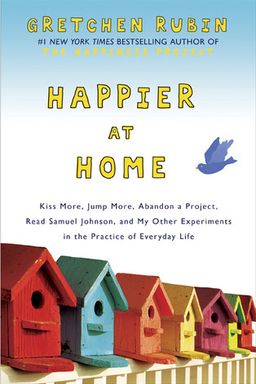
Happier at Home cover

Happier at Home

by Gretchen Rubin

Happier at Home by Gretchen Rubin provides a practical guide to transforming your living space into a sanctuary that reflects your family''s unique needs. Through small changes and mindfulness, this book empowers you to create a happier, more joyful home life.

Building Happiness Where You Live: The Power of Home

What if everything you truly need to feel happier is already within the four walls where you live? In Happier at Home, Gretchen Rubin invites you to rethink the everyday spaces, routines, and relationships that form the emotional architecture of your life. Rubin contends that happiness isn’t about radical transformation or distant adventures—it’s about changing your life without changing your life. Her experiment centers on a single, profound insight: home is not merely a physical place but a psychological construct where meaning, safety, and identity converge.

Home as the Crucible of Happiness

Rubin’s core argument can be summed up in Samuel Johnson’s declaration: “To be happy at home is the ultimate result of all ambition.” Through her project, she explores how the sphere of home—our living spaces, our family life, our possessions, and even our neighborhood—forms the bedrock of human happiness. While her first book, The Happiness Project, surveyed happiness broadly across work, friendship, and creativity, Happier at Home drills deeper. It’s not about embellishing life with grand gestures or moving to Bali for spiritual renewal, but about cultivating delight, gratitude, and peace amid everyday domestic detail.

Rubin begins her journey after a moment of homesickness while standing in her own kitchen. That experience—what she calls “prospective nostalgia”—makes her realize the deep longing many of us feel even for our present, ordinary days. She writes not about escapism but about “being happier where I am.” The aim, she tells us, is not perfection but presence.

A Structured Year of Experiments

Rubin organizes her second happiness project around nine months, from September to May—each month devoted to one theme that relates to home: possessions, marriage, parenthood, time, body, neighborhood, interior design, and so on. She fills each theme with practical experiments—setting daily resolutions, decluttering her shelves, cultivating rituals, testing philosophical ideas, and recording progress using a resolution chart inspired by Benjamin Franklin’s virtue log. Her approach is methodical yet deeply personal. She knows that one person’s happiness experiments may appear quirky to another, but she argues convincingly that individual happiness grows out of individual circumstance.

Why Define Happiness Through Place?

For Rubin, home is both physical and metaphysical. It is “where I walk through the door without ringing the bell” and “where I take a handful of coins from the change bowl without asking.” Through this definition, she invites readers to explore the duality of home: as material comfort and as moral sanctuary. The paradoxes she faces—wanting freedom but craving belonging, simplicity yet abundance—mirror the contradictions we all live with. Her famous “Splendid Truths” (eight in total by the end of the book) articulate the insights she uncovers: that happiness involves self-knowledge, acts of kindness, growth, and understanding that “now is now.”

The Personal Becomes Universal

Rubin’s narrative blends memoir, philosophy, psychology, and home economics. She grounds big ideas in small domestic moments: arguing with her husband over a messy counter, planning a “holiday breakfast,” or creating shrines to represent family and work. Through lively anecdotes, she demonstrates that happiness emerges from mundane effort—what William Morris called “taking a genuine interest in all the details of daily life.” Her candor makes the lessons accessible. She admits to losing her temper, procrastinating, and failing resolutions, reinforcing that happiness is not a permanent state but a practice.

Why This Matters for You

Rubin’s project matters because it translates elusive happiness research into tangible domestic acts. The principles of gratitude, mindfulness, engagement, and growth cease to be clichés when applied to the everyday: the smell of a child’s shampoo, the ritual of greeting your partner, or the careful organization of your possessions. In an era obsessed with external success and constant movement, Rubin reminds readers that the deepest joy often lies in ordinary stability. Her experiments suggest that the greatest revolution may occur not in the world outside, but in the emotional texture of the home you inhabit already.

“The days are long, but the years are short.” Rubin’s mantra captures both the urgency and tranquility of cultivating happiness where life truly happens—at home.

In what follows, you’ll see how Rubin transforms nine everyday domains—possessions, marriage, parenthood, time, body, neighborhood, family, and self—into profound laboratories for joy. Each idea reveals how you, too, can make your home not just a shelter, but a sanctuary for happiness.


Possessions and True Simplicity

Rubin begins her second happiness project with the most tangible arena—our stuff. September’s theme of Possessions explores how our things shape happiness, not through luxury or excess, but through engagement and meaning. She challenges the popular message that happiness demands minimalism and, instead, argues for mindful ownership—a balance between Waldenlust, the yearning for simplicity, and the joy of cherished possessions.

Cultivating Shrines

To deepen her sense of home, Rubin creates “shrines”—small curated collections of objects that embody love, purpose, and identity. Her “Shrine to My Family” includes framed photos and keepsakes like her grandmother’s bluebird figurine. Her “Shrine to Work” blooms with painted wisteria along her office walls, transforming functional space into a symbol of creativity. The idea echoes psychologist Mihaly Csikszentmihalyi’s finding that meaningful possessions form “domestic symbols of the self.” Shrines aren’t altars to consumerism—they are reminders of values woven into everyday life.

Going Shelf by Shelf

Rubin’s method for decluttering—“Go shelf by shelf”—turns the abstract goal of simplicity into manageable habits. Rather than dramatic purges, she opts for steady progress, clearing corners and closets one by one. Drawing on her “Secret of Adulthood” that “Outer order contributes to inner calm,” she finds that tidying eases mental load and even boosts kindness. Each item is judged by two questions: Do I use it? Do I love it?

She illustrates this through real domestic details: sorting scarves with her mother’s help, identifying “problem objects” like broken gadgets or sentimental clutter, and creating memory boxes for her daughters. Her insight echoes William Morris’s dictum—“Have nothing in your houses that you do not know to be useful, or believe to be beautiful.”

Reading the Manual

From tangled technology to unopened appliances, Rubin discovers that confusion breeds unhappiness. Her resolution to “Read the manual” reminds us to engage deeply with our tools. Mastering everyday objects—even a coffeemaker—creates a mini “atmosphere of growth.” Each small act of competence fuels happiness and quiets frustration.

The Heart of True Simplicity

Possessions, Rubin argues, can be both “wading pool and diving board.” They comfort yet energize. It’s not quantity but quality of engagement that matters. When objects connect to identity and memory—the bluebird for happiness, the photo for family—they create psychological warmth. Her conclusion reframes material life: “Happiness is not having less; happiness is not having more; happiness is wanting what I have.”

“Be Gretchen,” she writes, choosing her own comfortable balance between simplicity and richness. Possessions can weigh you down or lift you up—depending on whether they express who you are.


Marriage and Proofs of Love

October’s focus—Marriage—turns home into an emotional workshop. Rubin’s experiments explore how to sustain tenderness in long-term partnerships, when love’s routine often dulls its sparkle. She contends that nurturing marriage hinges not on grand romance but on deliberate micro-gestures—kisses, gratitude, and cheerfulness—that rebuild affection every day.

Kiss in the Morning, Kiss at Night

Rubin establishes an affectionate ritual: kissing her husband Jamie at morning, departure, and bedtime. Though it feels mechanical at first, these moments transform their relationship into what psychologists call an “emotional bid system” (the term used by John Gottman). Touch triggers oxytocin and connection; structure sustains intimacy. Rubin learns that acting loving fosters loving feelings—a central happiness paradox.

Giving Gold Stars

Rubin flips her natural craving for praise into generosity. Research by Terri Orbuch shows that affirmations matter most to men, who often rely on partners as primary sources of encouragement. So she resolves to “give gold stars”—words of appreciation for Jamie’s efforts, like cooking or planning family outings. The result? Mutual uplift. “It isn’t enough to love,” Saint Thérèse once said, “we must prove it.” This proof, Rubin discovers, strengthens trust and admiration.

Make the Positive Argument

Marriage, Rubin finds, is sustained by perspective. When irritation sparks (“Jamie doesn’t help with chores”), she consciously reframes: “Jamie is helpful.” This cognitive flip echoes research on neuroplasticity—thought patterns shape emotional response. By arguing the positive case, she renews fondness and prevents spirals of resentment. It’s her antidote to what she calls “unconscious overclaiming,” the tendency to overestimate your own effort compared to your partner’s.

Take Driving Lessons—Choosing the Bigger Life

Perhaps Rubin’s boldest marital act is personal: conquering her fear of driving, which had burdened Jamie with all car duties. The project becomes symbolic of choosing “the bigger life”—facing fears that shrink freedom. Supported by instructor Attila (“Butterfly Fingers”) and inspired by a friend’s example, Rubin redefines courage as daily discomfort. She learns, “Happiness doesn’t always make me feel happy.” Doing what’s hard—learning to drive—enriches marriage through shared independence.

For Rubin, marriage thrives not on perfect harmony but on daily choices to be kind, appreciative, and brave. “It isn’t enough to love; we must prove it”—and sometimes, proving it means learning to drive through fear.


Parenthood and Paying Attention

In November, Rubin explores Parenthood under the motto “Pay Attention.” She seeks more patience, warmth, and mindfulness amid family chaos. Her approach combines affection with self-discipline: happiness in parenting arises from awareness, not control.

Underreact to Problems

Drawing on advice from an Antarctic researcher—“Underreact to troubles”—Rubin practices calm during crises, such as spilled nail polish or child tantrums. Quiet composure transforms household tension into humor. This principle mirrors Stoic philosophy: emotions respond to interpretation more than events themselves. Acting serene, she says, trains the mind to feel serene.

Enter into the Interests of Others

Rubin learns from Tolstoy’s fictional hero Nabatov, who “entered into all the interests of his mother’s life.” Similarly, she cultivates curiosity about her daughters’ worlds—from SpongeBob to pop songs—seeing love not as indulgent conversation but as deliberate empathy. “It isn’t enough to love,” she repeats from Saint Thérèse, “we must prove it.” This resonates with modern psychologists who associate empathy with secure attachment and long-term resilience.

Wednesday Adventures

To balance life’s busyness, Rubin invents “Wednesday adventures”—special after-school outings with her older daughter, Eliza. Museums, bakeries, even Bloomingdale’s jewelry section become sacred memory-making rituals. Scheduling joy ensures presence, echoing her Third Splendid Truth: “The days are long, but the years are short.” These planned adventures capture time before adolescence sweeps it away.

Warm Greetings and Farewells

In a rare family-wide resolution, Rubin encourages all members to give heartfelt hellos and goodbyes. This simple routine cultivates affection and acknowledgment—the social glue of belonging. She observes how such “micro-interactions” alter mood and build emotional safety, echoing Gottman’s concept of responding to emotional bids.

Parenting, Rubin discovers, isn’t about managing behavior—it’s about managing presence. Her gratitude mantra, “These are the good old days,” reminds every parent that the ordinary is the extraordinary.


Time and the Art of Unhurried Living

January’s project—Time—confronts the modern disease of hurry. Rubin, like most of us, feels relentlessly pressed, haunted by to-do lists. Her goal: to “cram her day with what she loves” and create an atmosphere of unhurriedness without reducing productivity.

Control the Cubicle in My Pocket

Rubin’s phone and computer are the “cubicle” that follows her everywhere. She devises strict boundaries: no email during family time, no tech during travel, no nightly inbox checks. Quoting Manisha Thakor, she calls constant connectivity “the plastic bag over my head.” Instead of multitasking, she adopts single-task focus—paradoxically increasing efficiency. She learns that minimizing digital interruption restores mental rest, creativity, and actual face-to-face love.

Guard My Children’s Free Time

Trying to protect Eliza’s schedule from endless piano lessons and structured “opportunities,” Rubin defends unstructured play as fertile ground for imagination. She argues, citing Bertrand Russell’s praise of “browsing and boredom,” that idle time cultivates insight. Her pediatric philosophy anticipates today’s research on creativity: free play builds problem-solving and self-direction more than overprogramming does.

Suffer for Fifteen Minutes

Small steps beat Herculean effort. Rubin applies her motto to overdue tasks—like organizing hundreds of digital photos—working just fifteen minutes daily. The result is liberation through manageable discipline. She references Trollope’s insight: “A small daily task, if it be really daily, will beat the labors of a spasmodic Hercules.” This practice turns procrastination into progress, teaching that consistency builds peace.

Go on Monthly Adventures

Extending her Wednesday tradition, Rubin imagines monthly adventures with her husband but discovers the Sixth Splendid Truth: “The only person I can change is myself.” Still, the aspiration pushes her to see novelty’s value. Research confirms that shared new experiences rekindle couple closeness (as per psychologist Arthur Aron’s “Novelty Hypothesis”). Even if plans fall through, setting the intention opens mental space for spontaneity.

Rubin learns to replace busy with deliberate. “Speed implies being busy,” she writes, echoing Miyamoto Musashi, “but skill means never appearing busy.” Slowness, it turns out, is not idleness—it’s mastery.


Interior Design and Renovating the Self

December’s focus on Interior Design is metaphorical rather than decorative. Rubin seeks to renovate herself within—fortifying “built-in happiness” and resisting “happiness leeches,” or draining influences. She learns that to make home happier, she must improve her own internal architecture.

Resist Happiness Leeches

Rubin identifies three types of negative emotional contagions: grouches who invoke pessimism, jerks who disrespect others, and slackers who shirk responsibility. Drawing from studies by Will Felps and James Fowler, she explains that emotions are social viruses; positivity spreads just as depression does. Her counter-strategy: avoid leeches, keep humor alive, and remember her Seventh Splendid Truth—“Happy people make people happy, but you can’t make someone be happy.”

Dig Deep

Her friend’s mantra “Dig deep” becomes a call for moral effort. In moments of irritation with her children, Rubin reminds herself to find patience beneath anger. The resolution echoes Viktor Frankl’s claim that man’s freedom lies in his response—not circumstances. “Controlling my quick irritation,” she writes, “I realized I couldn’t yell my way toward tenderness.” Happiness demands restraint as much as expression.

Respond to the Spirit of a Gift

When her husband surprises her with a bracelet instead of the ring she asked for, Rubin remembers Saint Thérèse’s lesson of gracious acceptance—respond to the spirit rather than the content of the gift. True gratitude isn’t transactional; it’s empathetic. This act reorients attention from expectation to appreciation, what psychologists call “positive reappraisal.”

Abandon Self-Control

Paradoxically, Rubin strengthens discipline by releasing it. She implements two strategies: abstinence (cutting sweets entirely rather than moderating) and convenience (arranging environments to make good habits easy). She cites Roy Baumeister’s research on ego depletion: self-control is finite, so systems must conserve it. Freedom through structure—her abiding paradox—turns denial into ease.

Interior design, Rubin discovers, begins with mindset. “If better were within,” she writes, “better would come out.” Happiness renovation starts beneath the surface.


Neighborhood, Family, and Finding Meaning Close to Home

April and March intertwine Rubin’s insights about community and kinship. By turning outward—from household to street, from self to family—she shows that happiness radiates through connection. “Anything one does every day is important,” cites Gertrude Stein; routine is sacred geography.

Be a Tourist Without Leaving Home

Rubin reimagines her New York neighborhood through fresh eyes, practicing curiosity as if she were visiting for the first time. She revisits favorite walks, notes smells of nuts stands and bookstores, and reads guidebooks to her own city. Like Gertrude Stein’s Paris, her Manhattan becomes both familiar and thrilling. “Home is the world where I belong,” she writes, proving that everyday beauty requires awareness, not travel.

Practice Nonrandom Acts of Kindness

Rejecting the slogan “random acts of kindness,” Rubin favors intentional benevolence. She helps acquaintances professionally, smiles at store clerks, picks up litter, and sends praise online. These small nonrandom gestures nurture belonging—a practical form of compassion that echoes Adam Smith’s vision of mutual sympathy in community life.

Find My Own Calcutta

Inspired by Mother Teresa’s advice, Rubin seeks her “own Calcutta”—a cause she feels personally called to. Through her husband’s chronic illness, she joins New York’s organ donation network, helping redesign its registry. Her activism demonstrates how altruism cultivates meaning; what psychologist Martin Seligman terms “eudaimonic” happiness. Helping others is both a gift outward and inward.

By embracing her neighborhood and her family’s challenges, Rubin discovers that fulfillment lies in proximity: we find our Calcutta not in distant sacrifice but in the causes next door.


The Final Truth: Now Is Now

Rubin concludes with her Eighth Splendid Truth—Now is now. After months of resolutions, she realizes that happiness isn’t deferred, earned, or stored. It’s present in ordinary acts—folding towels, greeting loved ones, working in quiet satisfaction—if only you notice.

Escaping the Arrival Fallacy

Rubin exposes the illusion that happiness awaits after goals are achieved. Studies show most people expect the future to be happier, yet often overlook joy in the present. Her antidote is deliberate awareness: to treat current days as the “good old days” while they unfold. This principle transforms domestic chores into spiritual practice.

Home as Inner Wealth

Echoing Samuel Johnson’s aphorism, “He who would bring home the wealth of the Indies must carry the wealth of the Indies with him,” Rubin concludes that true prosperity is portable. Home becomes metaphor—self-awareness and love carried within. By choosing gratitude over glamour, she finds joy even in imperfection.

Living in Ordinary Sacredness

Her final epiphany comes through Laura Ingalls Wilder’s closing lesson in Little House in the Big Woods: “This is now.” Rubin reflects that ordinary family evenings and household rhythms form the luminous treasure she’d sought all along. Happiness isn’t exotic—it’s domestic, fleeting, and real.

“Now is now,” Rubin writes. “And now is already a long time ago.” Her happiness project ends not with triumph or perfection, but with wonder at the present moment—the treasure in the heart of the home.

Dig Deeper

Get personalized prompts to apply these lessons to your life and deepen your understanding.

Go Deeper

Get the Full Experience

Download Insight Books for AI-powered reflections, quizzes, and more.