
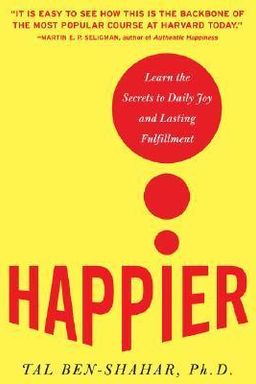
Happier cover

Happier

by Tal Ben-Shahar, PhD

Happier by Tal Ben-Shahar, PhD, offers a transformative guide to finding joy and purpose in life. Through practical insights, learn to align your actions with your values, balance pleasure with meaning, and nurture fulfilling relationships. This book is a roadmap to a more meaningful, happy existence.

The Science and Art of Becoming Happier

Why is it that many of us, despite success, wealth, or social acclaim, still feel a sense of emptiness? In Happier, Harvard psychologist Tal Ben-Shahar tackles what he calls the “question of questions”: how can we become not just successful, but truly happy? He argues that happiness isn’t a static state or a lucky accident—it’s the cumulative experience of meaning and pleasure, cultivated through intentional practices and self-awareness.

Ben-Shahar’s central contention is that happiness must be treated as both an emotion and a philosophy—a practical, ongoing pursuit rather than an elusive destination. He calls happiness the “ultimate currency”: the most valuable measure of life, surpassing wealth, prestige, or status. This book bridges science and self-help, introducing research-backed strategies for developing daily habits that move us from fleeting highs to sustained fulfillment.

The Breakdown of the Happiness Paradox

You probably recognize the feeling: working relentlessly toward a goal, only to find that achieving it doesn’t bring lasting satisfaction. Ben-Shahar starts with his personal story of winning Israel’s national squash championship at sixteen—a moment that should have fulfilled him completely. Yet hours after victory, his elation vanished, replaced by the same emptiness he’d hoped to escape. This became the catalyst for his lifelong study of happiness.

He introduces four archetypal “hamburgers” to illustrate our approaches to happiness. The hedonist enjoys the present, ignoring future consequences. The rat racer sacrifices joy now for later achievement. The nihilist gives up on both meaning and enjoyment. Only the happy archetype integrates immediate pleasure with future purpose—savoring the climb toward meaningful goals. Happiness, therefore, demands reconciling present and future benefits.

The Return to Meaning and Pleasure

Drawing on thinkers from Aristotle and Freud to Viktor Frankl, Ben-Shahar defines happiness as the “overall experience of meaning and pleasure.” We may feel sadness or frustration at times, but sustained happiness requires moments of joy combined with a sense that our actions have value. Pleasure compels us to move—it’s emotional fuel—while meaning gives direction to that motion. When we integrate both, we flourish.

As Aristotle proposed, happiness is the purpose and end of human existence. Freud claimed we are motivated by pleasure; Frankl insisted we are driven by meaning. Ben-Shahar synthesizes both, suggesting that striving for purpose and joy makes us human. Positive psychology, launched by Martin Seligman in 1998, validates this: happiness correlates with success, health, and deeper relationships, not the other way around.

Practical Philosophy: From Theory to Habits

Just reading about happiness isn’t enough—you must act on it. Ben-Shahar structures Happier as a workbook, complete with reflection moments called “Time-Ins” and exercises such as keeping a gratitude journal or creating daily rituals. He cites research by psychologists Robert Emmons and Michael McCullough showing that writing five daily gratitudes significantly lifts psychological well-being.

This blend of philosophy and practice is what delineates positive psychology from traditional self-help. Where pop psychology offers oversimplified promises, positive psychology delivers rigorously tested, accessible strategies for fostering joy and resilience. Ben-Shahar’s classroom experiences—where hundreds of Harvard students reported life-improving outcomes—demonstrate that applying these methods can transform not only individuals but educational and workplace cultures.

Why This Revolution Matters

Ben-Shahar situates the rise of positive psychology within a social crisis: rates of depression have soared despite material abundance. In cultures obsessed with achievement and wealth, emotional bankruptcy has become epidemic. The pursuit of happiness, he insists, is not selfish—it’s essential for personal and social health. When happiness becomes the ultimate currency, everyone profits.

Ultimately, Happier is an invitation to live deliberately—to combine the rigor of science with the art of gratitude, reflection, and love. By learning to balance meaning and pleasure, to enjoy the journey as we move toward a purposeful destination, we can redefine success altogether. The challenge isn’t simply to ask, “Am I happy?” but rather, “How can I become happier?” That question, Ben-Shahar argues, opens the door to a lifelong, ever-expanding pursuit of fulfillment.


Reconciling Present and Future Joy

One of Ben-Shahar’s most vivid metaphors for happiness comes from his “hamburger model.” Imagine four hamburgers, each representing a different life approach. The tasty but unhealthy burger symbolizes the hedonist—pleasure now, pain later. The tasteless but healthy one captures the rat racer—pain now, benefit later. The awful burger that’s both unpleasant and unhealthy typifies the nihilist, who finds neither joy nor meaning. Finally, the delicious, nourishing burger embodies the happy archetype—pleasure and meaning together.

The Arrival Fallacy and the Floating Moment

Ben-Shahar warns against two major fallacies that rob us of fulfillment. The arrival fallacy is the false belief that achieving a future goal will guarantee lasting happiness. The floating moment fallacy is the belief that endless short-term pleasure equals happiness. Both miss the truth: our well-being depends on integrating present enjoyment with future purpose. Without direction, pleasure dissipates; without immediate joy, purpose loses power.

The Rat Racer’s Trap

Ben-Shahar tells the story of Timon, a fictional character who sacrifices joy for achievement—from grades to promotions to wealth—and ends up empty. Timon confuses relief (the temporary high after meeting a target) with genuine happiness. Relief is “negative happiness”: it stems from ending discomfort, not from positive engagement. Society reinforces this mindset by rewarding outcomes rather than processes, encouraging people to chase destinations while neglecting the journey.

The Integrated Path

True happiness, Ben-Shahar concludes, comes from the experience of climbing toward a peak you value—not from reaching it. You can embrace challenge while enjoying the pursuit itself. He compares happiness to “climbing the mountain” rather than lounging in the valley or endlessly summiting new peaks. A fulfilling life thrives on balance: ambition and appreciation, striving and savoring.

This idea echoes Mihaly Csikszentmihalyi’s concept of flow—the state of being fully absorbed in an activity that is both challenging and rewarding. Where the rat racer delays gratification and the hedonist consumes it immediately, the happy person merges effort with enjoyment. “Present and future benefit,” says Ben-Shahar, “is the essence of sustained happiness.”


Happiness as the Ultimate Currency

Ben-Shahar proposes a radical redefinition of wealth: happiness, not money, is the true measure of life’s worth. Just as a business is measured by profit and loss, he argues, individuals are measured by emotional profit—whether positive experiences outweigh negative ones. Under this lens, happiness becomes our ultimate currency.

Why Wealth Fails as a Metric

He points to sobering statistics: despite tripled wealth in Britain and economic booms in China, happiness levels have declined. Depression rates in the U.S. have multiplied since the 1960s. Nobel laureate Daniel Kahneman’s research supports this paradox: high income increases satisfaction but not moment-to-moment happiness; wealth often correlates with tension and limited joy. Emotional bankruptcy, like financial bankruptcy, occurs when negative experiences overwhelm positive ones.

Marva Collins and the Ultimate Profit

Ben-Shahar illustrates emotional profit through educator Marva Collins, who founded an inner-city school in Chicago for “unteachable” children. Though financially strained, Collins found profound happiness each time a child learned to read or expressed love. When a student said her first words to Collins—“I love you, Mrs. Collins”—the teacher realized she was “the wealthiest woman in the world.” Her reward came not from money, but from meaning and human connection.

From Material to Emotional Wealth

Ben-Shahar warns that we confuse means for ends, sacrificing happiness for money instead of using money to pursue happiness. Emotional bankruptcy at the societal level manifests as anxiety, substance abuse, and nihilism. “While we are making huge strides in science and technology,” he writes, “we are falling behind emotionally.” His remedy is simple but profound: measure your life in happiness, not possessions.

“The least of things with meaning,” wrote Carl Jung, “is worth more than the greatest of things without it.”

By treating happiness as our ultimate currency, we shift from accumulation to appreciation—from material solvency to emotional abundance. Every interaction, goal, and decision can then be evaluated by its return in joy and meaning. In that shift, Ben-Shahar sees not just personal transformation but the potential for a happiness revolution.


Finding Meaning and Flow in Work

Work, according to Ben-Shahar, is both a necessity and an opportunity for happiness. The key is to find or craft work that provides meaning and pleasure, rather than falling into the trap of being enslaved by money or obligation. The Hebrew root of the word “work” also means “servitude”—and we are free only when we choose to serve our passions.

Jobs, Careers, and Callings

Building on Amy Wrzesniewski’s research, Ben-Shahar describes three orientations toward work: a job (done for the paycheck), a career (pursued for advancement and prestige), and a calling (chosen for fulfillment and joy). Life satisfaction depends on how we perceive our work, not our title or salary. A cleaner who sees their job as contributing to hospital healing can be happier than a CEO disconnected from purpose.

The MPS Process: Meaning, Pleasure, Strengths

To discover meaningful work, Ben-Shahar offers the MPS process: list what gives you meaning, what gives you pleasure, and what your strengths are. The overlap among these reveals your ideal activities. For example, someone who loves children, enjoys creativity, and is patient might find fulfillment in teaching or youth mentoring. Work that resonates with your deepest interests is self-concordant—it aligns with who you are.

Crafting Your Calling

Even if you’re stuck in a job you didn’t choose, you can cultivate happiness by reframing or reshaping it. Ben-Shahar cites hospital janitors who create meaning by connecting with patients and staff. They see their work not as cleaning rooms but as contributing to healing. This mindset—called “job crafting”—can transform routine tasks into purposeful engagement.

Ultimately, happiness at work isn’t just about changing jobs—it’s about changing perception. When you highlight purpose and joy in what you do, even ordinary tasks become sources of fulfillment. As Ben-Shahar concludes, “Instead of focusing on what we can live with, we should ask what we cannot live without.”


The Power of Relationships and Unconditional Love

Relationships, Ben-Shahar argues, are the most powerful predictors of happiness. Ed Diener and Martin Seligman’s research found that “very happy people” share one major trait: rich, supportive relationships. Romantic partnerships, friendships, and family bonds multiply joy and buffer pain. As Francis Bacon said centuries ago, “Friendship redoubleth joys and cutteth griefs in half.”

The Circle of Happiness

Drawing from psychologist Donald Winnicott’s work, Ben-Shahar describes how unconditional love creates a “circle of happiness.” Just as children play more creatively near their mother’s comforting presence, adults flourish when they feel securely loved. This emotional safety fosters risk-taking, learning, and self-expression. True love, then, is not blind indulgence but active affirmation of another’s core self—the qualities that make them real and good.

Love Beyond Lust

Ben-Shahar warns that lust—mistaking physical attraction for love—guarantees disappointment. Real intimacy comes from mutual knowing rather than constant validation. Quoting sex therapist David Schnarch, he explains that passion deepens when partners pursue authenticity: “Focus not on being validated, but on being known.” Over time, this knowledge builds “love maps” (John Gottman’s term) of each other’s values and dreams, enriching connection and desire.

Cultivating, Not Finding

Contrary to Hollywood’s “soulmate myth,” the secret isn’t finding love—it’s cultivating it. Like meaningful work, lasting relationships require effort and attention. Happiness in love means balancing meaning (shared goals and growth) with pleasure (enjoyment and affection). Gratitude letters, one of Ben-Shahar’s recommended practices, help partners strengthen their bond by celebrating what already works, not just what’s missing.

“All who would win joy must share it; happiness was born a twin.” —Lord Byron

Relationships remind us that happiness is shared currency. By investing in connection—with love that is both unconditional and intentional—we amplify not only our own joy but the world’s collective abundance.


Letting Your Light Shine: Worthiness and Happiness

What if your biggest obstacle to happiness is the belief that you don’t deserve it? In one of the book’s most powerful meditations, Ben-Shahar explores why we limit our own capacity for joy. Drawing on Marianne Williamson’s famous words—“Our deepest fear is that we are powerful beyond measure”—he argues that many people unconsciously sabotage happiness because they feel unworthy of it.

The Fear of the Light

Social and cultural messages often reinforce guilt around happiness. We are taught that virtue means sacrifice and that pursuing joy is selfish. Historically, philosophies like Kant’s “morality of duty” equated goodness with self-denial. Ben-Shahar counters this: true morality lies in creating harmony between helping ourselves and helping others. Happy people are more empathetic, generous, and creative in service—happiness itself fosters goodness.

Embracing Inherent Worth

The antidote is recognizing inherent worthiness. Every person, he writes, “must consider themselves worthy of happiness.” This isn’t conditional on success or perfection but stems from simply being human—capable of feeling, learning, and loving. When you accept yourself as deserving, you open yourself to life’s gifts instead of deflecting them with fear or self-criticism.

Breaking the Self-Fulfilling Cycle

People who fear loss often avoid joy altogether. By ensuring they have nothing to lose, they keep pain at bay—but also exclude happiness. This self-protection becomes self-defeat. Ben-Shahar encourages replacing the “yes, but…” mindset (“Yes, I’m happy, but it won’t last”) with acceptance: “Yes, I’m happy, and I will savor it now.” Happiness, like light, expands as we let it in.

Once you permit yourself to be human—to feel deeply, to fail, to flourish—you simultaneously invite compassion and courage. In doing so, you stop waiting for happiness and start living it.


The Happiness Revolution: Shifting Society’s Values

Ben-Shahar ends with a call for a global transformation—the happiness revolution. He compares it to the scientific and industrial revolutions, which transformed material existence. This new revolution, however, is internal. It demands a collective shift from material perception (measuring success by wealth and status) to happiness perception (measuring success by meaning and pleasure).

From Materialism to Mindfulness

Scientific progress has liberated humanity from superstition but also led to emotional impoverishment. In many societies, we’ve learned to respect equations and ignore emotions. The happiness revolution restores balance—it reasserts happiness as the ultimate goal of human life, echoing Aristotle and the Dalai Lama’s belief that “the very purpose of our life is happiness.”

Why This Revolution Is Peaceful

Unlike Marx’s materialist revolution, Ben-Shahar’s is peaceful, non-political, and internal. There’s no need to redistribute wealth through force; we must redistribute attention—shifting it from competition to connection. When happiness becomes society’s core value, envy, greed, and conflict decline. Wars fought over resources lose justification; joy, unlike gold or oil, is infinite. As Buddha taught: “Thousands of candles can be lit from one candle, and the life of the candle will not be shortened.”

Practicing the Revolution

You join the revolution every time you ask not “Am I successful?” but “Am I happier?” You participate by cultivating gratitude, pursuing self-concordant goals, and nurturing relationships based on authenticity. In personal conflicts, Ben-Shahar recommends evaluating outcomes by their yield in the ultimate currency. Forgiveness, compassion, and understanding are not just moral—they are profitable in happiness terms.

In this vision, happiness isn’t a privilege—it’s a public responsibility. By letting your light shine, helping others, and designing life around meaning and pleasure, you help advance the quietest, most transformative revolution: one that begins within and radiates outward.

Dig Deeper

Get personalized prompts to apply these lessons to your life and deepen your understanding.

Go Deeper

Get the Full Experience

Download Insight Books for AI-powered reflections, quizzes, and more.