
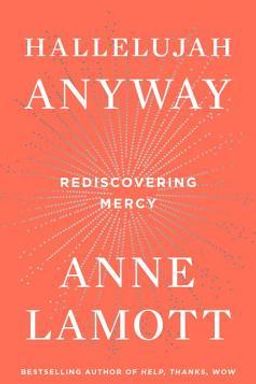
Hallelujah Anyway cover

Hallelujah Anyway

by Anne Lamott

In ''Hallelujah Anyway'', Anne Lamott offers a heartfelt exploration of mercy, urging readers to bring kindness and humility back into their lives. Through personal anecdotes and spiritual insights, this book shows how embracing self-compassion and simplicity can lead to profound joy and fulfillment.

Rediscovering Mercy in a Hard World

Have you ever wished the world—or your own mind—were just a little gentler, a little softer, a little more forgiving? In Hallelujah Anyway: Rediscovering Mercy, Anne Lamott invites you to look at mercy not as a pious virtue or a rare act of kindness, but as the very ground of being that holds this messy, chaotic life together. She argues that mercy is the only medicine strong enough for the dissonance of our time—a kind of radical, stubborn kindness that can restore connection, humility, and hope.

Lamott contends that though mercy seems antiquated or idealistic, it is actually revolutionary. It challenges cynicism, perfectionism, and the self-loathing that plague modern life. Quoting the Old Testament prophet Micah—“What does God require of you but to do justice, and to love mercy, and to walk humbly with your God?”—she builds her meditation around those three principles, but zeroes in on mercy as both antidote and compass. The book, a blend of memoir, sermon, and humor, explores how we can recover mercy in ordinary life: forgiving others, forgiving ourselves, and learning to stay human in a world that seems bent on hardness.

Why Mercy Matters Now More Than Ever

Lamott begins with an acknowledgment: the times are scary, people are rattled by trauma and fear, and most of us are scrambling for safety, certainty, and control. But none of those are lasting sources of peace. She confesses that she, too, often prefers being right over being kind—because being right feels good, even when it isolates us. The problem, she says, is that “hope of renewal and restoration is found in the merciful fibrillating heart of the world,” not in judgment or control. Mercy is not weakness; it’s the strength that lets us begin again after failure, heartbreak, or bitterness.

The world, Lamott writes, has convinced us that mercy makes us vulnerable or foolish. As children we learned to hide it to survive, to look smart or tough. Yet as adults, that hiding breeds estrangement and exhaustion. “I am starving to death for mercy,” Lamott admits. Rediscovering mercy means retrieving that hidden child-self—the part of you that was once tender, curious, and unguarded—and allowing it to breathe again.

Learning Mercy Through Story and Struggle

Throughout the book, Lamott tells stories drawn from her own missteps, faith, family, and recovery community—each one an experiment in mercy. She recounts a painful public mistake in which she hurt and angered others with a careless comment, and how her son lovingly but firmly held her accountable. The hardest part, she realized, wasn’t apologizing to others but extending mercy to herself. That small act of grace became a threshold to freedom.

Lamott also retells classic biblical stories—the Prodigal Son, Jonah and the whale, the Good Samaritan—not as distant religious parables but as intimate mirrors of human stubbornness and grace. Jonah’s reluctance to forgive Nineveh, the older brother’s refusal to join the feast, the Samaritan’s compassion across boundaries all reveal how mercy demands that we “see the awful person, sometimes even ourselves, a bit more gently.”

In that gentle seeing, heaven becomes—quoting Father Ed Dowling—“just a new pair of glasses.” We can’t fix the world’s cruelty or our own neuroses overnight, but we can choose to soften “ever so slightly.” That softening, she insists, is a spiritual act.

Maps to the Heart: How We Find Our Way Back

In later chapters, Lamott uses metaphors like maps, gardens, and tadpoles to show how mercy restores direction and vitality. In one story, lost in both consumerism and maternal conflict, she finds a small moment of grace when a salesgirl offers her a cup of water—an ordinary mercy that becomes a turning point. In another, she recalls a trip to Hiroshima where a song shared between former enemies illuminates the possibility of forgiveness beyond comprehension. Over and over, Lamott reminds us that mercy often looks small: a phone call, a laugh, a snack shared in grief. Yet these acts reroute us toward wholeness.

Why We Resist Mercy—and Why We Must Practice It Anyway

Lamott does not romanticize mercy. It’s awkward, unglamorous work that usually involves humiliation and vulnerability. We resist it because it feels safer to judge or to harden our hearts. “The problem with mercy is that it requires that we stop condemning others for being total shits,” Lamott jokes—“although they may be that.” But, she adds, “If I do so, it makes me one.” Her humor disarms the moralism in spirituality and makes mercy feel possible, even funny.

Ultimately, Hallelujah Anyway is about remembering what our souls already know: that love and mercy are woven through everything, even ruin. “Mercy means that we soften ever so slightly,” Lamott writes, “so that we don’t have to condemn others… it buys us a shot at a warm and generous heart, which is the greatest prize of all.” The phrase “hallelujah anyway”—borrowed from gospel singer Candi Staton—captures her message. Even when life is unbearable, we can say hallelujah not because things are okay, but because mercy allows life to continue. Mercy is the light that flickers on in dark rooms, the impulse to try again, to laugh, to forgive, to love anyway.

In this book, you’ll travel with Lamott through stories of failure, friendship, and faith; through reflections on Jonah, Ruth, and Jesus; through grief, addiction, aging, and parenting. You’ll learn that mercy is not a doctrine but a way of seeing and being. And maybe, just as Lamott hopes for herself, you’ll find that beneath all the noise of judgment and fear, your soul still recognizes mercy’s voice and rejoices in hearing what it already knows.


What Mercy Really Means

Lamott begins by asking what we actually mean when we talk about mercy. For her, mercy is radical kindness—a kind of tenderness that transcends fairness and deserts. It’s “forgiving the unforgivable,” “absolving the unabsolvable.” It’s not a prize we earn but a gift we grow from. This radical kindness, she writes, is “the fragrance that the rose leaves on the heel that crushes it.”

Mercy as Radical Practice

True mercy, Lamott insists, isn’t passive or sentimental—it’s active. It demands we choose compassion in conflict, offer empathy when we’re hurt, and forgive when our egos want revenge. It’s about offering aid in desperate straits, and receiving it, too. Mercy refuses to be transactional; it asks us to love without reason. “God has such low standards,” she jokes, meaning that divine mercy reaches the screwups and cynics, not the flawless few.

The Trouble with Being Right

Much of modern life revolves around being right—politically, morally, intellectually. Lamott skewers this impulse with wicked humor. “I want to want to soften,” she writes, “but I love being right—it’s mood-altering.” Her sober friend put it perfectly: “I don’t notice that I’m hungry and angry, I just notice that I’m right.” For Lamott, mercy is the antidote: the invitation to loosen our grip on certainty and self-righteousness.

Seeing With New Glasses

She quotes Father Ed Dowling’s line that “sometimes heaven is just a new pair of glasses.” Mercy changes our perspective; it allows us to see others—and ourselves—a little more gently. Instead of re-litigating past wounds, we look again with a softened gaze. For Lamott, that simple act—a shift of perception—is where spiritual growth begins.

Mercy, then, is not a distant theological concept but a daily discipline: catching yourself judging, softening anyway, and starting over. It is, as Lamott quips, “a decent deal.”


Unfolding From Brokenness

In her chapter “Gold Leaf,” Lamott compares the spiritual life to the Japanese art of repairing broken pottery with gold lacquer—kintsugi. “We dishonor it if we pretend it hadn’t gotten broken,” she says. The cracks tell the story; they become the artwork. In the same way, mercy doesn’t erase our brokenness—it highlights it with compassion, making it part of our beauty.

The Courage to Unfold

Citing Rilke’s line “I want to unfold,” she describes how we get “folded” over time by fear, people-pleasing, and striving. Our culture applauds productivity and perfection, but that folding suffocates the soul. To unfold is terrifying—because it may mean missing deadlines, disappointing others, or pausing the performance that keeps us safe. But the alternative, she warns, is an airless life.

Forgiveness as Freedom

To heal the folds, Lamott says, we must forgive—ourselves and others. “The only way out of jail is forgiveness.” She references Lewis Smedes’s insight that “to forgive is to set a prisoner free and discover the prisoner was you.” But forgiveness can’t be forced by intellect or moral willpower; it arises from humility, community, and grace. “No, the way out takes admitting that you’re wrong and sorry. No, no, anything but that.” She laughs at her own resistance, modeling honesty over piety.

Mercy Found Among the Broken

Lamott illustrates mercy through vivid stories—the Good Samaritan, an alcoholic priest helping a man who soils himself at a recovery meeting, and survivors forgiving murderers in Charleston and South Africa. She marvels at how ordinary people enact mercy through service and patience. In each case, she shows that mercy thrives most where dignity seems impossible. “They treated him like one of them because they could see that he was one of them,” she writes. “That is what we mean by mercy.”

Like kintsugi, mercy gilds the cracks instead of hiding them. It’s how common people become radiant without ever becoming perfect.


Learning Through Life’s Cycles

In “Life Cycles,” Lamott traces the human journey from birth through aging, showing that mercy accompanies us at every stage—even in our deepest mistakes. Her tone is both funny and tender, like the friend who assures you that your chaos isn’t uniquely shameful, just human.

From Innocence to Anxiety

Lamott recalls childhood innocence—the “bonnyness” of being loved, fed, nuzzled—before fear and performance creep in. Families, even well-meaning ones, teach kids to hide need and sadness so as not to rock the boat. Children internalize shame and perfectionism; mercy, in turn, leaks away. “We learned to put on happy faces like makeup,” she quips. Mercy begins to disappear because we learn survival over tenderness.

Love, Loss, and Forgiveness

The adult years bring their own cycles: romance, parenting, failure, and loss. Lamott describes raising her son—equal parts miracle and madness—and later, their confrontation after her public mistake. His act of loving accountability becomes a parable of mercy: hard, costly, but freeing. She sees that mercy is a “cloak that wraps around you and protects you,” allowing both giver and receiver to breathe again.

Aging as Final Lesson

Lamott moves gently through old age, where dependency returns us to childlike vulnerability. In caring for one another—bathing, feeding, sitting still—mercy becomes tactile. “The stronger person gets the other person water,” she writes. “The weaker has the harder job—of receiving.” In these exchanges, she finds the miracle she’s been chasing: two imperfect people helping each other hold on to dignity and love.

Life begins and ends with dependence, she reminds us, but mercy makes that dependence sacred rather than shameful.


Maps Back to Connection

In “Destinations,” Lamott takes her readers from a boutique called Zoologie to the ruins of Hiroshima, using the motif of maps to show how mercy guides us home—out of consumer distraction, through grief, and back into belonging. Each map, she argues, leads us toward kindness, away from isolation.

Lost in the Aisle of Zoologie

After a bitter argument with her son, Lamott wanders into a chic store seeking solace. Amid overpriced sweaters and antique maps, she realizes how easily we substitute consumption for connection. When a young clerk hands her a tiny cup of water, she names it as “the greatest mercy I know.” The simple gesture—a stranger noticing distress—is grace in action. As she puts it, “The map is kind action.”

Hiroshima: Mercy After Devastation

Shortly after, Lamott visits Japan with her Jesuit friend Tom. In Hiroshima, she witnesses a group of Hawaiian singers performing for locals—a breathtaking symbol of forgiveness between former enemies. This meeting of victims and aggressors, unified by music, embodies mercy’s redemptive power. “It gentled me,” she says, redefining meekness as being gentled “like wild horses in benevolent hands.”

Maps, Lamott concludes, are never static—they return us to love. They guide us, even through ruins, toward the next right, kind thing.


Mercy in the Face of Tragedy

Lamott confronts humanity’s darkest moments—suicide, addiction, death—with the same faith that mercy still holds steady underneath. Her chapter “Impatiens” centers on grief: loving persistence in the presence of loss. She recalls her friend Ann, whose son Jay took his own life at ninety-two. Lamott walks readers through the shock and tenderness of that week—the meals shared, the awkward gestures, the uncomfortable peace. What survives, she says, is mercy.

God in the Midst of Suffering

Lamott maps spiritual frustration onto the story of Lazarus: Jesus weeping, getting “pissy” at his followers’ incomprehension. She aligns herself with Martha and Mary, skeptical and angry. Yet in the end, the miracle is not just resurrection but mercy itself—no one ran away. “Mercy means I don’t bolt,” Lamott says. “I stay.” Staying present through grief becomes the holiest act.

Ordinary Resurrections

At Jay’s memorial, those gathered feed each other with stories, avocados, and tears—small sacraments of mercy. The impatiens flowers Ann plants each year, reflecting moonlight in her garden, become symbols of compassion that outlast despair. “Mercy has claws,” Lamott writes—it holds on even when hope cannot. Through this raw narrative, she illustrates her gospel: that love persists, ragged and faithful, long after the worst has happened.

In tragedy, mercy doesn’t erase pain—it stays beside it, whispering, “I won’t let you go.”


Learning to Be Here As Is

In her later reflections, Lamott explores how mercy transforms self-hatred into acceptance. We come to God, or life, she says, “as is”—damaged, jealous, petulant—and we’re loved anyway. Quoting Paul’s admission (“I do not do the good I want to do, but the evil I do not want”), Lamott finds solace in shared imperfection rather than in moral victory.

The Thorn as Teacher

She revisits Paul’s “thorn in the flesh” as an allegory for her own jealousies and judgments. When God tells Paul that grace is enough, Lamott hears it as an invitation to stop trying to fix everything and to cooperate with mercy instead. “Being told I could keep my awfulness made holding on to it much less attractive,” she quips. Acceptance becomes the first step to change.

Little Steps Toward Softening

Her method is modest: tell the truth, laugh at yourself, lean into friends, practice 2% more willingness each day. Mercy, she says, is evolutionary, not explosive. It grows like yeast. When we confess failures aloud, when we forgive the person we envy, when we choose to stay kind in traffic—these tiny risings accumulate into transformation.

Lamott closes by insisting that we are all “bread to be served to the hungry,” whether the hunger is ours or another’s. Mercy is the oven heat of life—it bakes us into who we really are.


Opening the Drawer Again

In her luminous finale “The Open Drawer,” Lamott returns to the precise moment mercy began to vanish from her childhood—a racist remark made in front of her father when she was five—and how healing came decades later through therapy and imagination. It’s a stunning meditation on reclaiming innocence and self-forgiveness.

The Origins of Armor

As a child, Lamott experienced her father’s laughter at another man’s cruel comment as betrayal. She learned to “get thicker skin,” to put her softness into a drawer. For years, migraines and humor became her coping armor. Only later did she recognize that moment as the beginning of her disconnection from mercy—both from others and herself.

Healing the Memory

Through a therapeutic exercise using eye-movement stimulation, Lamott revisits the memory as an adult. In her mind, friends appear to defend her child-self and hold her safely. She imagines her father realizing his mistake, and she forgives—not him, but herself. She forgives her own taking on of shame, her softness, her inability to be “thick-skinned.” She recognizes that “the men were just portals… we are the ones who need to be absolved.”

Mercy as the Force of Creation

Lamott likens mercy to yeast activating dough—a tiny living thing that alters everything it touches. It’s the energy of new life, found in tadpoles, mustard seeds, and the breath of compassion. “You can take the risk to be changed,” she writes, “surrounded and indwelled by this strange yeasty mash called mercy.” That risk is the return to wholeness, to the soft heart that still shines beneath the scars.

By reopening the drawer, Lamott finds that mercy was never gone—just waiting to be remembered, waiting to breathe again.

Dig Deeper

Get personalized prompts to apply these lessons to your life and deepen your understanding.

Go Deeper

Get the Full Experience

Download Insight Books for AI-powered reflections, quizzes, and more.