
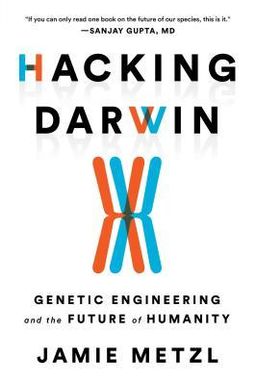
Hacking Darwin cover

Hacking Darwin

by Jamie Metzl

Hacking Darwin by Jamie Metzl delves into the genetic revolution poised to redefine humanity. As we move beyond natural selection with genetic engineering, the book examines technological advances, ethical challenges, and societal implications, urging an informed embrace of this transformative era.

The Human Future in Our Hands

What happens when evolution stops being blind and becomes a matter of human choice? In Hacking Darwin, Jamie Metzl argues we are entering the genetic age—a period when reading, writing, and rewriting the code of life becomes routine. Through vivid examples, policy analysis, and ethical debates, Metzl shows that combining cheap genome sequencing, artificial intelligence, and precise gene editing is transforming biology into an information science. You, and societies everywhere, now face decisions that could permanently alter the trajectory of our species.

From Darwin and Mendel to CRISPR

Metzl begins by connecting Charles Darwin’s theory of natural selection with Gregor Mendel’s discovery of genetic heredity. These two frameworks—how species evolve and how traits are inherited—converge in today’s genetics revolution. When Watson and Crick uncovered DNA’s structure in 1953, and later when the Human Genome Project sequenced the first human genome in 2003, biology crossed a threshold: life’s code could be read. But only with recent tools like CRISPR and AI-driven genomics has editing that code become cheap, fast, and widespread.

Metzl likens our moment in biology to 1962 in space exploration, when President Kennedy declared America would go to the moon—not fantasy, but a pledge backed by technology nearing readiness. Today, genome sequencing costs have dropped from billions to hundreds of dollars, analytic power has exploded, and the capacity to intentionally redirect evolution exists. We are no longer passive products of nature; we are becoming active designers of life.

Personal and Collective Turning Points

Metzl frames the revolution personally. Visiting a cryobank to freeze his sperm, he confronts the intimacy of a global transformation: freezing reproductive material is both a personal precaution and an act that might intersect with future technologies to design healthier or enhanced children. Everyday reproductive choices—egg freezing, IVF, embryo screening—are becoming stepping-stones toward deliberate evolution. As millions of such choices accumulate, they quietly rewrite humanity’s collective genetic path.

The Policy and Power Lag

What worries Metzl most is not the science but the governance vacuum surrounding it. Having testified before U.S. Congress, he has seen firsthand that public policy trails far behind laboratory capability. National laws differ wildly, from China’s permissive genomic initiatives to the U.K.’s careful regulatory frameworks, and the absence of global standards invites both innovation and abuse. The gap between exponential science and slow-moving ethics, he writes, may be the most dangerous feature of the genetic age.

A Blueprint for the Book

Across the chapters that follow, Metzl stitches together biology, computing, economics, and moral philosophy. You’ll learn how IVF and embryo screening foreshadow widespread designer conception (The End of Sex), how CRISPR democratized gene editing, how AI and big data drive genomic insight, and how aging itself might be slowed or reversed. He interweaves these disciplines with ethical and policy strands: the return of eugenic anxieties, questions of fairness and diversity, and the need for a new international rulebook before competitive pressures push societies beyond deliberation.

Core message

From here on, Metzl says, mutation will not be random but self-designed, and selection will not be natural but self-directed. You are living through a species-level transformation that fuses science, ethics, and politics. The question is not whether we can hack Darwinian evolution—but whether we can do so wisely.

This opening vision sets the tone for the rest of the book. Metzl’s thesis is not utopian or dystopian—it is pragmatic: technological evolution is inevitable, but the moral direction of that evolution remains ours to choose. In the pages ahead, he helps you see what is coming, what it means, and what decisions humanity must make while there is still time to choose.


Rewriting Life’s Code

You begin to see why the genetic revolution is not a sudden rupture but a cumulative achievement. Metzl traces how decades of work converged: the discovery of DNA’s structure, the decoding of genomes, and now the precise rewriting of genes with CRISPR and its successors. To control heredity, you must both read and write the genetic instructions—and that intersection between Darwin’s random mutation and Mendel’s inheritance defines this new era.

Tools of Transformation

Sequencing technology has collapsed in cost and time—what took thirteen years and billions of dollars for the Human Genome Project now takes a day and hundreds of dollars. Artificial intelligence systems analyze patterns far beyond human cognition, mapping how thousands of genes combine to shape complex traits. CRISPR-Cas9 serves as the editing tool of choice: by guiding a specialized enzyme with RNA, scientists can cut and repair DNA at near-arbitrary locations.

This new precision has unleashed innovation across sectors. In agriculture, CRISPR produces non-browning apples and disease-resistant crops; in medicine, it powers therapies that engineer immune cells to attack cancer; in conservation, it even resurrects extinct traits. Metzl details how companies such as Editas, Caribou, and Inscripta scaled CRISPR from research tool to industry platform, enabling a biotechnology explosion similar to the microchip revolution in electronics.

CRISPR’s Limits and Evolution

CRISPR is not perfect. Early concerns about off-target effects, mosaicism, and unintended consequences compelled rapid technical refinement—new enzymes like Cas12a, base editors that switch single letters without cutting DNA, and prime editors capable of near-typo-level corrections. Metzl’s key point: each safety concern triggers adaptive innovation. Biology’s feedback loop is now as fast as Silicon Valley’s software cycle.

From Research to Responsibility

But sheer capability provokes moral crisis. The 2018 announcement by Chinese scientist He Jiankui of gene-edited twins (altering the CCR5 gene) jolted the global community. The experiment was technically crude and ethically catastrophic. Metzl interprets such events not as isolated scandals but as symptoms of a system racing ahead without guardrails. The fusion of accessible tools, weak regulation, and competitive incentive makes heritable editing inevitable unless global norms are built in time.

Central takeaway

With CRISPR, control over evolution is decentralized. You live in a world where any well-equipped lab can rewrite DNA, so the challenge shifts from scientific ability to collective responsibility.

Understanding these tools helps you grasp the stakes of every later chapter: embryo selection, longevity engineering, and even national strategy all rest on this foundation. Humans have hacked the operating system of life; whether that hack enhances or harms depends on how we govern it.


Designing the Next Generation

Human reproduction, Metzl argues, is quietly shifting from a natural act to a technological process. IVF, embryo screening, and induced pluripotent stem cell techniques are combining to make conception increasingly a laboratory enterprise. The phrase ‘the end of sex’ is provocative by design—it means not the end of intimacy but the decoupling of sex from reproduction.

The Fertility-Tech Stack

Decades after the first IVF birth in 1978, laboratory reproduction has become routine. Add preimplantation genetic testing (PGT) and you gain the ability to screen embryos for diseases before pregnancy. Now researchers are learning to generate eggs and sperm from adult cells (Yamanaka’s iPSC breakthrough). That reprogramming could yield hundreds of embryos from a single couple, giving parents data-rich choice over which to implant.

Metzl projects a near-future where choosing an embryo feels as normal as comparing health plans. Avoiding single-gene diseases like Tay-Sachs or cystic fibrosis already motivates many parents; as predictive scores for complex traits (height, intelligence, disease risk) improve, the boundary between therapy and enhancement will blur. For many, lab conception will appear safer, cheaper, and morally easier than natural pregnancy followed by prenatal screening and potential termination.

Ethics and Incentives

Metzl reminds you that parents are incentive-driven. They want healthy children; insurers want to lower disease costs; employers already subsidize fertility benefits. Eventually, he argues, these forces will normalize embryo screening and selection. While you may recoil at the phrase ‘designer baby,’ the trend will likely begin as disease prevention and end as optimization.

Yet, this individual pursuit produces collective consequences. Unequal access to genetic choice could entrench inequality; over-selection for certain traits could reduce genetic diversity. The tools of compassion could, without oversight, yield a stratified species. Metzl’s challenge is double: expand access to beneficial technologies while maintaining diversity and humility.

Ethical crux

Private parental choices, multiplied by millions, are shaping human evolution. What feels personal is profoundly political.

Understanding this transition helps you grasp why global governance, cultural reflection, and equitable access matter. When creation itself moves to the laboratory, every birth becomes a choice about the future of our species.


The Power of Genetic Data

Predictive genetics runs on one essential fuel: data. To forecast traits or optimize embryos, scientists need vast databases linking genetic variants to outcomes. Metzl highlights how AI, big data, and global sequencing efforts create this foundation—and why control over data equals control over the future of health and reproductive choice.

Global Genome Projects

Iceland’s deCODE project linked DNA to family records for a whole population; the U.K.’s 100,000 Genomes Project integrates genomics into the NHS; the U.S. All of Us initiative aims for diversity in a million genomes; China is sequencing at enormous scale under national plans linking health, AI, and biosecurity. These projects create the raw material for polygenic risk prediction—scores estimating your predisposition to diseases or traits.

AI as Decoder

Just as DeepMind’s algorithms mastered Go’s complexity, machine learning can discern multigene patterns invisible to human reasoning. Companies such as Deep Genomics and Google Health use this analytic power to predict disease risk and drug targets. Metzl calls this the moment when biology merges with information science: data, not molecules, become the primary drivers of discovery.

Privacy, Ownership, and Power

Data ownership fuels new ethical dilemmas. Should individuals profit when their genomes generate corporate value? Platforms like LunaDNA experiment with data-sharing tokens, while others promise open-science models. Meanwhile, nations compete: GDPR prioritizes privacy, China prioritizes state control. The result, Metzl warns, is a geopolitical data arms race where the winners may dominate medicine, security, and even bio-enhancement markets.

Strategic warning

Genomic data are the oil of the twenty-first century. Whoever controls the pipelines will steer the future of biology.

In the genetic age, information itself becomes a determinant of survival and influence. Ensuring fair, ethical, and secure data governance may prove as consequential as decoding the genome itself.


Engineering Aging and Longevity

Metzl extends the discussion beyond reproduction to reprogramming life itself. If we can edit genes, why stop at birth? The frontier now is aging—treating it as a disease to be delayed or reversed. He describes research across senolytics, epigenetic reprogramming, plasma-based rejuvenation, and synthetic biology that together point to a future of radical longevity.

Senolytics and Epigenetic Repair

Senolytics aim to kill senescent cells that accumulate and fuel inflammation. Trials in animals show restored organ function and longer health spans. Parallel advances in epigenetic therapies, which tune the chemical marks that regulate gene expression, offer reversible, drug-like control over the aging process. Pharmaceutical companies from Novartis to Eli Lilly now invest heavily in these pathways, signaling that rejuvenation has moved from science fiction to translational science.

Rewinding the Biological Clock

Perhaps the most striking research involves partial epigenetic reprogramming. Yamanaka factors can revert adult cells to a youthful state; experiments at the Salk Institute showed rejuvenation in mice. Parabiosis studies—in which old mice receive blood from younger counterparts—suggest circulating factors might refresh tissues. Companies like Alkahest are testing plasma-based treatments for age-related conditions like Alzheimer’s, hinting at a pipeline of near-term interventions.

Synthetic Biology and Organ Engineering

Synthetic biology redefines what it means to build life. Craig Venter’s synthetic cells, the GP-write initiative to design entire genomes, and chimeric research inserting human cells into animals to grow transplantable organs illustrate biology as engineering. These advances could solve organ shortages and design bio-based materials and foods. Metzl positions these achievements within a theme of human creativity shifting from invention outside life to invention within life.

Message

If aging is programmable, the boundary between medicine and enhancement vanishes. Extending healthy lifespan is not only a personal benefit but a political and ethical project: who gets access, and how long should life last?

Metzl concludes this theme with optimism tempered by realism. Immortality is improbable, but significant longevity gain is plausible. The challenge, as always, lies in equitable access and moral foresight, not in scientific limitation.


Ethics, Diversity, and Global Governance

As the science accelerates, Metzl insists that ethics and governance must keep pace. He revisits the history of eugenics to frame why discussions of editing and selection carry heavy moral baggage. Twentieth-century coercive sterilizations and Nazi atrocities make society justifiably wary. But he differentiates modern ‘liberal eugenics,’ grounded in choice and health, from the state-driven horrors of the past.

The 'Playing God' Debate

Philosophers like Leon Kass and Michael Sandel warn that engineering humans risks desecrating the sense of life as a gift. Others, like Julian Savulescu, counter that parents have a moral duty to select the healthiest possible children. Nicholas Agar promotes a middle path: individual freedom without coercion. Metzl sides with ethical humility—acknowledge power, remember history, and avoid discrimination and loss of human diversity.

The Value of Variation

Diversity, he emphasizes, is evolution’s insurance policy. Just as monocultures collapsed in agriculture, narrowing human genetic variation could leave us vulnerable to disease or uniform thinking. Some harmful variants provide hidden benefits (the sickle-cell gene’s malaria resistance); erasing variation without holistic understanding invites unforeseen consequences. Genetic diversity, like cultural diversity, is a safeguard of resilience.

From National Laws to Global Norms

Regulatory patchwork defines the current era. The U.K.’s Human Fertilisation and Embryology Authority offers a model of transparent deliberation, while the U.S. remains fragmented and China combines bold experimentation with state oversight. Data legislation—from Europe’s GDPR to China’s security laws—reflects deeper philosophical divides about autonomy versus authority. Without international coordination, competitive asymmetries could spiral into ethical conflicts and medical tourism.

Toward a Global Framework

Metzl draws lessons from nuclear non-proliferation: cooperation plus containment. He urges the creation of a global bioethics commission, inclusive dialogues across cultures, and clear red lines against coercive or hazardous applications. Just as environmental norms and human-rights conventions arose from public mobilization, so too must global genetic norms emerge from informed citizens rather than elite decrees.

Enduring lesson

Genetic engineering is not just a scientific project but a moral test. The real frontier is not the lab, but whether humanity can align power with principle before it’s too late.

Metzl’s final plea is participatory: learn the science, join the discussion, and help set the norms. The biological future is not predetermined; it is the sum of the decisions we make together.

Dig Deeper

Get personalized prompts to apply these lessons to your life and deepen your understanding.

Go Deeper

Get the Full Experience

Download Insight Books for AI-powered reflections, quizzes, and more.