
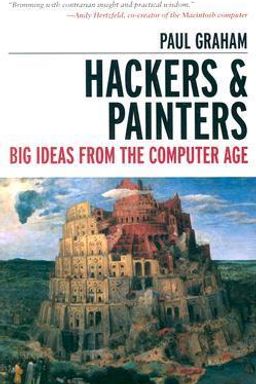
Hackers and Painters cover

Hackers and Painters

by Paul Graham

Hackers and Painters by Paul Graham delves into the creative essence of programming, likening it to art. The book explores how rebelliousness fuels innovation, the financial potential of startups, and the evolving nature of programming languages. Perfect for anyone seeking to understand the artistic and lucrative aspects of technology.

Hacking and Painting as Radical Creativity

Have you ever wondered what connects a master painter like Leonardo da Vinci to a modern programmer building software into the night? In Hackers and Painters: Big Ideas from the Computer Age, Paul Graham argues that hacking—the art of creating code—and painting—the art of creating visual beauty—are not opposites but two manifestations of the same creative force. Both are crafts born of curiosity, skill, and a relentless drive to make something genuinely new.

Graham contends that hackers are today's painters, inventing new worlds out of logic and imagination. This provocative thesis reframes programming from a technical pursuit into an artistic one. Hackers, like Renaissance sculptors or poets, work in an environment of constraint—limited time, imperfect tools, and infinite possibilities. Through this lens, Graham challenges traditional boundaries between science and art, arguing that great hackers are not merely engineers but modern-day artists, defined by their taste, daring, and devotion to beauty.

Creativity as Craft, Not Ceremony

Much of Graham’s argument rests on dismantling how we categorize creative work. He rejects the sterile hierarchy that places science in one box and art in another, insisting that both arise from the same instinct: the urge to make good things. In his view, the distinction between design and research mirrors that between creation and discovery. Designers seek to make something good; researchers seek to make something new. The best work, he notes, happens where these paths converge—when new ideas yield beautiful things worth building.

Graham’s comparison between hackers and painters forces readers to confront how we undervalue hacking. In universities, he observed programmers pressured to write academic papers instead of beautiful software—a system that mistakes scientific credentials for creative accomplishment. He recalls learning to program by experimenting, not theorizing, the way an artist sketches before painting. In both disciplines, progress comes from doing, not talking.

Beauty, Simplicity, and the Maker’s Mind

Why does Graham compare hackers to painters rather than to scientists or architects? Because both hackers and painters pursue beauty. He describes great code as beautiful from the inside—the elegance of its logic, the clarity of its structure, and the way each piece fits with the next. This is not just efficiency but aesthetic intuition, akin to how a Renaissance artist might feel the balance between form and space.

In Chapter 9, “Taste for Makers,” Graham deepens this idea. He lays out principles of good design that apply equally to software, math, and painting: simplicity, timelessness, solving the right problem, and the elegance that makes beauty feel like inevitability. For Graham, good design is hard because it forces you to face reality—to remove ornament and address the essential problem. Hackers who pursue simplicity rather than cleverness, he writes, become artists in the truest sense.

When Innovation Meets Freedom

The book also connects creativity to independence. Graham defends the hacker’s rebellious spirit—the refusal to follow rules just because they’re fashionable. In “Good Bad Attitude,” he compares hackers to Feynman breaking into safes during the Manhattan Project and to the founders who launched companies like Apple by thinking differently. He sees disobedience not as arrogance but as vitality—the essential trait of those who create what’s next.

Freedom, for Graham, is the hacker’s environment. Most great work happens early—when mediums are new and rules haven’t yet solidified. Just as Shakespeare’s creative explosion defined early modern theater, the innovations of programmers are defining our era of technology. Startups, he argues in “How to Make Wealth,” are modern versions of Renaissance workshops—a handful of ambitious makers, driven by passion, reshaping the world.

Why Hacking is the Art of Our Time

All these threads—creative rebellion, aesthetic simplicity, financial invention—merge into Graham’s central vision: hacking isn’t just a job; it’s an art form. Painters had oils and canvases. Hackers have Lisp and Python. Their mediums differ, but their purpose is identical—to make something that changes reality, that reveals beauty in structure, that embodies care and clarity. As Graham says, “Great software, like great painting, has to be better than it has to be.”

Big Idea:

To truly understand technology, you must stop seeing it as a mere tool and start seeing it as a canvas—where logic becomes art, and innovation is an act of beauty. Hackers are not the engineers of the future; they’re the artists of our time.


Breaking Rules to Find Freedom

In "Good Bad Attitude," Paul Graham celebrates the hacker’s defining quality—creative disobedience. To him, hacking is mastery through rebellion: bending systems until they yield new possibilities. This rebellious spirit echoes not only in tech culture but throughout history. He recalls physicist Richard Feynman, who amused himself by cracking safes during the Manhattan Project—a harmless act that revealed both intellectual curiosity and contempt for artificial boundaries.

Rebellion as a Creative Tool

Graham suggests that the impulse to break rules drives progress. The best hackers, like the founders of Apple, began by ignoring conventions. They believed the world could be better—simpler, more human—and so they built products that overturned norms. This mindset is essential not only in technology but in thought: questioning authority leads to innovation. For Graham, this parallels free speech itself; hackers defend intellectual freedom because their job depends on it.

Disobedience and American Creativity

Graham expands this idea into a political observation. Hackers thrive in America, he argues, because American culture historically rewards rule-breaking. He draws on Jefferson’s quote—“The spirit of resistance to government should be kept alive”—to suggest that creativity and rebellion are national virtues. When societies suppress curiosity and dissent, they lose their innovative energy. The hacker’s unruliness, then, isn’t dangerous; it’s patriotic.

(Graham’s perspective mirrors C.S. Lewis’s warning in The Abolition of Man that tyranny “exercised for the good of its victims” is the most oppressive form of control—the very attitude that stifles creative liberty.)

Curiosity Over Conformity

Hackers are naturally suspicious of systems—whether legal, academic, or corporate—that prioritize obedience over discovery. Graham describes how modern intellectual property laws, designed to protect creators, ironically stop new creators from studying how existing systems work. He warns that criminalizing curiosity harms not only hackers but innovation itself. The hacker’s instinct to explore and tinker is civilization’s safeguard against stagnation.

The genius of hacking lies in disobedience. Progress doesn’t come from following rules—it comes from asking why those rules exist, and what might be possible without them.


Creating Wealth Through Startups

In the twin essays “How to Make Wealth” and “Mind the Gap,” Graham reframes entrepreneurship and capitalism as acts of creation, not exploitation. He argues that creating wealth is not about taking money from a fixed pile but making new things people want. Just as farmers once produced grain and carpenters built furniture, modern innovators produce software—a substance of value assembled from ingenuity and skill.

Wealth Isn’t Money—It’s Creation

Graham draws a crucial distinction: money is a medium of exchange; wealth is the underlying goods and services. When you make something people want, you create wealth. In ancient times this meant physical products, but today it means ideas, algorithms, and digital goods. He uses Apple’s transformation under Steve Jobs as proof that wealth grows when creativity meets demand. Jobs didn’t redistribute old riches—he invented new ones.

Startups as Modern Workshops

He likens startups to the adventurous merchant voyages of the Middle Ages: small groups tackling risky technical problems for outsized rewards. A startup, in his view, compresses “your working life into a few years” of intense creativity. By creating technology that scales, entrepreneurs can become far richer than employees who work steadily for decades. This is not injustice—it’s simply the math of leverage and specialization.

Through examples from Viaweb and history—Florentine merchants, British industrialists, and Silicon Valley hackers—Graham shows that prosperity comes when societies reward innovation rather than corruption. “Let the nerds keep their lunch money,” he says; those who create wealth make nations powerful.

Inequality as a Measure of Health

In “Mind the Gap,” Graham challenges our discomfort with income inequality. He argues that unequal outcomes in modern democracies usually signal productive variation, not injustice. When people can freely create wealth, results will vary by talent and effort—just as some artists paint masterpieces while others paint postcards. Suppressing those differences, through heavy taxation or rigid systems, only ensures collective poverty. Economic variance, paradoxically, keeps societies healthy.

Startups prove that prosperity scales with creativity. Wealth isn’t a pie to divide—it’s a fire to feed.


Technology, Freedom, and the Future

In “The Other Road Ahead” and “The Hundred-Year Language,” Graham explores the deep relationship between technological innovation and freedom. His essays chronicle how shifts in software architecture, programming language, and design philosophy change not just what we build—but who we become.

The Rise of Web-Based Software

In 1995, Graham’s startup Viaweb introduced one of the first web-based applications. Instead of forcing users to install programs, they ran on servers “via the web.” This idea, revolutionary at the time, led directly to what we now call cloud computing and Software-as-a-Service (SaaS). He predicts that as technology moves online, users will gain simplicity while developers gain speed—and the tech giants of the desktop era, like Microsoft, will lose dominance. Whoever controls flexibility, not hardware, controls the future.

Evolving Languages, Evolving Minds

Graham’s essay “The Hundred-Year Language” stretches further, asking what programming might look like a century from now. Drawing evolutionary parallels, he envisions languages converging toward simplicity, abstraction, and expressive power. Lisp, the 1958 language he champions, already embodies these ideals. To design the future, he argues, we must imagine having unlimited resources—and build languages that emphasize human clarity over machine efficiency. The future belongs to those who treat code not as control but as conversation.

Freedom as the Engine of Innovation

Technology flourishes when creative people can pursue ideas without constraint. Graham cites open-source communities as modern engines of scientific freedom. Unlike closed corporation labs, open-source projects let hackers work “for love, not money,” mirroring how Renaissance artists refined their craft through experimentation. Freedom, he writes, isn’t just a moral ideal—it’s a prerequisite for discovery.

Technological freedom magnifies human creativity. When you remove constraints, invention becomes inevitable—and beauty follows.


Designing for Humans, Not Machines

In “Design and Research,” Graham shifts from economics and programming to human experience. He argues that all great design—whether software or architecture—begins with empathy. You have to design not for logic, but for life. A good programming language, like a good chair, should be built around human needs, not theoretical purity.

Thinking Like a Designer

Graham distinguishes design from research: designers seek good solutions, researchers seek new ones. The best creators combine both goals. When hackers think like designers, they ask who their users are, what they need, and how they truly behave. He cites Jane Austen, who read her novels aloud to her family to test their appeal, as a model for how builders should test software—they must constantly calibrate against real people.

Prototypes and Refinement

Borrowing from Renaissance artists, Graham praises the method of gradual refinement. Painters start with broad sketches and layer in detail; software designers should do the same. Releasing early prototypes lets users guide improvement naturally. He compares this to the artistic principle “a painting is never finished—only stopped.” The same holds true for robust software that continually evolves.

Morale and the Joy of Building

A surprising insight in this essay is psychological: the key to great design is morale. When designers love what they build, users feel it. Boredom breeds bad work—something visual artists and programmers share. The most human design, Graham concludes, comes from creators who are human themselves, who build for delight rather than obligation.

Design is empathy made tangible. You can’t craft beauty for people until you first understand what makes them come alive.


Taste and Timelessness in Creation

“Taste for Makers” dives into the mechanics of beauty—how to recognize and produce it across disciplines. Graham blends aesthetics from mathematics, architecture, and engineering to propose universal laws of good design. Like G.H. Hardy, who said “there is no permanent place for ugly mathematics,” Graham insists the same for code: ugly solutions eventually disappear, replaced by elegant ones.

The Principles of Great Design

  • Simplicity: Good design is clear and uncluttered. Complexity hides weakness; simplicity reveals truth.
  • Timelessness: Designs that depend on fashion die quickly. True beauty continues to feel right long after its time.
  • Solving the Right Problem: Like the stove dial example, design fails when it answers the wrong question efficiently.
  • Symmetry and Nature: The best designs emulate patterns found in life itself—recursion, rhythm, and organic form.

Beauty as Hard Work

Graham insists that beauty isn’t decoration—it’s discipline. Every Renaissance master worked obsessively to achieve effortless grace. Likewise, good software looks easy only because its makers invested extraordinary care. For creators, that means pushing past the fear of imperfection, embracing iteration, and designing things worthy of lasting admiration.

Beauty is not simplicity for its own sake—it’s clarity born of effort. The timeless works are those we sweat over until they look effortless.

Dig Deeper

Get personalized prompts to apply these lessons to your life and deepen your understanding.

Go Deeper

Get the Full Experience

Download Insight Books for AI-powered reflections, quizzes, and more.