
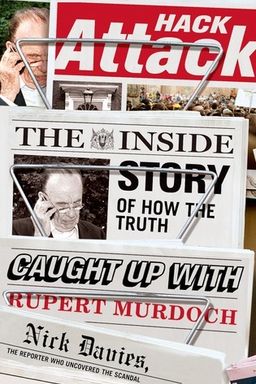
Hack Attack cover

Hack Attack

by Nick Davies

Hack Attack offers a gripping narrative of the phone hacking scandal that dismantled Rupert Murdoch''s media empire. Through vivid storytelling, it reveals the dark side of tabloid journalism and the power of truth in holding the mighty accountable.

Power, Corruption, and the Machinery of Modern Media

How can a single newsroom's illegal acts expose the architecture of an entire political media system? In Hack Attack, Nick Davies investigates how phone hacking, bribery, and intimidation became standard tools in British journalism — and how those practices were protected by political power, law firms, and even the police. His central argument is that the phone-hacking scandal was not an aberration but a symptom of systemic corruption linking the press, politics, and police.

Davies contends that you can only grasp the scandal if you see hacking as part of a 'culture of impunity'. Editors demanded scoops, management bullied staff, private investigators sold secrets, lawyers sealed the damage, and politicians courted media power. Each part of the system — newsroom, investigator, regulator, and government — reinforced the others. The story becomes not just about crime, but about how commercial incentives and political dependency created structural corruption in public life.

The System Behind the Scandal

The scandal started in a tabloid newsroom where ‘dark arts’ — hacking, blagging, surveillance — were treated as routine. Davies shows how journalists at the News of the World collaborated with private investigators like Glenn Mulcaire, who broke into voicemails using default PINs, and Steve Whittamore, who blagged confidential data from telecom and government employees. Editors such as Andy Coulson and Greg Miskiw pressured their teams through what Davies calls the 'Bully Quotient,' creating an environment where illegality felt like normal productivity. If you didn't deliver a scoop, you risked your career.

These cultural and managerial forces didn’t act in isolation. Fleet Street reporters relied on a criminal marketplace of investigators who bribed police and accessed personal data through corruption. Southern Investigations, run by Jonathan Rees and Sid Fillery, embodied the crossover between journalism and organised crime. Davies traces this underground economy back to the 1990s, when tracing agents, ex-officers, and addiction‑recovery networks provided illicit intelligence for cash. Newspapers imported corruption wholesale, paying for results without asking how they were obtained.

The Collusion of Power and Law

When evidence of hacking surfaced, institutions that should have stopped it — Scotland Yard, the Crown Prosecution Service, the Information Commissioner, and political parties — instead became complicit through inertia or collusion. Operation Caryatid in 2006 found huge databases of hacked information, yet police limited charges to one reporter and one investigator. The Press Complaints Commission declared the matter closed, and News International’s lawyers used settlements and strict secrecy to bury evidence. This pattern of concealment illustrated how wealth and access could neutralize oversight.

Davies frames this dynamic as a closed loop of power: tabloid editors courted politicians by shaping public mood, politicians rewarded media loyalty with access and regulatory leniency, and law enforcement looked away to maintain friendships or avoid confrontation. Rupert Murdoch’s newspapers became quasi-political actors — both reflecting and dictating government behavior — while wielding threats of exposure as leverage. From Tony Blair’s calls with Murdoch before the Iraq War to David Cameron hiring former News of the World editor Andy Coulson, each alliance deepened the grip of media over politics.

The Breaking Point

The chain finally snapped in July 2011, when the Guardian's revelation that the News of the World hacked missing schoolgirl Milly Dowler’s voicemail triggered public outrage. Advertisers fled, the newspaper closed, and the scandal reached Parliament. Davies calls this the moral inflection point — a visceral example of cruelty that the public could not rationalize away. Crucially, it forced politicians and regulators to act, leading to the Leveson Inquiry, criminal trials, and the collapse of Murdoch’s bid to take full control of BSkyB.

The book ends not in triumph but in realism. Some culprits faced prison or resignation, but the underlying structures — concentrated ownership, political dependency, market-driven bullying — remained. Davies’s greatest lesson for you is that systemic corruption survives exposure. Only persistent, legally savvy, independent journalism can hold power to account when the institutions meant to protect the public are compromised by that same power.


Inside the Newsroom Culture

Inside the News of the World newsroom, what looked like individual lawbreaking was actually structural behavior. Davies depicts a workplace where the line between competition and coercion vanished. Editors screamed for exclusives on celebrities and crime victims. Reporters learned that moral hesitation — not the law — was the real career risk. Illegal practices were normalized through repetition and reward.

Normalization of the Dark Arts

Hacking voicemails, bribing sources, and using investigators were not exceptional. They were part of the workflow. Glenn Mulcaire’s invoices and notebooks — containing thousands of names and contacts — functioned as company assets. News editors like Ian Edmondson and Neville Thurlbeck signed off payments or relayed orders. Davies calls this the newsroom’s operational norm: illegal information used for routine content production, protected by plausible deniability at higher levels.

Bullying as Discipline

The 'Bully Quotient' defined internal dynamics. Reporters feared managers who texted threats at midnight or humiliated them publicly. Under editors such as Andy Coulson or Kelvin MacKenzie, this culture produced both ambition and moral collapse. You see why journalists began rationalizing hacking as self‑defense: everyone else was doing it, the bosses demanded it, and success meant survival.

Corporate Concealment

When exposure loomed, denial became corporate strategy. The ‘rogue reporter’ line — blaming Clive Goodman alone — offered a narrative shield. Emails describing “clean sweep” deletions and selective sackings (like Edmondson’s) showed how denial morphed into document destruction. Legal teams managed containment: settle privately, admit nothing, and control the narrative. By institutional design, ethical questions were reframed as PR crises.

Davies’s portrayal of the newsroom is sociological, not merely criminal. It warns that corruption thrives when commercial success masks moral bankruptcy, and when managers’ behavior dictates values more powerfully than law or principle.


Networks of Illicit Investigators

Davies shows that behind every big scoop stood an industry of private investigators and corrupt insiders. The lines between journalism, policing and crime blurred into a functional alliance. Tracing agents and ex‑officers sold stolen or blagged data to reporters who paid with cash or favors.

A Criminal Supply Chain

From Southern Investigations under Jonathan Rees and Sid Fillery to freelance blaggers like Steve Whittamore, a hidden market of illicit access supported Fleet Street. Phone-company employees leaked data for money; police officers traded internal reports; DVLA and bank staff sold addresses. The Information Commissioner’s Operation Motorman found more than 13,000 illegal requests covering almost every major British newspaper.

Corruption as Contagion

Once bribes and theft became normalized supply lines, newspapers imported that corruption wholesale. Every purchase blurred ethics. Davies frames this as the 'corrosive loop': when journalism buys from criminal markets, it inherits their methods. Papers gained transgressive power but lost legitimacy — and regulators hesitated to prosecute, fearing loss battles with billion‑dollar media companies.

These networks explain how phone‑hacking scaled industrially. They reveal a parallel economy of ‘information mercenaries’ whose labor sustained the facade of legitimate reporting.


The Machinery of Concealment

Davies meticulously reconstructs how police, lawyers, and corporate managers cooperated — often unintentionally — to hide wrongdoing. Each institution feared exposure more than it sought truth.

Scotland Yard’s Limited Investigations

Operation Caryatid in 2006 uncovered massive evidence but restricted its scope to protect the Palace and political elites. Detectives seized notebooks with thousands of victims but charged only Goodman and Mulcaire. Meanwhile, senior officers maintained social ties with News International executives. Years later, a new inquiry (Operation Weeting) exposed the earlier neglect, forcing resignations at the Yard.

Legal Tactics and Secret Settlements

News International used money and confidentiality to seal off incriminating files. The Gordon Taylor settlement exceeded £1 million, paired with sealed orders that kept police evidence out of view. Law firms like Harbottle & Lewis and Farrer & Co. produced narrowly phrased letters that the company weaponized to deny systemic wrongdoing. Similar hush agreements with Goodman and Mulcaire bought silence and time.

Regulatory Paralysis

The Information Commissioner and Press Complaints Commission compounded the failure. Despite thousands of illegal data requests uncovered by Operation Motorman, prosecutions were minimal. The PCC declared the hacking an 'aberration'. This pattern allowed News International to claim the issue closed while deleting archives behind the scenes.

Davies’s insight is harsh: the institutions tasked with protecting the public often act as buffers for the powerful. Their failures turn negligence into active concealment.


Power, Politics, and the Murdoch Empire

Davies frames Rupert Murdoch’s empire as both media business and political organism. Its influence stemmed not just from circulation but from psychological leverage: the fear politicians felt of being targeted by his papers.

How Influence Operated

Murdoch’s executives blurred journalism and lobbying. Rebekah Brooks and Andy Coulson cultivated ministers, using access to trade policy favors for positive coverage. Editors could ‘monster’ political enemies or reward allies. The same access that guaranteed scoops also bought deregulation that favored Murdoch’s commercial interests in Sky and News Corp.

Rituals of Access and Fear

Davies describes weddings, private dinners, and phone calls as currency in a system of elite co‑dependency. Tony Blair consulted Murdoch before the Iraq War; Gordon Brown and David Cameron sought his approval. For decades, politicians internalized the idea that survival required Murdoch’s blessing. When The Sun switched support to the Conservatives in 2009, its front pages became daily campaign material — an editorial coup disguised as journalism.

By revealing these practices, Davies shows how concentrated media ownership can erode democracy’s feedback loops. Fear of being 'monstered' replaced the pursuit of transparent policy-making.


Investigation, Risk, and Legal Strategy

To expose the truth, Davies and Guardian editor Alan Rusbridger pioneered a hybrid method of journalism: using legal discovery to force accountability. Reporting alone couldn’t penetrate the fortress of corporate secrecy; litigation had to pry open police archives and internal files.

Orchestrating Exposure

Collaborating with lawyers like Mark Lewis, Charlotte Harris, and Hugh Tomlinson, Davies built cases that turned civil claims into investigative tools. Sienna Miller’s and Nicola Phillips’s lawsuits compelled disclosure of Mulcaire’s notebooks and identified editors like Ian Edmondson as participants. Funding from figures like Max Mosley allowed victims to overcome prohibitive legal costs. Each claim chipped away at corporate secrecy, transforming fragments of evidence into public records.

Managing Risk

Davies faced immense pressure — threats of libel, smear campaigns, and reputational war. His team balanced precision and protection: redacting sources while verifying facts through triangulation. The strategy illustrated a principle of modern investigative reporting — persistence plus legal discipline equals exposure. (Compare this with Bob Woodward’s Watergate methods — both relied on external legal processes to authenticate illegal conduct.)

The interplay between journalists, lawyers, and whistle‑blowers becomes the book’s quiet heroism: a blueprint for resisting institutional power when formal accountability has failed.


The Breaking Point and Aftermath

The 2011 Milly Dowler story transformed years of technical revelations into moral outrage. Hacking a murdered child’s phone shattered public tolerance and sparked parliamentary revolt. Advertisers pulled out; Murdoch closed the News of the World. What years of political caution couldn’t achieve, public disgust accomplished almost overnight.

Cascade Effects

The outrage killed Murdoch’s BSkyB takeover — Project Rubicon — and triggered the Leveson Inquiry. Operation Weeting expanded its scope, uncovering thousands more victims. Senior police officers and editors resigned. For the first time in decades, media concentration faced unified political resistance.

Leveson and Limited Reform

Lord Justice Leveson’s inquiry took 337 witnesses and thousands of documents. He proposed an independent regulator backed by statute — not government control, but credible enforcement. Newspapers resisted fiercely, invoking free speech. The inquiry led to criminal convictions for Coulson, Thurlbeck, and others, but Parliament shrank from enacting Leveson’s full vision.

Davies’s conclusion is unsentimental: moral shock produced temporary reform, not structural change. Murdoch’s empire survived; similar pressures still distort journalism. The story exposes how fragile accountability remains when concentrated media power outlives every scandal it creates.

Dig Deeper

Get personalized prompts to apply these lessons to your life and deepen your understanding.

Go Deeper

Get the Full Experience

Download Insight Books for AI-powered reflections, quizzes, and more.