
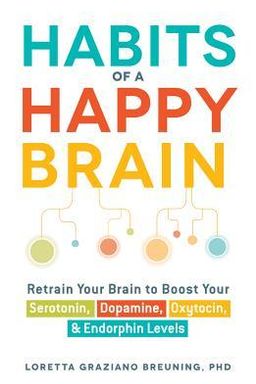
Habits of a Happy Brain cover

Habits of a Happy Brain

by Loretta Graziano Breuning

Habits of a Happy Brain reveals the secret to boosting your happiness by understanding and optimizing the brain chemicals that influence joy. Loretta Graziano Breuning provides practical tools to retrain your brain, enabling you to break free from habituation and cultivate lasting happiness in just 45 days.

Rewiring Your Inner Mammal for Real Happiness

Why does happiness feel so fleeting? You get a raise, a compliment, or a great meal—and then you’re back to feeling ordinary or frustrated again. In Habits of a Happy Brain, Loretta Graziano Breuning reveals that this yo-yo of feeling good and bad isn’t personal failure. It’s biology. Your brain releases four happy chemicals—serotonin, dopamine, oxytocin, and endorphin—but only in short bursts designed to guide survival, not eternal bliss.

Breuning asks a simple but radical question: Can you train your brain to feel good in ways that actually help you thrive? Her answer is an emphatic yes, but not through positive thinking slogans. You must cultivate new neural habits aligned with the mammalian brain’s natural wiring. Over forty-five days of repetition, you can replace old, self-defeating paths with new routes that trigger happy chemicals productively.

Your Brain Is a Mammal’s Legacy

Humans share vital brain structures—the limbic system and its chemical messengers—with other mammals. This primitive system focuses not on meaning or purpose but on survival signals: food, safety, and social bonds. When prehistoric ancestors secured those things, their brains released “good feelings” to reinforce successful behavior. You inherited that same mechanism. When you find opportunities—whether career wins or emotional support—you get a chemical rush. When obstacles appear, you feel cortisol, the stress hormone, pushing you to act.

That’s why being late to a meeting or feeling excluded from a party can feel oddly life-threatening. Your mammal brain interprets small setbacks as survival threats. Consciously, you know better. But neurochemically, your wiring tells a different story. Breuning argues that researchers focusing solely on pathologies underestimate how much normal human unhappiness stems from these ancient feedback loops, not moral or emotional weakness.

The Four Happy Chemicals

Each chemical produces distinct types of pleasure and drives specific behaviors. Dopamine brings excitement when you anticipate rewards—it’s the “I did it!” thrill. Endorphin masks physical pain for survival, felt as euphoria during exertion or laughter. Oxytocin delivers the warmth of trust and bonding, crucial for social cooperation. Serotonin gives the confidence and pride of being respected. Together, they steer every mammal’s choices. But they turn off quickly so you’ll keep seeking the next chance at survival. Continuous happiness would be maladaptive—it would remove motivation to act.

Understanding these chemicals’ natural rhythms liberates you from chasing perpetual joy. You stop expecting to “stay happy” and instead learn to recreate its sources wisely. Breuning contrasts this biological realism with cultural myths promising endless satisfaction through wealth, romance, or spiritual enlightenment. It’s not society’s fault we feel up and down—it’s evolution’s design.

Why Habits Matter More Than Willpower

Your brain builds habits through repetition and emotional association. Early experiences—especially before age seven—lay down core circuits linking actions to happiness or pain. A child who felt praised for helping her parents learns that assisting others feels rewarding. Another who felt shame for mistakes may wire fear around effort. By adulthood, these circuits become “neural superhighways.” Trying new behavior feels like hacking through jungle vines, exhausting and risky. That’s why change feels bad at first—it threatens the old survival patterns.

You can still form new routes through deliberate repetition. Every time you take a small, positive action—without relying on instant pleasure—you gradually pave a new path. After about forty-five consistent days, electricity flows easily down that new circuit and triggers real satisfaction. Breuning calls this process “rewiring your inner mammal.” Motivation shifts from impulsive chemical cravings to purposeful creation of well-being.

From Vicious to Virtuous Cycles

When dopamine, serotonin, and oxytocin fade, your brain notices cortisol instead. The discomfort urges action, and we often choose quick fixes—junk food, shopping, venting anger—that briefly relieve stress but reinforce unhealthy circuits. Breuning calls this the “vicious cycle of happiness”: each shortcut brings temporary highs and deeper lows. The way out is to accept the momentary pain of not acting—let cortisol surge and pass while choosing a healthier behavior. That “do nothing” pause opens room for new, virtuous habits that replace old chemical traps.

Other books, like Charles Duhigg’s The Power of Habit, emphasize cue–routine–reward loops, but Breuning adds the biological foundation explaining why rewards work. It’s not discipline or morality—it’s molecules guiding survival learning. Knowing this helps you design changes with compassion for your body’s instincts.

Designing a Happier Operating System

Breuning’s 45-day program combines understanding and practice. You select one small new behavior—a “happy habit” aligned with genuine needs, such as celebrating small wins for dopamine, practicing trust for oxytocin, expressing pride for serotonin, or laughing for endorphin. Then you repeat it daily, regardless of mood. If you miss a day, you restart from Day One. Her tone throughout the book is encouraging but unsentimental: happiness is a skill, not a gift, and it grows from realistic expectations about your mammal brain.

Core Message

You cannot eliminate unhappiness, nor can you delegate happiness to others or institutions. But you can manage your inner mammal intentionally. Understanding how your brain’s chemicals operate allows you to cultivate lasting, sustainable joy—a kind grounded in daily survival accomplishment rather than fantasy ideals.

Ultimately, Habits of a Happy Brain teaches that feeling good isn’t magic or luck. It’s chemistry guided by your choices. By building new neural highways through consistent, meaningful repetition, you can transform life from chasing brief spurts of pleasure to designing a steady rhythm of authentic well-being.


Meet Your Inner Mammal

Breuning begins by showing how your brain isn’t a pristine modern computer—it’s a software upgrade running on ancient mammalian hardware. Think of it as three nested systems: the reptilian brain managing basic survival, the limbic system managing emotion and social bonds, and the cortex enabling reasoning and prediction. They collaborate—and sometimes compete—to keep you alive and connected.

Survival and Social Threats

The mammal brain evolved to interpret threats to social standing as threats to survival. Being excluded from a prehistoric tribe could mean death, so modern humans still react to social rejection with intense distress. When you worry about being ignored, losing status at work, or embarrassing yourself, your brain releases cortisol as if danger looms. Breuning reframes these reactions not as overreactions but as echoes of survival instincts. Recognizing this helps you stop judging stress as moral failure—it’s protective chemistry.

How Experience Wires the Brain

From birth to about age seven, your brain fires enormous electrical storms of learning. Every experience that brings good feelings builds a pathway that says “this is good for me.” Painful moments wire “avoid this.” Because childhood judgments of survival are primitive—criticized mistakes feel as dangerous as predators—many adult fears trace to those early circuits. Once built, these networks become automatic, filtering every new event through ancient lessons. You’re not born with a fixed personality; you’re born with flexible neural clay that hardens through repetition and emotion.

As in other mammal species Breuning describes—lions chasing prey, elephants remembering water holes—dopamine, serotonin, oxytocin, and endorphin act as internal GPS signals pointing to rewards and warnings. The better you understand these chemicals, the better you can shape your habits to steer toward fulfillment instead of fear.

Nature’s Reward System

A lion’s surge of dopamine when sighting prey, an elephant’s joy upon finding water, or a monkey’s pride after foraging—all mirror your experiences of achievement, connection, or respect. They remind us that “success” at any level taps ancient motivations. This natural model also explains why happiness fades quickly: each burst is metabolized once the need is met so energy can be redirected. You’re wired for cycles of pursuit, reward, calm, and pursuit again—not permanent highs.

Takeaway

Your mammal brain isn’t broken—it’s brilliantly adaptive. Understanding its survival logic reveals why daily ups and downs occur and helps you train those waves rather than fight them.


The Four Happy Chemicals

Each of the four happy chemicals plays a distinct role in fostering wellbeing and survival. Breuning demystifies them by offering vivid animal analogies that translate neuroscience into everyday intuition.

Dopamine – The Anticipation High

Dopamine fuels the excitement of progress—your reward for discovery. When you check off a task, solve a puzzle, or even find a parking spot, you’re mirroring an ape celebrating a ripe fruit. Research on monkeys expecting juice rewards shows how easily this chemical habituates. You quickly take a reward for granted, then rage when it’s lost. (In Charles Duhigg’s model of habits, dopamine is the “craving” signal between cue and reward.) To create healthy dopamine, celebrate small victories instead of bigger, rarer ones.

Endorphin – The Body’s Painkiller

Endorphin masks pain long enough to escape danger—a zebra running after injury or a runner pushing through exhaustion. In daily life, laughter, crying, and moderate exertion trigger short spurts of endorphin. Unlike adrenaline, which mobilizes crisis energy, endorphin creates brief oblivion. Although tempting, Breuning warns against chasing pain for pleasure—the addiction risk mirrors opiate misuse. Embrace endorphin through healthy effort and humor, not self-harm or extremes.

Oxytocin – The Trust Hormone

Oxytocin rewards social alliance—the sense of belonging and safety you feel around trusted people. In mammals, grooming, mother-child bonding, and shared vigilance foster oxytocin flows. Humans replicate this through touch, shared meals, and mutual support. Yet Breuning cautions that trust must turn off sometimes: unbounded oxytocin leads to gullibility. Building trust slowly, with realistic expectations, restores balance. Proxy trust—pets or digital communities—can help prime circuits for deeper human connection.

Serotonin – The Pride Hormone

Serotonin signals the calm security of social importance. Alpha monkeys and admired humans alike get serotonin when respected. This good feeling motivates status-seeking behaviors—but without awareness, we chase validation endlessly. Breuning distinguishes serotonin’s biological role from arrogance or greed: it evolved to assure resource access and safety. You can stimulate serotonin healthily by recognizing your own contributions and expressing pride constructively.

The magic of Breuning’s framework lies in seeing happiness as a composite chemical symphony rather than a single note. Rebalance them—don’t maximize one—and you sustain genuine well-being.


Cortisol and the Roots of Unhappiness

If happy chemicals drive us toward rewards, cortisol alerts us to threats. Breuning portrays it as nature’s survival alarm—a painful messenger, but essential. Avoiding it entirely would leave you oblivious to danger.

How Pain Builds Protection

Whenever you face harm or disappointment, cortisol records sensory details from moments before the pain, wiring circuits for future avoidance. A burned hand learns to shun flame; a broken heart learns to detect similar cues long before betrayal. This efficiency produces quirky associations—like the girl who developed panic at laughter after hearing it before a car crash. Big pain creates big circuits that endure for decades.

Social Pain and the Need to Belong

Mammals evolved to feel isolation as physical pain. When separated from their herd, cortisol surges until reunion restores calm. Humans inherit this mechanism, so being ignored activates brain regions similar to physical injury (as supported by Naomi Eisenberger’s social pain research). This wiring promotes belonging but fuels anxiety in modern life. Recognizing these circuits prevents overreacting to perceived social threats—your brain simply warns of disconnection.

By accepting cortisol as a survival signal rather than an enemy, you regain agency. Waiting through a cortisol wave without reacting strengthens your ability to choose rationally instead of reflexively. Each calm endured rewires you for resilience.

Pain protects, but chronic reactivation of old pain circuits traps you in unnecessary fear. Identifying those circuits—often built from childhood social loss—lets you stop rehearsing threats and free your neurochemistry for calm living.


Breaking the Vicious Cycle of Seeking Happiness

Breuning calls happiness “nature’s operating system.” But many people hack it badly—chasing instant highs that generate cumulative lows. The result is the vicious cycle of happiness. Each shortcut—overeating, arguing, bingeing, rescuing—temporarily silences cortisol yet soon triggers more of it.

Why Quick Fixes Fail

When dopamine dips after a reward, you feel an emptiness. Cortisol steps in, urging you to “do something.” Repeating whatever cured discomfort last time—eat, text, buy—cements the circuit. But each repetition dulls response and amplifies side effects. Over time, the same act produces less pleasure and more pain. Breuning’s casino-gambler example illustrates this perfectly: first win equals massive dopamine, later wins equal none, losses cause rage.

Resisting the ‘Do Something’ Impulse

To end vicious cycles, she teaches radical patience: when cortisol spikes, do nothing. Waiting contradicts every instinct, but this pause allows electricity to reroute. Each moment endured without your old coping habit builds capacity for new healthy ones. With time, alternative behaviors—laughing, learning, helping—start producing small happy-chemical flows, eventually competing with the old addiction-like loop.

From Survival to Choice

Instead of blaming unhappiness on society, upbringing, or others, Breuning insists you reclaim personal management of your limbic system. You can’t control others’ neurochemistry or eliminate pain, but you can guide your own. Accepting discomfort as a signal, not punishment, begins a “virtuous circle”: each calm response rewires survival instincts toward confidence.

Choosing to wait through cortisol—even seconds—initiates freedom. Every non-reactive moment is a seed of a happier, healthier brain.


How Your Brain Wires Itself

Breuning’s description of brain wiring provides practical insight into why habits feel hard to form or break. Your neural network evolves through five processes—myelination, synaptic optimization, pruning, dendritic growth, and receptor adaptation—which convert experiences into automatic responses.

Myelination and Ease

Each repeated behavior builds fatty insulation (myelin) around neurons, making electricity flow faster. That’s why practiced skills feel effortless. Most myelination happens before age seven and again during adolescence, etching deep patterns such as respect, trust, and self-worth. Adult learning lacks that biological turbocharge, requiring deliberate repetition to mimic it.

Synapses and Emotion

Emotion speeds learning by “adding rowboats,” as Breuning whimsically describes—a surge of neurotransmitters helping signals jump synapses. A thrilling win or painful loss permanently shapes circuits because strong feelings enhance transmission. Repetition creates slow learning; emotion builds instant learning.

Pruning and Focus

Unused neurons die off, sharpening focus. Childhood pruning makes you intelligent by connecting new experiences to old ones. But it also limits perception—by adulthood, electricity flows easily only where paths exist. Breaking out of those paths requires effortful redirection of attention.

Growth and Adaptation

Repeated attention grows dendrites; enduring emotions grow receptors for specific chemicals. Neglecting joy receptors atrophies them. This biology validates why daily practice matters. Each positive repetition maintains the hardware of happiness.

You can’t delete old circuits, but every new activation builds alternatives. Forty-five days of steady repetition transforms fragile trails into highways of pleasure grounded in reality.


New Habits for Each Happy Chemical

Turning insight into practice, Breuning offers ritual-like strategies for each chemical. Each requires repetition, realism, and acceptance of temporary discomfort. The aim isn’t perfection—it’s daily activation small enough to sustain.

Dopamine Habits

Celebrate small victories aloud—“I did it!” Identify mini-goals and take consistent tiny actions. Divide unpleasant tasks into short ten-minute chunks to create frequent success signals, as dopamine flows with each completed piece. Adjust the challenge level to keep excitement alive—too easy kills reward; too hard prevents pursuit.

Endorphin Habits

Laugh deeply, cry occasionally, exercise differently, stretch, and make effort fun. Variety prevents injury and keeps mild pain triggers healthy. Avoid chasing euphoria—focus on exertion and release rather than intensity. Humor and creative movement are safe sources of this chemical balance.

Oxytocin Habits

Build trust gradually with stepping stones—small positive exchanges. Practice “trust but verify.” Enjoy reciprocal attention rather than blind dependence. Engage proxy trust via animals or friendly crowds, but also cultivate direct, realistic relationships. Honor commitments to feel trustworthy and trigger oxytocin inwardly.

Serotonin Habits

Express pride once daily. Enjoy your social position instead of longing for higher status. Recognize subtle influence and make peace with aspects of life you can’t control. By thanking yourself or taking public pride in small efforts, you stimulate healthy pride without arrogance.

Forty-five days of these simple rituals rewires your limbic system to seek joy from contribution and growth rather than impulse and dependence.


Overcoming Obstacles and Choosing Happiness

Despite understanding these mechanisms, internal resistance remains. Breuning identifies seven rationalizations people use to stay unhappy—each rooted in misguided attempts to control neurochemical ups and downs.

Common Mental Roadblocks

  • “I can’t lower my standards.” High ideals create chronic disappointment when reality fails to provide constant thrills.
  • “I shouldn’t have to do this.” Believing happiness is owed discourages effort and learning.
  • “It’s selfish to focus on my happiness.” False altruism masks resentment and prevents genuine well-being.
  • “I must prepare for the worst.” Hyper-vigilance sustains cortisol, shrinking the capacity for joy.
  • “I won’t be able to do this.” Fear of failure reinforces old defeat circuits.
  • “Society prevents happiness.” Externalizing responsibility keeps you powerless.
  • “I’ll be happy when ...” Conditional happiness delays it indefinitely.

Choosing a New Circuit

Breuning’s solution is radical ownership: you alone can train your mammal brain. Others can’t rewire it for you, nor can institutions supply steady dopamine or oxytocin. Each obstacle fades when you act despite discomfort. Start small, choose one behavior to repeat daily for 45 days, and accept errors as part of learning.

This pragmatic optimism resembles Viktor Frankl’s Man’s Search for Meaning: freedom lies in choosing one’s attitude under any circumstance. Breuning simply adds the biological mechanism—it’s not philosophy, it’s wiring. When you take charge of your chemicals, self-reliance and compassion intertwine. You stop waiting for a perfect world and experience calm amid imperfection.


Training Your Brain with Everyday Tools

In her closing chapters, Breuning introduces ten everyday tools that strengthen new circuits and sustain happiness. Each harnesses biological principles to make the forty-five-day practice both feasible and fun.

The Ten Tools

  • Mirror: Observe someone with habits you want; your mirror neurons will imitate success subconsciously.
  • Balance: Stimulate neglected chemicals—to grow complete emotional strength.
  • Graft: Attach new habits to old ones, like combining creativity with social connection.
  • Energy: Prioritize physical and mental energy to support new learning.
  • Legacy: Connect with enduring contributions—family, work, creativity—to satisfy innate survival drives.
  • Fun: Make practice enjoyable so repetition becomes effortless.
  • Chunk: Divide big tasks to stimulate frequent dopamine hits.
  • Satisfice: Embrace good-enough outcomes instead of endless optimization.
  • Plan: Anticipate future needs before crisis hits.
  • Visualize: Picture neurons growing daily like tendrils forming connections.

These methods help you sustain momentum and overcome inertia. If one falters, another supports it, integrating physical, emotional, and cognitive reinforcement.

Real happiness isn’t automatic joy—it’s the ongoing practice of using your tools intentionally. By recognizing your mammalian instincts and directing them consciously, you turn fleeting pleasure into enduring contentment.

Dig Deeper

Get personalized prompts to apply these lessons to your life and deepen your understanding.

Go Deeper

Get the Full Experience

Download Insight Books for AI-powered reflections, quizzes, and more.