
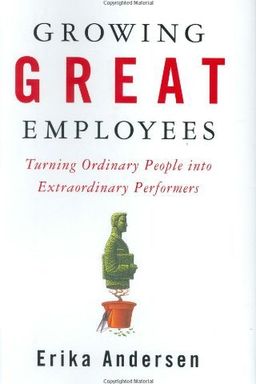
Growing Great Employees cover

Growing Great Employees

by Erika Andersen

Growing Great Employees teaches leaders to cultivate extraordinary talent by applying gardening principles. Erika Andersen''s insightful guide helps managers foster a nurturing environment, skillfully hire, and coach employees to achieve personal and organizational growth.

Growing Great Employees: Cultivating Success Like a Master Gardener

What if managing people was less about commanding and more about cultivating? In Growing Great Employees, Erika Andersen argues that great managers are really gardeners—individuals who prepare the soil, plant carefully, and tend to their people with consistent attention and skill. Just as a thriving garden requires patience, knowledge, and the right environment, so too does an exceptional workplace. Andersen contends that growing great employees means adopting a long-term mindset, building strong listening habits, and creating a culture where people are empowered to grow into their best selves.

Andersen, founder of the consulting firm Proteus International, blends decades of organizational experience with the warmth of a metaphor that anyone can understand: management as gardening. She shows that in a world obsessed with quick fixes—“one-minute managers” and “instant results”—real growth takes time, consistency, and belief in human potential. Her argument is that managers who invest in people as gardeners invest in soil, seeds, and sun will see remarkable, sustainable results. The reward is not only flourishing employees but a healthier organization where creativity, trust, and productivity thrive.

From Soil to Strategy: The Foundations of Leadership

The book begins with the central analogy: to grow anything worthwhile, you must first prepare the soil. Translating this into management terms, Andersen emphasizes that “listening” is the foundation of leadership. Soil preparation in gardening lets roots penetrate deeply; listening lets trust and understanding take root between manager and team. In Chapter 1, she dismantles the myth of the all-knowing boss. Great leaders, she says, talk less and listen more. The best organizations thrive not because their managers dictate brilliant policies but because they cultivate open environments where people feel heard and valued.

This shift from telling to listening is more radical than it seems. Andersen recounts how an executive transformed a tense meeting simply by spending 90% of his time listening. Rather than asserting authority, he invited employees into the conversation—literally liberating potential that was suffocating in silence. Listening, she argues, enriches the organizational soil, making it open and receptive enough for growth.

Planning, Planting, and Pruning in the Workplace

After laying the groundwork, Andersen moves into planning before planting—her version of hiring and structuring work intelligently. Like a gardener who knows whether she’s designing a rose garden or a vegetable patch, a manager must clarify what kind of workplace they want to grow. This means identifying core competencies: the values, skills, and behaviors essential to success. Without this clarity, organizations hire haphazardly and end up with chaotic, mismatched teams. Andersen guides readers through defining job roles, writing clear job descriptions, and selecting people who truly fit both the position and the culture.

Once the right people are planted, they need careful nurturing—but not suffocation. The concept of “not too deep, not too shallow” teaches that micromanaging overwhelms employees (burying them under pressure), while neglect leaves them unanchored. Instead, new hires should receive the right guidance at the right time through consistent feedback, realistic expectations, and gradual independence. This balance, Andersen says, transforms onboarding from a box-ticking exercise into an act of meaningful cultivation.

Mindset: The Gardener’s Belief in Growth

The gardener’s mind—Andersen’s phrase from Chapter 5—is the heart of her philosophy. Managers must replace controlling attitudes with belief in people’s potential. If plants don’t thrive, gardeners don’t blame nature—they adjust light, water, or soil. Likewise, when employees struggle, managers should examine their systems, communication, and assumptions rather than assigning blame. This mindset aligns closely with Carol Dweck’s concept of the “growth mindset”: believing that ability can be developed through effort and support. Andersen adds a psychological twist—our internal self-talk shapes how we see our employees. If a manager privately thinks, “She’ll never improve,” that belief silently curtails opportunity. Change the belief, and behavior changes too.

This self-awareness transforms management from a reactive task into an intentional act of coaching. When leaders believe in their employees’ potential and genuinely want them to succeed, they approach challenges differently: with curiosity, patience, and encouragement instead of frustration or fear.

Practical Growth Tools: Weeding, Staking, and Spreading

Beyond mindset, Andersen offers concrete models for the everyday tasks of management—“staking” and “weeding” your garden. Staking means setting clear performance agreements so employees know exactly what they’re accountable for. Weeding means giving timely, specific feedback to correct problems before they grow. Using her “camera check” technique, Andersen teaches managers to focus on observable behaviors rather than vague judgments—a method aligned with modern leadership psychology (Daniel Goleman’s emotional intelligence framework complements this well). Later chapters explore delegation (“letting it spread”) as the process of empowering others without abdicating responsibility. By giving employees space to stretch and supporting them with feedback and resources, managers turn workers into self-sustaining professionals.

In the final chapters, Andersen tackles the toughest realities of leadership: when good plants fail to thrive. Sometimes, despite your best care, employees cannot or will not grow. Letting them go—with dignity and fairness—is also part of effective cultivation. Her metaphor reaches full bloom when she describes “plants becoming gardeners.” Managers who cultivate this mindset not only grow strong employees but future leaders who, in turn, will nurture others. In the end, Growing Great Employees is a guide to sustainable leadership: create rich soil through listening, plant well through hiring and clarity, nurture through trust and feedback, and prune when necessary to keep the garden—and the organization—alive and growing.


Listening as the Foundation of Leadership

Andersen begins by asserting that listening is to management what soil preparation is to gardening. Just as rich, well-turned soil sustains every part of a garden, deep listening creates the environment in which employees can thrive. Too often, leaders think their value lies in giving answers; Andersen flips this entirely. The most effective leaders, she says, are those who learn to listen first—to their employees, customers, and teams—before deciding what to say or do.

The Four Listening Skills

Listening well, Andersen insists, is not a personality trait but a teachable skill. Her four-part model—Paying Attention, Inviting, Questioning, and Restating—is deceptively simple but deeply powerful.

  • Paying Attention: engage physically and mentally. In practice, this means maintaining eye contact, setting aside distractions, and focusing on the speaker’s words rather than your next response.
  • Inviting: encourage others to share. Nods, small verbal cues like “go on,” and body language signal genuine openness.
  • Questioning: ask curiosity-driven questions instead of leading ones. Instead of “Don’t you think you should...?” try “What outcomes are you hoping for?”
  • Restating: summarize key points in your own words to confirm understanding and show respect. For example, replying, “You’re concerned the project feels rushed and could harm quality—right?” mirrors comprehension and builds trust.

Listening in Action

Andersen contrasts two managers: Jessica, distracted by her computer during a meeting, and Jessica 2.0, who closes her laptop, looks her employee in the eye, and asks questions to understand. Both conversations last the same amount of time—but the outcomes couldn’t be more different. One leaves confusion and defensiveness; the other creates clarity, empowerment, and goodwill. The message: effective listening saves time long term by reducing errors, resentment, and rework.

The Role of Self-Talk

Even before words are spoken, managers sabotage listening with what Andersen calls self-talk—the silent judgments that color every conversation. Imagine an employee known for complaining walks in. If your inner monologue groans, “Here we go again,” you’re already closed off. Andersen’s advice: change your self-talk to align with your managerial intent. Say to yourself, “I want this person to learn to resolve issues constructively—and maybe today’s conversation can help.” The small shift in mental framing transforms tone, posture, and openness. Self-talk, she argues, is the fertilizer of the management garden—either nourishing or poisoning the environment.

“Understanding something intellectually is very different from being able to put it into practice…and I want you to be able to do this!” —Erika Andersen

Listening, then, is both art and discipline. It is physical (eye contact and focus), emotional (respect and curiosity), and intellectual (interpreting without imposing). Like a gardener testing soil before planting, a manager who listens well uncovers the invisible conditions that determine growth—and from there, every other skill Andersen teaches takes root.


Planning Before Planting: Designing for Fit

Before buying seeds, a gardener studies sunlight, soil, and space. Likewise, Andersen urges managers to plan their “garden” before hiring. Too often, leaders engage in what she calls 'plop-in' hiring—putting random people into roles with no strategic consideration of fit. The result resembles a messy bed of mismatched plants competing for air and light. The antidote: defining the workplace culture and core competencies before recruiting.

Defining Core Competencies

A core competency is not a task but a behavior essential for thriving in your environment. If your organization values innovation, your team’s core competencies might include curiosity and calculated risk-taking. Andersen provides a three-step blueprint: Find Exemplars (who already exemplifies success?); Look for Clues (what slogans or jokes reveal hidden values?); and Work from a List (choose four to six shared behaviors that define how people succeed). Once defined, these become the DNA of hiring, training, and performance management.

Responsibilities over Tasks

Traditional job descriptions, Andersen argues, often drown in minutiae. Instead of listing actions (“answers phones”), managers should define responsibilities (“assures clear and timely communication”). The difference between tasks and responsibilities is the difference between checking boxes and taking ownership. This shift turns reactive employees like “Anthony Assistant” into purposeful contributors like “Alice Assistant,” who sees communication not as typing but as ensuring clarity and connection.

Andersen’s job description template organizes each position into key relationships, responsibilities, and abilities. Combined, these guide both hiring and ongoing management. When Jorge Lopez, a general manager at SENSIA, applied this model to hire an HR director, he and his team clarified five regional competencies—teamwork, flexibility, innovation, decisiveness, honesty—and built a job map that attracted exactly the right candidate. Planning before planting works.

Culture by Design, Not Accident

Culture emerges whether you plan it or not. By articulating the garden you want to grow, you move from accidental to intentional culture. Gardner-managers don’t just react to weeds—they plant purposefully to prevent them. This proactive clarity not only reduces hiring mistakes but creates a workplace where people grow toward shared sunlight—aligned values and transparent expectations.

In short, “planning before planting” transforms chaos into coherence. When you define the kind of workplace you’re cultivating and the shared qualities required to thrive in it, every hiring decision and performance conversation becomes part of a living ecosystem, not a collection of isolated tasks.


Planting New Employees at the Right Depth

A seed buried too deep will suffocate; one left on the surface will dry out or be swept away. New employees face the same risk. Andersen calls this the fine art of “planting not too deep and not too shallow.” Onboarding, for her, is not paperwork but planting—and its success determines everything that follows.

Three Questions Every New Hire Asks

Andersen says every new employee, consciously or not, asks three things: Who do I need to know?, How do things get done here?, and What is expected of me? Ignoring these questions leads to confusion and frustration. She encourages managers to make these answers explicit by sharing relational networks, unwritten cultural norms, and concrete performance expectations early on.

Learning as Growth Rings

Building on her LearningPath model, Andersen visualizes employee learning as a tree accumulating rings. Growth begins with awareness (“I could do this differently”), deepens through motivation (“I see why this matters”), and blossoms into new skills. Behavior only changes after repeated cycles of awareness and practice. The takeaway: training should occur in manageable layers. When onboarding is overwhelming—dumping everything at once—nothing takes root. When it’s too sparse, employees flounder without nutrients.

Teaching by Listening

Ironically, the best onboarding teachers are great listeners. Andersen recounts how managers who pause to ask “What makes sense so far?” and “What feels unclear?” discover whether learning has actually occurred. Asking an employee to restate what they’ve understood—without judgment—serves as a mirror test for comprehension. “Do you have any questions?” rarely works, she notes, because fear of looking ignorant silences honesty. Encouraging questions, practicing restatement, and checking listening signals (eye contact, attention span, posture) ensure that information is absorbed, not memorized and forgotten.

The result is a workplace where learning feels organic. Employees absorb culture and responsibility in layers—they grow from curious seedlings into confident contributors because someone took the time to plant them properly.


Adopting the Gardener’s Mindset

In Chapter 5, Andersen shifts from skills to spirit. The key to all good gardening—and management—is how you think. She calls this state of mind the Gardener’s Mind, but it’s equally a Coach’s Mindset: believing in your people’s potential and wanting to help them succeed. Without it, even the best methods produce little lasting change.

Shifting Beliefs Through Self-Awareness

Our assumptions shape our outcomes. If you secretly believe employees are lazy or hopeless, your behavior will reinforce that belief. Andersen offers a process for changing unhelpful beliefs: Recognize, Question, Gather New Data, Test, and Revise. Suppose you think “Jane can’t handle high-pressure work.” Ask: “Can she?” Gather data—performance examples, peer feedback, new contexts—and test it by giving Jane a chance. Often, new evidence challenges old assumptions, and managers discover talent they once overlooked. This belief-audit technique translates cognitive psychology into practical leadership.

Why Belief Matters

Andersen shares how one CEO’s beliefs almost sabotaged his team. He assumed his new boss disliked him—a belief unsupported by facts. When coached to question it, he realized his negative assumption had colored every interaction. Once shifted, his openness toward his boss fostered new trust. The story illustrates a central truth: our expectations become self-fulfilling prophecies. Changing your beliefs changes your behavior—your tone, your listening, your patience—and these, in turn, change outcomes.

Maintaining Positivity Under Pressure

Like gardeners who continue tending after storms, managers sustain positive mindsets through what Andersen calls good mental hygiene. When frustration rises, train yourself to pause and challenge your own inner voice. Shift from “This isn’t working” to “What’s another way to nourish this?” Belief-driven resilience transforms leadership from reactive control to empathetic stewardship. The payoff is enormous: a culture where trust grows naturally, and people rise to meet expectations rather than shrink from judgment.


Understanding Social Styles: Managing by Personality

No two plants need the same amount of sunlight or water—and no two employees require the same management style. In Chapter 6, Andersen uses Roger Reid and David Merrill’s Social Style model to help managers become more observant and adaptive. The model maps behavior along two axes—Assertiveness (telling vs. asking) and Responsiveness (thinking vs. feeling)—producing four styles: Drivers, Expressives, Amiables, and Analyticals.

The Four Styles at a Glance

  • Drivers: fast, decisive, task-focused. They “get it done.” They need autonomy and results, but must learn to consider others’ input.
  • Expressives: energetic, social innovators. They “get it further.” They need freedom and acknowledgment but benefit from reality checks.
  • Amiables: team builders and consensus seekers. They “get to it together.” They thrive on harmony but need to practice assertiveness.
  • Analyticals: detail-oriented planners. They “get it correct.” They value precision but must learn to share their thinking and act decisively.

Versatility: The Ultimate Management Skill

The measure of leadership maturity, Andersen says, is versatility: your ability to flex between styles to meet others where they are. A versatile leader listens like an Amiable, analyzes like an Analytical, acts like a Driver, and inspires like an Expressive—depending on the situation. Being rigidly yourself (“That’s just who I am”) stunts your effectiveness. True gardeners adapt to each plant’s needs while maintaining the integrity of the whole garden.

Understanding Social Styles helps managers avoid one-size-fits-all leadership. You learn to give each employee the nourishment—structure, recognition, data, or empathy—that helps them grow fastest. The result is not manipulation but emotional intelligence in practice: leading as both scientist and gardener.


Making Clear Agreements and Providing Feedback

Once your garden is thriving, it needs maintenance—staking, weeding, and pruning. In management, these translate into clear agreements and constructive feedback. Chapter 7 provides Andersen’s most actionable tools: her Agreement Model (Clarify, Commit, Support) and her Feedback Framework for positive and corrective feedback.

The Agreement Model

Clarify: Define success visually—what will the finished outcome look like? Commit: Verify mutual understanding by having employees summarize the agreement. Support: Follow through by tracking progress, providing feedback, and keeping a coaching mindset. Agreements fail less from malice than vagueness. Like staking a young plant, clarity keeps effort upright and aligned.

The Art of Feedback

Using her camera check metaphor, Andersen teaches managers to focus on observable behavior instead of inferred character. Don’t say, “You’re unprofessional.” Say, “You arrived late to two client meetings last week.” Specific, timely feedback that includes the impact (“This affects our credibility”) motivates change. She offers the same structure for praise: describe the behavior, note its impact, and express genuine appreciation. A “great job” is nice; “Your report’s clear graphs made it easy for the client to decide immediately” is transformative.

By pruning with care—addressing issues early, clearly, and constructively—you prevent small problems from choking team health. The garden analogy holds: feedback, like pruning, is uncomfortable only if delayed. Regular attention keeps everything in bloom.


Helping Employees Grow Into Leaders

In Chapter 9, Andersen explores the ultimate joy of management: seeing your plants become gardeners. Coaching, she explains, is helping people develop new skills and knowledge through partnership rather than directive instruction. Her Coaching Model (Explore, Commit, Develop) structures this ongoing mentoring process.

Explore: Identify and Adapt

Good coaches first explore the development need collaboratively—clarifying skill levels (“low, medium, high”) and selecting options suited to each. Andersen warns against three errors: treating beginners like experts (sink or swim), treating experts like beginners (micromanaging), and neglecting skilled employees completely (assuming they need no growth).

Commit: Clarify Roles and Timelines

Once direction is set, both manager and employee commit to specific steps. The employee summarizes their understanding; benchmarks and deadlines turn abstract growth into visible progress. This shared commitment fosters accountability without coercion—growth by consent, not command.

Develop: Teaching Through the LearningPath

Teaching becomes a cycle of Involve, Explain, Practice, Integrate. New skills must first engage curiosity (involve), be clearly demonstrated (explain), be safely tested (practice), and finally be applied to real work (integrate). Andersen’s example of Andy coaching Josie to make peer agreements shows this beautifully: structured guidance blended with encouragement until competence blossoms into confidence.

Ultimately, great managers redefine success as creating self-sufficient thinkers. Coaching well means designing yourself out of dependency, so each employee becomes both learner and teacher—a gardener who grows others.


Balancing Accountability: Knowing When to Let Go

Not every plant survives. In Chapters 10 and 11, Andersen addresses the toughest balance: deciding when to support further and when to uproot. Overhelping struggling employees drains energy; underaddressing toxicity strangles morale. Her Manager’s Bill of Rights sets four fundamental expectations: employees must (1) respond to feedback, (2) keep agreements, (3) manage their own growth, and (4) be good company citizens.

When these conditions are repeatedly violated despite coaching, the manager’s responsibility shifts from growth to separation. Andersen’s process—Prepare, Perform, Follow Up—ensures termination is humane and precise. Prepare emotionally and legally. Perform impeccably: state the decision clearly, without blame or false hope. Follow up by supporting the team afterwards, addressing uncertainty, and reaffirming fairness. “The day it’s easy to fire someone,” Andersen quotes a CEO, “is the day you should quit.”

Letting people go ethically matters as much as hiring them wisely. In the well-tended garden of business, compassion and accountability coexist: removing one wilted plant ensures the health of all others.


Pursuing Mastery: Becoming a Master Gardener

The final chapter, The Master Gardener, completes Andersen’s metaphor with a call to mastery. Exceptional managers don’t just implement techniques—they embody them. Mastery, she says, comes from three practices: Don’t Stop Yourself, Honor How You Learn, and Practice.

Don’t Stop Yourself

Every growth path passes through discomfort. Whether it’s learning to delegate or to give tough feedback, mastery requires pushing past fear and self-doubt. When you catch yourself saying, “I’ll never be good at this,” Andersen urges you to reframe: “I haven’t learned it yet.” Reprogramming your self-talk is the mental pruning that allows continued growth.

Honor Your Way of Learning

People learn differently—by doing, hearing, seeing, writing, or reflecting. Figure out which methods make lessons stick for you. Maybe you learn best by role-playing (doing) or keeping a leadership journal (writing). Andersen’s message: mastery honors individuality. Find your method and commit to it—the way each plant grows best in its preferred light.

Practice Relentlessly

Finally, mastery depends on consistent repetition. Skill grows ring by ring, like a tree. Rehearse difficult conversations, experiment with delegation, and reflect on what worked. Expect failure; measure learning by awareness gained, not perfection achieved. In Andersen’s closing story, Josie evolves into a manager herself—proof of the garden’s self-renewing cycle. When your employees grow enough to teach others, you aren’t obsolete—you’ve succeeded beyond measure.

Dig Deeper

Get personalized prompts to apply these lessons to your life and deepen your understanding.

Go Deeper

Get the Full Experience

Download Insight Books for AI-powered reflections, quizzes, and more.