
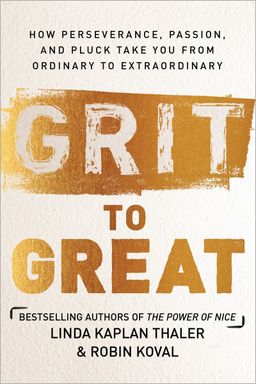
Grit to Great cover

Grit to Great

by Linda Kaplan Thaler & Robin Koval

Grit to Great reveals the secret to extraordinary success: grit. Linda Kaplan Thaler and Robin Koval share inspiring stories and practical strategies to cultivate resilience, passion, and perseverance, challenging the notion that talent alone guarantees success. Discover how grit can transform your life.

The Transformative Power of Grit

Why do some people seem to rise above every obstacle while others give up too soon? In Grit to Great, advertising legends Linda Kaplan Thaler and Robin Koval argue that the defining difference between those who succeed spectacularly and those who stall is one unglamorous but crucial trait: grit. Grit, they insist, is not a genetic gift or the product of luck—it’s a character muscle composed of passion, perseverance, and resilience that anyone can build over time.

The authors—best known for ad campaigns like the Aflac Duck and Herbal Essences’ “Yes! Yes! Yes!”—draw from their own careers in building billion-dollar agencies and from stories of famous and ordinary achievers to demonstrate that grit, not talent, determines success. They challenge the cultural obsession with innate genius or smooth luck and replace it with an old-school ethic of guts, hard work, and endurance. The book’s simple thesis is that you don’t have to be brilliant, rich, or connected; you just have to stick with it longer than everybody else.

Why Grit Matters More Than Ever

Thaler and Koval open their argument with examples like Steve Jobs, Colin Powell, and Michael Jordan—all individuals who started out as average kids. Each faced failure, humiliation, or rejection early on, yet found ways to persist. Their lives demonstrate that greatness isn’t predetermined by talent but achieved through repeated effort. Grit is what allows you to keep going after you’ve failed 9000 times, as Jordan famously said, or to invent your way back after being fired, as Jobs did.

The book positions grit as an antidote to today’s culture of instant gratification and self-esteem without substance. In their view, we have grown soft—praising mediocrity instead of effort, protecting kids from failure instead of teaching them resilience. The authors argue for a cultural and personal course correction, a return to the values that built earlier American generations: self-reliance, persistence, and grit-in-action.

The Four Pillars of Grit

Throughout the book, Thaler and Koval break grit into four essential ingredients—Guts, Resilience, Initiative, and Tenacity. These aren’t abstract virtues but practical skills anyone can learn and apply.

  • Guts: Courage to take on risks and face fear (like George S. Patton’s idea that courage is fear holding on a minute longer).
  • Resilience: The ability to bounce back from rejection or loss. Jerry Seinfeld, booed off the stage his first night, didn’t quit; he improved.
  • Initiative: Thinking differently to create opportunities, like young Kenyan Richard Turere, who hacked together flashing lights to scare lions from his family’s herd.
  • Tenacity: Sticking with practice for years like Pablo Casals still practicing cello at ninety-three because he “was beginning to notice some improvement.”

These four pillars echo what psychologist Angela Duckworth later formalized in her research (in Grit: The Power of Passion and Perseverance), and Thaler and Koval’s framework offers everyday tools to nurture each one through deliberate practice and self-discipline.

From Ordinariness to Achievement

The authors weave their own story into the cultural narrative. Their partnership began in a cramped Manhattan brownstone with a handful of secondhand desks and one client. They worked long nights, juggled trash bags themselves, and built the Kaplan Thaler Group into one of America’s biggest agencies through gritty persistence. They used rejection as fuel, showing that a lack of pedigree can actually become your strength if it teaches you to work harder and smarter.

“Grit,” as they define it, bridges character and action. It’s not enough to be optimistic or confident—you must do the work. The authors continually contrast grit with entitlement culture. They worry that children who never experience failure never develop the resilience life demands. Princeton degrees don’t guarantee endurance; struggle does.

The Journey of Building Your Grit

Across eight chapters, the book takes readers through every dimension of grit—from redefining talent (“The Talent Myth”) and abandoning fuzzy dreams (“Ditch the Dream”) to facing rejection (“Lose the Safety Net”) and developing patience (“Wait Training”). They show how resilience, flexibility, and optimism form grit’s deeper framework. Case studies—Dave Thomas building Wendy’s, Marin Alsop breaking into male-dominated conducting, and Diana Nyad swimming from Cuba to Florida at sixty-four—offer vivid portraits of persistence in action.

What makes Grit to Great especially relatable is its focus on everyday grit. You don’t have to invent the iPhone or cross an ocean; you can practice grit every time you clean out a drawer, commit to finishing a course, or say no to the easy way out. Grit transforms not just careers but character—it’s a skill for life.

The message of the book: Hard work beats talent when talent stops working hard. Anyone can move from average to extraordinary by cultivating the four core traits of grit—guts, resilience, initiative, and tenacity—and applying them with patience and optimism every day.

Ultimately, Thaler and Koval invite readers to rediscover a timeless truth: achievement isn’t given; it’s earned through effort. Grit isn’t glamorous or trendy—it’s steady, stubborn, and transformative. And by learning to build it, you don’t just change what you can accomplish; you change who you become.


Why Talent is Overrated

We often celebrate talent as if it’s destiny, but Linda Kaplan Thaler and Robin Koval challenge this myth directly. In chapter two, “The Talent Myth,” they argue that innate ability may open doors, but only sustained effort keeps them open. Talent without grit, they insist, is like a blueprint for a home never built—it has potential but no power until put to work.

The False Promise of Raw Ability

Through their advertising experience, the authors learned that every creative success hides months of rewrites, arguments, and sleepless nights. Their iconic Aflac Duck campaign took an entire year and thirty people to produce thirty seconds of humor. The public saw brilliance; they saw marathon persistence. The message is clear: behind every “effortless” success, there’s grueling preparation and teamwork. (Stephen King once noted in the epigraph they quote: “Talent is cheaper than table salt.”)

To reinforce their point, Thaler and Koval cite psychologist Angela Duckworth’s research at the University of Pennsylvania. Duckworth developed a grit scale that outpredicts IQ in determining future achievement. From West Point cadets to spelling bee finalists, those who scored high on her “passion and perseverance” index outlasted and outperformed those with higher raw intelligence. The takeaway: IQ may indicate potential, but grit determines progress.

Character Over Credentials

The authors highlight stories like that of Dave Thomas, founder of Wendy’s, who rose from orphaned poverty to build a global brand. Thomas’s secret wasn’t genius; it was Grandma Minnie’s mantra: “Don’t cut corners.” He turned a life of hardship into an unbreakable ethic, literally shaping Wendy’s square patties as a metaphor for integrity. His philosophy—“If you lose quality, you lose everything”—shows how moral grit can create enduring success.

Similarly, research reveals that high test scores are unreliable predictors of life outcomes. Google stopped asking for transcripts, realizing grades and SAT scores didn’t forecast innovation. What matters most is what Dean Stamoulis calls “results intelligence”—the ability to bounce back, adapt, and deliver results under pressure. Grit, in this context, is the ultimate form of smartness.

The Grit Advantage in Action

Kaplan Thaler and Koval’s own story of winning Wendy’s business illustrates this perfectly. Competing against 75 major agencies, they worked seventy-hour weeks, rehearsed like Broadway actors, ate nothing but fries and Frosties, and presented with flawless energy after an all-nighter. Their competitors had size and resources, but Linda and Robin had determination. The client told them, “You convinced us that no one would work harder.” A few years later, Wendy’s surpassed Burger King to become the number-two fast-food chain in America. It wasn’t brilliance—it was grind.

The broader lesson is captured in Mark Murphy’s research on hiring: most people fail in jobs not for lack of skill but because of attitude. In his study of 20,000 new hires, 89 percent washed out due to poor motivation or weak emotional resilience. Only 11 percent failed because they didn’t know how to do the work. The key differentiator was drive—grit again.

The authors’ bottom line: Talent can get you noticed, but grit earns you longevity. The smartest people often crumble when things get tough because they’ve never built endurance through struggle. If you want to thrive, be the one who prepares a little longer, rehearses a little harder, and hangs on when others quit.

Ultimately, what Grit to Great teaches here is humility: your intellect is a gift, but your effort is your responsibility. By replacing “I’m gifted” with “I’m gritty,” you trade short-term applause for long-term achievement.


From Dreamers to Doers

Dream big. Follow your passion. We’ve all heard the rallying cry—but Linda Kaplan Thaler and Robin Koval think it’s misleading. In chapter three, “Ditch the Dream,” they argue that success doesn’t stem from daydreaming about greatness but from taking gritty, disciplined action toward concrete goals. Dreams without effort, they write, are “life in a hammock.”

The Trap of Fantasy Thinking

The authors cite psychologist Gabriele Oettingen’s findings that fantasizing about success can actually make you less likely to achieve it. The reason? Your brain gets a premature dopamine hit from imagining the finish line. You feel rewarded before you even start running. Unlike elite athletes who visualize training and obstacles, ordinary dreamers skip straight to the applause—and then lose steam when real struggle arrives. (This echoes Oettingen’s broader framework of “mental contrasting,” which pairs visualization with reality planning.)

In the authors’ words, “While dreamers are sleeping, the doers are taking victory laps.” To move from dream to goal, you must wake up and take measurable steps. The shift from what if to what’s next is at the heart of grit.

Examples of Gritty Goals

James Patterson illustrates this principle perfectly. Before he became the world’s best-selling author, he was an advertising executive writing at dawn before work. For years his novels barely sold. But he woke early every day and wrote anyway, filling yellow legal pads with drafts. His breakthrough came when he reinvented narrative pacing—short chapters with cliffhangers in Along Came a Spider. He didn’t dream of becoming famous; he just kept writing. Passion met persistence—and persistence won.

Or consider Marin Alsop, who became the world’s first female conductor of a major symphony, a goal she pursued for forty-two years. Told “girls don’t conduct,” she created her own orchestra, practiced conducting invisible symphonies in her mirror, and taught herself until the establishment caught up. Her story is endurance turned art. Similarly, chess prodigy Fabiano Caruana achieved world-class rank not because he dreamed of glory but because his family moved countries repeatedly to find the best coaches. Success required relocation, homeschooling, and sacrifice—grit from the entire family unit.

Pivoting When Necessary

Thaler and Koval also emphasize that grit doesn’t mean blind stubbornness. Sometimes it means revising the dream. Robin Koval realized she was good at drawing but not passionate about it, so she pivoted from art to advertising, where creativity met purpose. Linda Kaplan Thaler abandoned a failing acting career for copywriting and songwriting, finding fulfillment by channeling her humor and timing into ad jingles. Both women moved the goalposts—and that flexibility became part of their success.

Their advice to readers: break down goals by importance and difficulty. If a dream is hard but deeply meaningful, commit to daily micro-steps. If it’s trivial, discard it. Meaning fuels perseverance. What distinguishes achievers isn’t their certainty but their willingness to keep adjusting course without losing faith in the destination.

In short: Stop chasing fairy-tale dreams. Set gritty, grounded goals. Replace “someday” with a step-by-step plan today. And when life reroutes you, bend, don’t break—grit is as much about flexibility as it is about fire.

By redefining success as the byproduct of sustained doing, not fleeting dreaming, Thaler and Koval rescue ambition from wishfulness. If you want to change your life, they suggest, start by taking your hands—literally and metaphorically—out of your pockets and begin the climb.


The Courage to Fail and Keep Going

Failure, rejection, risk—these are words most of us dread. In “Lose the Safety Net,” Thaler and Koval flip that fear upside down. They argue that avoiding discomfort limits growth. Real courage, they suggest, doesn’t mean being fearless; it means taking action despite fear. Like tightrope walker Nik Wallenda crossing the Grand Canyon without a harness, you must learn to maintain focus when the ground disappears beneath you.

Practicing for the Unknown

Wallenda’s story is more than a stunt. It’s an illustration of preparation as the ultimate safety net. He spent five years training for the crossing, practicing in hurricane-force winds and storms, rehearsing how to recover balance after tremors. His calm on the wire came not from bravery but from repetition. Similarly, when flight attendant Lee Yoon-Hye guided passengers from a burning Boeing 777 after a crash, her heroism “was just training taking over.” Grit transforms panic into muscle memory.

Redefining Failure

The authors introduce Jia Jiang’s “Rejection Therapy,” where he deliberately sought 100 days of rejection to desensitize himself to failure. Asking strangers absurd favors—borrowing $100, flying a plane, or ordering Olympic-ring doughnuts at Krispy Kreme—taught him that rejection wasn’t character assassination; it was opinion. Some people even said yes, proving fear’s exaggeration. By turning “no” into data, he gained confidence to take bigger leaps. His viral experiment embodies the grit mindset: fall, learn, repeat.

Self-Doubt as a Teacher

In workplaces full of competition, many talented professionals, especially women, experience impostor syndrome—believing they’re fraudulent despite success. Google executive Sabrina Farmer overcame this by confronting her assumptions: “What’s the worst that can happen?” Changing that perspective reframed every challenge as a solvable problem, not a potential humiliation. The result: action replaces paralysis. (Psychologist Valerie Young’s book The Secret Thoughts of Successful Women provides similar insight.)

Linda Kaplan Thaler herself faced impostor moments early on: a Jewish piano teacher hired to play Christmas carols for wealthy clients even though she barely knew the words. When threatened with firing for a single wrong note, she rose to the occasion, playing so beautifully that guests begged for more and she earned double pay. The story embodies her message: grit converts fear into performance.

Leaping Without Guarantees

Robin Koval’s own leap came when she left a secure corporate advertising career to lead the nonprofit Truth Initiative, taking on Big Tobacco. She left New York, friends, and familiarity behind, trading comfort for impact. Her choice required surrendering every safety net she’d built—but also allowed her to fulfill her purpose. Her Bronx-born answer to fear? “Bring it on.”

The chapter’s message: Safety is overrated. Progress comes from movement—stepping onto life’s high wire knowing you might wobble but also trusting your training. Replace excuses with experiments, and rejection with resilience.

By normalizing failure as a necessary part of forward motion, Thaler and Koval demystify courage. Grit isn’t blind risk; it’s calculated daring. You can’t win without learning to fall—and to get up faster each time.


The Art of Patience and Persistence

In today’s world of instant downloads and one-click everything, patience feels extinct. But in chapter five, “Get Into Wait Training,” Thaler and Koval reclaim it as a secret superpower. Grit, they say, depends on your ability to delay gratification—to work steadily when results are uncertain.

The Discipline of Waiting

The Dutch proverb that opens the chapter says it all: “A handful of patience is worth more than a bushel of brains.” The authors show how self-control predicts long-term success better than cognitive ability—a theme echoed by psychologist Walter Mischel’s famous marshmallow test. Icelandic educator Margrét Pála Ólafsdóttir now teaches “boredom sessions” in preschool to train resilience early: children must stay with chosen activities and even celebrate feeling bored, learning tolerance for delayed rewards. Boredom, it turns out, is practice for persistence.

The authors note that self-control correlates with creativity and achievement. As Paul Tough explains in How Children Succeed, noncognitive skills like curiosity and grit matter more than IQ. The same principle fuels the stories that follow.

Stories of Steady Perseverance

Susan B. Anthony spent fifty years fighting for women’s right to vote and died before seeing the 19th Amendment passed. Architect Robert Mills never saw the Washington Monument completed. Mike Moore, the Mississippi attorney general who fought Big Tobacco, endured four years of ridicule, bankruptcy threats, and political isolation before winning the largest civil settlement in U.S. history. Each believed “failure is impossible” and viewed time not as an enemy but as an ingredient. Their sustained fight shows patience as an active, not passive, virtue.

Thaler and Koval also connect patience to everyday workplace motivation. In long campaigns—like developing an unapproved drug or multi-year ad account—you sustain morale through “small wins.” Celebrate progress markers, not just milestones. Yale admissions officer Michael Motto uses the same philosophy when assessing applicants: he looks for “grit indicators”—students like Julio from Texas who email relentlessly, volunteer, and self-direct. Small steps prove endurance.

Training for Endurance

From Admiral McRaven’s viral “make your bed” commencement speech to Robin Koval’s nightly desk-cleaning ritual, the authors emphasize routines as grit’s workout plan. Each small completed task builds psychological momentum. Clearing clutter, finishing reports, or mastering one chord at a time teaches discipline that scales to bigger challenges. Incremental progress fuels motivation—what researchers call the “progress principle.”

Their practical advice extends to neuroscience: replace willpower, which depletes, with habit, which endures. Train your brain with “thirty-second pauses” to resist impulses. Practice gratitude to reduce impulsivity. Over time, your delayed gratification muscle grows stronger—and so does your capacity for greatness.

The takeaway: Grit is patience plus motion. Waiting isn’t weakness—it’s strategic endurance. Every long-term success, from suffrage to skyscrapers, is the product of countless small steps taken by people who refused to stop short.

By redefining waiting as a form of active perseverance, Thaler and Koval remind us that success often comes to those who can endure the silence between effort and reward. Grit, in the end, is endurance with purpose.


Resilience: Bending Without Breaking

Chapter six, “Bend Like Bamboo,” explores how resilience—the ability to adapt under pressure—is grit’s most flexible element. Bamboo, the authors note, survives typhoons by bending, not resisting. Likewise, success requires elasticity: the ability to pivot, reframe, and grow stronger from adversity.

Surviving with Flexibility

The story of Eleanor Longden, a British psychology student diagnosed with schizophrenia, dramatizes emotional resilience. Hearing voices, she descended into despair until a supportive doctor helped her reinterpret them as metaphors for fear. Over time, she reframed her illness into insight, earning a PhD and becoming an advocate for mental health. Her recovery wasn’t about willpower but about reframing fear into understanding—bending her mind instead of breaking it.

During World War II, Edith Weill fabricated a convincing story about being half-Christian to survive a Nazi camp, remembering every detail for three years. Her mental agility preserved her family. In both cases, adaptability equaled survival.

Learning Optimism

Psychologist Martin Seligman’s research on optimism (and its opposite, learned helplessness) supports the book’s message: resilient people attribute setbacks to temporary causes, pessimists to permanent ones. Thaler and Koval share the story of Arthur, an electrician who lost three fingers but laughed that at least his remaining ones were the most useful. Optimism is learned perspective—it allows you to reframe loss as manageable, turning hardship into humor.

Inventor James Dyson embodies another layer of resilience—learning through failure. He built 5,127 failed prototypes before his vacuum succeeded. By embracing failure as feedback, he developed what economist Albert Hirschman called “the principle of the hiding hand”: difficulty provokes ingenuity. Thaler and Koval call this “failing forward.” Each collapse plants the next success.

Growth Mindset in Action

Stanford’s Carol Dweck classifies this habit as a “growth mindset”—the belief that ability expands through effort. People with growth mindsets don’t label themselves as talented or doomed; they adjust and learn. The authors present numerous examples—from Danny Flamberg, who reinvented himself from rabbi to marketing leader, to Haskell Wexler, a color-blind cinematographer who won Oscars by emphasizing light and texture instead of hue. Their adaptability created excellence through constraint.

In essence: Resilience is gritty flexibility—the art of bending without breaking. Fail fast, recover faster, and remember that every challenge carries the seed of reinvention.

Thaler and Koval’s bamboo metaphor captures grit’s quiet strength: you endure not by resisting, but by flowing with change. Character isn’t forged in stability—it grows through stretch.


No Age Limit on Grit

Chapter seven, “No Expiration Date,” overturns the idea that ambition has an age limit. Grit, the authors insist, is ageless. Whether you’re nine or ninety, perseverance can restart your story. Their evidence spans from nonagenarian authors to older innovators and lifelong learners who defy stereotypes of decline.

Late Bloomers and Lifelong Learners

James Henry learned to read at ninety-two and published a bestselling memoir at ninety-eight. Diana Nyad completed her Cuba–Florida swim at sixty-four after failing four prior times in her twenties. Misty Copeland became a principal ballerina despite starting at thirteen—“too old,” by ballet standards. These stories dominate this chapter, underlining that grit defies biological clocks.

The authors also challenge society’s fetish with “thirty under thirty” success lists. Many great works happen later: Picasso’s final masterpieces, Sethanne Howard’s PhD at fifty, Ken Jeong’s acting career at forty. Culture sells youth; grit rewards patience.

The Science of Growing Minds

Modern neuroscience supports this optimism. The brain remains “plastic,” able to form new connections through continual challenge. Exercises, novelty, and learning new skills stimulate dendrite growth, keeping cognition sharp. Authors cite Manning Rubin’s concept of “neurobics”—simple acts like brushing your teeth with your non-dominant hand—to illustrate brain training through novelty.

Equally important: movement. They quote research showing that “a body in motion stays in motion”—the physics of perseverance applied to life. Physical and mental agility feed each other, creating a self-reinforcing loop of vitality.

Reinventing Purpose

Thaler’s father, inventor Marvin Kaplan, embodies the encore career mindset. At ninety-five, he still teaches electronics and runs a “comedy lab” at his retirement community. Passion, not paycheck, fuels longevity. Marc Freedman’s Encore.org expands this principle nationally, connecting retirees to new social causes. As he puts it, “You don’t have to stop—you can rewire.”

Main idea: Grit doesn’t expire. With curiosity, exercise, and purpose, every decade can be your most productive. Retirement isn’t retreat—it’s reinvention.

By reframing aging as opportunity, Thaler and Koval remind us that persistence is timeless. As long as you’re breathing, your greatest contribution might still lie ahead.


Grit as a Force for Good

The final chapter, “Grit for Good,” expands individual perseverance into collective purpose. Once you’ve built grit, Thaler and Koval argue, the next step is using it to uplift others. True fulfillment comes not from personal milestones but from service—what psychologists call “eudaimonic happiness,” the joy of meaningful contribution.

The Biology of Helping

Humans, the authors note, evolved to cooperate. Altruism triggers the same brain reward systems as personal gain. Doing good literally feels good. Studies like the “IKEA effect” show that effort increases satisfaction—whether assembling furniture or building social causes. Grit applied to service multiplies its rewards.

Stories of Purpose-Driven Grit

Navyn Salem, a Rhode Island mom of four, used her energy to found Edesia—a nonprofit food factory producing Plumpy’Nut to fight child hunger worldwide. With no background in nutrition, she taught herself global logistics, navigated bureaucracy, and built supply chains for millions. As she said, “I had toddlers and a newborn, but I worked till I collapsed.” Her grit transformed empathy into enterprise.

Senator Leticia Van de Putte channeled generational adversity into public service. Even after personal tragedies, she returned to her duties, inspiring others with her Spanish word for grit—ganas, meaning “desire and drive.” And Covenant House counselor Brian Bob used tough love to save homeless youth—his intervention with a drug-addicted teenager turned that teen into a successful business owner and donor years later. Each story shows grit’s greatest evolution: persistence on behalf of others.

Happiness Through Effort

Studies cited by the authors confirm that volunteering improves health and longevity. High-school students improve cholesterol levels through service; adults over fifty reduce hypertension when volunteering 200 hours a year. Psychologist Viktor Frankl once noted that “happiness cannot be pursued; it ensues from meaning.” Thaler and Koval reach the same conclusion: grit doesn’t just achieve goals—it enriches life by linking effort to empathy.

Final message: Grit’s ultimate purpose is connection. It begins with personal perseverance but matures into compassion-fueled action. When you turn your grind into generosity, you go from good to great—and help others do the same.

By closing with altruism, Thaler and Koval transform grit from self-help to social philosophy. The most powerful proof of character isn’t how high you climb, but how many others you lift as you rise.

Dig Deeper

Get personalized prompts to apply these lessons to your life and deepen your understanding.

Go Deeper

Get the Full Experience

Download Insight Books for AI-powered reflections, quizzes, and more.