
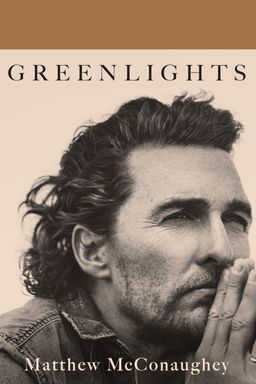
Greenlights cover

Greenlights

by Matthew McConaughey

In ''Greenlights,'' Matthew McConaughey shares his unconventional life lessons, portraying an adventurous journey filled with humor, challenges, and triumphs. This memoir reveals his philosophy of turning red lights into greenlights, inspiring readers to embrace life''s unpredictability with courage and creativity.

Catching Greenlights: The Art of Livin

How do you find meaning, momentum, and peace in life when the road ahead feels full of red lights? In Greenlights, Matthew McConaughey invites you to see life as a traffic system of stop signs, yellow lights, and greenlights—moments that either pause us, challenge us, or propel us forward. The Oscar-winning actor argues that recognizing, respecting, and navigating these lights is the essence of what he calls “the art of livin.”

McConaughey doesn’t see his book as a memoir or a self-help guide. It’s what he calls an approach book—a road map made of stories, scars, and philosophies gathered over fifty years and distilled from thirty-five years of journals. The book explores how you can reframe setbacks as setups, embrace discipline before freedom, and balance ambition with gratitude. It’s not about avoiding failure, but about finding your footing when you trip—and trusting that one day, even the red lights turn green.

Seeing Life as a Series of Greenlights

McConaughey’s idea of a “greenlight” isn’t just good fortune. It’s any moment that affirms our path—an opportunity, a success, an unexpected gift, or even a challenge that will later prove meaningful. He explains that some greenlights are given—like luck or natural talent—while others are earned through relentless effort and faith. When you’re stopped at a red or yellow light—a loss, a breakup, a failure—you might curse the detour. But time, perspective, and courage show that such obstacles are often preparation for future blessings. His refrain, echoed throughout the book, is that “a red light eventually turns green.”

This worldview transforms life’s randomness into rhythm. McConaughey insists everything fits the plan—even the moments that don’t seem to. “Sometimes the plan goes as intended,” he writes, “and sometimes it doesn’t—that’s part of the plan.” This blend of faith, optimism, and earthy pragmatism runs throughout his philosophy.

From Outlaw Logic to Life’s Lessons

McConaughey organizes his stories into themed sections that trace the arc of his life and moral development—from childhood “Outlaw Logic,” through youthful rebellion, fame, struggle, and maturity. His father’s tough love, his no-nonsense Texan upbringing, and his colorful early adventures (like building a thirteen-story tree house or spending a strange exchange year with a surreal family in Australia) showcase how his sense of humor and self-reliance were forged in fire.

Each “part” of the book corresponds to a different type of greenlight: resilience, identity, risk, reinvention, love, or legacy. Together, they form a philosophy of action—of finding your frequency and staying aligned even when life turns static. His message is that wisdom comes from engagement, not reflection alone. “If you’re up to nothing,” he quips, “no good’s usually next.”

Why This Philosophy Matters

McConaughey’s reflections matter because they offer a bridge between self-help spirituality and dirt-under-your-fingernails realism. He’s not teaching perfection or saintliness, but authentic alignment—a way of living consistent with who you are and who you aim to become. His tales of movie stardom sit side by side with meditations on humility, fatherhood, luck, and loss. He doesn’t hide the ugly parts—the arrests, ego trips, lust, or loneliness—but shows how they sharpened his gratitude for grace.

“The art of livin is learning when to persist, when to pivot, and when to wave the white flag and live to fight another day.”

A Road Trip Through Meaning

The structure of Greenlights resembles a road trip: spontaneous, reflective, humorous, and messy. One moment he’s telling a story about getting arrested while drumming naked in Austin; the next, he’s quoting scripture or reciting his own poetry about courage and time. This blend of swagger and sincerity gives the book its rhythm—what McConaughey calls “finding your frequency.” Like Kerouac in On the Road or Cheryl Strayed in Wild, he turns personal pilgrimage into creative medicine. Yet his version is guided by a Texan’s compass: responsibility, hard work, and faith that life’s seemingly crooked paths all lead home.

What You’ll Learn

In the pages ahead, you’ll learn how McConaughey’s “outlaw logic” shaped his confidence, how a humiliating exchange year in Australia led to self-reliance, and how silence and solitude—like his time in a desert monastery—became his reset button. You’ll follow him from the dizzying fame of A Time to Kill through his creative drought and deliberate hiatus that ultimately sparked the “McConaissance.” And finally, you’ll see how love, fatherhood, and faith grounded him in a mature philosophy: to live deliberately, with humor, humility, and steady courage. If you’ve ever struggled to find your rhythm amid life’s signals, Greenlights offers both a mirror and a map.


Outlaw Logic: Lessons from a Wild Upbringing

Matthew McConaughey grew up in a world defined by contradictions—faith and fury, love and discipline, violence and tenderness—and learned early on how to find stability in chaos. His parents’ marriage of three weddings and two divorces was, as he puts it, “Russian roulette with wedding bands.” Their kitchen-table brawls often ended in passionate reconciliations. They embodied what he calls ‘outlaw logic’: a worldview that prized authenticity, consequence, and humor over convention. And from that chaos came lessons about resilience, responsibility, and love’s messier truths.

Growing Up McConaughey

In East Texas, McConaughey’s father, Jim, was a mountain of a man—a former Green Bay Packer turned pipe salesman—while his mother, Kay, was a spitfire of relentless optimism and denial. “She beat two kinds of cancer with aspirin and denial,” he writes. Their version of parenting was biblical mixed with boot camp: corporal punishment for lying, backhanded rewards for truth, and quick forgiveness. These were the seeds of his moral code: tell the truth, take your licks, love hard, move on.

He learned consequence through belt-whippings and reward through affection. When he was caught lying about a stolen pizza, he was punished not for theft but for dishonesty. “Words that hurt,” he writes, “were the only ones that could also heal.” This gritty upbringing can seem abusive by modern standards, but for McConaughey it was a necessary apprenticeship in integrity with teeth—the kind that made him fearless and accountable.

Mom’s Audacious Existentialism

McConaughey’s mother taught him the power of audacity and self-creation, if not scrupulous honesty. When he was a boy, she convinced him he’d won the Little Mr. Texas contest even though the trophy literally said “Runner-Up.” Her philosophy? Truth is flexible if it serves your spirit. “If you understand it, it’s yours,” she told him when she encouraged him to plagiarize a poem he loved. While that lesson troubles modern ethics professors, it underpins McConaughey’s creative philosophy: if you inhabit an idea fully, it belongs to you.

His mother’s radical confidence nurtured his performative instincts. As she told him, “Don’t walk into a place like you wanna buy it. Walk in like you own it.” Yet his father’s rugged pragmatism balanced that flair. The old man valued triceps over biceps—the “work muscle” over the show muscle—and taught him to honor the job before the dream. Together, they built an inner duality that defines McConaughey’s adulthood: poetic imagination anchored by work ethic.

The Rule of Consequences

McConaughey recalls the night his father commanded his older brother to fight him as a coming-of-age test. When his brother finally knocked their dad out with a 2x4, the old man rose, bleeding but proud: “That’s my boy.” It was a primal rite of passage—fear met with love, conflict followed by respect. This logic—tribal, visceral, and raw—became his template for manhood: stand your ground, earn your place, and honor the hierarchy when it’s real.

Outlaw Logic as a Life Skill

Outlaw logic taught McConaughey that freedom without discipline is chaos, but discipline without freedom is prison. Real creativity, he says, “needs resistance the way Earth needs gravity.” His wild childhood was a gym for the moral muscles that would later steady him through Hollywood success, scandal, and solitude. It taught him to pivot between persistence and surrender—to be both the outlaw and the gentleman. For anyone feeling trapped by rules or chaos, his lesson rings true: create structure so you can improvise.


Finding Your Frequency: Turning Red Lights Green

In his late teens, McConaughey took a detour that became one of his crucibles: a cultural exile in Australia. At 18, chasing adventure, he joined an exchange program expecting beaches and surfboards. Instead, he landed in the surreal household of the Dooleys—a controlling, eccentric family that turned his life into a personal Twilight Zone. It was there, stripped of freedom and familiarity, that he found his grounding frequency—the first time he truly heard his own internal signal beneath the static of the world.

A Year of Isolation and Madness

The Dooleys lived not by Sydney’s surf but in remote Warnervale, where young Matthew spiraled into loneliness and paranoia. The father, Norvel, demanded he suppress individuality (“You’ll learn not to voice your opinion for the masses”), while the hunchbacked mother orchestrated bizarre domestic dramas. When they finally insisted he call them “Mum and Pop,” McConaughey snapped—and found himself.

He realized his sole responsibility was to his own compass. “No way I’m calling anyone but my own mother and father ‘Mum and Pop,’” he declared. That act of defiance—refusing to betray his identity for comfort—is what he now sees as a greenlight disguised as a red. “For the first time in 148 days,” he writes, “my head, heart, and spirit finally agreed on something: no.”

Boundaries as Freedom

McConaughey’s Australian ordeal sounds like hazing from the universe, but it refined his philosophy: boundaries create freedom. Until you know your no, your yes means nothing. In starving isolation, he discovered internal structure—the sense of self that later anchored him through fame’s distortions. Freedom, he learned, isn’t the absence of limits. It’s choosing your limits consciously.

His physical austerities—becoming a vegetarian, running six miles a day, abstaining from sex—weren’t punishments but purification rituals. They stripped away indulgence until his identity became audible. The takeaway for readers: sometimes life sends you to the Dooleys so you can stop outsourcing your authority. As he later summarized, “We need gravity, guidelines, demarcations. The freedom’s in the form.”

Persistence Pays

When McConaughey finally returned from that exile, people thought he was lucky to have survived a nightmare. He saw it differently: he’d been refined by adversity. The same furnace would later appear in Hollywood when he refused to compromise his artistic standards for money. For McConaughey, the formula is simple—pressure reveals character, and self-knowledge turns captivity into capacity. “We cannot appreciate the light without the shadows,” he writes. “Better to jump than to fall.”


Designing Your Own Weather: The Power of Work and Will

Success, McConaughey learned, doesn’t arrive through wishful thinking but through engineering greenlights. He insists that we can’t simply wait for luck—we must design conditions that make luck inevitable. His early career shows this principle in motion: from Austin film student to Hollywood star, he crafted his own breaks by aligning preparation, instinct, and timing.

The Leap into Film

While studying at the University of Texas, a random moment changed his trajectory. Instead of studying for his psychology exam, he found a beat-up copy of Og Mandino’s The Greatest Salesman in the World—a book that whispered, “I will form good habits and become their slave.” That night, he realized law wasn’t his calling. Film was. With one phone call to his father, he made a pivot that defined his life. Jim McConaughey’s only advice? “Don’t half-ass it.”

That inheritance of total commitment became his professional creed. When he auditioned for Dazed and Confused, his “all-in” habit turned an unscripted cameo into an iconic role. The line “All right, all right, all right”—his first ever on film—wasn’t written. It was the spontaneous sum of his character’s loves: cars, rock ’n’ roll, weed, and women. Luck favors the prepared, but grace rewards the present.

Less Impressed, More Involved

After A Time to Kill made him famous overnight, McConaughey stumbled into a different test: fame’s illusion. Walking down Santa Monica’s Promenade one day, he noticed that strangers suddenly treated him like a myth. He responded by carving into a tree the phrase “Less impressed, more involved.” It was his antidote to ego. He learned that heroism isn’t rising above life—it’s dropping down into it.

Recalibrating Fame

When fame confused him, he took retreats into silence—the desert monastery in New Mexico, for example, where he confessed his temptations to a monk and heard only two healing words in response: “Me, too.” That humility became fuel for a grounded kind of ambition, one that prizes craft over credit. From designing his van “Cosmo” into a mobile studio to living in a trailer park just to stay anonymous, McConaughey literally engineered environments that preserved his authenticity.

Creating Your Weather

His phrase “create your own weather so you can blow in the wind” summarizes the balance between control and surrender. Build habits, context, and preparation—that’s the weather. Then let intuition and luck move through you—that’s the wind. This principle applies beyond Hollywood: anyone can structure for spontaneity. McConaughey reminds us that art, business, and love all thrive when we choreograph, then dance.


Turning the Page: Reinvention and the McConaissance

By the early 2000s, McConaughey was trapped by his own success. After a string of hit romantic comedies—The Wedding Planner, How to Lose a Guy in 10 Days, Failure to Launch—he found himself “entertaining” instead of acting. The pay was great, the fame steady, but his soul was restless. So he did the unthinkable in Hollywood: he stopped.

Saying No to Say Yes

McConaughey turned down every romantic-comedy script, even when the offers doubled from $5 million to $14.5 million. “It was the best script I’d ever read—the same one I’d said no to three times,” he jokes. For nearly two years, he vanished from the spotlight, determined to unbrand himself. In an industry that equates visibility with survival, that exile was career suicide—or, as he later realized, a cleansing fast.

Faith in the Invisible

Empty of offers, he leaned into family and quiet. Marriage to Camila, the births of Levi and Vida, and years on his Texas ranch re-centered him on faith, love, and simplicity. This was his version of what philosophers call creative asceticism: pruning the tree so it could bear better fruit. By detaching from external validation, he restored his internal compass.

The Greenlights Return

Then, suddenly, the scripts he’d dreamed of arrived: The Lincoln Lawyer, Mud, Killer Joe, Magic Mike, Dallas Buyers Club, True Detective. His transformation—from rom-com heartthrob to Oscar-winning actor—became so dramatic that Hollywood coined a term for it: “The McConaissance.” Ironically, as he jokes, he invented the term himself during a Sundance interview. But the label captured something rare: creative renaissance born of restraint.

Living for Legacy, Not Spotlight

In turning the page, McConaughey learned that reinvention requires subtraction before addition. You can’t write a new chapter if you refuse to end the last one. Like Coach Royal told his musician friend, “I’ve never had trouble turning the page in the book of my life.” McConaughey followed that advice and found that saying no to what no longer fits creates room for destiny—and greenlights the roles that do.


Love, Legacy, and the Science of Satisfaction

As McConaughey matured, his focus shifted from ambition to alignment—from being impressive to being present. The later chapters of Greenlights explore what happens when achievement evolves into stewardship. Marriage, fatherhood, and mentorship didn’t soften him; they gave his swagger a soul. The lessons here translate from career to character: how to move from chasing success to sustaining peace.

The Courage to Commit

When his son Levi asked why “Momma isn’t a McConaughey,” Matthew realized his lingering fear of marriage wasn’t rational—it was avoidance of depth. After conversations with his pastor, he reframed marriage not as an endpoint but an expansion: “In marriage, we don’t lose half of ourselves—we become more of ourselves.” That revelation led to his proposal to Camila and to the life he calls his masterpiece.

Man Enough

Fatherhood, he insists, is the ultimate greenlight. “Man is never more masculine than after the birth of his first child.” Kids, he says, straighten your moral spine by aligning head, heart, and gut. His parenting ethos—equal parts discipline and humor—mirrors what his own father gave him, minus the belt. For him, parenting is art under pressure: keeping kids wild enough to dream and grounded enough to care.

Living Your Legacy Now

For McConaughey, legacy isn’t something written in obituaries—it’s lived daily. “Begin with the end in mind,” he advises. He sees every decision as an entry on life’s résumé: the story you tell before your eulogy. COVID-19 and social unrest gave him further perspective on mortality and purpose. “If we can make justified changes now,” he writes of 2020, “this red-light year will one day, in the rearview mirror, turn green.”

The Art of Satisfaction

In his fifties, McConaughey no longer separates art from life. Both are practice in gratitude, failure, and faith. His mantra “just keep livin” (from Dazed and Confused) has matured from a catchphrase into a creed: satisfaction isn’t in getting everything you want, but in loving what’s inevitable. The science of satisfaction, he suggests, is simple: design your weather, accept fate as part of the plan, and know that eventually, everything turns green.

Dig Deeper

Get personalized prompts to apply these lessons to your life and deepen your understanding.

Go Deeper

Get the Full Experience

Download Insight Books for AI-powered reflections, quizzes, and more.