
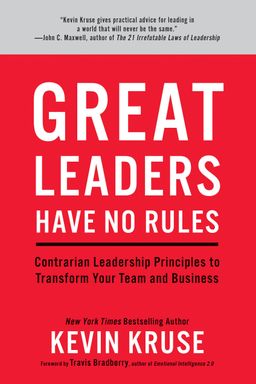
Great Leaders Have No Rules cover

Great Leaders Have No Rules

by Kevin Kruse

Great Leaders Have No Rules encourages leaders to rethink traditional management by embracing contrarian principles that foster autonomy and productivity. Kevin Kruse reveals how breaking free from outdated practices can transform your team and business, leading to more effective and innovative leadership.

Leadership Without Rules: The New Playbook for Influence

What if everything you thought you knew about being a great leader was backward? In Great Leaders Have No Rules, Kevin Kruse proposes that most traditional management advice—open-door policies, strict rulebooks, appearing flawless, or maintaining distance from employees—actually undermines engagement and performance. Instead, he argues that real leadership means intentionally shaping influence, building trust, and leading with transparency, empathy, and courage.

Kruse opens with a provocation: leadership is a superpower, and whether you realize it or not, you’re using it every moment of the day. Every look, comment, delay, or silence affects others. In a world of constant connectivity and rapid change, traditional management rooted in control and hierarchy is obsolete. Great leaders today must focus on influence, not authority, and inspiration, not enforcement.

Reinventing Leadership for the Modern World

Kruse contends that we’ve inherited outdated leadership models from the Industrial Age, when efficiency, hierarchy, and procedures drove success. But in today’s economy—fluid, digital, and global—these rigid systems hinder creativity and trust. Instead of policing employees, Kruse encourages leaders to abolish rules, empower autonomy, and operate from shared values and transparency. His approach is deeply human-centered, viewing leadership as the art of influence through trust rather than authority through fear.

The book functions as both a paradigm shift and a practical manual. Each chapter dismantles a traditional management cliché—“Keep your door open,” “Don’t play favorites,” “Leaders should be strong”—and replaces it with a counterintuitive principle grounded in psychology and real-world application. Far from chaos, Kruse demonstrates that removing rigid rules creates ownership and accountability.

The Ten Contrarian Principles of Effective Leadership

Kruse identifies ten core principles that redefine leadership effectiveness:

  • Close your open-door policy to build boundaries, focus, and trust.
  • Shut off your smartphone to regain attention and lead by example.
  • Have no rules—replace them with values, guidelines, and accountability.
  • Be likable, not liked; seek respect over approval.
  • Lead with love; care about your people as humans, not just performers.
  • Crowd your calendar; live by disciplined structure to achieve balance and deep work.
  • Play favorites; treat people fairly, not equally, by recognizing performance and potential.
  • Reveal everything—even salaries—to foster trust, empowerment, and agility.
  • Show weakness to establish authenticity and connection.
  • Recognize that leadership is not a choice—you’re always influencing others.

Each principle merges scientific research, behavioral psychology, and Kruse’s own stories as an entrepreneur who learned these lessons through costly failures and later triumphs. The result is a compelling argument for conscious, transparent, and values-driven leadership in every environment—from companies to classrooms to homes.

Why Leadership Matters Everywhere

Kruse insists that leadership is not reserved for executives. Everyone influences others—coworkers, customers, friends, family. Parents lead children; frontline employees lead peers. Whether you stand at the head of a boardroom or the dinner table, your daily behaviors model what leadership looks like. This universality makes his framework personally transformative as much as professionally applicable.

In essence, Great Leaders Have No Rules is about intentional leadership—recognizing your invisible power to influence and choosing to direct it positively. Kruse shows that empathy, structure, and accountability are not opposites but complements. In replacing outdated rules with trust and transparency, leaders unleash creativity, strengthen culture, and drive both engagement and results.


Close Your Open Door Policy

Kruse begins his revolution in leadership with an unlikely first step: close your open door policy. While openness seems like the epitome of transparency and approachability, he argues that this practice destroys productivity, fosters dependency, and undermines true communication. Drawing from Steve Harvey’s viral memo demanding staff stop “popping in,” Kruse reclaims that message as both justified and instructive.

Why Open Doors Fail

An open door, whether literal or digital, invites distraction. Executives and team leads lose focus when interrupted by constant “Got a minute?” conversations. Studies show workers are interrupted 50-60 times per day and take up to 25 minutes to regain focus (as UCLA’s Gloria Mark documented). Multiply that across a week, and leaders are essentially robbed of their ability to think deeply or plan strategically.

For employees, open doors don’t always feel safe either. Research by Professors James Detert and Amy Edmondson reveals that many workers withhold ideas out of self-preservation; a “trap door” fear of backlash keeps them silent. The supposed openness often benefits extroverts or politickers rather than empowering thoughtful, cautious contributors.

Rebuilding Real Communication

Instead of random interruptions, Kruse advocates for structured accessibility. Leaders should schedule predictable one-on-one meetings and establish communication cadences—weekly check-ins, monthly town halls, and quarterly updates. These predictable rhythms foster psychological safety: employees know when and how to speak up without disrupting others.

His “office hours” model, borrowed from academia, keeps communication open but within boundaries. Staff can book time to discuss issues, ensuring that leaders have uninterrupted blocks for deep work the rest of the day. This balance of structure and approachability turns conversations from interruptions into intentional collaborations.

Rules of Productive Access

To further refine boundaries, Kruse introduces practical rules:

  • Set office hours: Choose specific days or times for unscheduled drop-ins to protect focus and energy.
  • Institute the “two-solutions rule”: Employees must bring at least two potential solutions when presenting a problem.
  • Turn open-door culture into proactive culture: Actively solicit ideas via surveys, skip-level conversations, and anonymous question cards during meetings.

True openness, Kruse concludes, doesn’t mean constant availability. It means predictable, purpose-driven access. When you close your open door, you reclaim deep work time for yourself and empower your team to think, decide, and act independently—hallmarks of a self-leading organization.


Have No Rules

Imagine being reprimanded for buying a pack of Post-it notes. That’s exactly what happened to Kruse after his company was acquired—and it launched his rebellion against excessive rules. “Great leaders have no rules,” he argues, because rules exist to control the 3% of people who abuse freedom at the expense of the 97% who can be trusted.

Rules Undermine Ownership

Rules, though often created with good intentions, create psychological distance and diminish personal accountability. They tell employees: “We don’t trust you to decide.” Over time, this micromanagement mindset breeds disengagement and compliance rather than commitment. Coach Mike Krzyzewski calls it “becoming an administrator of rules rather than a leader.”

Kruse provides examples where sensible rules backfire: a teacher forced to volunteer under coercion stops enjoying it; IT blocks social media access, preventing legitimate research; or overly rigid HR policies turn creativity into cynicism. The real culprit isn’t bad people—it’s lazy leadership seeking control through paperwork.

Replacing Rules with Trust and Accountability

Kruse recommends four “rule replacements” that unleash responsibility while preserving alignment:

  • Hire the right people: Netflix’s culture deck inspires this principle. When you hire self-motivated adults, they don’t need micromanagement—they need autonomy. Netflix even replaced policy manuals with a five-word expense policy: “Act in Netflix’s best interests.”
  • Hold people accountable for results: Instead of enforcing rules, establish clear outcomes and tie rewards or recognition to results (for example, bonuses tied to cross-selling success, as Kruse experienced).
  • Give guidelines, not dictates: Leaders like Ricardo Semler at Semco eliminated policies altogether, letting employees set their own salaries, vacation, and work hours based on transparency and shared information.
  • Establish values and standards: Replace top-down rules with collaboratively created standards—behaviors the team holds itself accountable to (echoing Wooden’s and Krzyzewski’s coaching philosophies).

Rules communicate distrust. Guidelines and values communicate ownership. In uncertain environments, trust and adaptability—not control—create agility. The most effective leaders, Kruse concludes, create principles and frameworks, not rulebooks.


Be Likable, Not Liked

Would you rather be liked or respected? Kruse confesses that his biggest leadership downfall was being a “recovering people pleaser.” Drawing on stories from Silicon Valley CEOs, leadership experts, and personal experience, he warns that needing to be liked leads to indecision, dishonesty, and burnout.

The Dangers of Needing Approval

When leaders crave approval, they procrastinate on difficult decisions, sugarcoat performance feedback, and make promises they can’t keep. Kruse recalls keeping an underperforming salesperson for six months longer than he should have because he didn’t want to “hurt his feelings.” The result? The salesperson was shocked when fired—and the team lost trust in Kruse’s leadership clarity.

Examples from Yahoo’s decline under Jerry Yang illustrate that excessive niceness can cripple organizations. Yang was beloved but indecisive, unable to make the tough calls required to pivot. As Kris Boesch notes in Culture Works, morale depends less on niceness and more on consistency, fairness, and courage.

From People Pleasing to Principle-Based Leadership

Kruse advises replacing the need to be liked with a need to lead right. Define your values, lead by them, and measure success by consistency—not popularity. Using his own values of fairness, authenticity, and transparency, he models this by giving candid feedback even when uncomfortable. As Super Bowl champion Gary Brackett says, “What other people think of me is none of my business.”

To find the human side of tough leadership, Kruse draws on CEO Doug Conant’s transformation at Campbell’s Soup. Conant led one of the most dramatic corporate turnarounds by being “tough on standards and tender on people.” He held employees accountable to performance goals but paired every critique with empathy and care.

How to Be Likable Without Needing to Be Liked

  • Give honest feedback early and often—it shows care and courage.
  • Accept that not everyone will like you; focus on being respected.
  • Lead from values, not moods; consistency earns trust.
  • Balance high expectations with humanity—tough and tender, like Conant.

Leadership isn’t a popularity contest—it’s an act of service. When you stop seeking approval, you start earning trust. When you focus on being likable—warm, consistent, and values-driven—you become the kind of leader worth following.


Lead with Love

Love at work? Kruse insists it’s not only appropriate but essential. Following leaders like Tom Coughlin of the New York Giants and coach John Wooden, he argues that strong leadership is grounded in agape love—a selfless concern for others’ well-being, not romantic affection.

From Tyrant to Mentor: Love as Leadership Transformation

Tom Coughlin, once nicknamed “Colonel Coughlin,” transformed his rigid, fear-based coaching into a leadership style built on compassion, connection, and mutual respect. The result? A Super Bowl victory, a unified team, and enduring admiration from players like Michael Strahan. “You taught us what love really is,” Coughlin told his team—a statement that defined his turnaround.

Kruse connects this to research by Dr. Sigal Barsade on “companionate love” in the workplace. Teams that express care, tenderness, and compassion perform better, exhibit lower burnout, and maintain higher trust. Love, it turns out, is organizational glue.

How to Practice Love at Work

  • Start small: learn and use your team members’ names, birthdays, and personal stories.
  • Express gratitude often; as Campbell’s CEO Doug Conant proved, handwritten thank-yous change lives.
  • Hold career-path conversations—help people grow even if it leads them elsewhere.
  • Offer kindness before criticism and curiosity before conclusions.

Kruse shows that leading with love doesn’t mean weakness; it means strength through empathy. Like Wooden, you don’t have to like everyone equally, but you can—and must—love them equally. “I will not like you all the same,” Wooden said, “but I will love you all the same.”

Love builds trust, trust fuels engagement, and engagement drives results. In the end, leading with love is less about sentiment than strategy—it’s the most powerful culture builder a leader can choose.


Show Weakness to Build Strength

Strength doesn’t inspire trust—vulnerability does. Kruse’s message in this chapter is that showing weakness is not a flaw; it’s a superpower that humanizes leaders and builds authentic trust.

The Courage to Be Vulnerable

Using NFL star Brandon Brooks’s openness about his anxiety disorder, Kruse illustrates how vulnerability can transform both personal and team performance. Once Brooks stopped hiding his fears and sought help, his performance soared—culminating in a Super Bowl win. His courage to be open modeled resilience for teammates and fans alike.

Leaders fear that admitting imperfection will erode credibility, but modern psychology proves the opposite. The “pratfall effect,” identified by Elliot Aronson, shows that people like and trust competent individuals more when they admit mistakes. Vulnerability activates empathy; it invites connection over performance.

Building Cultures of Trust and Innovation

Kruse ties vulnerability to psychological safety, which Harvard’s Amy Edmondson and Google’s Project Aristotle identified as the key ingredient for innovative teams. When leaders admit “I don’t know” or “I need help,” they signal that failure and learning are safe. This openness encourages employees to take smart risks, fostering creativity and engagement.

Tell Hero’s Journey Stories

Kruse coaches leaders to craft “hero’s journey” stories about their own growth and setbacks. Instead of pretending infallibility, share challenges you’ve overcome. Audiences—from teams to customers—connect deeply with struggle and transformation. As Joseph Campbell observed in The Hero with a Thousand Faces, heroes aren’t born great; they evolve through difficulty.

Ultimately, showing weakness is about courage and clarity. It says, “I trust you enough to let you see me.” Kruse warns to calibrate transparency: share personal lessons, not private burdens. Authentic vulnerability—combined with optimism and responsibility—creates leaders who are real, relatable, and resilient.


Leadership Is Not a Choice

Kruse concludes with a profound truth: you are always leading. Whether you manage a team, raise children, or interact with strangers, your behavior influences others. Leadership isn’t a job title—it’s human contagion in motion.

Influence as Social Contagion

Drawing from Gustave Le Bon’s classic The Crowd and contemporary research by Nicholas Christakis and James Fowler, Kruse shows that behavior spreads like a virus. If you quit smoking, those around you are more likely to quit. Eat healthier? Your friends will mimic you. He even recounts how his own divorce led to several coworkers divorcing soon after—a sobering reminder of how influence ripples beyond intention.

This phenomenon extends to every environment. Families that share regular meals have children less likely to abuse substances. Parents who talk openly about safe sex influence teen decisions. Even physicians adopting new medical practices influence peers in their networks.

Lead with Intent

Because influence is unavoidable, Kruse exhorts readers to lead with intent. Your choices—punctuality, gratitude, empathy, self-control—radiate outward. Want your kids to be kind? Model kindness. Want employees to care about the company? Show genuine care for them. Leadership never stops when you go home or shut your laptop.

Leaders, Kruse concludes, are like emotional mirrors: we project attitudes that multiply through others. You can’t opt out of influence, only choose its direction. “Leadership,” he writes, “is not a choice—it’s a responsibility.”

Dig Deeper

Get personalized prompts to apply these lessons to your life and deepen your understanding.

Go Deeper

Get the Full Experience

Download Insight Books for AI-powered reflections, quizzes, and more.