
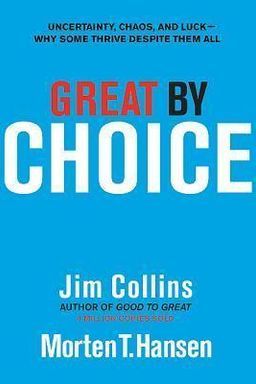
Great by Choice cover

Great by Choice

by Jim Collins & Morten T Hansen

In ''Great by Choice,'' Jim Collins and Morten T. Hansen reveal why some companies not only survive but thrive in chaotic environments. Through rigorous research, they uncover how success is driven by discipline, empirical innovation, and a preparedness that borders on paranoia. This book offers actionable insights for businesses striving for greatness in unpredictable times.

Building Greatness in Uncertainty

How do some leaders and companies not only survive chaos but grow stronger through it? In Great by Choice, Jim Collins and Morten Hansen explore why some enterprises achieve ten times the results of their peers in unpredictable conditions. Their answer is that greatness is not primarily a matter of luck, innovation, or charisma, but of disciplined behavior. The most successful leaders—whom they call 10Xers—navigate chaos through a distinctive blend of fanatic discipline, empirical creativity, and productive paranoia, powered by ambition beyond self-interest.

The book dismantles the myth that extreme environments reward boldness or speed alone. Instead, it argues that resilience, rigorous testing, and consistent progress determine who thrives. Across industries—from healthcare to airlines to technology—the 10Xers build systems that absorb shocks, convert luck into advantage, and scale innovation into enduring success.

The Core Argument

The authors’ central finding is striking: the environment does not determine the outcome; your behavior does. Pairs of companies faced the same uncertainty—Intel and AMD, Progressive and Safeco, Southwest and PSA—but one outperformed the other by orders of magnitude. The reason lay not in luck or opportunity but in disciplined choices and consistent principles. Greatness, they argue, can be built methodically in a turbulent world.

The 10X Leadership Mindset

10Xers reject the idea that chaos excuses poor results or that fortune decides fate. They expect uncertainty and prepare for it meticulously. Their hallmark behaviors form a coherent system:

  • Fanatic Discipline: unwavering consistency of action aligned to clear objectives.
  • Empirical Creativity: innovation grounded in real-world evidence.
  • Productive Paranoia: obsessive vigilance that converts fear into preparation.
  • Level 5 Ambition: aspiration directed toward building something greater than oneself.

These behaviors are reinforced by operating practices such as the 20 Mile March (steady, self-imposed performance discipline), the principle of Fire Bullets, Then Cannonballs (experiment before scaling), Leading Above the Death Line (risk management through survival margins), and SMaC Recipes (clear, durable operating codes). Together they describe how to act, decide, and persist amid chaos.

A World of Uncertainty

The backdrop of the book—economic volatility, technological change, and global crises—could easily foster fatalism. Collins and Hansen reject that reaction. You can’t predict luck or chaos, but you can shape your company’s readiness, choices, and responses. Amundsen’s controlled polar expedition versus Scott’s unplanned tragedy exemplifies this ethos: both faced identical conditions, but only one prepared for every contingency. The same principle governs enterprises like Intel, Amgen, and Southwest—thriving not by predicting change, but by preparing obsessively for it.

The Research Approach

The authors built their conclusions on a rigorous, multi-year comparative study of industries from 1972 to 2002. They tracked performance ratios (10X vs. peers), coded decisions for risk exposure and timing, and even quantified luck events. The surprising result: the 10X companies were not luckier, more innovative, or more visionary. They simply managed uncertainty better. They earned a higher Return on Luck—a measure of how effectively they used both good and bad fortune.

What You Will Learn

Throughout the following frameworks, the book teaches you how to build resilience into daily operation:

  • Create consistent progress through the 20 Mile March, performing steadily regardless of external conditions.
  • Experiment empirically and scale only after validation—Fire Bullets, Then Cannonballs.
  • Prepare for downturns by maintaining buffers and bounding risk—Lead Above the Death Line.
  • Convert core principles into tangible behavior with SMaC Recipes: Specific, Methodical, and Consistent frameworks.
  • Understand innovation’s threshold: being inventive enough to compete, but disciplined enough to execute at scale.

Underpinning all of this is the human element—finding and developing the right people and cultivating cultures that multiply disciplined behavior. The 10X leaders are rarely flamboyant or revolutionary; they are pragmatic, mission-driven, and relentlessly consistent. Their leadership lives at the intersection of humility and ferocious will.

Practical Implication

Building greatness in uncertainty requires constructing systems that don’t depend on prediction. You maintain long-term performance bands, prepare contingency buffers, and use empirical validation before committing major resources. When luck intervenes, you capitalize on it rather than collapse from it. The art lies in balancing creativity with discipline, aggression with caution, and speed with deliberation—a skill set the 10X framework teaches in practical, measurable terms.

As you move through the book’s interlocking ideas, one principle remains constant: you cannot control the storm, but you can control how well you navigate it. In the long run, the difference between failure and greatness is not chaos, but choice.


The 10Xer Way

At the heart of Great by Choice is the idea that extraordinary performance stems from characteristic behaviors rather than bursts of genius. The 10Xers—the leaders of companies that outperformed peers tenfold—demonstrate a disciplined mindset that combines ambition, empirical logic, and preparedness. Their magic lies not in charisma but in behavior repeated consistently under pressure.

Fanatic Discipline

10Xers anchor themselves in purpose. Discipline means not just hard work but consistency. Leaders like Herb Kelleher at Southwest modeled company values daily, ensuring that culture guided behavior more than external circumstances. Peter Lewis at Progressive refused to manipulate earnings to satisfy Wall Street, reaffirming integrity during stress. The outcome is stability: when others swing wildly with markets, disciplined enterprises maintain performance within controlled bands.

Empirical Creativity

Innovation is essential but only when grounded in data. Andy Grove’s handling of his cancer diagnosis mirrored his business philosophy: he gathered peer-reviewed research, tested assumptions, and built decision trees. Likewise, Amundsen’s preparation for the South Pole—studying Eskimo survival techniques—illustrates disciplined creativity. 10Xers validate their ideas before scaling, blending imagination with rigorous verification.

Productive Paranoia

Fear can be paralyzing—or productive. 10X leaders channel constant vigilance into preparation. Bill Gates’ infamous “nightmare memos” demonstrate this trait: he forced Microsoft to anticipate existential threats long before they appeared. This paranoia drives buffer-building—cash reserves, risk boundaries, redundancy—so when crisis hits, they act decisively while others panic. (Note: this resembles Nassim Taleb’s antifragility—systems strengthened by stress.)

Level 5 Ambition

10X ambition transcends personal ego. Leaders pursue missions—for people, for purpose, for impact—that outlast them. Dane Miller of Biomet exemplified this by minimizing personal compensation and focusing on sustainable company success. Employees follow such ambition because it’s selfless and clear. The paradox: humility and willpower coexist. You lead not to glorify yourself, but to build institutions that endure.

These four ingredients—discipline, creativity, paranoia, and purpose—interact like elements of an alloy. Alone, each is incomplete; together, they create a behavioral engine that thrives amid uncertainty. As Collins argues, greatness is not fortune’s gift but a pattern of deliberate choice and action.


The Discipline of the 20 Mile March

The metaphor of the “20 Mile March” defines the operational counterpart to 10X discipline: steady progress regardless of conditions. Inspired by polar explorers who advanced a fixed distance every day—neither racing in good weather nor stalling in storms—the concept teaches you to set self-imposed performance bands that anchor performance through volatility.

Two Bounds of Discipline

A true 20 Mile March has boundaries. The lower bound is the minimum you commit to achieving in hard times; the upper bound limits overextension in boom periods. This dual restraint builds resilience. Stryker, for instance, targeted steady 20% net income growth—no more, no less—while competitors like USSC overreached and crashed. Progressive kept its underwriting ratios steady at 96%, growing profitably through three decades of market turbulence.

Why It Works

The 20 Mile March transforms uncertainty into structure. It creates feedback loops that keep an enterprise grounded, fosters confidence through consistent results, and prevents boom-bust cycles. Companies who adopted the march early—often while small—weathered crises far better. The data show that preexisting marchers had dramatically fewer collapses during industry downturns than their more opportunistic peers.

How to Build Your March

  • Choose measurable metrics you control (growth, margins, user base).
  • Set clear minimums and maximums that reflect your capacity.
  • Publicly commit to the discipline—accountability prevents drift.

By marching steadily, you train your organization to perform under constraint and to resist reactive impulses. When chaos strikes, it’s the reliable marchers—those with patience, systems, and nonnegotiable standards—who endure.


Fire Bullets, Then Cannonballs

In unpredictable worlds, experimentation saves you from fatal errors—but only if you scale validated ideas. Collins and Hansen frame this as the Bullet and Cannonball principle: test small, scale big. Fire bullets—cheap, low-risk experiments—to find what works. Then, after empirical success, fire cannonballs—bold commitments that bring full force to proven concepts.

Bullets as Experiments

Early failures are cheap tuition. Amgen fired multiple scientific bullets before identifying EPO as its breakthrough drug. Each test built knowledge, refined methods, and reduced uncertainty. Bullets should be quick, low-cost, and informative. They signal readiness but never jeopardize the core enterprise.

Calibrated Cannonballs

A cannonball is a concentrated resource bet. Done right—once calibration data confirm a target—it creates massive advantage. The research showed that 10X companies fired calibrated cannonballs 69% of the time versus 22% for comparisons. Amgen’s early experiments made its EPO launch extraordinarily successful; Microsoft’s swift commitment to deliver DOS for IBM exemplified calibration under pressure. By contrast, AMD and PSA made uncalibrated leaps that drained resources and crippled growth.

Your Playbook

  • Fire numerous bullets to discover what works empirically.
  • Scale only after multiple confirmations.
  • Avoid emotional bets—calibrate before committing deeply.

In short, innovation depends not just on creativity but on the discipline to validate before you bet big. The greatest returns on luck occur when you merge boldness with evidence.


Staying Above the Death Line

Leading “above the Death Line” means structuring your organization so that no adverse event can destroy it. Collins defines three risk types you must always manage: Death Line risk (a bet that could kill you), Asymmetric risk (downside outweighs upside), and Uncontrollable risk (forces beyond your influence). Great leaders avoid or buffer all three.

Build Oxygen Canisters

10X companies stockpile reserves before crisis. Intel maintained tens of billions in cash—40% of annual revenue—while peers saw that as inefficiency. Southwest entered 9/11 with enough liquidity to survive months of grounded flights. In study after study, 10X teams held between three and ten times more reserves than averages. These “oxygen canisters” sustain life in thin air.

Bound Risk Deliberately

Before every major move, 10Xers ask: “What happens if this fails?” They minimize exposure by running small pilots (bullets), avoiding overleverage, and refusing one-way bets. The data reveal they made far fewer Death Line decisions (10% vs 36% in comparisons). Survival precedes growth; you must stay alive to exploit future luck.

Zooming Out and In

10X leaders practice dual-speed decision making: zoom out to assess whether conditions are stable or deteriorating, then zoom in for rapid execution when time is short. Intel’s Operation CRUSH in the 1980s—recognizing a looming danger and responding decisively—is a case in point. (Note: similar mental models appear in military command theory and in Daniel Kahneman’s dual thinking systems.)

The practical takeaway: prepare before chaos hits, contain catastrophic exposure, and maintain situational awareness. You win by surviving, not by betting on being lucky.


SMaC: Durable Operating Codes

A SMaC recipe—Specific, Methodical, and Consistent—is the playbook that turns abstract strategy into durable practice. It’s a set of concrete rules that guide daily action even when leadership or context changes. The best SMaC systems endure for decades, adjusting only when empirical evidence demands revision.

What Makes a Good SMaC

Howard Putnam’s 10-point list for Southwest Airlines captures the idea: one aircraft type, short-haul segments, no meals, quick turns, fun culture, no interline bags. Employees always knew what to do and not do. The recipe protected simplicity—its biggest strategic asset. Over time, Southwest changed less than 15% of these elements, while competitors constantly rewrote their playbooks.

Durability with Flexibility

Good SMaC rules are like a constitution: changeable, but only through deliberation. Progressive followed a SMaC of disciplined pricing and experimentation limited to 5% of revenues. Intel’s SMaC embedded Moore’s Law and manufacturing rigor. Apple’s resurgence under Jobs came by reviving its early SMaC—tight integration, design coherence, and secrecy—rather than chasing fads.

Creating Yours

  • List behaviors tied to past success.
  • Codify 8–12 specific rules you can enforce daily.
  • Review rarely, amend cautiously, only when data supports change.

A strong SMaC recipe reduces confusion and panic, aligning creativity with consistency. It allows people to act fast because they already know the rules.


Innovation and Execution

Contrary to popular belief, the most innovative companies don’t always win. Collins and Hansen introduce the Innovation Threshold: every industry demands a certain level of novelty just to compete. Once you cross that threshold, disciplined execution and scaling matter more than being first. Amgen beat Genentech not by out-inventing it, but by out-executing it.

Threshold Logic

In sectors like biotech or semiconductors, you must innovate intensively to stay relevant. In others, like airlines or insurance, incremental improvement suffices. But everywhere, once minimum innovation is in place, success hinges on how you deliver, not just what you invent. 10Xers pair creativity with process mastery—what Collins calls the “AND” approach: innovation and execution.

Evidence and Example

Amgen and Intel prove the point. Though not first movers, they scaled proven ideas faster and more reliably. By contrast, US Surgical’s bold but mismanaged innovations and Genentech’s tumultuous R&D outstripped their capacity to handle complexity. The research found that only about 9% of market pioneers remained long-term winners—a sobering metric that rebalances innovation hero worship.

The takeaway: innovate to the threshold required, but invest most energy in disciplined scaling—testing, production systems, and delivery excellence. Creativity without execution is noise; execution without creativity is stagnation. You must manage both.


Return on Luck

Luck touches everyone. What separates great companies from average ones is their Return on Luck (ROL)—how effectively they capitalize on good fortune and recover from misfortune. Collins and Hansen coded 230 luck events and discovered 10Xers were no luckier than others. What changed the game was response quality.

Luck Is Common, ROL Is Rare

Both 10X and comparison companies averaged about the same number of good and bad luck events. Yet some transformed identical opportunities into lasting advantage. Bill Gates saw the Altair 8800 computer—like many others did—but acted faster and sustained execution longer. AMD and Digital Research had equally big breaks but squandered them through delay or mismanagement. It’s not who gets lucky, but who converts luck into results.

How to Earn a High ROL

  • Recognize luck early—differentiate signal from noise (zoom out, then in).
  • Decide when to disrupt and when to stay the course.
  • Validate empirically—fire bullets before committing cannonballs.
  • Prepare buffers so bad luck doesn’t knock you out before good luck arrives.

The essence of ROL is agency. You cannot summon fortune, but you can prepare to exploit it. 10Xers stack the odds by staying relentlessly ready—financially, operationally, and psychologically—for whatever winds blow their way.


The Power of People Luck

Sometimes the luckiest thing that happens is the arrival of the right person at the right time. The authors call this Who Luck—and while you can’t control who walks in, you can increase the odds by building cultures that attract and retain the right people. Every major 10X company benefits from such people-luck, but their greatest gift is making the luck systematic through rigorous selection.

Why People Are the Ultimate Leverage

Fu‑Kuen Lin’s EPO breakthrough at Amgen was an instance of who luck that defined an era. But what made it meaningful was leadership’s recognition and support. Peter Lewis’s transformation of Progressive, or Southwest’s rigorous hiring ratio (6,000 hires out of 200,000 applicants), show that culture compounds human fortune. High standards and deep cultural fit turn coincidental encounters into compounding advantage.

Practical Steps

  • Be fanatically selective in hiring and promotions.
  • Use culture and purpose as filters for fit.
  • Get the right people before deciding the right strategy.

Over time, disciplined hiring converts who luck into structural strength. You don’t just find great people—you create the system where great people thrive.


Speed, Recognition, and Timing

Time itself is a strategic variable. Successful leaders don’t just move quickly—they calibrate speed to circumstances. The authors found that early recognition of critical moments (“unequal moments”) is one of the strongest predictors of good outcomes. The best companies act fast when they must and slow when they can.

Recognizing the Moment

In the data, early-recognized turning points produced positive results 71% of the time; late recognition yielded just 28%. Companies like Microsoft and Progressive spotted emerging shifts—the rise of the Internet, customer dissatisfaction in insurance—earlier than their rivals, and zoomed out to evaluate implications before zooming in to act.

Calibrating Decision and Execution Speed

10Xers match pace to situation. They act deliberately during stable conditions but accelerate when threats grow acute. Deliberate decision-making correlated with good outcomes 63% of the time; reactive moves correlated with failure in 97% of cases. Once decisions are made, they execute with speed appropriate to the problem’s tempo—another learned discipline.

Speed isn’t about haste; it’s about control—knowing when to wait, when to listen, and when to strike. That rhythm turns potential chaos into orchestrated motion.

Dig Deeper

Get personalized prompts to apply these lessons to your life and deepen your understanding.

Go Deeper

Get the Full Experience

Download Insight Books for AI-powered reflections, quizzes, and more.