
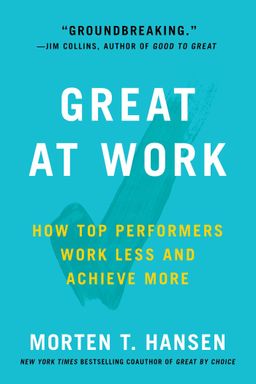
Great at Work cover

Great at Work

by Morten T Hansen

Great at Work unveils the secrets of top performers who achieve more by doing less. Morten T. Hansen presents seven actionable practices that debunk the myth of innate talent, offering practical strategies to boost productivity and performance by working smarter. Discover how to focus your efforts, redesign your work, and harness passion and purpose for outstanding results.

Work Smarter, Not Harder

Why do some people achieve outsize results without burning out, while others work long hours yet stay average? In Great at Work, Morten Hansen sets out to answer this question through an ambitious five-year study of 5,000 professionals across 15 industries. The surprising conclusion: hours and innate talent explain only about 10 percent of the performance differences. The rest comes from how people work—the specific practices they use to focus, learn, collaborate, and find meaning.

The Evidence-Based Foundation

Hansen and his team combined surveys, interviews, and field research to identify seven practices that together explain 66 percent of the variation in performance—a strikingly large effect by social science standards. These practices form the Work Smart Framework, organized into two clusters: mastering your own work and mastering working with others. The first cluster covers doing fewer things better, redesigning for value, continuous learning, and connecting passion with purpose. The second deals with influencing others, managing teams, and collaborating across boundaries.

The Core Idea: Value Over Volume

To 'work smart' means to maximize the value of your work by focusing selectively and applying intense, purposeful energy. In one of his early insights, Hansen contrasts his grueling consulting hours at Boston Consulting Group with a peer named Natalie, who left on time yet produced brilliant analyses. Her secret wasn’t more hours but sharper focus and smarter methods. This story drives the book’s message: you improve performance not by adding effort but by applying effort more intelligently.

Seven Practices, One Philosophy

The book unfolds through seven 'work smart' practices. First, Do Less, Then Obsess teaches you to focus narrowly on a few priorities and attack them with obsessive intensity. Second, Redesign Work for Value shows how small structural changes can dramatically increase results—like flipping classroom models or eliminating wasteful steps in a process. Third, Don’t Just Learn, Loop redefines learning at work as fast, iterative experimentation rather than long study sessions. Fourth, P‑Squared (Passion and Purpose) emphasizes that energy spikes when you combine what excites you with what helps others.

The remaining three habits focus on collaboration. Be a Forceful Champion teaches influence—winning support through both emotional inspiration and adaptive persistence. Fight and Unite focuses on teams: debate ideas fiercely, then commit collectively. Finally, Disciplined Collaboration helps you avoid the twin traps of isolation and overcollaboration by choosing only the collaborations that yield real value and executing them with rigor.

Challenging Common Myths

Hansen’s data dismantles several popular beliefs. Long hours and multitasking? Often counterproductive. Passion alone? Dangerous if it’s misaligned with customer value. Collaboration everywhere? A recipe for inefficiency unless it’s disciplined. His framework echoes findings in other evidence-based guides like Cal Newport’s Deep Work and Daniel Pink’s Drive but adds organizational nuance—balancing personal mastery with systemic practice.

The Broader Payoff

Hansen’s model doesn’t just raise productivity—it enhances well-being. The same practices that improve performance also explain nearly 30 percent of variance in job satisfaction and burnout. “Do Less, Then Obsess” frees time and reduces stress, while “Disciplined Collaboration” prevents overload. However, he cautions that passion‑driven work can easily spill into overwork, reminding you to invest your “time dividend” consciously between career and life.

Core Definition

Working smart = selecting a few high‑value activities, obsessing to deliver extraordinary quality, redesigning for impact, learning continuously, aligning passion with purpose, influencing others effectively, and collaborating with discipline.

Each subsequent idea in the framework digs deeper into how to apply these evidence-based habits, transforming how you prioritize, learn, contribute, and connect. The goal isn’t to work longer—but to multiply the value of every hour you invest.


Do Less, Then Obsess

Most people try to do too many things, mistaking activity for achievement. Hansen’s first practice flips this logic. Elite performers narrow their focus to a few priorities and then obsess over executing them flawlessly. This blend of selectivity and intensity yields breakthroughs, not burnout.

Less Is More—If You Obsess

The contrast between polar explorers Roald Amundsen and Robert Scott captures the idea. Scott tried five transport methods and managed a complex expedition; Amundsen relied on dogs and perfected that system. Amundsen succeeded because he cut complexity and mastered his narrow method. In modern work, spreading yourself across too many goals creates both the 'spread-too-thin' trap and the 'complexity' trap—too many interdependencies and coordination costs.

Obsessive Quality

Doing less isn’t laziness; it’s focus. But focus alone isn’t enough—you must channel disproportionate energy into excellence. Sushi master Jiro Ono illustrates this: he serves twenty pieces, massages octopus for up to an hour, and trains apprentices for years before letting them serve. That obsessive pursuit of perfection turns a job into an art.

Actionable Tactics

  • Apply Occam’s razor: ask what’s truly essential—'as few as you can, as many as you must.'
  • Use precommitments to stay on strategy: block distractions or publicly define your “no-go” criteria.
  • Negotiate tradeoffs openly with your boss; explain that doing one thing well means saying no to another.

When you concentrate your firepower, you increase both quality and efficiency. The best route to distinction rarely comes from doing everything—it comes from doing a few things superbly.


Redesign Work for Impact

Working smarter doesn’t just mean focusing—it means designing your job so the same effort produces more value. Hansen encourages 'outside-in' thinking: measure your output by how much it benefits others, not by how much effort you expend.

Creating Value, Not Just Activity

Principal Greg Green transformed Clintondale High School by flipping his classrooms—lectures at home, exercises in class. Teachers didn’t work longer; they worked differently. Failure rates dropped dramatically. Similarly, Hartmut Goeritz at APM Terminals increased throughput 30 percent by eliminating low-value services and instituting 'never drive empty' truck cycles. Redesigning work turned normal effort into exceptional value.

The Value Equation

Hansen frames productivity as value = benefits to others × quality × efficiency. You can increase any of those variables—raise customer benefit, upgrade quality, or improve speed and cost. Conversely, work that meets internal goals but yields no client benefit adds zero value.

How to Redesign Smartly

  • Hunt for pain points: look for recurring complaints or slow processes.
  • Challenge inherited assumptions—ask 'why' repeatedly until inefficiency shows itself.
  • Run small A/B experiments to test redesign ideas safely before scaling.

Even small redesigns ripple widely. When you treat work as a design problem—not a time problem—you stop grinding harder and start multiplying the difference you make.


Learn in Loops

Instead of accumulating hours of experience, top performers accelerate growth through structured micro-experiments. Hansen’s 'learning loop' adapts deliberate practice (popularized by Anders Ericsson) to modern workplaces. You learn fastest by trying, measuring, and adjusting—quickly and frequently.

How the Loop Works

In knowledge work, you often lack long training hours or coaches. Hansen breaks improvement into mini-cycles: define a skill, practice it in real situations, collect feedback, measure progress, and iterate. Brittany Gavin, a hospital food-service supervisor, used fifteen-minute loops daily—micro-behavior changes like asking better questions and tracking follow-through. Her results moved her from the top 30 percent to the top 10.

Tactics You Can Apply

  • Carve out 15 minutes a day to work on one specific behavior.
  • Break big skills into micro-elements you can measure.
  • Seek nimble feedback from peers or digital tools.
  • Embrace dips: short-term declines precede big leaps in learning.

Continuous improvement isn’t about endless hours—it’s about structured experiments and quick adaptations. This practical looping habit makes growth a daily reflex, not an annual resolution.


Pair Passion with Purpose

You’ve heard 'follow your passion.' Hansen says that’s half right. Passion provides energy; purpose gives direction. Combine them and you get what he calls P‑Squared—a powerful, sustainable driver of performance. Pure passion without contribution can become indulgent; purpose without passion feels lifeless.

Defining the Two Forces

Passion is internal enjoyment—creativity, achievement, relationship-building, or mastering skills. Purpose is outward—the difference your work makes to customers, colleagues, or society. Together they multiply your energy per hour. Hansen’s data show employees high in both perform about 18 percentile points better than the average.

Real Matches in Action

Genevieve Guay, a concierge in Quebec, thrives because her joy in service aligns perfectly with improving guests’ experiences. At SAP, executive Steven Birdsall combined his sales passion with the purpose of helping clients implement software faster, birthing a new, billion-dollar line of business. In both, alignment—not intensity—was decisive.

How to Build P‑Squared

  • Start with 'do no harm'—ensure your work benefits others.
  • Reframe your daily work as contribution, not obligation.
  • Seek projects where excitement and impact overlap.

When passion fuels purpose, performance becomes meaningfully self-sustaining. You stop burning energy and start generating it.


Influence Through Forceful Advocacy

Working smart includes mastering influence. Hansen’s fifth practice, Forceful Champions, shows how great advocates combine inspiration with tactical grit. Rational argument alone often fails; you need emotional resonance and adaptive persistence to move people and ideas.

Inspire Emotion, Not Just Logic

At Dow Chemical, Ian Telford’s e‑epoxy project initially died under rational objections. He revived it by framing a vivid emotional journey—fear of missing the market, excitement of leading it. Similarly, Jamie Oliver’s public demonstrations used disgust and hope to inspire health reforms. People decide emotionally before they justify logically.

Practice Smart Grit

Persistence without empathy can sabotage your cause. Indian innovator Arunachalam Muruganantham built his sanitary pad mission by adapting—training women as entrepreneurs rather than battling skeptics. Lorenza Pasetti of Volpi Foods diffused a European legal fight by confronting opponents personally, in their own context. Smart grit means adjusting tactics without diluting commitment.

Great champions don’t just push their ideas—they mobilize others. They inspire hearts, map power networks, and turn allies into amplifiers. Influence becomes less about argument, more about collective movement.


Fight and Unite

High-performing teams thrive on paradox: they argue vigorously yet act as one. Hansen’s Fight and Unite principle captures this: great teams have debates that sharpen thinking ('fight') and disciplined alignment when the decision is made ('unite').

Healthy Conflict

The Bay of Pigs disaster shows what happens when teams avoid dissent. In contrast, Reckitt Benckiser institutionalized constructive conflict through norms: prepare thoroughly, voice contrary data, and let arguments—not rank—decide. Heineken manager Dolf van den Brink encouraged candor using visual cues (red and green cards) to make disagreement safe and expected.

Fast Unity

After debate ends, high-performing teams converge quickly. Decisions get public commitment, even from dissenters. This prevents endless revisiting. Christine, a pharma salesperson, modeled this by supporting a rejected idea wholeheartedly once the group decided, helping turn it into success.

Fight without unity equals chaos; unity without fight equals groupthink. Balanced well, this practice produces better decisions and faster execution—the hallmark of smart teamwork.


Collaborate with Discipline

Collaboration is valuable only when it creates net gains. Hansen calls the ideal balance Disciplined Collaboration—a pragmatic approach that weighs benefits against costs. You deliberately choose when to collaborate and design those efforts for measurable value.

Avoiding Two Extremes

Some organizations, like Fort Dodge Hospital, suffer from undercollaboration: silos, duplicate tests, and poor outcomes. Others, like Centra Consulting, drown in overcollaboration—too many experts, meetings, and muddled decisions. The goal is balance.

The Collaboration Premium

Before saying yes, compute a quick equation: Benefit – Opportunity Costs – Collaboration Costs. Mike McMullen at Agilent used this reasoning to greenlight a project predicted to generate $150M; by lowering costs and aligning resources, he created a positive premium. In Centra’s failed bid, the premium was deeply negative—more cooks, worse soup.

Rules for Disciplined Collaboration

  • Build a business case: prove the value first.
  • Craft unifying, measurable goals.
  • Reward results, not meetings.
  • Commit full resources—no part-time teams.
  • Engineer trust fast through verification, public commitments, and small wins.

Collaboration pays off when it’s selective, well-resourced, and rooted in trust. Without discipline, it drains both time and morale.


Work Smart, Live Well

Finally, Hansen emphasizes that working smart should improve your life, not consume it. His data show the seven practices explain not only 66 percent of performance differences but also 29 percent of variation in well-being. Yet each practice affects balance differently, so you must consciously shape your time dividend.

Balance Gains and Trade‑offs

'Do Less, Then Obsess' and 'Disciplined Collaboration' reduce burnout by eliminating overload. 'Passion + Purpose' boosts satisfaction but risks over-involvement—you might struggle to switch off. Conflict-prone teams under 'Fight and Unite' can edge toward emotional exhaustion if debates get personal. Hansen’s advice: manage each practice’s side effects deliberately.

Protecting the Time Dividend

  • Spend freed time wisely—split it between better work and richer life.
  • Keep passion in check: set device or schedule boundaries.
  • Fight ideas respectfully, not people, to minimize emotional fatigue.

Small Changes, Big Results

The book closes with micro-experiments: say 'let me think' before committing, circle calendar entries creating real value, or pilot one redesign. Tiny, structured tweaks often yield compounding benefits. Like Dr. Bennick’s one-minute policy to preserve patients’ sleep, small gestures can transform systems.

Working smarter isn’t a single skill—it’s a compounding system. Start with focus, redesign for value, loop faster, connect passion to purpose, influence effectively, and collaborate wisely. Then use your regained time to live intentionally. Success and well-being can—and should—reinforce each other.

Dig Deeper

Get personalized prompts to apply these lessons to your life and deepen your understanding.

Go Deeper

Get the Full Experience

Download Insight Books for AI-powered reflections, quizzes, and more.