
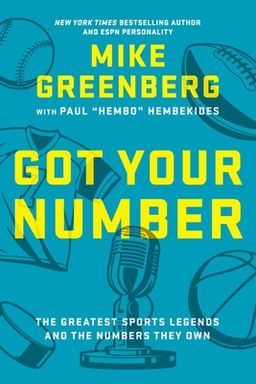
Got Your Number cover

Got Your Number

by Mike Greenberg With Paul Hembekides

The ESPN host partners with his producer to create their list of top 100 sports legends.

Who Owns a Number? The Joyful Sport of Arguing

When you see a jersey number—12, 23, 42, 99—who pops into your head first? And if a friend names someone else, do you feel that spark of friendly outrage that turns coffee talk into a full-on sports debate? In Got Your Number, Mike Greenberg (with researcher Paul Hembekides) argues that numbers aren’t just digits; they’re living symbols of identity, memory, and meaning in sports. The book’s core claim is deliciously simple and irresistibly debatable: for every number from 1 to 100, one athlete (or team, or moment) “owns” it—by achievement, impact, timing, and, yes, sheer joy. Greenberg contends that these choices aren’t mathematical proofs; they’re invitations. But to play the game well, you have to understand why numbers matter more to fans than most stats ever will.

The premise springs from a newsroom question during the pandemic: many Hall of Fame quarterbacks wore no. 12—but who owns 12? The room said Tom Brady, and a book idea was born. From there, Greenberg builds a tour of sports lore from Ozzie Smith’s no. 1 to Wayne Gretzky’s no. 99, stitching together the stat lines, iconic snapshots, societal stakes, and personal emotions that make certain numbers feel inevitable. It’s a love letter to arguments you enjoy having and stories you love retelling—the kind of conversation Greenberg calls the “highest form” of talk: heated but with zero consequence (and maximum belonging).

Why Numbers Stick Harder Than Stats

Greenberg makes a sly observation early: ask a casual fan how many points Michael Jordan scored in his career and you’ll get blank stares; ask for his number and people answer instantly. Uniform numbers are mnemonics; they’re how you and I tag memories—Jordan’s 23, Gretzky’s 99, Jeter’s resonant 2 introduced by Bob Sheppard (“now batting for the Yankees…”), or Jackie Robinson’s 42, retired across baseball. Numbers are the fan’s shortcut to identity; they’re also passports back to moments that took your breath away (Secretariat’s 31-length Belmont win; Wilt’s 100-point night; Cal Ripken Jr.’s 2,632 straight).

How Greeny Chooses (and Why You’ll Argue)

The author insists he’s not voting—he’s declaring. His criteria blend “art and science”: accomplishment, physical talent, mental toughness, game intelligence, clutchness, impact on the sport and society, iconic moments, sportsmanship, citizenship, and joy. That last one matters; Greenberg prizes the thrill you feel watching someone like Ozzie Smith at shortstop (no. 1) or Steph Curry (no. 30) distort what you thought was possible. Sometimes the claim is statistical (Jerry Rice at no. 80 owns the all-time receiving universe), sometimes it’s cultural (Bill Russell at no. 6 as the greatest winner and civil rights pillar; Billie Jean King at no. 73 for the Battle of the Sexes), and sometimes it’s a pristine moment you can’t forget (Jack Morris’s ten-inning World Series shutout, Mario Lemieux returning the night he finished radiation, Willis Reed limping out for game seven as Walt Frazier authored the best game-seven line ever).

Memory, Generations, and Friendly Bias

Greenberg admits every fan is a time capsule. Your dad saw Oscar Robertson and will wedge him into any Jordan–LeBron debate; your kid will do the same for LeBron someday. The book gently leans into that truth: sports are how we hold onto childhood and family, which is why these numbers feel personal. The LeBron chapter even uses 84—his birth year—to frame how growing up in the social media era reframed scrutiny and greatness. Greeny makes room for nuance: he calls Kareem the most accomplished American team-sport athlete (no. 33), while still staking “best” on Jordan (no. 23). Likewise, he places Brady (no. 12) on the G.O.A.T. throne, yet argues Peyton Manning (no. 55, for his 55-TD season) was the game’s most complete regular-season quarterback. You don’t have to agree; that’s the fun.

What You’ll Explore in This Summary

You’ll see how numbers become identity badges and time machines, and how Greenberg weighs greatness (beyond box scores). You’ll meet clutch gods (Derek Jeter at no. 2), transcendent leaders (Pat Summitt, no. 43), culture shifters (Jackie Robinson, no. 42; Serena Williams, no. 39), and pure one-of-one phenomena (Secretariat’s 31, Gretzky’s 99, Phelps’s 28 medals). You’ll revisit bright-line moments—Jordan’s 63 at Boston Garden, Buster Douglas’s KO of Tyson, Nancy Kerrigan’s grace in Lillehammer—and dynasties that defined eras (the ’72 Dolphins, ’85 Bears, Wooden’s 88 straight).

All of it adds up to a bigger point: sports are the best way to invest everything in something that “means absolutely nothing”—and somehow means everything to you. The numbers in this book are a shared language. They don’t end disagreements; they catalyze the best kind of ones. That’s why Greenberg’s final posture matters: he’ll defend every choice, but he wants you to argue back, then hand the conversation down to your kids. The list is definitive only in this sense: it’s definitive proof that numbers make memories sticky—and that debating them makes fandom feel like home.


Numbers Make Identity Stick

Greenberg’s most persuasive idea is that uniform numbers are how you and I remember athletes—not their total points, yards, or strokes, but the digits stitched on their chests. That’s not an accident; it’s history and human wiring. Numbers first appeared on sleeves in early baseball (Cleveland, 1916), then on backs (Yankees, 1929), often aligned with batting order—Babe Ruth was 3, Lou Gehrig 4—baking numerology into fame. Over the decades, the number became as much a calling card as a surname: Jeter’s 2, DiMaggio’s 5, Jackie’s now-sacred 42, Gretzky’s unrepeatable 99. You don’t need a stat table to summon them; your brain tags legends by digits.

A Number Is a Story You Wear

No. 2 means “clutch” because Bob Sheppard’s intro for Derek Jeter turned a number into theater: “Your attention, please…” No. 5 is Joe DiMaggio’s grace—his 56-game hitting streak and the quote Greenberg calls his favorite, about playing hard because “some kid may be seeing me for the first time.” No. 3 is Ruth’s swagger (“I had a better year than the president”), home runs that outpaced entire teams, and the House That Ruth Built. No. 42 is Jackie Robinson’s courage; MLB retired it league-wide in 1997. No. 99 is Wayne Gretzky, whose excellence dwarfs any peer so completely that the NHL retired the number across the sport, echoing Robinson’s honor. These digits are anchors for stories you tell yourself about what greatness looks like.

The Joy of Hearing a Number

Greenberg highlights the audio cues that cement identity. Jeter’s number voiced by Sheppard. Vin Scully’s incomparable soundtrack to baseball for 67 years—a number that, for many, now is Dodger baseball. “Go crazy, folks!” painting Ozzie Smith’s (no. 1) first-ever left-handed home run—a one-in-3,009-at-bats miracle—on the postseason canvas. These aren’t just plays; they’re how your memory attaches soundtrack to symbol.

When Numbers Become Sacred

Retired digits elevate identity to myth. Greenberg recounts Gehrig’s 4—the first retired number in baseball—forever linked to “the luckiest man” speech. The Celtics hang 6 for Bill Russell, a winner beyond parallel (eleven rings) and a conscience in the fight for civil rights; the NBA has since retired 6 league-wide. Anthony Muñoz’s 78 in Cincinnati is the franchise’s only homegrown Hall jersey, a banner for the greatest offensive lineman many players ever faced. And some numbers transcend a person to encompass a cause: 42 is American progress; 39 (Serena Williams) is the modern standard of sustained excellence in women’s sports; 73 (Billie Jean King) is the night she played for something bigger than a match.

More Memorable Than the Math

Ask yourself: which is easier to recall—Jordan’s 32,292 career points or his 23? Hank Aaron’s 6,856 total bases or his 44 breaking Ruth’s 714 amid threats (and his grace in doing it)? Greenberg’s not dunking on stats—he reveres them (and Hembo’s trove is encyclopedic). He’s arguing for what you instinctively know: numbers on a jersey are the brain’s shorthand. They signal belonging (fans choose 5 or 23 for their kids), connect families (Greenberg and his children pick 5 for DiMaggio and his dad), and let you relive goosebumps in a single digit.

(Context: This echoes Austin Kleon’s idea in Show Your Work! that symbols and simple hooks help work spread. In sports, the “hook” is often a number you can chant, hang, and pass down.)


How Greeny Weighs Greatness

You don’t convince a room full of sports nerds without a rubric. Greenberg shows his work: he blends accomplishment (titles, records), ability (physical gifts, IQ), temperament (toughness, clutch), and significance (impact on sport and society)—with one unusual ingredient: joy. If an athlete made you feel lucky to watch, that halo matters. Read his casework and you see the method is consistent, even when the outcomes invite brawls at the bar.

Accomplishment and Apex

Some choices are freight trains of proof. Jerry Rice (no. 80) doesn’t just lead in every receiving category; Hembo’s email of Rice stats reads like a cheat code: 197 receiving TDs, 22,895 yards, 151 postseason catches, three-Super-Bowl games with three TDs—the kind of dominance that makes “greatest WR ever” a closed case. Tom Brady (no. 12) has seven rings (more than any franchise), 35 postseason wins, ten Super Bowls, and a career that aged in reverse—by 43 he was SB MVP. Michael Phelps (no. 28) is the most decorated Olympian ever: 23 golds; eight in a single Games. These aren’t arguments so much as exhibits you can’t unsee.

Clutch and Context

But greatness isn’t only volume; it’s timing. Derek Jeter (no. 2) led in postseason hits, runs, and total bases, and carried a dynasty with leadership as much as numbers. Jack Morris (no. 47) pitched a ten-inning shutout in game seven—the last of its kind—and Greenberg’s right: that one night put him in Cooperstown because it tells the story of baseball pressure better than a WAR column ever could. Michael Jordan’s 63 at the Boston Garden (no. 67) wasn’t a ring, but it was a thunderclap—against a 67-win, 40–1-at-home Celtics team, having barely played that season. Greenberg reads stakes as data, and you should, too.

Impact Beyond the Game

Some numbers are moral arguments. Jackie Robinson (no. 42) integrated baseball—and America’s conscience changed. Bill Russell (no. 6) took principled stands in the teeth of racism and later received the Presidential Medal of Freedom. Billie Jean King (no. 73) didn’t just beat Bobby Riggs; she used a TV audience of 90 million to advance pay equity and women’s sports (and later earned the Medal of Freedom). Pat Summitt (no. 43) built the model of modern women’s college basketball—eight NCAA titles, 100% graduation for players who finished with her—and made coaching women a destination. Greenberg doesn’t silo off-field work; he counts it, because you and I feel it when we say their names.

The X-Factor: Joy

Greenberg insists joy is a criterion. Ozzie Smith (no. 1) was more than 13 straight Gold Gloves—he made grounders ballet. Steph Curry (no. 30) isn’t just the greatest shooter ever; he changed what your pickup game looks like and proved you can build dynasties “from the arc out.” Secretariat (no. 31 lengths) didn’t just take the Triple Crown; he ran so beautifully that a nation swooned (three magazine covers in a week). Joy is subjective, but in fandom, it’s real data.

(Comparison: Bill Simmons’s The Book of Basketball leans heavily on titles and prime peaks; Greenberg adds civic weight and fan delight—closer to David Halberstam’s blend of sport and society in Playing for Keeps.)


Clutch, GOATs, and Generational Bias

If you’ve ever lost an afternoon to a Jordan–LeBron thread, you know how this goes. Greenberg gives you a friendlier framework: “best” and “greatest” aren’t always the same thing; era and context matter; and your age biases you. He calls Kareem the most accomplished in American team sports (six MVPs, six titles, the scoring crown for 39 years), while still putting Jordan as his “best” (six-for-six in Finals, nine first-team All-Defense, winning obsession). LeBron (chapter number tied to 1984) gets explicit credit for shouldering modern scrutiny while building the most sustained peak in NBA history (eighteen seasons at 25+ PPG, Finals MVP with three franchises, I Promise School). In other words: you can respect all three without flattening what makes each unique.

Clutch Is a Real Skill

Greenberg treats “clutch” as measurable because fans live the evidence. Jeter’s October. Montana’s 4–0 Super Bowl record (11 TDs, 0 INTs), including the 92-yard drive to John Taylor and “The Catch” that started it all. Brady’s 28–3 comeback. Jordan’s repeated endgame daggers (he led both teams in scoring in 36 of 37 playoff series). The point isn’t that analytics lie; it’s that moments change legacies because sports are a theater of moments. That’s what you replay in your head.

The Best Arm vs. The Best Quarterback

He makes careful distinctions to avoid false binaries. Dan Marino (no. 13) might have thrown the best football anyone’s ever seen (5,084 yards and 48 TDs in 1984 when those were sci-fi numbers), yet rings eluded him. Brady owns the résumé. Manning (no. 55) might be the game’s most meticulous offensive architect, a walking OC who rewired pre-snap football—and he still came up short some Januaries. The book creates space for all three truths at once.

Your Age Is Showing (And That’s Okay)

Greenberg jokes he can predict your answer “seven times out of ten” if he knows your age: his dad always worked Oscar Robertson into Jordan talk; he now reflexively defends Jordan against LeBron; his kid will pledge LeBron against the next phenom. The lesson for you: examine your nostalgia without surrendering it. Memory is part of fandom; it just shouldn’t be the only part. When Greenberg crowns Gretzky (no. 99) as the greatest gap over field in any North American team sport, he does it with receipts—nine MVPs, more assists than anyone else’s points—but still leaves room for Mario Lemieux’s wonder (and heroism).

(Note: This echoes Michael Lewis’s Moneyball tension—numbers vs. narrative—but Greenberg’s synthesis says you need both. Hembo’s stats are the backbone; the stories are the soul.)


Moments That Made Us Gasp

You remember sports by their “where were you?” moments. Greenberg curates a highlight reel of nights so vivid you can smell the room you watched them in. They’re not all championships; they’re emotional apexes—performances or images that tattooed themselves onto your sports brain and never faded.

Impossible, Then Suddenly Real

A few read like fables. Secretariat’s Belmont (no. 31 lengths) where Ron Turcotte looked back into empty track because the camera could barely keep the horse and the field in the same frame. Buster Douglas (no. 94 chapter recounts 1990) dropping Mike Tyson as you sat slack-jawed on your couch, wondering if heavyweights obeyed the laws of physics after all. Ozzie Smith’s (no. 1) first-ever lefty home run after 3,009 at-bats—“Go crazy, folks!”—converting St. Louis into a shaking snow globe. Mario Lemieux finishing radiation in the morning, then scoring that night in Philly. These are not just box scores; they’re parables of awe and resilience.

Pictures You Don’t Need to See Again to See

Some images are so iconic you can close your eyes and watch them. Bobby Orr flying across the crease as the puck goes in (no. 4). Willis Reed emerging from the tunnel on one leg; Walt Frazier quietly dropping 36 and 19. Kirk Gibson hobbling around the bases after that swing; Vin Scully’s voice painting the whole thing. Wilt Chamberlain’s scribbled “100” sign (no. 100), a game no TV camera caught but that lives brighter than HD. The lonesome jog of Cal Ripken’s lap the night 2,632 turned Gehrig from unreachable to respectfully passed (no. 99). You relive these because they’re more than plays; they’re proof of what humans can do under lights.

Courage Under Absurd Pressure

Greenberg’s most moving vignettes show heart under impossible glare. Nancy Kerrigan (’94 Lillehammer) skating to silver with the world peering in after an assault that hijacked the Games—Verne Lundquist remembering that news teams turned a figure-skating practice into a national event. Jack Morris refusing the hook in game seven, pitching through every jam because he “never had a negative thought.” Ray Lewis lifting a city’s pulse—“best leader I ever played against,” said Peyton—amid an all-time defense (2000 Ravens). And yes, Terrell Owens in Super Bowl XXXIX: 9 catches for 122 yards on a leg doctors begged him not to test. “Selfish?” Not that night.

Why Moments Matter More Than Math (Sometimes)

These scenes are Greenberg’s argument for narrative weight. You and I don’t replay spreadsheets. We replay Jeter backhanding in the hole and spinning; Jordan shrugging in ’92; Elway helicoptering for a first down in Super Bowl XXXII; Serena’s “evolution” farewell in a roaring U.S. Open night. The math supports legacy; the moments make it unforgettable.

(Parallel: In Why We Love Sports by Roland Lazenby and others, the “peak experience” explains why one night can outweigh a year. Greenberg adds: one digit can summon the peak in a heartbeat.)


Dynasties, Defenses, and Perfect Seasons

Greatness also comes in collectives—teams and units that crystallized an era. Greenberg assigns numbers to whole groups when their dominance becomes its own legend. If you crave a barstool tour of the best ever, this chapter of the book is your hop-on bus.

The Only Perfect Season

The 1972 Miami Dolphins (no. 72) aren’t just undefeated; they’re a champagne ritual. 14–0 in the regular season, 3–0 in the playoffs, and the only 17–0 season without a tie in NFL history. They led the NFL in total and scoring offense and defense—an absurd two-way flex. When Bob Griese broke his leg, 38-year-old Earl Morrall went 9–0, then Griese returned to close. Dominant and resilient: that’s how you last 50 years at the top of a mountain.

The Best Team Greenberg Ever Saw

The 1985 Bears (no. 85) are his personal no. 1: outgained opponents in 18 of 19 games; the only team since 1978 to score 400+ and allow fewer than 200; +339 point differential; two postseason shutouts; ten postseason quarters without allowing a TD. Buddy Ryan’s 46 defense turned first-and-ten into a panic attack. Walter Payton was still the engine; Mike Singletary the mind; Richard Dent the closer; Mike Ditka the swaggering id. If you punted on first down, Greeny jokes, they’d still go .500.

Steel and Squeeze

The 1970s Steelers defense (Lambert’s 58, Ham’s 59, Greene’s 75) remains the only NFL dynasty defined primarily by defense. Eighteen playoff games between 1972–79, and they didn’t allow a 100-yard rusher or 300-yard passer. In 1976 they pitched five shutouts in eight games. The Ravens (2000) are their 21st-century cousins: ten points allowed per game and a postseason in which the defense outscored opposing offenses 2–1 on TDs. Ray Lewis (no. 57 chapter) was “the best leader in NFL history,” per owner Steve Bisciotti, and Belichick and Manning co-signed the terror.

Hoops Empires

Wooden’s UCLA win streak (88) is the most audacious run the men’s game has ever seen—an average margin of +23 over nearly three calendar years. Geno Auriemma’s UConn women (seeded by Rebecca Lobo at no. 50) built an equivalent modern juggernaut; Lobo’s 35–0 title season made Storrs a destination and established the template for sustained excellence in women’s hoops. Greenberg also cherishes the 1970 Knicks (the Garden’s greatest night), a team built on defense, selflessness, and a captain who limped out so his teammate Clyde could author the best game-seven line you’ve ever read.

A Wild, Loud, Beautiful Baseball Year

The 1986 Mets (no. 90 in the book’s run) were chaos wrapped around dominance: 108 wins (behind only the 1906 Cubs and 1909 Pirates in NL history), a +205 run differential, four starters with 15+ wins and 70% W%. They clinched history with “a little roller up along first…” past Bill Buckner and a Vin Scully call that New Yorkers can still recite. Greenberg doesn’t glorify the off-field circus; he immortalizes the baseball and the swagger—“We liked the attention…and we won,” Darryl Strawberry says.

(Context: If you love dynasties, pair this with Jeff Pearlman’s Boys Will Be Boys or David Halberstam’s The Breaks of the Game for behind-the-scenes anatomy. Greenberg’s twist is to yoke each empire to a number that encodes its myth.)

Dig Deeper

Get personalized prompts to apply these lessons to your life and deepen your understanding.

Go Deeper

Get the Full Experience

Download Insight Books for AI-powered reflections, quizzes, and more.