
Idea 1
Inside Big Tech's Hidden Power: The Story of Google Leaks
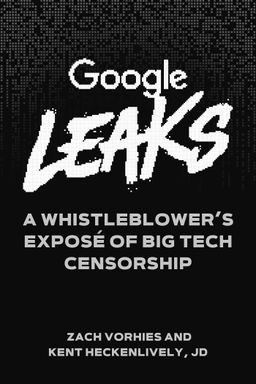
Have you ever wondered what really happens inside the world’s most powerful companies—those that shape the information you see, the news you read, and even the way you think? In Google Leaks, Zach Vorhies pulls back the curtain on Google and YouTube, revealing how the company allegedly shifted from its original mission of open access to a mechanism of control. His story is part whistleblower confession, part technological thriller, and part modern parable about how information itself can become corrupted when those wielding it believe they know best.
Vorhies, a senior engineer at Google, began as an idealistic technologist thrilled by the company’s motto “Don’t be evil.” Yet by 2016, he claims, Google had strayed from neutrality and transformed into a political actor—an institution determined to “prevent another Trump situation.” This book documents his eight-year journey from engineer to whistleblower, as he unearthed internal documents, confronted deceptions, and ultimately risked his career and safety to expose what he viewed as Google’s manipulation of reality.
The Core of Vorhies' Argument
At the heart of Google Leaks lies one defining claim: Google has built an apparatus for mass thought control, cloaked in the language of fairness, inclusion, and algorithmic improvement. Vorhies details internal programs—“Machine Learning Fairness,” “Algorithmic Unfairness,” and “Purple Rain”—described as technological solutions for filtering misinformation and “bias.” But, as he discovered, these tools could also reinterpret factual truths that contradicted Silicon Valley’s preferred ideology. He argues that by deciding what information people can access, Google was no longer just organizing data—it was redefining reality itself.
The turning point came in the aftermath of Donald Trump’s 2016 victory. Vorhies recounts Google’s internal anguish: executives distraught over the result, employees crying in corporate meetings, and company-wide calls to battle “fake news.” These meetings convinced him that Google’s leadership planned to use machine learning not to promote truth but to engineer consensus. He began seeing search results tweaked, conservative voices suppressed, and controversial topics quietly removed from YouTube searches.
From Idealist to Whistleblower
Vorhies’s journey mirrors the transformation of countless insiders who enter big tech with hope and leave disillusioned. Initially working on beneficial projects—like integrating YouTube across PlayStation and Nintendo platforms—he gradually confronted an organization whose priorities shifted toward information curation and social influence. When he uncovered Google’s internal guidelines defining “algorithmic fairness,” he found a vision in which statistically accurate results (such as more men appearing as CEOs) were labeled unfair and modified until socially acceptable. To him, that crossed the line between coding and propaganda.
His discovery of internal “blacklists” for YouTube and Google News further cemented his fears. These documents, he says, suppressed searches for political topics, tragedies, and health controversies—ranging from mass shooting details to alternative medicine. The deeper he looked, the more he believed Google was no longer the impartial gatekeeper but a self-proclaimed “Ministry of Truth.”
Why This Story Matters
Vorhies’s story isn’t just about one company—it’s a cautionary tale for anyone living in the digital age. It raises uncomfortable questions: if algorithms decide what information you see, are you still free to think independently? How should private corporations balance content moderation with freedom of speech? And can democracy survive if truth itself becomes curated by machine learning engineers?
While critics may dispute Vorhies’s interpretations, Google Leaks taps into a broader anxiety about the erosion of transparency in technological governance. It reminds readers of George Orwell’s warnings from 1984 and Aldous Huxley’s Brave New World—novels that depicted societies sedated or controlled through manipulation rather than force. In Vorhies’s world, the tyrants are algorithms trained by human prejudice. His message is clear: the information age, once envisioned as liberation, has become the battlefield for freedom itself.
The Journey You'll Explore
As this summary unfolds, you’ll follow Vorhies’s path from idealistic engineer to dissident whistleblower. You’ll see how Google’s internal culture evolved after the 2016 election; learn about the programs that allegedly censor dissenting views; trace the events that led him to contact Project Veritas; and witness the dramatic confrontation when Google sent police to his home. Finally, you’ll explore the implications—ethical, technological, and societal—of a world where code shapes truth itself.
Vorhies’s account is emotional, controversial, and deeply personal. But beyond its political tensions, Google Leaks invites you to ask: what does it mean to stay human in a system designed to program who you are allowed to be?