
Idea 1
The Anatomy of Strategy That Works
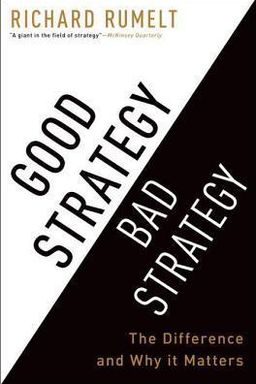
Why do most strategies fail while a few radically reshape industries? Richard Rumelt’s Good Strategy/Bad Strategy argues that the heart of effective strategy is not grand vision or motivational fluff, but clear diagnosis, decisive choice, and coordinated action. Rumelt calls this the kernel—a compact framework that separates real strategy from rhetoric. Good strategy begins when you stop pretending that goals are plans and face the real obstacles in front of you.
At its core, Rumelt proposes that strategy is a form of applied insight: you craft a way to overcome the most critical challenge. He divides this into three essential parts—diagnosis, guiding policy, and coherent actions. A diagnosis defines what’s really going on, the guiding policy sets a principle for response, and coherent actions are the tightly aligned steps that bring it to life. This triad is simple in theory but hard in practice—because it forces you to decide instead of merely proclaim.
The book’s arc: clarity, choice, and design
Across sixteen chapters, Rumelt dismantles the myths that make bad strategy persist—vague visions, unwillingness to choose, and worship of positive thinking—and then rebuilds from fundamentals. He teaches that good strategy is analytical and creative at once: you find leverage points through focus, proximate objectives, reframing, and design. You learn to detect weak links, exploit surprises, and ride waves of change. But all of these depend on disciplined thinking and courage to choose a path.
The examples range widely—Lou Gerstner’s IBM revival through reframing its purpose (“integrated solutions, not hardware”), Steve Jobs’s radical simplification of Apple’s product line, and Cisco’s positioning on the IP wave. Others illustrate failure: Enron’s jargon-filled fluff, Lehman Brothers’ goals-as-strategy, and Global Crossing’s market delusion. Through these stories, Rumelt makes strategy concrete and human: it’s about leaders facing uncertainty with clear eyes and coherent action.
The kernel as diagnostic tool
Rumelt’s kernel instantly clarifies why most companies confuse ambition with strategy. A goal—“grow 20%,” “be number one,” “transform culture”—has no mechanism. Only a diagnosis and guiding policy can link ambition to action. You can test any plan by asking three questions: What’s our diagnosis? What guiding policy arises from that? What coherent actions follow? If any is missing, you have a slogan, not a strategy.
Like a medical diagnosis, strategic diagnosis simplifies reality into a story that directs treatment. Kennan’s “containment” strategy against the USSR began with a clear diagnosis of Soviet motives. Lou Gerstner’s IBM turnaround required reframing the firm’s stagnation not as technological failure but as organizational misalignment. Steve Jobs’s Apple rescue used diagnosis (“too complex, bleeding cash”), guiding policy (“focus and simplify”), and coherent actions (“cut products, outsource manufacturing, sell directly”).
Why bad strategy dominates the world
Rumelt insists that bad strategy persists because it feels comfortable. It avoids trade-offs, glorifies motivation, and hides behind templates—“vision, mission, values”—that look strategic but aren’t. Organizations avoid choosing because choice creates pain and winners/losers. Moreover, consultants and executives substitute “New Thought” (positive thinking) for analysis. They believe fervor makes success inevitable, ignoring obstacles. Good strategy is uncomfortable precisely because it reveals what must be faced.
Understanding these roots matters. The reluctance to decide fosters consensus mush—commitments so vague that no one objects and no one acts. Breaking this pattern requires leadership willing to name problems and impose direction.
Focus, design, and reframing
A second major theme is focus—the act of concentrating effort on pivotal points of leverage. Good strategists reject distraction and diffuse action. Jobs’s product pruning, Schwarzkopf’s Desert Storm maneuver, and Marco Tinelli’s multi-stage coordination in Lombardy all show how focused moves create unexpected advantage. You surprise competitors by not behaving diffusely.
Reframing unlocks power. David beat Goliath not by matching strength but by changing the game—distance combat instead of armor battle. Sam Walton did the same by reframing the store-as-network, turning logistics and data into the unit of strategy. Andy Marshall reframed US defense planning by exploiting Soviet costly counters. In each case, insight, not size, created leverage.
Design and evolution
Strategy, Rumelt writes, is design under uncertainty. In “chain-link” systems—where weakest parts control total performance—you must coordinate multiple improvements together. Tinelli’s factory turnaround, JPL’s Voyager architecture, and IKEA’s tightly integrated flat-pack model illustrate how design coherence substitutes for sheer resources. High fit equals excellence but also fragility; when underlying conditions shift, integrated designs can crumble (as Xerox’s old model did).
You can’t escape constant change, but you can ride it. Waves of technological and regulatory shifts reshape industries. The strategist’s task is not prophecy but positioning—seeing a bit farther than others and acting early. Cisco rode four simultaneous technological waves by investing ahead of mainstream adoption. The principle: if you can see ten percent farther into an emerging attractor state (e.g., “IP everywhere”), you gain disproportionate advantage.
Thinking and judgment
Finally, Rumelt turns inward—to cognitive discipline. Strategy demands independent judgment amid noise and herding. You fight biases using tools: make lists, pre-commit your view before debate, destroy your own ideas, consult imaginary expert panels, and generate alternatives even after a “first good insight.” He warns against the “inside view”—believing your case is unique—and shows how herds inflated the cable and housing bubbles by mistaking price for truth. Strategic thinkers cultivate distance and sanity.
Core idea
Good strategy starts with clarity and choice. You diagnose reality, choose a guiding policy that focuses energy, and align coherent actions that reinforce one another. Everything else—vision statements, ambition, motivational talk—is decoration.
Rumelt’s book is a call to courage and craft. It teaches you that strategy is not planning—it’s design plus judgment. When you build it around the kernel, face challenges directly, and concentrate force at leverage points, you transform uncertainty into intelligent action.