
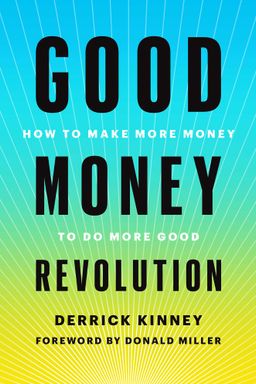
Good Money Revolution cover

Good Money Revolution

by Derrick Kinney

Good Money Revolution guides you to earn more money with a purpose. Derrick Kinney''s insights help you align financial success with meaningful generosity, transforming wealth into a tool for personal and global betterment. Discover the Good Money Framework to enhance your financial life and support causes you care about.

Money as a Force for Good

What if money wasn’t something to be ashamed of but a tool to make the world better? In Good Money Revolution, financial advisor Derrick Kinney challenges the deeply ingrained belief that money is bad—or that wealthy people are selfish. He contends that money itself is neutral; it simply takes on the character of the person using it. When good people acquire more of it, they can generate more good in the world. Kinney’s core argument is simple yet powerful: money is good, and good people should have more of it.

This book isn’t just about getting rich in the traditional sense; it’s about liberating you from guilt or fear around wealth. Kinney wants readers to move from mere success—defined by income or possessions—to significance, which comes from using money intentionally to improve other people’s lives. He frames this transformation as a revolution, inviting readers to join him in rewriting their personal money stories.

From Scarcity to Significance

Kinney begins with his own story of growing up modestly, wrestling with feelings of inadequacy, and realizing that even as a child he loved earning, saving, and giving. He argues that most people grow up with negative money conditioning—messages like "money is evil," "rich people are greedy," or "you should feel guilty for wanting more." Those beliefs create scarcity mindsets that block growth and generosity alike. Kinney’s approach flips this narrative: money, used wisely, becomes a multiplier of purpose and impact.

He shares how his clients—people from diverse backgrounds—often achieved career success but still felt emotionally empty. Their wealth met material desires yet failed to deliver joy. The missing ingredient? Generosity. Money alone cannot fill spiritual or emotional voids, but when it is connected to a purpose—a cause that aligns with your values—it becomes meaningful. As Kinney says, happiness isn’t what you have, it’s what you do with what you have.

The Good Money Framework

The book introduces a seven-step plan called the Good Money Framework, a practical method for connecting financial growth with generosity. It starts by discovering your “Generosity Purpose”—the cause that lights you up—and then helps you integrate that purpose into how you earn, save, invest, and give. Kinney’s formula looks like this: Earn more → Save more → Give more. Instead of waiting until you “have enough,” he advocates giving early and often, because small, consistent giving builds both wealth and character.

He also introduces key tools for financial freedom: saving proactively, eliminating debt strategically, and treating money as a flowing river rather than a stagnant pond. In his view, money should always be in motion—invested, shared, circulated—to create ongoing cycles of abundance. The framework brings together practical advice on investing, budgeting, generosity planning, and mindset shifts. It empowers readers not just to accumulate wealth but to use it to build legacy.

Why This Revolution Matters

Kinney’s message lands at a critical cultural moment. As he notes, it’s become fashionable to criticize wealth, equating success with exploitation. Yet his antidote is clear: when good-hearted people hesitate to earn and invest, power shifts to those who least deserve it. He urges you to replace guilt with purpose. You can make money ethically, build your financial confidence, and wield generosity as a form of influence. In this sense, Kinney’s philosophy aligns with voices like Adam Grant’s (Give and Take) or Rabbi Daniel Lapin’s (Thou Shall Prosper), emphasizing generosity and moral responsibility as pathways to prosperity.

Throughout the book, Kinney blends financial guidance with personal development, teaching that mastering your money story is synonymous with mastering your life story. His invitation is revolutionary not because it promises overnight wealth, but because it reframes making money as an inherently good act. As he writes, “Surely your goal is not to be the richest person in the cemetery.” Instead, he wants you to become a wealth creator who earns with purpose, saves with discipline, and gives with joy.

Key takeaway:

Kinney calls for a mindset shift—from fear and scarcity to abundance and significance. Money isn’t about accumulation; it’s about activation. Good people making good money are the ones who change the world.


The Generosity Purpose

At the heart of Derrick Kinney’s philosophy is what he calls your Generosity Purpose. This is your personal mission—the cause that bothers you enough to take action. It might be caring for the homeless in your city, supporting education for at-risk children, or funding clean water projects abroad. Whatever it is, Kinney says it should ignite a fire within you, driving both your business decisions and personal goals.

Pairing Purpose with Profits

Generosity, Kinney argues, isn’t just good for the soul—it’s good for business. He tells the story of Dave, a manufacturing-company owner who had lost his motivation. When Kinney suggested linking his company’s growth to building a school in a village he had once visited, Dave’s enthusiasm—and profits—surged. Within three months, his sales increased by 20 percent. His purpose had reignited his passion and performance. This pattern repeats throughout the book: meaning fuels momentum. The act of giving energizes your business, helps you attract clients who share your values, and brings satisfaction that money alone cannot deliver.

Small Steps Create Big Impact

Kinney emphasizes that generosity doesn’t require millions. Start small. Michelle, a client inspired by her own family’s struggles with homelessness, began donating monthly to a local shelter. Her contribution may have seemed modest, but the emotional return was immense: she found fulfillment, purpose, and pride in her work. This snowballs. The more you give, the more motivated you feel to earn—and as you earn more, you’re able to give more. Kinney calls this the cycle of giving, a self-reinforcing loop of prosperity and impact.

He compares this approach to the business model of companies like Bombas and TOMS, which tie every sale to a charitable act. These brands thrive not in spite of their generosity, but because of it. Their customers value the chance to participate in something meaningful. Kinney challenges readers to apply the same principle in their own lives: make your income an engine for justice and joy. (Note: Bea Boccalandro’s Do Good at Work offers similar research showing that businesses rooted in social purpose boost productivity and morale.)

Key takeaway:

Your Generosity Purpose links emotion to economy. It transforms financial goals into human goals, making wealth creation not just permissible but noble.


The Good Money Framework

Kinney offers a detailed seven-step system for transforming financial confusion into confidence. He calls it the Good Money Framework, and it operates like a GPS for both earning and impact. Each step translates abstract ideals into concrete, doable actions.

Step 1: Discover Your Generosity Purpose

Define your cause—the wrong you want to help right. Kinney gives exercises where you identify the emotion and injustice that move you most and choose an organization or project to support. It might be helping your local food bank, funding a scholarship, or aiding victims of trafficking. Writing down this purpose makes it real.

Steps 2–7: From Goals to Giving

  • Set your top three financial goals. Visualize exactly what you want—debt freedom, home ownership, or retirement security—and give each goal a meaningful reason and deadline.
  • Determine your desired income. Kinney asks, “What income would reflect your true worth?” Then tie that number to your giving ambitions so it’s anchored in purpose, not greed.
  • Review ways to earn more. This might include asking for a raise, starting a side hustle, or acquiring a new certification. Kinney cites examples like teachers publishing classroom guides or working parents driving for DoorDash to fund family goals.
  • Create a simple saving and investment plan. Forget overcomplication; automate deposits into savings, debt repayment, and giving accounts to make progress effortless.
  • Implement a generosity strategy. Don’t wait to give—do it now. Kinney teaches that money in motion has more impact than dollars sitting idle.
  • Track your progress. Schedule quarterly reviews not only of your assets but also of your generosity. Include family or friends; celebrate wins together.

Kinney’s framework democratizes wealth management. You don’t need a finance degree; you need clarity, consistency, and commitment. He compares your money to employees: each dollar should have a job—whether it’s saving, investing, giving, or building joy.

Key takeaway:

The framework turns intentions into actions. It’s about doing good while doing well—aligning your day-to-day financial habits with your highest values.


Investing in Buckets and Lanes

Kinney simplifies the intimidating world of investing with memorable metaphors he calls buckets and lanes. His goal is to help you stop treating investing as a mysterious art reserved for experts and instead see it as a common-sense system that multiplies your purpose.

Three Buckets for Balanced Growth

Kinney identifies three kinds of investments: for yourself, in yourself, and in others. “Invest for yourself” includes traditional returns—stock portfolios, retirement accounts, or real estate. “Invest in yourself” means reading, studying, and developing new skills to boost your earning ability. “Invest in others” involves helping others grow—mentoring, sponsoring education, or supporting people’s dreams. This triad produces holistic wealth: financial, emotional, and social.

Four Lanes of Financial Traffic

He further segments investment strategy into four “lanes” like a highway: (1) Checking/savings for liquidity, (2) Two-to-five-year investments for midterm goals, (3) Retirement accounts for long-term stability, and (4) A “play account” for high-risk, high-reward opportunities. This layout helps you avoid rushing into the wrong lane and losing focus. The metaphor demystifies diversification—each lane travels toward the same financial freedom destination at different speeds.

Save Like a Pessimist, Invest Like an Optimist

Quoting investor Morgan Housel, Kinney advises readers to “save like bad times are coming, invest like good times will last.” That means you keep safety buffers—low debt, emergency savings, and modest risk tolerance—while maintaining long-term optimism about innovation and human progress. This blend of caution and confidence ensures sustainability rather than speculation.

Kinney personalizes this wisdom with stories from his marriage: when he and his wife divided roles in managing money, aligning strengths turned chaos into harmony. The lesson is that smart investing isn’t about chasing returns—it’s about creating systems that work for you and expressing trust in the future through purposeful action.

Key takeaway:

Investing well doesn’t mean getting rich quick—it means building resilient wealth aligned with your purpose. By diversifying across buckets and lanes, you earn twice: once from your work and once from your wisdom.


Flip Your Money Mindset

In Part Two, “Bad Money,” Kinney dismantles limiting beliefs that sabotage financial growth. He reveals five attitudes—scarcity, strain, resentment, fear, and hopelessness—that hold people back. These mental scripts often stem from childhood experiences, cultural conditioning, or toxic narratives equating wealth with corruption. His antidote: flip the script.

Rewriting the Narrative

Kinney describes clients who tremble at balancing a checkbook or feel ashamed asking for a raise because they were taught that money causes conflict. He offers a series of reflections: recall your earliest money memory—was it joy or fear? Identify the belief behind it, and rewrite it to say, “Money is a tool I can use to do good.” This simple exercise separates your identity from your inherited anxieties.

Drawing on insights from financial psychologist Brad Klontz (who coined “money scripts”), Kinney warns that unconscious beliefs drive financial behavior more than logic. If you constantly say “I’m bad with money,” you will behave accordingly. Change the self-talk, and you’ll change your results. As author Ramit Sethi explains in I Will Teach You to Be Rich, mindset precedes mechanics—you can’t budget your way out of shame.

The Power of Self-Worth

Kinney emphasizes self-value as the foundation of wealth. You must believe you deserve prosperity. Quoting Donald Miller, he reminds us that “God created you so others could enjoy you, not endure you.” When you view yourself as valuable, you act more confidently—asking for raises, starting businesses, investing generously. Fear dissipates when worth replaces worry.

Key takeaway:

Money beliefs are psychological ceilings. Break them by reframing money from a moral issue to a purposeful tool. Once your mindset shifts, wealth follows naturally.


Giving Changes Everything

In Part Three, Kinney explores how giving transforms not just recipients but givers themselves. He compiles heartwarming stories—from a student sleeping in a tent who inspired a community’s generosity to his own children giving away their shoes at a homeless shelter. Each story reinforces his thesis: giving awakens fulfillment, health, and happiness.

The Ripple Effect of Kindness

Citing Harvard researchers, Kinney explains that generosity triggers a contagion of altruism. When one person gives, three more are inspired to do the same. He illustrates this with the moment his daughter Lauren saw another volunteer remove his shoes for a homeless man—within minutes, all four Kinney children followed. Generosity is behaviorally viral, spreading empathy through social networks.

Health and Happiness

Giving doesn’t just warm the heart—it alters your biology. Kinney quotes research showing that volunteering lowers stress, blood pressure, and even mortality rates. The act of helping releases oxytocin, producing the “helper’s high.” He tells the story of Mary, a widow who regained vitality by working at a baseball stadium and donating her income to a food bank. Her generosity restored her well-being in ways medicine never could.

Giving Is Good Business

On a larger scale, Kinney demonstrates that generosity fuels commercial success. Companies like TOMS Shoes and Bombas prove that doing good sells because people trust givers. He also recounts his own experience as “the giving investment advisor”—clients were drawn not only to his financial acumen but to his community involvement. Generosity builds reputation, loyalty, and meaning. (Jason Feifer of Entrepreneur magazine echoes this: businesses that connect with communities thrive.)

Key takeaway:

Giving transforms money from a transaction into a relationship. It strengthens hearts, families, and economies—and proves that the best investment is in others.


Living the Good Money Revolution

In his closing chapters, Kinney urges readers to join the Good Money Revolution—a lifelong movement of earning ethically, saving wisely, and giving fearlessly. It’s not merely a financial plan but a worldview: money managed with integrity and generosity becomes an eternal investment.

Eternal Investing

Kinney borrows from author Randy Alcorn’s “dot and line” illustration: the dot represents your time on earth, while the line symbolizes eternity. Too many people obsess over the dot—their current comforts—forgetting the infinite impact they could make beyond it. He encourages giving now, not later, because today’s gifts compound spiritually. A $2,000 donation today can spark decades of change that ten times that amount in a future will might never achieve.

The Good Money Challenge

Kinney ends with a call to action—a pledge where you commit to earn, save, and give more. He invites readers to sign the challenge as a symbolic contract with themselves: “I believe that money is good. Good money in the hands of good people gets good work done.” It’s a declaration that financial stewardship is moral leadership.

Underlying all these lessons is one philosophy: life isn’t about having more—it’s about doing more with what you have. You may never become a billionaire, but you can become a creator of good wealth, a person whose money tells the story of compassion and courage. As Jon Gordon’s quote reminds us, “When we die, it’s going to matter—did we make a difference?”

Key takeaway:

The revolution doesn’t end with reading—it begins when you act. The way you earn, spend, and give becomes your legacy, echoing far beyond your lifetime.

Dig Deeper

Get personalized prompts to apply these lessons to your life and deepen your understanding.

Go Deeper

Get the Full Experience

Download Insight Books for AI-powered reflections, quizzes, and more.