
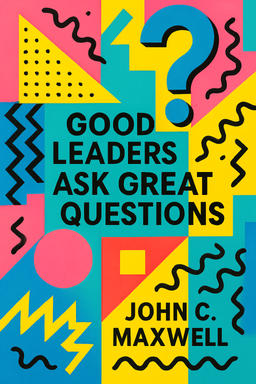
Good Leaders Ask Great Questions cover

Good Leaders Ask Great Questions

by John C Maxwell

In ''Good Leaders Ask Great Questions,'' John C. Maxwell reveals how the art of questioning is integral to successful leadership. Learn to drive innovation, foster personal growth, and engage your team effectively by mastering the art of inquiry.

Leadership Begins with Questions and Influence

What if the secret to stronger leadership isn’t having the right answers—but asking the right questions? John C. Maxwell, one of the most influential leadership thinkers of our time, argues that authentic leadership begins not with authority or talent, but with influence fueled by curiosity, listening, and service. Drawing on decades of mentoring and leading teams, Maxwell frames leadership as a relational art grounded in humility and learning.

In this synthesis of his core ideas, leadership unfolds as a progression: from asking great questions and leading yourself daily, to listening deeply, building question-friendly teams, serving others, and leading through seasons of challenge and change. Each stage transforms leadership from control to connection, from tasks to transformation.

The essence of influence

Maxwell opens with the truth that leadership is influence—nothing more, nothing less. Influence, he explains, doesn’t come from job titles or charisma but from trust, credibility, and value creation. A leader’s task is to add value to others and to serve as a catalyst for growth. Harry Allen Overstreet’s line captures the heart of this idea: those who can capture and hold attention shape human behavior. To do so, you must pursue character, relationships, and communication with intention.

Influence compounds over time, much like relational capital—it grows with consistent integrity, service, and trust. Maxwell’s own trajectory (building organizations like EQUIP and the John Maxwell Team) illustrates how mutual respect and listening produce movements, not just enterprises.

The power of questions

At the core of Maxwell’s leadership model lies a deceptively simple practice: ask great questions. Great questions unlock doors to understanding, relationships, and innovation. They spark curiosity, disarm defensiveness, and turn ordinary conversations into discovery sessions. Leaders who ask “why” and “what if” shift from managing to mentoring. Thomas J. Watson once said, “The ability to ask the right question is more than half the battle of finding the answer,” and Maxwell builds his first principle around this truth.

He distinguishes between problem-solving questions (What’s really happening?), connection questions (What matters most to you?), and exploratory questions (What else might be possible?). Each type leads to a different kind of breakthrough—intellectual, relational, and creative.

Listening as leadership

However, Maxwell cautions that questions without listening are empty. Listening is the multiplier that transforms curiosity into connection. Drawing from Co-Active Coaching’s framework, he explains three levels of listening: internal (self-focused), focused (person-focused), and global (environmentally aware). High-impact leaders master Level II and III listening—reading tone, emotion, and atmosphere to lead compassionately and accurately.

Listening, he insists, is leadership in action. Leaders must welcome real feedback, especially from close advisors. Maxwell’s practice of empowering aides like Linda Eggers to offer candid truth shows how listening builds organizational honesty and collective learning.

The mirror principle: lead yourself first

Leadership maturity requires self-interrogation. Borrowing from Coach John Wooden’s example—asking daily how he could make his team better—Maxwell developed seven guiding self-questions: Am I investing in myself? Am I grounded? Am I adding value to my team? Am I in my strength zone? Am I taking care of today? Am I surrounding myself with the right people? These prompts make reflection habitual and prevent leadership drift.

Leading yourself begins with humility. It involves noticing your own blind spots—ego, insecurity, or narrow perspective—and inviting trusted colleagues to expose them. By acknowledging limits and building truth-telling teams, you foster strength through transparency.

From serving to multiplying

Maxwell’s leadership philosophy culminates in service. He echoes Robert Greenleaf: “The servant-leader is servant first.” When you serve people’s growth, you earn credibility and loyalty. Leadership ceases to be about personal advancement and becomes about creating success for others. In crises, this servant posture keeps hope alive; in stability, it multiplies capacity by developing potential leaders.

Service, purpose, and influence intertwine. As you clarify your strengths and life purpose, align your daily habits with what makes you come alive (“what makes you sing, cry, and dream”). Purpose-rooted leaders inspire trust and legacy—whether shepherding teams or leading global initiatives. (Note: This echoes Viktor Frankl’s and Simon Sinek’s emphasis on “why” as the foundation of inspiration.)

Leadership as seasons and rhythm

Finally, Maxwell portrays leadership as cyclical: winter (planning), spring (planting), summer (cultivation), and autumn (harvest). Awareness of seasons keeps you from forcing growth and allows patience in development. Similarly, his shift from producer to leader mirrors life’s rhythm—moving from doing to developing others, from leading tasks to leading people. Mature leadership sees further, commits longer, and serves deeper.

Ultimately, Maxwell’s unified message is simple yet profound: great leaders stay curious, listen well, serve first, and grow others continuously. Influence rooted in curiosity and character—not control—creates the kind of leadership that outlives its era.


Mastering the Art of Questions

Good leaders provide answers; great leaders ask the questions that reveal better ones. For Maxwell, the act of questioning is foundational because it drives learning, trust, and collaboration. Questions are mental keys that unlock possibilities normally hidden behind assumptions or fear. They replace pride with curiosity and control with discovery.

Why questions expand leadership

Maxwell notes that most people resist asking questions for fear of looking uninformed. Yet, as entrepreneur Richard Thalheimer said, it is better to look uninformed than to remain uninformed. Questions reflect humility—the gateway to wisdom—and reveal your genuine interest in others. Whether speaking with Condoleezza Rice or mentoring team members, Maxwell models preparation and curiosity to open relational and intellectual doors.

He recommends repeatedly asking three universal questions: “What can I learn?”, “Who can help me?”, and “What can I share?” They create continuous growth loops between mentor and mentee, idea and action. (Note: This framework parallels Peter Drucker’s consulting philosophy—leading by asking smarter questions.)

Question types and their value

  • Problem-solving questions: Get to root causes (“Why did this happen?”). Effective for diagnosis and innovation.
  • Connection questions: Build empathy (“What matters to you right now?”). Strengthen trust and collaboration.
  • Exploratory questions: Stimulate imagination (“What if we tried…?”). Encourage creativity and risk-taking.

Each type of question aligns with a leadership need—clarity, relationship, or growth. The skill lies not only in asking but in listening actively to the answers before responding.

Action plan for question-led leadership

To become a question-led leader, Maxwell outlines a three-step routine: write down your strategic questions weekly, identify the right people to ask, and listen harder than you speak. Over time, this habit builds what he calls “a culture of curiosity.” In practice, this means beginning meetings with “Who has a question?” instead of “Here’s what we’ll do.”

A practical maxim for every leader

“Good questions inform; great questions transform.” —John C. Maxwell

When you lead with curiosity, you empower others to think, contribute, and create. The outcome isn’t just better decisions—it’s a learning organization where leadership becomes a shared process rather than a positional one.


Listen to Lead

Maxwell teaches that listening is leadership’s multiplier. Without attentive listening, even great questions or strategies fail to connect. He distinguishes superficial hearing from transformational listening—the kind that uncovers emotion, tension, and opportunity.

The three levels of listening

  • Level I: Internal Listening—focus on your own perspective. It’s functional but self-centered.
  • Level II: Focused Listening—attention shifts outward; you read tone, words, and intent.
  • Level III: Global Listening—you sense the environment and adapt in real time. This is the leader’s zone.

Why listening builds influence

Listening honors others’ voices and diffuses defensiveness. It fosters trust because people feel seen, not managed. Maxwell’s organizational practice—empowering assistants and inner circle members to tell him hard truths—models psychological safety in action. His story of miscommunication with David Hoyt in Malaysia illustrates how failed listening undermines credibility and results.

Habits that strengthen listening

  • Create an open-ear policy—invite feedback before decisions are final.
  • Stop interrupting—silence is often your strongest tool.
  • Reflect what you heard—clarify meaning rather than assuming agreement.

Listening transforms leadership from monologue to dialogue. As Maxwell puts it, leaders who listen well expand their influence; those who don’t shrink it.


Lead Yourself Before You Lead Others

Leadership always begins on the inside. Maxwell’s daily discipline, inspired by Coach John Wooden’s habit of self-questioning, is to check alignment between values, motives, and actions. You can’t lead others effectively until you’ve learned to lead yourself consistently.

Seven daily self-questions

  • Am I investing in myself? (Personal growth powers future impact.)
  • Am I genuinely interested in others? (Service must replace self-importance.)
  • Am I grounded and humble? (Humility preserves authenticity.)
  • Am I adding value to my team? (Focus daily on contribution.)
  • Am I in my strength zone? (Work where returns are exponential.)
  • Am I caring for today? (Prioritize health, relationships, and mission.)
  • Am I with the right people? (Your circle determines your ceiling.)

These questions replace drifting with intentionality. They transform reflection into rhythm. Maxwell recommends journaling, weekly reviews, and mentor accountability to hardwire growth into your schedule.

Seeing and removing blind spots

Your biggest leadership risks are things you can’t see—singular perspective, insecurity, ego, or weak character. The fix begins by assuming you have blind spots and creating a feedback culture to expose them. Invite truth-tellers, accept correction, and build structures to cover weaknesses. Gandhi’s alignment—thinking, feeling, speaking, and acting consistently—shows how eliminating internal contradictions amplifies integrity.

By mastering your inner world, you become trustworthy in the outer one. People follow authenticity before expertise.


Serve to Lead

For Maxwell, the highest level of leadership is servanthood. Leadership and service are not opposites but the same discipline—putting others first and multiplying value. Influence rooted in ego is fragile; influence rooted in service endures.

Servant-first posture

Building on Robert Greenleaf’s classic servant-leader model, Maxwell argues that leadership starts with the question: “How can I serve you?” This mindset prevents positional arrogance and keeps leaders connected to real needs. Maxwell himself practices this question daily with his team, modeling authentic humility.

Delegation and accountability

Servanthood requires empowering others through delegation—not dumping tasks, but assigning them with context and trust. Byron Dorgan’s reminder applies: you can delegate authority, but never responsibility. Maxwell’s 80% rule—if someone can perform a task 80% as well as you, delegate it—frees you to lead while developing others.

Leading in adversity

A serving leader anchors teams during crises. Define reality, communicate hope, and guide practical recovery steps. Maxwell emphasizes that leadership during hard times isn’t about having certainty—it’s about sustaining belief when others lose it. Hope becomes a strategic asset.

You serve to lead, and you lead to serve. When your motive is helping others succeed, you build the kind of loyalty and legacy that no title can command.


Create Question-Driven Teams

Curiosity must become a cultural habit, not an individual quirk. Maxwell advises building teams where questions are welcomed and where the best idea wins, regardless of title. In such environments, humility and collaboration replace hierarchy and fear.

Selecting people for shared thinking

His meetings—often called “learning lunches” or “Table sessions”—bring together people of diverse backgrounds who balance character, competence, and curiosity. He chooses people who add value, adapt emotionally, and celebrate others’ success. These qualities foster what he calls “the midwife effect”—helping ideas come to life through mutual questioning.

Designing question-friendly structures

  • Eliminate positional authority during discussions.
  • Rotate roles (facilitator, devil’s advocate, synthesizer) to prevent stagnation.
  • Reward curiosity and collaboration over ego-driven certainty.

Teams flourish when curiosity is institutionalized. As Maxwell’s organizations demonstrate, consistent meetings that privilege questions generate creative breakthroughs and collective ownership of decisions.


Lead with Purpose, Strength, and Seasons

To sustain influence, you need clarity of purpose and rhythm of growth. Maxwell intertwines these through three lenses: your unique calling, your personal strengths, and leadership seasons.

Discovering your purpose

Borrowing from Martin Luther King Jr., Maxwell challenges: “If a person hasn’t found something to die for, they’re not fit to live.” Purpose directs passion and endurance. Use reflective questions—what makes me sing, cry, dream, excel, and differ?—to identify patterns of meaning. Each answer reveals where your authentic leadership should flow.

Leveraging your strengths

Authentic leadership thrives on self-awareness. Rather than imitating others, lead from your natural temperament. Maxwell identifies humor, authenticity, confidence, hope, and simplicity as his strengths; yours might vary. Feedback, tools like StrengthsFinder, and introspection clarify which roles suit your wiring. Introversion, he reminds us, is not a limitation—it can be a leadership asset for reflection and trust-building.

Recognizing leadership seasons

Leadership progresses in rhythms: winter (plan), spring (plant), summer (cultivate), and autumn (harvest). Recognizing these cycles allows patience and strategic timing. In life’s decades, Maxwell maps alignment in your 20s, advancement in your 40s, and legacy-building in your 60s. Whatever the season, be faithful to plant, nurture, and harvest.

When purpose directs you, strengths empower you, and timing guides you, your leadership transforms from reaction to rhythm. You stop chasing urgency and start cultivating legacy.


Grow Leaders, Not Followers

Mature leadership means multiplying others’ capacity. Maxwell describes the shift from being a high-performing producer to an empowering leader. Early-stage leaders focus on doing; advanced leaders focus on developing others who can do even more.

Shifting focus: me → we

At first, your value lies in personal output. But remaining indispensable traps you at a lower leadership level. The goal is to enable independence in others—coaching, delegating, and designing systems that scale. Maxwell urges leaders to prioritize tasks that give the greatest organizational return, not merely personal reward. The 80% delegation rule applies again: release tasks someone else can handle nearly as well.

Followership and humility

Great leaders also practice following. Quoting Aristotle, Maxwell reminds us, “Who would learn to lead must first learn to obey.” Following cultivates empathy and restraint. Leaders who understand how it feels to be led create healthier teams where authority is shared, not imposed. This flexibility allows leadership to flow naturally among those best positioned for each moment.

Organizations that prize growth through others outperform those that prize individual heroics. Your enduring success depends on how many leaders you raise, not how much you personally achieve.


Lead Through Conflict and Change

Conflict and transition test a leader’s maturity more than any speech or strategy. Maxwell presents clear frameworks for handling both challenges with integrity.

Resolving conflict

When conflict arises, act quickly and privately. Ask if the person can change (skill) and will change (attitude). Discuss specifics, listen carefully, set written expectations, and affirm their worth. If willingness is absent, protect the team’s health by letting go—your first loss should be your last. Clarity is kindness.

Navigating poor leadership and transition

Working for a difficult boss or preparing succession demands diplomacy. First, examine your own role, gather facts, and approach others in private with solutions, not accusations. If the relationship cannot be redeemed, leave honorably. When passing leadership, begin early and plan deliberately—like Jack Welch or Bob Russell, train your successor as you run your leg of the relay.

Change is the constant where character is tested. Grounded leaders confront truth quickly, communicate with compassion, and exit with grace. Legacy is measured not by tenure, but by continuity.

Dig Deeper

Get personalized prompts to apply these lessons to your life and deepen your understanding.

Go Deeper

Get the Full Experience

Download Insight Books for AI-powered reflections, quizzes, and more.