
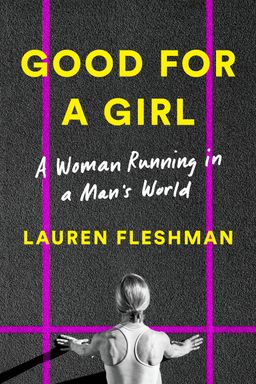
Good for a Girl cover

Good for a Girl

by Lauren Fleshman

In ''Good for a Girl,'' Lauren Fleshman shares her journey as a pro runner navigating a male-dominated sports world. This memoir-manifesto reveals systemic gender biases and advocates for empowering change, offering a compelling call to action for equality and health in athletics.

Running in a Man’s World: Rethinking Women’s Sports

What happens when the arenas we've been told are equal were never truly designed for us? In Good for a Girl, Lauren Fleshman tackles that question with unflinching honesty and the sharp insight of someone who has lived both the triumphs and traumas of being a woman runner in a world built for men. Fleshman argues that even fifty years after Title IX, sports remain a male template adjusted superficially for girls, forcing female athletes to conform to performance standards, training methods, and expectations that ignore the biology, psychology, and lived experience of women. This mismatch, she contends, is quietly harming millions of girls and women—and it's time to rebuild the system from the ground up.

At its core, Fleshman’s message is simple but radical: equality isn’t about women doing what men do. It’s about understanding women’s bodies, experiences, and development as unique and valuable. This book is both a memoir and manifesto—a story of growing up as a competitive girl runner, becoming a world-class athlete, struggling through the consequences of misunderstanding female physiology, and finally stepping into leadership as a coach and advocate. Through it, Fleshman invites you to reconsider how girls are taught to move, compete, and define success.

The Cost of Competing Like a Man

Fleshman opens with vivid scenes from her coaching life, watching young women training for the Olympic Trials. She contrasts their strength and determination with the invisible wounds carried by generations of female athletes—eating disorders, stress fractures, lost menstrual cycles, and deep-seated shame about their bodies. These problems, she writes, are not freak accidents but predictable outcomes of designing sports around male puberty patterns, male hormones, and male ideals of competitiveness.

Her own life mirrors this. From a fearless child who raced boys in the schoolyard to an elite athlete who tried to suppress her body’s female changes to keep winning, Fleshman reveals how the transition from girlhood to womanhood became a professional obstacle. Puberty, menstruation, and weight shifts were viewed as liabilities to performance. Coaches didn’t know how to talk about them. So girls learned to hate their bodies just as they were supposed to be discovering their power.

When Equality Backfires

Fleshman’s feminist critique centers on the flawed definition of equality that emerged post–Title IX: that girls should get what boys have, and achieve it the way boys do. While this opened doors, she argues that it also set a trap. Female athletes were squeezed into a male model of linear improvement and ripped away from the natural rhythms of their biology. Young runners were praised for childlike physiques and punished silently when they matured. The sports system treated puberty as failure, health as weakness, and masculine coachability as the feminine ideal.

This approach led to a constant message: to win, you must be less woman, more machine. Fleshman expands this idea beyond running to all sports, noting how the male body’s hormonal advantage during late adolescence produces different trajectories. Yet coaching and training pipelines still expect girls to mirror boys’ improvement curves. The result is alarming: girls drop out of sports at twice the rate of boys by age fourteen, often believing their bodies betrayed them.

Sport as Liberation—and Trap

Fleshman’s memoir traces a double-edged truth: sports gave her freedom, identity, and self-belief—but also pain, pressure, and alienation. Her father’s early lessons in toughness (“kick them right in the balls!”) taught her that defying limits was how girls earned power. But later, that same mindset trapped her in a pattern of overtraining and perfectionism. Her college and professional careers reveal how easily sport can encourage disconnection from one’s body. The more she aimed to be “exceptional,” the more she learned to ignore hunger, fatigue, and emotion.

Through injury, disordered eating, and exhaustion, Fleshman begins to suspect the problem isn’t individual failure—it’s systemic blindness. When she finally transitions to coaching, she discovers the power of a different approach: nurturing athletes holistically, teaching them to listen to their hormones, cycles, and emotions as sources of wisdom, not weakness. The transformation is profound. Athletes flourish when coached by someone who sees them as full human beings.

Why This Book Matters

Fleshman turns her personal story into a larger call for cultural change. She connects individual suffering to the institutions—school sports programs, NCAA teams, and professional sponsorships—that overlook women’s physiology. She critiques corporations like Nike for marketing empowerment while punishing female athletes financially for pregnancy or body changes. Drawing parallels to broader research (such as Caroline Criado Perez’s Invisible Women), Fleshman demonstrates how data gaps and male-default science leave women vulnerable across every field, not just sports.

Her solution isn’t simply more funding or access, but a new ethical standard for how we define excellence. We need coaches trained in female physiology, policies that monitor menstrual health like concussion safety, and a cultural shift that values longevity and joy over medals. In her closing chapters, Fleshman’s tone changes from critique to creation: she founds Littlewing Athletics, a female-centered training team in Bend, Oregon, proving that humane coaching can produce world-class results without breaking bodies or spirits.

Core Message

“Equality isn’t sameness. True equality requires designing systems around the real experiences of women—their bodies, rhythms, and lives. Anything less will keep calling harm ‘hard work.’”

Through memoir, science, and activism, Good for a Girl reminds you that empowerment isn’t earned by erasing difference. It’s claimed by embracing it. Fleshman’s vision reframes how you might see your own work, your body, and your pursuit of success: not as a battle to become what someone else defines, but as a practice of listening to what’s already true in you.


The Female Performance Wave

One of Fleshman’s most groundbreaking concepts is what she calls the female performance wave—the natural rhythm of improvement, plateau, and resurgence caused by hormonal and developmental changes. She argues that while boys grow stronger and faster almost continuously through adolescence, girls experience a performance ebb. Coaches often read this as weakness and push harder, when in reality it’s the body reorganizing into adult strength. Ignoring this leads to injury, burnout, and identity loss.

Understanding the Wave

Female puberty changes everything: body composition, energy use, pain tolerance, and even motivation patterns. Yet most training models treat the menstrual cycle as irrelevant or inconvenient. Fleshman shows how female athletes need time and education to adapt to these changes instead of fighting them. Her own sophomore slump at Stanford became a turning point—she stopped trying to shrink into her prepubescent form and instead learned to fuel properly and respect her body. The result? A return to national championship shape and newfound joy in competition.

The Cost of Ignorance

Because this wave isn’t widely understood, thousands of girls quit sports at puberty. Many restrict calories to ‘freeze’ their bodies in the lean, childlike phase of performance, destroying bone density and hormonal health. Fleshman cites statistics showing that up to 75% of female teen runners exhibit signs of disordered eating and that stress fractures are three times more common in girls. She calls this crisis the predictable outcome of teaching girls to see their biology as an obstacle.

When coaches are educated in female physiology—understanding how periods affect performance, energy, and recovery—they can design training around the body’s rhythm. She calls for mandatory education on menstrual health and puberty for all coaches working with female athletes, much like the NCAA’s concussion protocols. (She echoes Dr. Kate Ackerman’s research on RED-S—Relative Energy Deficiency in Sport—as evidence that low energy availability compromises long-term health.)

Riding, Not Resisting

Fleshman reclaims the female performance wave as normal and even powerful. Growth isn’t linear—it’s cyclical. The plateau is not failure but incubation: a period when the body restructures strength for adult capacity. When women respect this and reframe comparison, their potential skyrockets in their mid-twenties and thirties—the very ages when male athletes begin to decline. Her own coaching proves this: every athlete at her Littlewing Athletics team eventually surpassed their college best once given time and holistic care.

Key Takeaway

Instead of teaching girls to outrun puberty, Fleshman urges us to help them ride the wave—to understand that discomfort is transformation, not defeat.

By highlighting this unseen rhythm, Fleshman opens a path toward sustainable excellence. You realize that thriving—whether in sport, career, or growth—requires learning when to push, when to rest, and when to trust the body’s wisdom. It’s not about being consistent according to someone else’s timeline; it’s about being consistent in honoring your own.


Puberty, Body Image, and Sport Culture

Fleshman paints puberty as sport’s great unspoken turning point. Before puberty, girls run, jump, and play on equal footing with boys. But once hormones shift, the system changes the rules without saying so. Bodies soften, breasts develop, hips widen—and coaches respond with silence or subtle punishment. Athletic girls suddenly face a conflict between function and perceived femininity. The result is a paradox that haunts women throughout their sports lives.

When Growth Feels Like Betrayal

As Fleshman’s own body changed in adolescence, she watched boys sprint ahead while girls were told they’d fallen behind. She internalized that to win meant staying childlike. The locker room became a battlefield of self-conscious adjustments—wedgies, shirt tugs, avoidance of mirrors. These scenes mirror sociological research showing 87% of teenage girls in sports feel embarrassed about breast movement and 65% develop disordered eating patterns. Fleshman makes these statistics real through her own story: the eighth-grade dressing room taunts about her flat chest taught her that femininity felt incompatible with strength.

Coaches and the Culture of Silence

No one talked to her—or any girl—about what was happening. Male coaches feared being labeled inappropriate; female assistants were underpaid, with “also menstruates” as their main credential. This silence allowed myths to rule: that thinner is faster, that missing periods is normal, that pain means progress. Fleshman dismantles these lies by showing how they arise from fear and ignorance, not science. She demands coaches be trained to speak openly about puberty, periods, and nutrition as signs of health, not weakness.

The Clash of Function and Appearance

One of Fleshman’s most poignant insights is what scholars call the “body duality” of female athletes—the expectation to be both physically dominant and aesthetically pleasing. Her father’s admiration for her toughness (“You’ve got balls the size of Texas!”) burned early messages about power being masculine. Later, she discovered a harsher truth: female champions could be celebrated only if they looked good doing it. Watching the 1996 U.S. gymnastics team win gold despite abuse and starvation diets, she realized “coachability and beauty” had replaced health and agency as values. She sees this as the defining contradiction of sport culture.

Fleshman’s Reframe

“The trained female body isn’t wrong because it’s different. It’s only wrong because someone taught you to measure it against a male ideal.”

When Fleshman later coaches, she deliberately creates a space where female athletes learn to see muscles, curves, and menstrual cycles as part of their professional toolkit. Her evolution pushes you to question how many parts of your own body story were shaped not by truth but by silence. Recognizing that silence is the first step toward rewriting it.


The Economics of Gender in Professional Sports

Moving into her professional career, Fleshman exposes the powerful intersection of sexism and economics. Her detailed accounts of negotiating contracts with Nike reveal an industry where women’s bodies are assets only when they fit a narrow mold. A male runner with the same record would earn six figures, while female athletes are offered half—or punished for pregnancy with total pay suspension.

The Market of the Male Gaze

Fleshman recounts meetings with sports marketing executives who told her outright that “men watch sports, not women” and that “the female athletes worth watching are the ones who appeal to men.” These comments weren’t anomalies—they were policies shaping who gets sponsorships and airtime. Even Nike’s women’s catalogs featured models who looked more like lingerie ads than athletes. When Fleshman challenged this, she landed an audience with CEO Mark Parker and pushed for real female athlete representation. Her insistence led to a groundbreaking photo campaign—“Objectify Me”—featuring herself in athletic gear, not naked, and reframing objectification as acknowledgment of female strength.

Pregnancy as Professional Liability

Perhaps the sharpest critique comes from Nike’s treatment of pregnant athletes. Fleshman reveals she was offered $25,000 per year post-pregnancy, down from six figures, with all pay suspended until she “returned to race form.” Other Nike runners like Kara Goucher and Alysia Montaño confirmed similar treatment in later exposés. Fleshman’s experience became a bridge to activism—showing how corporate contracts replicate reproductive discrimination. She left Nike for a women-led brand, Oiselle, which welcomed her pregnancy as part of her narrative, not an interruption.

Redefining Value

This story reframes success: Fleshman learned that market power shouldn’t depend on body conformity but contribution. By cofounding Picky Bars and championing athlete health as brand worth, she proved female entrepreneurship can rewrite sports economics. Her eventual collaboration with Oiselle and advocacy for reform inspired other pros like Kara Goucher to join and speak out. Together, they sparked industry-wide movements for contract equality and parental rights.

Insight

Money reveals what a culture truly values. In sports, it’s time to value women’s full selves—not the fragments that sell shoes.

Fleshman’s journey through sponsorship illuminates far more than personal struggle; it’s a mirror for how corporations define worth through visibility and compliance. Her defiance transformed financial punishment into political leverage, rewriting what athletic worth can mean in a woman’s body.


Coaching for Wholeness: Littlewing Athletics

Fleshman’s transition from competitor to coach provided her ultimate proof that transformation in women’s sports is possible. Founding Littlewing Athletics in Bend, Oregon, she built the kind of professional team she wished had existed when she was young—a women-centered program combining physical science with emotional and mental nourishment. The results were extraordinary: healthy athletes, record performances, and renewed joy.

Building Around the Female Body

Instead of imposing identical workouts, she starts each training cycle by asking about menstrual patterns, injuries, and stress. Physical therapy, dieticians, mental health support, and medical care are part of the infrastructure, not luxuries. She calls this the new standard for high-performance coaching: treating health as foundation, not bonus. In her team’s first year, she measured success not by times or medals but by the absence of broken bones and lost periods.

Empowered Athletes, Not Obedient Ones

Fleshman’s coaching philosophy centers on autonomy. She teaches athletes to “take the wheel,” make their own calls, and listen inward. This contrasts sharply with the compliance culture that produced disasters like Mary Cain’s abuse under Alberto Salazar’s Nike Oregon Project. Fleshman frames coachability not as obedience but self-trust—the courage to say no, rest, recover, or question authority. Her athletes, including Mel Lawrence, thrived precisely because they learned partnership, not submission.

Community and Success Reimagined

By 2021, all six Littlewing athletes set lifetime bests and qualified for the Olympic Trials without sacrificing health or happiness. Fleshman measures victory differently now: in thriving bodies, menstrual stability, emotional resilience, and athletes who leave sport still in love with movement. She believes this model is scalable—proof that female-centered coaching doesn’t dilute competition but deepens it.

Lesson for You

Whether you’re leading a team or raising one, success built on trust and health outlasts any win built on fear.

Fleshman’s Littlewing model demonstrates that changing sports culture begins locally, by revolutionizing relationships one athlete at a time. You don’t need to overhaul the entire industry to start—just decide that wholeness is worth coaching for.


Healing, Advocacy, and the Future of Women’s Sport

The closing chapters of Good for a Girl broaden Fleshman’s message into a blueprint for transformation. After the loss of her father, her retirement, and years of coaching, she sees that healing—individual and collective—must drive women’s sports forward. The goal isn't just fairness, but thriving.

From Memoir to Movement

Fleshman’s advocacy connects deeply personal experiences—puberty confusion, eating disorders, contractual injustices—to systemic reform. She calls for policies protecting menstrual health, for formal certifications in female physiology, and for data tracking injuries and dropout rates. She likens these reforms to the concussion safety revolution, arguing that female athletes deserve equivalent protections. She envisions reshaping everything from coaching education to uniform design to prevent self-consciousness and body shame.

Storytelling as Change

Perhaps most poignant is her emphasis on storytelling as activism. Sharing lived experiences, she insists, is how culture shifts. Fleshman’s own willingness to speak publicly—whether about pregnancy or failure—models the vulnerability needed to dismantle shame. She invites others to flood the landscape with stories: “The invisible and the forbidden.” From athletes to parents, coaches to policymakers, everyone can contribute to rewriting the narrative of what female success looks like.

Toward True Equality

True equality, Fleshman concludes, means creating systems where female-bodied experiences aren’t exceptions—they’re the blueprint. She envisions a world where girls receive sports bras as standard equipment, where coaches of all genders understand menstruation, and where women in leadership shape policies unfiltered by patriarchal bias. Her father’s passing becomes metaphor: learning to run for herself, no longer for external approval. Sport, she realizes, taught her that autonomy can coexist with courage.

Fleshman’s Closing Call

“We need more than winners. We need women who thrive and leaders who listen. Equality isn’t a finish line—it’s a redesign.”

The future she imagines is more humane and expansive—for all who move, compete, and dream. Good for a Girl leaves you believing change doesn’t start with the next generation of girls. It starts with the adults who finally learn to see them.

Dig Deeper

Get personalized prompts to apply these lessons to your life and deepen your understanding.

Go Deeper

Get the Full Experience

Download Insight Books for AI-powered reflections, quizzes, and more.